 (+91) 8853765397
 NEWSLETTER


Quick Answer: A vehicle wrap printing business starts with an eco solvent printer (1.8m dual-head preferred, ₹2.75–4.5 lakh), a laminator, and installation training — total setup ₹4–7 lakh as an add-on to an existing shop, or ₹6–9 lakh standalone. Wrap rate realities in 2026 India: partial graphics ₹3,000–8,000/vehicle, full wraps ₹25,000–80,000 for cars and ₹60,000–1.5 lakh for buses; production cost sits at ₹18–35/sq ft of printed cast vinyl against installed rates of ₹50–150/sq ft. The business’s real moat is installation skill, not machinery. This guide covers equipment, media, pricing, training, and client acquisition for Indian conditions.
Watch traffic at any Indian metro signal: delivery riders in brand livery, cabs wearing campaign skins, food trucks in full-color wraps committing billboard-scale advertising at poster-scale prices. Vehicle wraps sit at the intersection of two growing curves — businesses hungry for mobile impressions, and a young car culture increasingly happy to personalize paint. For an eco solvent print business, wrapping is the highest-value product evolution available: same printer, bigger tickets, deeper moats.
But it is also the product that punishes shortcuts most severely: climbing into this segment takes specific media, a laminator, controlled workflow, and honest-to-god installation craft. This guide covers the full climb — equipment, materials, rates, skills, mistakes — for Indian print shops making it in 2026.
Why Vehicle Wraps Are the Crown Jewel of Eco Solvent
- Ticket size: a full car wrap (₹25,000–80,000) equals 400–1,000 sq ft of banner sales at premium-margin economics — one Tuesday-afternoon sale can fund the week’s overheads.
- Barriers as armor: the installation skill barrier filters competition; once certified and portfolio-heavy, you compete on portfolio, not against ₹2/sq ft undercutting.
- Advertising math clients understand: a wrapped delivery van generates metro-class impressions for 3–5 years at under ₹30/day of media depreciation — the most persuasive CPM pitch available in local advertising.
- Duplication of customer relationships: every fleet account repeats with every newly-acquired vehicle; brand refreshes cycle the whole fleet back every 2–4 years.
Equipment: What the Wrap Business Actually Needs
| Equipment | Why | Investment |
|---|---|---|
| 1.8m dual-head i3200 eco solvent printer | Width for seamless side panels; dual-head for wrap-deadline throughput | ₹2.75 – 4.5 lakh |
| 64″ laminator with quality roller set | Cast laminate application is non-negotiable for wraps | ₹45,000 – 70,000 |
| Existing or new cutting plotter (optional) | Partial graphics/registration details cut efficiently | ₹22,000 – 45,000 |
| Installation tool kit (pro grade) | Squeegees, heat gun(s), knifeless tape, magnets, IR thermometer, gloves, blades | ₹15,000 – 35,000 |
| Controlled installation bay | Dust-free, temperature-stable, well-lit — wrap adhesives ratchet down quality hysterically in bad environments | ₹30,000 – 75,000 setup |
| Design PC + vehicle template library | Accurate vehicle-outline templates (按 model) for layout/quote precision | ₹35,000 – 60,000 (PC) + template subscriptions |
The printer is the familiar part — same i3200 ecology, same discipline. Read the media section below before assuming existing stock crosses over; it rarely does.
Media & Materials: Wraps Run on Cast, Not Calendered
This is the vocabulary decision that decides quality in wraps — the two vinyl classes split the market cleanly:
| Property | Calendered Vinyl | Cast Vinyl (Wrap-Grade) |
|---|---|---|
| Manufacture | Rolled/pressed PVC film | Cast from liquid state — dimensionally relaxed |
| Thickness | 80–100 microns typical | ~50–60 microns — conforms into curves without tension |
| Conformability | Flat panels, mild curves only; shrinks back over recesses | Mirror housings, deep channels, compound curves stay put |
| Lifespan outdoor | 1–3 years | 5–7+ years with cast laminate |
| Price | ₹8–15/sq ft | ₹25–60/sq ft (3M/Avery class higher still) |
| Use case | Flat cut graphics, temporary livery (get 1–2 yr jobs) | Full wraps, long-life fleet, anything with curves |
The golden rule of wraps: print on cast, laminate with cast. A beautiful print on calendered vinyl fitted over a car’s curves shrinks, lifts, and edges-curls inside months — every shortcut wrap eventually photographs its own failure on social media, carrying your shop’s reputation with it. Match laminate grade to vinyl grade always; adhesive systems are engineered as pairs.
Additional stock to hold: application fluids (positioning slip agents preferred for large panels), surface prep (isopropyl alcohol class), knifeless tape reels, and edge-sealing products for long-life guarantees.
Pricing: What Indian Clients Actually Pay (2026)
| Product Class | Scope | Market Rate | Your Production Cost |
|---|---|---|---|
| Cut-vinyl graphics pack | Doors, panels, logos, numbers — no full coverage | ₹3,000 – 8,000/vehicle | ₹700 – 2,000 |
| Partial wrap (sides/rear) | Bonnet/side/rear quarter coverage | ₹10,000 – 22,000 | ₹3,000 – 6,500 |
| Full car wrap | Complete color change/livery on hatch–sedan–SUV | ₹25,000 – 80,000 (premium paint-protection class above) | ₹8,000 – 22,000 |
| Commercial fleet livery | Van/truck brandings, box-body truck full print | ₹18,000 – 55,000/vehicle | ₹5,500 – 16,000 |
| Bus wrap | Full coach/city bus sides | ₹60,000 – 1,50,000 | ₹18,000 – 40,000 |
| Two-wheeler graphics | Tank/side fairing kits, delivery-box livery | ₹1,500 – 6,000 | ₹400 – 1,500 |
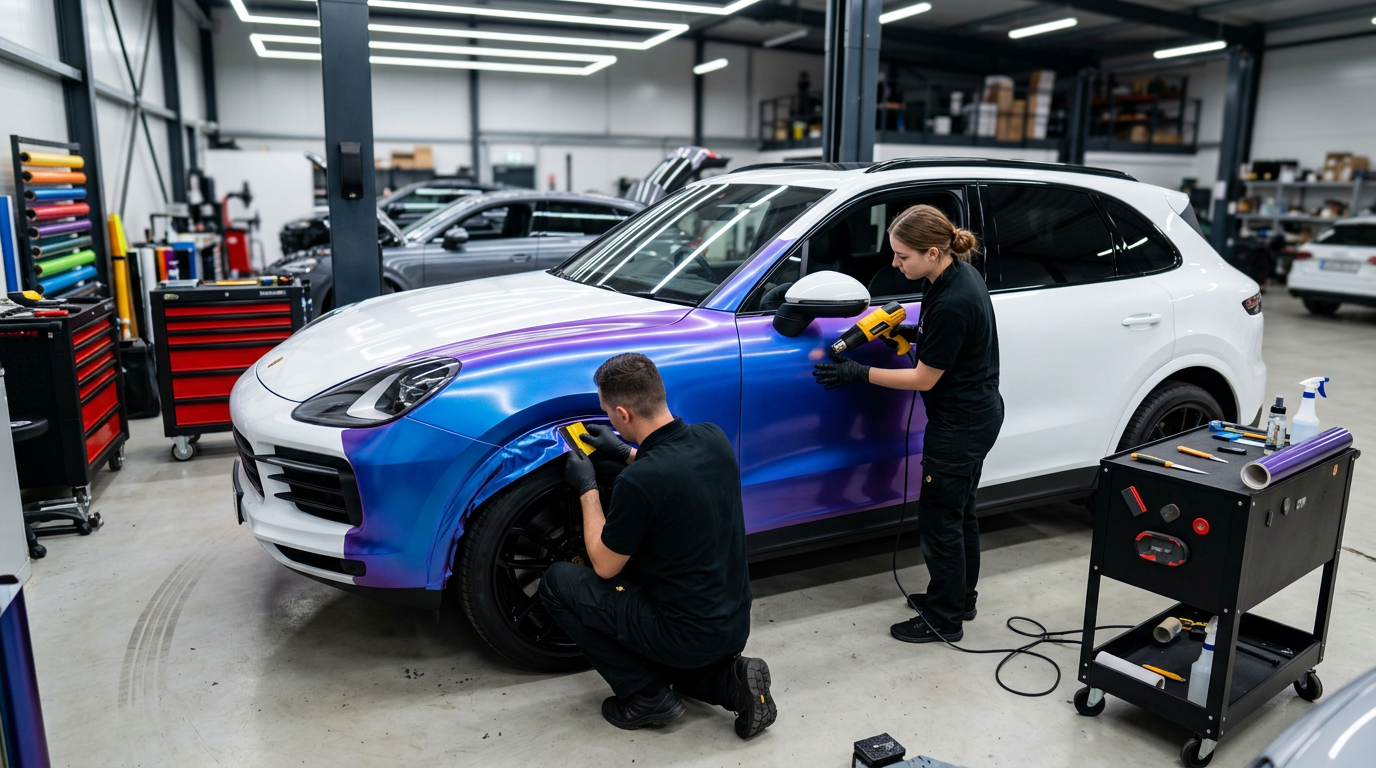
Where margin actually comes from in these numbers: installation hours. A full wrap’s media/ink might carry ₹9,000; the remaining premium buys 12–24 skill-hours of bay time, prep perfection, and post-heat discipline. This is why wrap price wars don’t happen — undercutters can’t hire their way around skill ceilings.
Learning Wrap Installation (The Real Business Asset)
Roadmap that works for Indian shops without formal industry:
- Certified training (₹15k–45k): Avery Dennison/3M/brand-agent programs run hands-on wrap schools (metro centers + dealer-supported sessions); two-to-five day courses take competent hands to employable basic-wrap skill, plus a certificate that closes client trust instantly.
- 100-panel apprenticeship window: family vehicles, staff cars, fleet-friend demos at cost — log every install photographed; 30 – 60 sessions convert school skill into portfolio speed.
- Skill anchors: surface decontamination discipline; stretch management (heat + patience, never force); knifeless-tape edge integrity; post-heat every edge to spec temperature. These are the four habits that separate five-year wraps from five-month failures.
- Staff it before selling it: never confirm commercial wrap work before certified hands exist in your bay. Every failed public install costs more reputation than its invoice replaces.
Workflow: From Enquiry to Handover (Template)
| Stage | Key Discipline |
|---|---|
| 1. Client consult & measurement | Exact vehicle variant template + panel-condition survey (paint damage = README exclusions in writing) |
| 2. Design on vehicle template | Approval image signed off (WhatsApp written confirmation) — printed wrap disputes live or die on this |
| 3. Print → cure 24 hrs | Full outgassing before lamination; wrap jobs tolerate zero cure short-cutting |
| 4. Cast laminate + rest | Roller-tension controlled; 12 hrs before bay entry |
| 5. Bay prep | Vehicle washed day-prior, alcohol prep, hardware removed (or documented exclusions) |
| 6. Install | Panel sequencing per template; post-heat edges to spec at every recess; quality checklist photographs |
| 7. Handover pack | Care sheet (wash timings, chemicals to avoid), aftercare appointment, warranty card |
Client Acquisition for Wrap Work
- The flagship principle: your own wrapped vehicle is your mobile showroom; nothing sells wraps like a stunning demo car parked outside or photographed daily on Instagram.
- Fleet Routes: delivery franchises, FMCG distributors, local logistics, water/milk-supply brands — pitch cost-per-impression math, not banners-vs-border comparisons. Fleet execs buy reach-per-rupee.
- Detailing & PPF partnerships: detailers meet car-passionate customers weekly; formalize a referral-ecosystem (they do PPF/ceramic, you deliver livery/partial graphics; reciprocal 10% works).
- Auto-trade: used-car dealers and accessory fitters add wraps to their margin menu; make trade-rate referrals honorably durable.
- Content engine: before/after split images, install timelapses, customer handover clips — wrap content is the single highest-performing organic print category on Indian Instagram right now.
Mistakes That Kill Wrap Businesses Early
1. Learning on client cars. Early wrap businesses have died from one viral photo of lifted edges on a Fortuner. Apprenticeship windows exist to fail privately — use them.
2. Printing wraps on calendered vinyl to quote-lower. The short-term quote victory becomes the shrink-lift-replacement claim in month 8. Cast or decline.
3. Skipping cure time under deadline pressure. Outgassing isn’t optional chemistry: laminated-fresh solvent blisters under India-summer car hoods within weeks.
4. Missing panel-survey documentation. Pre-existing paint/chip/rust disputes decided by memory are decided against you. Photograph-first discipline.
5. No warranty definition. Spell coverage scope (adhesive failure vs scratches vs repaint-of-original-paint exclusions) in the handover card. Wrap warranty ambiguity adversarializes every good client eventually.
6. Pricing wraps like banners-per-sq-ft. Wrap tickets carry skill-hours, bay hours, and guarantee liability — underpricing them teaches the market to forget their value, permanently.
Wrap Failure Forensics: What Failed Jobs Are Telling You
Wrap failures follow patterns whose causes matter far past the rework:
| Failure Seen | Actual Cause | Lesson Cost |
|---|---|---|
| Edge lifting at recesses | Skipped/insufficient post-heat spec at installation | Post-heat isn’t decoration — it’s adhesive chemistry completing |
| Large bubbles weeks later | Laminated before outgassing finished | Cure windows protect against calendar pressure |
| Film shrink-back from panel edges | Calendered film sold on a cast-film job | Material quotes must name the vinyl class in writing |
| Adhesive tear lifting paint on removal | Paint survey skipped; repaint/bonded panel history undocumented | The inspection photo folder is the warranty document |
| Fine silver-scratch haze on finish | Dry-application technique error or wrong squeegee pressure early days | Skill logs before commercial sold wraps, always |
Every pattern belongs in your team’s training material; the shop that post-mortems one failure prevents twenty.
Commercial Terms: Contracts & Liability for Wrap Work
Vehicle wrapping quietly becomes a liability-adjacent business at scale — a handful of paper habits make growth safe:
- Written scope per job: coverage diagrams with excludes (roof? mirrors? door jams?) — disputes live precisely where scope was implied.
- Paint-condition disclosure form: pre-install survey photos + owner sign-off on repaint status. Fresh resprays and wraps interact badly on removal — documented upfront, not argued later.
- Warranty wording: adhesive-failure warranty (yours, e.g., 2–3 years on vertical panels) explicitly separated from physical/scratch/abuse exclusions (owner’s). Set in print at handover.
- Fleet framework agreements: per-vehicle rates, turnaround SLAs, removal-and-rewrap cycles — fleets standardize perfectly onto year-long contracts once paperwork shows up prepared.
- GST discipline: installed-wrap work draws business-class attention; every invoice strengthens both sides of the value chain.
The Wrap Client Lifecycle: Maximizing Account Value
Wrap clients are annuities with wheels — the relationship map that top shops run:
- Acquisition: demo vehicle effect + referral mesh + fleet CPM pitches.
- Onboarding: survey + template + approval protocols lock mutual accountability immediately; the client learns your professionalism in the paperwork before the panel work.
- Delivery ceremony: documented handover pack + staged reveal photographs for both parties’ socials — shared media event, free acquisition content.
- Aftercare cycle: wash-care guidance at day 7 check-in, inspection appointment at month 1, warranty and care calendar thereafter.
- Refresh pipeline: fleet growth tickets, reposition campaigns, seasonal skin swaps, and 3–5 year replacement cycles — each log dated in the register so outreach lands before the fade, not after.
Top wrap studios don’t sell vinyl — they administer a vehicle-branding program for 20–60 active accounts. The art is customer management; the wrapping is freight.
Equipment Care Specific to Wrap-Duty Machines
- Profiles per wrap media line: cast wrap vinyl by different makers (3M, Avery, quality China cast) each custome-profiled; saved libraries eliminate per-job color discovery under deadline.
- Vacuum health obsession: wrap films’ heavier gauge tests bed suction constantly; clean bed channels weekly or suffer creeping buckles on ₹60/sq ft media.
- Take-up verification before every long wrap run: tension-system faults on wrap vinyl are measured in metres lost, not minutes.
- Cure-room space: physics of outgassing means wrap work physically occupies your floor before it earns — design the queue, or trips over drying panels become a quality variable.
The Full Wrap Process, End to End: Where Jobs Are Won and Lost
A vehicle wrap is a six-stage manufacturing process wearing a service business’s clothes. Quoting, printing, and installing each hold distinct margin — and distinct ways to lose it all:
| Stage | What Happens | Time (Typical Sedan Full Wrap) | Where Margin Leaks |
|---|---|---|---|
| 1. Measurement & design | Template-based design, client approval on mockup | 2–6 hours (design skill dependent) | Free endless revisions — cap revisions in the quote |
| 2. Print | Cast vinyl print on eco solvent, panel-planned for the car’s geometry | 2–4 hours machine time | Panel planning errors = whole-panel reprints |
| 3. Cure & laminate | 24h outgassing, then cast lamination film | 1 day + 1–2 hours | Rushing lamination → solvent bubbles under film, redo |
| 4. Prep | Deep wash, clay bar, isopropyl degrease, trim removal decisions | 2–3 hours | Skipped prep = lifting edges in 3 months = free warranty redo’s |
| 5. Installation | Panel-by-panel application, heat forming, post-heat at 90–100°C | 6–12 hours (skill = everything) | Inexperience — every lifted edge, tear, misalignment |
| 6. Aftercare & delivery | Inspection, customer handover briefing, photo documentation | 1 hour | Skipping the care briefing → customer kills wrap with pressure wash |
Notice where the hours concentrate: prep and installation. The print is the easy part — which is why wrap businesses are built on installer skill, not printer specs.
Material Science: Cast vs Calendered, and Why the ₹60/sq ft Question Matters
| Property | Cast Vinyl (₹60–120/sq ft media) | Calendered Vinyl (₹18–40/sq ft media) |
|---|---|---|
| Manufacturing | Cast as liquid film — near-zero internal stress | Rolled/pressed — carries “memory,” wants to shrink back |
| Conformability over curves/recesses | Excellent — this is why wraps exist | Poor–fair; flat panels and gentle curves only |
| Outdoor life | 5–7+ years | 2–4 years |
| Shrinkage failure | <1% — edges stay put | Visible edge-lift in 6–18 months on demanding jobs |
| Removal | Clean removal designed-in | Can leave adhesive, fight removal |
| Right use | Full/partial vehicle wraps, premium fleet | Flat commercial panels, temporary promos, budget decals |
The commercial translation: quote full wraps on cast or don’t quote them at all. A calendered-material “discount wrap” returns in month 9 as a furious customer with lifting edges and a reputation problem wearing your name. Budget jobs get calendered vinyl honestly marketed as flat-panel/short-term graphics — and print shops that master this honest upsell conversation (“casting vinyl matlab 5 saal ka sallam, calendered 1.5–2 saal”) convert 70%+ of serious wrap inquiries to proper materials.
Pricing Models & a Working Rate Card (2026 India)
Wrap pricing confuses newcomers into charity. Anchor on these models:
| Job Type | Prevailing Market Rate | Material+Print Cost Share | Notes |
|---|---|---|---|
| Full body wrap, hatchback/sedan (cast) | ₹45,000–85,000 | 25–35% | Skill-priced; luxury cars command 1.5–2× |
| Full wrap, SUV/MUV | ₹65,000–1,20,000 | 25–35% | More area + more complex geometry |
| Partial wrap (roof, bonnet, doors subset) | ₹15,000–35,000 | 20–30% | Best margin-per-hour segment — push these |
| Commercial fleet branding (per vehicle) | ₹12,000–40,000 | 30–40% | Lower per-unit, but 10–50 vehicle orders: volume gold |
| Auto-rickshaw / commercial three-wheeler | ₹3,000–8,000 | 35–45% | High volume in tier-2/3; fast installs |
| Bike kits | ₹2,500–8,000 | 20–30% | Passion customers, pay well for quality design |
| Printed racing stripes/decals only | ₹1,500–6,000 | 15–25% | Gateway product — converts to wraps later |
Three pricing rules that keep this profitable: (1) quote per-vehicle, not per-sq ft — customers think in cars, and flat per-sq-ft thinking hides your skill premium; (2) separate line-items for design, print, and install in your quotation — it justifies the total and protects design fees when customers say “sirf print kar do”; (3) 50% advance, balance before handover, always — a wrapped car is a customized product with zero resale value to anyone else.
The Skill Path: Becoming an Installer (Or Hiring One)
Installation skill is 70% of this business’s moat. Realistic paths:
- Self-training route (3–6 months): manufacturer channel tutorials (3M/Avery training content is genuinely excellent), practice on ₹3,000 hoods-and-doors of cheap material, volunteer wraps on friends’/family vehicles, then small paid partials before full wraps. Budget 200–400 practice hours before charging premium rates. Film everything — your learning content doubles as marketing.
- Material-brand certification programs: the major vinyl brands periodically run India training workshops (often through distributors) — 2–5 day hands-on courses. Ask your media supplier; fees are modest and the certificate closes corporate fleet deals.
- Hiring an installer: experienced installers command ₹35,000–70,000/month in metros — the math works only at 8+ wraps/month. Below that, owner-installer models dominate because they must.
Indian Market Realities: RTO, Legality & the Customers Nobody Mentions
- The RTO/colour question: a full colour-change wrap technically changes the vehicle’s registered colour, and RC endorsement is the legally clean path (and genuinely ambiguous in state-level practice). The safe commercial posture: colour-change wraps → advise customers to update RC; same-colour refreshes and commercial branding/liveries → no colour change involved. Never promise customers legal cover you don’t control; give them the honest advisory and let them decide — most do proceed.
- Commercial advertising on vehicles: fleet branding may attract local advertising-tax/hoarding rules in some municipalities when vehicles park prominently; fleets’ own legal teams usually own this, but flag it in B2B contracts as the client’s responsibility.
- The actual customer pyramid: bottom = bike/car enthusiasts (loud, small tickets, great Instagram content); middle = small-business fleet branding (5–15 vehicles: cabs, delivery fleets, service vans — the profit engine); top = advertising agencies wrapping for brands (agency work: tighter margins, professional POs, portfolio prestige). Build bottom-up for skills and content, middle-ward for money.
- The showroom niche: new-car dealers buy decals, number-plate surrounds, launch-event branding constantly — low glamour, reliable monthly billing, and they refer private buyers to you for wraps.
Tools & Workspace: The Setup Behind the Skill
| Item | Budget | Priority |
|---|---|---|
| Heat gun(s) — quality, temperature-controlled | ₹4,000–12,000 | Immediate — the installer’s primary tool |
| Squeegees (variety), felt-edge applicators, magnets, knifeless tape, precision blades | ₹3,000–8,000 | Immediate |
| Clay bars, isopropyl, prep chemicals, microfibres | ₹2,000–5,000 (recurring) | Immediate |
| Infrared thermometer + post-heat discipline | ₹1,500–3,000 | Immediate — post-heating is non-negotiable |
| Covered, dust-controlled bay (at least 6m × 4m for one car + working clearance) | Existing or rented — the real estate question | Essential; dust ruins installs like it ruins printheads |
| Good lighting (portable LED panels) | ₹5,000–15,000 | Early — edge inspection happens in shadowed door frames |
| Quality laminator (if not already owned) | ₹60,000–1,50,000 | Before your first cast wrap — hand-lamination is not a wrap business |
Total non-printer entry add-on: typically ₹1–2 lakh including the laminator — meaning a print shop already running eco solvent legitimately adds wrap capability for the price of one good month. That asymmetry — modest kit cost against ₹50,000–1,00,000 wrap tickets in a market with few skilled installers — is precisely why this product line deserves its own guide, and why shops that master installation discipline early own their local market within two years.
Marketing a Wrap Shop: Why the Car Is the Billboard
Wrap marketing is uniquely blessed: every completed job drives around your market as a moving portfolio for 4–6 years. Build the machine around this fact:
- The reveal video ritual: every delivery gets a 30–45 second reveal reel — before/after shots, peel-back transitions, the customer’s reaction. Car content is the most organically viral local-business content category in India; a wrap shop posting weekly reveals builds an audience most businesses pay agencies for.
- The permission slip: a discreet “Wrapped by [brand]” decal, with customer consent, near the rear bumper — inquiries trace to it for years. Consent matters: ask at delivery, offer a small aftercare discount in exchange.
- The enthusiast community: car/bike clubs, track-day groups, modification communities — sponsor one club meet’s decals and you’re inside the referral circle that decides where members wrap. Enthusiast customers are loud, loyal, and photograph everything: ideal first cohort.
- Google Business Profile, weaponized: “car wrap near me” is a high-intent, low-competition search in most tier-2/3 cities. Fifty genuine reviews with photos make you the default answer before competitors realize the game started.
- The B2B artery: fleet managers, cab operators, delivery franchises, driving schools, dealer groups — a quarterly visit cycle with a physical portfolio book. One 15-vehicle fleet account equals fifty enthusiast jobs in revenue, with one-tenth the marketing effort per rupee.
The Wrap Shop’s Five-Year Arc
Plotted honestly, this business’s trajectory differs from plain print shops — slower first years (skill-building), steeper later ones (reputation compounding):
| Phase | Signature Reality | Revenue Shape | The Make-or-Break |
|---|---|---|---|
| Year 1: The Apprenticeship | Partial wraps, decals, friend-network jobs; speed slowly building | ₹40k–1.2L/month, uneven | Not cutting corners on prep during hungry months — your year-1 cars are still driving references in year 4 |
| Year 2: The Portfolio | Full wraps completing in a day; first fleet pilot orders; reels audience growing | ₹1–2.5L/month | Cast-material discipline holding against margin temptation |
| Years 3–4: The Reputation | Regional name; dealerships and fleets contract-direct; assistant trained to your standard | ₹2.5–5L/month, high-margin | Capacity: second install bay or assistant-team done without quality dilution |
| Year 5+: The Brand | PPF/ceramic add-ons (natural adjacency — same customers, higher tickets), possibly training academy | ₹5L+/month, diversified | Choosing depth (premium services) over breadth (branch sprawl) |
Notice the pattern the years share: the wrap business compounds reputationally, not mechanically. A print shop can buy speed with a second head; a wrap shop’s growth currency is “whose car did you see?” — which is why patient quality in years 1–2 pays so disproportionately in years 3–5, and why the shops that survive the apprenticeship years inherit their markets.
Your First Five Jobs: The Deliberate Sequence
New wrap entrants ask “how do I get customers?” when the sharper question is “which five jobs should be my first five?” Sequence them deliberately: Job 1 — your own vehicle (full practice, zero customer risk, permanent showpiece). Job 2 — a friend’s car at material cost, filmed thoroughly (portfolio + honest learning). Job 3 — a paid partial wrap, roof or bonnet (client money, bounded risk). Job 4 — a small commercial fleet decal set (B2B discipline: PO, advance, deadline). Job 5 — your first full paid wrap, priced properly, photographed end-to-end. Five jobs, roughly two months — and you emerge with process proof, portfolio, cash flow, and the two referral loops (enthusiast + B2B) both running. Ambition supplies the rest.
Frequently Asked Questions (FAQs)
Q1. How much does it cost to start a vehicle wrap business in India?
As an eco solvent print shop extension: ₹4–7 lakh of incremental spend (printer upgrade or addition, laminator, bay, training, tools). Standalone from zero: ₹6–9 lakh all-in. The largest real investment is training days and apprenticeship vehicles — budget for both honestly.
Q2. What is the rate for a full car wrap in India in 2026?
₹25,000–80,000 depending on vehicle size, film brand/series, design complexity, and market tier; premium color-shift/PPF-class runs price on top. Commercial fleet liveries sit ₹18,000–55,000 per van/truck typically.
Q3. Can any eco solvent printer do vehicle wraps?
Technically yes for print output; practically, 1.8m dual-head builds dominate because standard vehicle side panels fit seamlessly within the width, and wrap deadline-work needs dual throughput. Single-head 1.6m machines wrap fine — one extra panel seam at a time.
Q4. Cast vinyl vs normal vinyl — why the insistence?
Conformability and memory. Cast films were formed relaxed — they wrap around mirrors and recesses without internal tension, staying down 5–7 years. Calendered films shrink back over curves within months. Wrap-warranty reality makes cast the only professional substrate.
Q5. Do I need certification to install wraps?
Not legally — but brand certifications (Avery/3M programs) meaningfully boost both skill and client trust, and fleet/corporate buyers increasingly ask for them in vendor evaluations. Strongly recommended before commercial volumes.
Q6. What margins do wraps generate?
Gross 55–70% on installed wraps typical; net depends on bay utilization and rework discipline. The economics shine most on liveries where graphics-coverage is high but compound-curve difficulty is moderate.
Q7. How long does a wrap last in Indian weather?
Cast-on-cast, correctly installed, sun-and-monsoons: 5–7 years before gigantically-visible aging. Ignored aftercare (harsh detergents, pressure-wash edges) shortens any wrap’s life — the care card protects your warranty cost as much as the client’s film.
Q8. What about removal services?
Yes — offer paid removal (₹3,000–8,000 typical) and you’ll both recover the client relationship before the competitor gets the re-wrap and control paint-condition risk through trained removal (heat + proper angles beat scraping always).
Q9. Biggest operational bottleneck in wrap shops?
Bay-days, not print-hours. A full wrap’s bay bay-occupancy of 1.5–2 days caps monthly count for one-bay shops at 12–18 full vehicles — plan fleet scheduling and partial-graphic混 fill-work around your bay calendar, not your printer’s idle meters.
Q10. Is PPF a natural next step after wraps?
Perfect adjacency: same bay discipline, same client class, ticket sizes ₹40,000–1.5L, equipment-light (pre-cut plotter patterns + installer skill do the work). Most successful wrap studios add PPF in year two — through certified training first, always.
Final Word: Slower Entry, Higher Castle
Vehicle wrapping asks more from a print business than any other eco-solvent product line: real training, media discipline, workflow patience, and environment investment. In exchange it returns the one thing commodity printing never can — a defensible premium. Wrap-fluent shops charge by trust, retain by repeat fleets, and outcompete by craft rather than rate. Build the skill ladder deliberately and this single line item regularly becomes a print business’s most profitable quarter of annual revenue.
Gearing up for wraps? Our 1.8m dual-head eco solvent machines are wrap-ready from day one — pair them with original inks and service backing, and talk to us about bundle pricing for print + laminator + starter-tooling packages in your city.
