
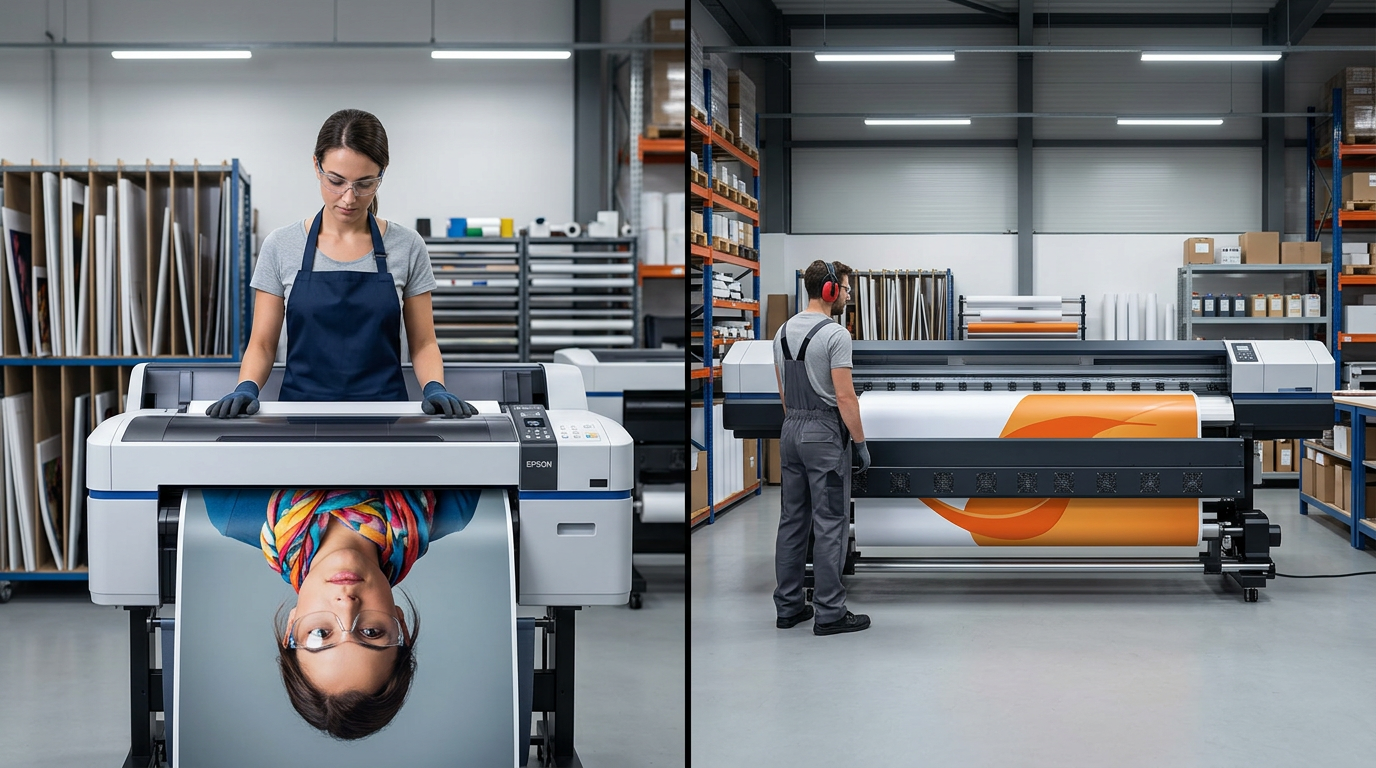
Quick Answer: Choose a solvent flex printer if your business is outdoor banners, hoardings, and high-volume work — it offers the lowest cost per sq ft (₹6–9), 2–3 year outdoor durability without lamination, and production speeds up to 150+ sq m/hr. Choose an eco-solvent printer if your customers demand photo-quality indoor graphics, vehicle wraps, backlit displays, or wallpaper — it delivers near-photographic quality with almost no smell, at a higher cost per sq ft (₹10–16) but 2–3× higher selling rates. The right choice depends entirely on who your customers are — this guide gives you the complete data to decide in 15 minutes.
Walk into any printing machinery dealer in India and this is the fork in the road they’ll present: “solvent le lo ya eco-solvent?” Solvent or eco-solvent? It sounds like a small technical difference — ink chemistry. In reality, it’s a business model decision that determines your print quality, your cost per square foot, your monthly profit, and which customers will (and won’t) buy from you.
Buy the wrong one, and you’ll spend years fighting your machine’s limitations: a solvent machine that can’t produce the photo quality your showroom clients demand, or an eco-solvent machine bleeding money on price-war banner jobs it was never designed for.
In this comparison guide, we put both technologies under the microscope — chemistry, quality, speed, real per-sq-ft economics, durability, ventilation, maintenance — and finish with a clear decision framework for every type of printing business.
The 60-Second Difference (If You Read Nothing Else)
Solvent printing uses aggressive chemical solvent ink that bites into PVC media. It’s the technology behind 90% of the roadside hoardings you see: extremely durable outdoors, cheapest to run, fastest to produce — but grainier up close and with a strong smell that demands ventilation.
Eco-solvent printing uses refined, milder solvent ink jetted through high-precision Epson heads in much finer droplets. The output is nearly photographic — smooth skin tones, crisp text, vivid gradients — with low odour. The trade-offs: higher running costs, slower production, and prints that need lamination for long outdoor life.
Neither is “better.” They are built for different customers. Keep reading to find yours.
What Is a Solvent Flex Printer? (The Outdoor Production Engine)
The Technology
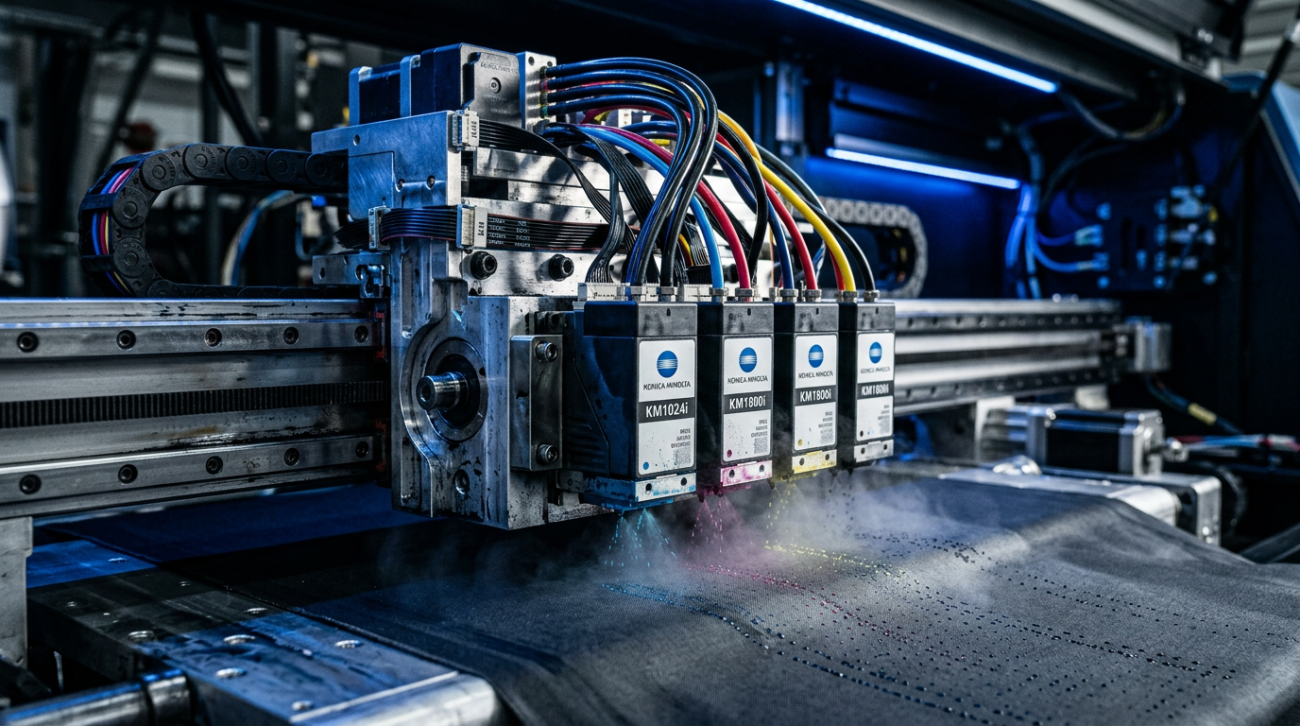
Solvent printers push pigment particles suspended in a strong petroleum-based solvent carrier through industrial print heads — in India, overwhelmingly Konica Minolta 512i or 1024i heads. When the ink hits PVC flex, the solvent slightly dissolves the media surface and the pigment anchors into it as the solvent evaporates. That chemical bond is why solvent prints are waterproof, scratch-resistant, and UV-stable for years without any lamination.
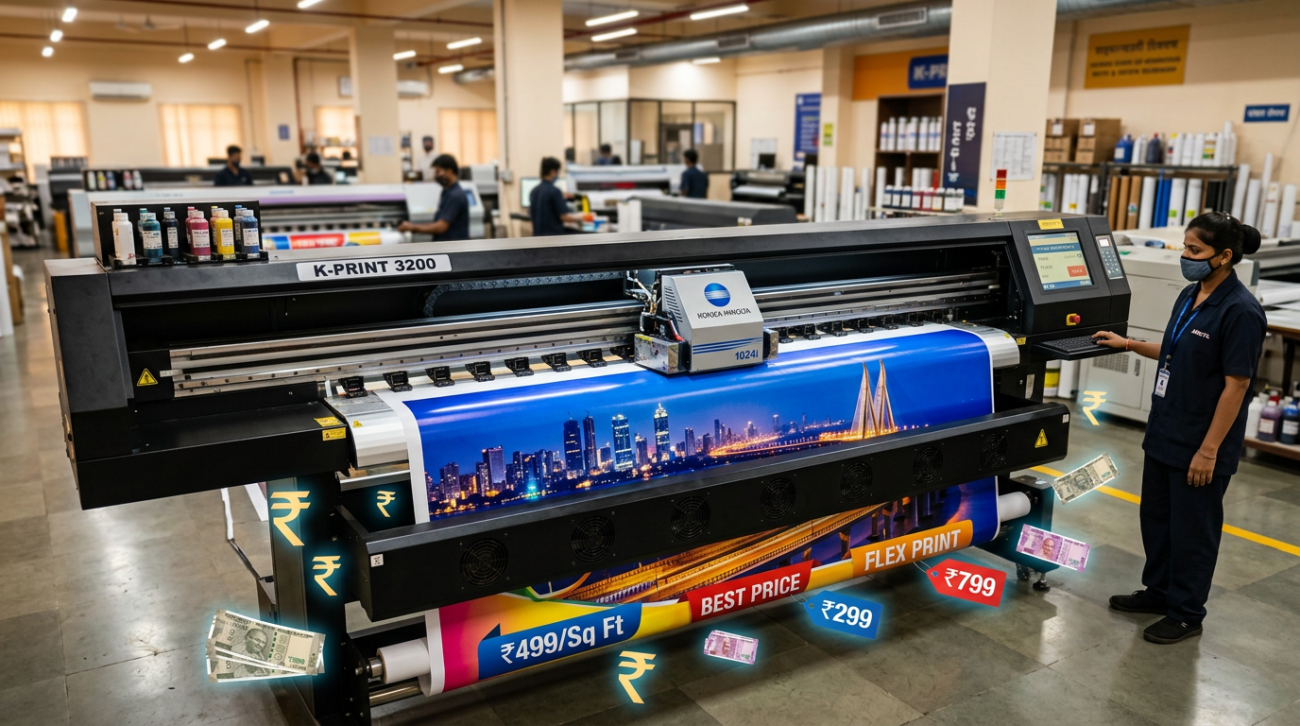
Standard Indian configurations are 3.2-metre-wide machines running 4 or 8 Konica heads — the classic “flex machine” powering printing hubs from Delhi to Dimapur.
Typical Solvent Machine Specifications
| Specification | 4-Head Machine | 8-Head Machine |
|---|---|---|
| Print Heads | 4× Konica Minolta 512i | 8× Konica Minolta 512i |
| Max Width | 3.2 m | 3.2 m |
| Speed (Production Mode) | 65–75 sq m/hr | 130–150 sq m/hr |
| Speed (Quality Mode) | 30–40 sq m/hr | 60–80 sq m/hr |
| Resolution | Up to 720×1440 dpi | Up to 720×1440 dpi |
| Droplet Size | 30 pl / 42 pl | 30 pl / 42 pl |
| Machine Price (2026) | ₹4.0–6.5 lakh | ₹6.5–9.0 lakh |
Strengths of Solvent Printing
- Lowest cost per sq ft in the industry: ₹6–9 all-in production cost. Nothing else comes close for volume outdoor work.
- Serious speed: An 8-head machine can print 1,000+ sq ft per hour in draft mode — election-season muscle.
- True outdoor durability: 2–3 years unlaminated on PVC flex. Print it, punch it, paste it, forget it.
- Cheap infrastructure compatibility: Konica heads (₹30–45k) and solvent ink are stocked everywhere in India; breakdowns don’t strand you for weeks.
- Forgiving on media: Prints reliably on the cheapest frontlit flex grades where eco-solvent ink struggles.
Weaknesses of Solvent Printing
- Visible grain at close range: At 30–42 pl droplet size, skin tones and gradients show texture. Fine for 10+ feet viewing; poor for a shop counter poster.
- Strong odour and VOCs: The smell is genuinely unpleasant and unhealthy in closed rooms — exhaust ventilation is mandatory, ruling out mall kiosks and basement studios.
- Head clogging discipline: Solvent ink dries aggressively; idle weekends without wet-capping mean blocked nozzles.
- Limited premium media: Cannot print the films and papers that unlock high-rate specialty work.
What Is an Eco-Solvent Printer? (The Quality Craftsman)
The Technology
Eco-solvent printers use a refined solvent formulation with lower VOC content, jetted through Epson precision heads (DX5 historically; the i3200 dominates in 2026) at droplet sizes as small as 3.5 pl — roughly one-tenth the droplet size of a Konica 512i. Smaller droplets, more nozzles (3,200 per head), and finer screening produce smooth, photographic output that solvent machines physically cannot match.
Indian configurations are mostly 1.6m and 1.8m widths with 1–2 heads, plus 3.2m models for wide premium work.
Typical Eco-Solvent Machine Specifications
| Specification | Single-Head 1.6m | Dual-Head 1.8m |
|---|---|---|
| Print Head | 1× Epson i3200 | 2× Epson i3200 |
| Max Width | 1.6 m | 1.8 m |
| Speed (Production) | 12–18 sq m/hr | 25–30 sq m/hr |
| Speed (Photo Quality) | 5–8 sq m/hr | 10–14 sq m/hr |
| Resolution | Up to 1440×1440 dpi | Up to 1440×1440 dpi |
| Droplet Size | 3.5–21 pl variable | 3.5–21 pl variable |
| Machine Price (2026) | ₹1.8–2.75 lakh | ₹2.75–4.25 lakh |
Strengths of Eco-Solvent Printing
- Photographic print quality: Smooth gradients, accurate skin tones, crisp 6pt text. Jewellery showrooms, photographers, and brand stores visibly see the difference.
- Low odour: Runs comfortably in commercial spaces, studios, and offices — opens locations solvent machines can’t occupy.
- Media versatility is the superpower: Self-adhesive vinyl, wall wraps, vehicle wrap vinyl, backlit film, canvas, wallpaper, photo paper, window film. One machine serves 10 premium product lines.
- Higher selling rates: ₹25–60/sq ft vs ₹12–20 for solvent banners. Lower volume, higher margin.
- Lower entry cost: A complete eco-solvent setup starts under ₹5 lakh.
Weaknesses of Eco-Solvent Printing
- Higher running cost: ₹10–16/sq ft production cost. Competing in ₹12/sq ft banner price wars with an eco-solvent machine is a slow financial death.
- Outdoor life needs lamination: Unlaminated eco-solvent prints fade in 6–12 months outdoors; lamination adds cost and a production step.
- Slower: 25 sq m/hr on a dual-head machine vs 136+ on an 8-head solvent. Not built for 5,000 sq ft emergency jobs.
- Coated-media dependence: Needs eco-solvent-compatible coated media; results on cheap uncoated flex disappoint.
Head-to-Head: The Complete Comparison Table
| Parameter | Solvent Printer | Eco-Solvent Printer |
|---|---|---|
| Print Head | Konica Minolta 512i/1024i | Epson i3200 / DX5 |
| Droplet Size | 30–42 pl | 3.5–21 pl (variable) |
| Print Quality (close view) | ★★★ Acceptable | ★★★★★ Photographic |
| Print Quality (billboard view) | ★★★★★ Excellent | ★★★★★ Excellent |
| Production Speed | 65–150+ sq m/hr | 5–30 sq m/hr |
| Machine Price | ₹4–9 lakh | ₹1.8–4.25 lakh |
| Ink Cost / sq ft | ₹1.2–2.0 | ₹2.5–4.5 |
| Total Cost / sq ft (incl. media) | ₹6–9 | ₹10–16 |
| Typical Selling Rate / sq ft | ₹12–20 | ₹25–60 |
| Gross Margin | 45–60% | 55–70% |
| Outdoor Life (unlaminated) | 2–3 years | 6–12 months |
| Lamination Needed? | Usually no | Yes, for outdoor/long life |
| Smell / Ventilation | Strong; exhaust mandatory | Low; basic airflow sufficient |
| Media Range | Flex, vinyl, mesh, canvas | Vinyl, films, canvas, wallpaper, photo paper, wraps |
| Head Replacement Cost | ₹30–45k per head (512i) | ₹45–80k per head (i3200) |
| Ideal Business | Banners, hoardings, events, elections | Indoor branding, wraps, photo, décor, backlit |
Print Quality Deep-Dive: What the Eye Actually Sees
Spec sheets don’t print banners — droplets do. Here’s what the quality difference looks like in real products:
- Roadside hoarding, 20m away: No difference. Both look vibrant. Solvent wins on economics — printing this job on eco-solvent is burning money for zero visible benefit.
- Shop fascia banner at the entrance: Eco-solvent pulls ahead. At 2–3 metres, solvent grain becomes noticeable on skin tones and food photography.
- Jewellery showroom wall wrap: Only eco-solvent is acceptable. Solvent output here looks cheap next to the diamonds.
- Vehicle wrap close inspection: Eco-solvent is the industry standard worldwide for a reason — both for media compatibility (cast wrap vinyl) and output smoothness.
- Wedding stage backdrop: Borderline; high-end clients now specify eco-solvent because photographers’ close-up shots reveal solvent grain.
The Economics: Which Machine Makes More Money?
Let’s compare two realistic single-machine businesses in the same Tier-2 city over one month:
| Metric | Business A: Solvent 3.2m (4-head) | Business B: Eco-Solvent 1.8m (dual-head) |
|---|---|---|
| Monthly Output | 35,000 sq ft | 8,000 sq ft |
| Average Selling Rate | ₹14/sq ft | ₹35/sq ft |
| Monthly Revenue | ₹4,90,000 | ₹2,80,000 |
| Production Cost/sq ft | ₹8 | ₹13 |
| Gross Profit | ₹2,10,000 | ₹1,76,000 |
| Fixed Costs (rent, staff, power) | ₹90,000 | ₹70,000 |
| Net Profit / Month | ₹1,20,000 | ₹1,06,000 |
| Machine Investment | ₹5.5 lakh | ₹3.5 lakh |
| Payback Period | ~5 months | ~3.5 months |
The honest reading: solvent scales on volume; eco-solvent scales on margin. Solvent rewards hustle — the more you print, the more you make, with harder work winning bigger. Eco-solvent rewards positioning — premium clients, premium rates, less physical volume. Both are excellent businesses; they just reward different personalities.
Media Compatibility: The Hidden Decision Factor
Your machine choice locks in which products you can sell. This matters more over 5 years than anything else:
| Product/Application | Solvent | Eco-Solvent |
|---|---|---|
| Frontlit/backlit flex banners | ✅ Excellent | ⚠️ Possible, costly |
| Hoardings & billboards | ✅ Industry standard | ❌ Not economical |
| Election/political volume work | ✅ Built for it | ❌ Too slow |
| Self-adhesive vinyl stickers | ✅ Good | ✅✅ Better quality |
| Vehicle wraps | ❌ Wrong media profile | ✅ Industry standard |
| Wall wraps & interior graphics | ⚠️ Odour + quality issues | ✅ Perfect fit |
| Backlit film (metro/rail displays) | ⚠️ Grainy in illumination | ✅ Perfect fit |
| Personalised wallpaper | ❌ | ✅ Growth segment |
| Canvas art & photo printing | ❌ Quality too low | ✅ Perfect fit |
| One-way vision glass film | ✅ Good | ✅✅ Better |
| Mesh banners / fabric | ✅ Good | ⚠️ Limited |
Ventilation, Smell & Where You Can Install
This practical factor decides many real-world purchases:
- Solvent machines emit noticeable VOCs and odour during printing. They belong in industrial units, godowns, ground-floor shops with dedicated exhaust ducting, and standalone workshops. Installing one in a basement, mall, or upstairs office invites health complaints and landlord trouble.
- Eco-solvent machines run with mild odour that normal room ventilation handles. This unlocks commercial real-estate: design studios, photo labs, mall-facing shops, and corporate-park units where premium customers actually walk in.
Power-wise, solvent machines with heaters draw more (single machine + drying ~4–5 kW with UPS backup recommended); compact eco-solvent units run comfortably on standard commercial connections with a 2–3 kVA UPS.
Maintenance Reality Check
| Aspect | Solvent (Konica) | Eco-Solvent (Epson i3200) |
|---|---|---|
| Daily Care | Nozzle check + clean; strict — solvent dries fast | Nozzle check + clean; more forgiving |
| Idle Tolerance | Low — weekend idle without wet-cap = clogged nozzles | Moderate — survives 2–3 idle days better |
| Typical Head Life (maintained) | 18–30 months | 18–36 months |
| Head Replacement Cost | ₹30–45k×4–8 heads | ₹45–80k×1–2 heads |
| Climate Sensitivity | High (heat thickens solvent) | Moderate |
| Skill Level Needed | Operator must be disciplined | Beginner-friendlier |
One under-discussed point: a solvent machine’s heads represent ₹1.2–2.5 lakh sitting on the carriage. An eco-solvent machine carries ₹45k–1.6 lakh. Both punish neglect, but the multi-head solvent machine punishes it at 2–3× the price.
The Decision Framework: Which One Should YOU Buy?
Buy a Solvent Flex Machine if…
- Your market is outdoor banners, hoardings, event backdrops, and political/election work
- Local selling rates hover around ₹12–16/sq ft and volume decides survival
- You have (or will find) 1,000+ sq ft/day of orders
- Your installation site has industrial-style ventilation available
- Your town’s customers judge by size and price, not close-up finish
Buy an Eco-Solvent Machine if…
- Your customers are showrooms, jewellers, photographers, corporates, interior designers, or vehicle wrap clients
- Local rates for quality vinyl/graphics run ₹25+/sq ft
- You’re starting inside a city with a commercial-space location
- You want multiple premium product lines (wallpaper, canvas, backlit, stickers) from one machine
- Budget is under ₹4.5 lakh all-in and you’re building upward
Buy BOTH (in the right order) if…
The dominant print-house model in successful Indian cities is: start with whichever machine matches your current demand, then add the other within 18–24 months. The combo is powerful — solvent handles the volume bread-and-butter at ₹14/sq ft while eco-solvent captures the ₹40/sq ft premium work. Each machine sells to the other’s customers: every banner client needs window graphics; every showroom client needs outdoor hoardings for their sale events.
Ink Chemistry 101: Why the Ink Decides the Business
Everything in this comparison flows from one root cause — the liquid inside the bottle. Understanding it for five minutes makes every other spec obvious.
Solvent ink is pigment suspended in a volatile organic carrier (cyclohexanone and related aggressive solvents in full-solvent formulations). That carrier does two jobs: it dissolves slightly into PVC media so pigment locks in mechanically, and it evaporates fast so output dries quickly on a heated platen. Aggressive carriers are exactly why solvent prints survive rain, sun, and flexing on banners — and exactly why the shop smells like a paint factory without extraction.
Eco-solvent ink replaces the aggressive carriers with refined glycol-ester-based solvents. The ink still bonds to coated media, but gently — preserving the media’s surface coating, which is what makes photographic reproduction possible on engineered vinyls and films. Lower aggression means lower odour, lower VOC exposure, and slower drying (hence those multi-stage heater systems and slower throughput).
Three practical consequences buyers often miss:
- Media coating dependency. Eco-solvent ink needs coated, eco-solvent-rated media to anchor properly. Cheap uncoated flex absorbs it unevenly — washed-out colours and poor scratch resistance. Solvent ink is far more tolerant of commodity media.
- Clogging physics differ. Full solvent dries brutally fast at the nozzle plate — 48 idle hours can cost a head. Eco-solvent evaporates more slowly, buying operators more forgiveness over idle weekends (but not immunity — wet-capping remains mandatory).
- Colour gamut and finish. Modern eco-solvent sets (CMYK + optional light cyan/light magenta) reproduce highlight detail in skin, jewellery, and food photography that 4-colour 30–42 pl solvent printing physically cannot.
Print Speed Reality: What Dealers Don’t Volunteer
The brochure speed and the billing speed are different numbers. Pass count — how many times the carriage lays ink over the same line — decides both quality and real throughput:
| Machine | Draft/Fast Mode | Production Mode | Quality Mode |
|---|---|---|---|
| Solvent 4× 512i | ~85 sq m/hr (banding visible) | 65–75 sq m/hr (sellable banners) | 30–40 sq m/hr (close-view work) |
| Solvent 8× 512i | ~165 sq m/hr | 130–150 sq m/hr | 60–80 sq m/hr |
| Eco-solvent 1× i3200 | ~20 sq m/hr | 12–18 sq m/hr | 5–8 sq m/hr (photo) |
| Eco-solvent 2× i3200 | ~38 sq m/hr | 25–30 sq m/hr | 10–14 sq m/hr (photo) |
Do the rupee math before falling for speed: an 8-head solvent machine producing 130 sq m/hr is only earning if you can sell 1,000+ sq ft per hour of output consistently. An idle fast machine earns zero — and charged EMI daily. Match head count to confirmed order books, then scale.
5-Year Total Cost of Ownership (TCO) Comparison
Machine price is the entry ticket, not the cost. Here’s what five years of ownership realistically costs for each technology, run 26 days/month:
| Cost Head (5 Years) | Solvent 4-head 3.2m | Eco-solvent dual-head 1.8m |
|---|---|---|
| Machine Purchase | ₹5,25,000 | ₹3,50,000 |
| Infrastructure (UPS, exhaust, electrical) | ₹75,000 | ₹45,000 |
| Laminator (needed for eco-solvent outdoor) | — | ₹55,000 |
| Print Head Replacements (2 full sets) | ₹2,60,000 (8 heads replaced) | ₹1,50,000 (4 heads replaced) |
| Ink (volume-adjusted) | ₹7,50,000 | ₹4,20,000 |
| Maintenance Parts (pumps, cappings, wipers, dampers) | ₹90,000 | ₹60,000 |
| Service Visits & Repairs | ₹1,20,000 | ₹80,000 |
| 5-Year TCO | ₹18,20,000 | ₹11,60,000 |
| 5-Year Output (realistic) | ~1,80,000 sq m | ~65,000 sq m |
| TCO per sq m | ₹10.1 | ₹17.8 |
The pattern repeats at every scale: solvent’s cost advantage compounds with volume; eco-solvent’s margin advantage compounds with rate. There is no crossover where the “wrong” technology wins on its competitor’s turf — which is precisely why matching machine to market matters more than negotiating the last ₹20,000 of machine price.
10 Questions to Ask Your Dealer Before Deciding
- Show me live prints from BOTH technologies on the media I’ll actually buy — not your demo media.
- What’s the real, sellable-mode speed? (Ask them to time a 50-sq-ft job, not recite brochure numbers.)
- Which heads, what drop size, and their current replacement price in writing?
- How many of each machine type have you installed within 100 km? Give me three references.
- What’s the warranty — and is head clogging covered or excluded?
- What consumables kit is included at delivery (cleaning solution, syringes, dampers, capping tops)?
- Which RIP software license is bundled, and is it dongle or soft license?
- Who is my service engineer, where does he live, and what’s the committed response time?
- If a head fails in month three, what exactly happens and what do I pay?
- What training days are included, and can my operator call your technician for the first 30 days?
A dealer who answers all ten confidently — in writing on the quotation — is worth more than any price advantage from one who won’t.
Real-World Scenarios
Scenario 1 — Raju Bhai, Indore: Runs a shop near a wholesale market; 80% of orders are market banners and event backdrops at ₹12/sq ft. Buys a used eco-solvent machine because it was cheap. Result: can’t compete on speed or cost against solvent shops; machine runs 2 hours/day; sells at a loss within a year. Wrong machine, right market.
Scenario 2 — Meera, Kochi: Photographer with studio clients. Buys a 4-head solvent machine “to also do banners.” The smell and grain kill her photo products; studio clients reject the output. Wrong machine, wrong market fit — a single-head eco-solvent at ₹2 lakh was her correct answer.
Scenario 3 — Farhan, Lucknow: Starts with a dual-head eco-solvent serving interior designers and showrooms at ₹30–50/sq ft. Year two, adds a solvent machine hired for election season; keeps both running. Correct order, correct sequencing.
5 Myths That Confuse Indian Buyers (Busted)
Myth 1: “Eco-solvent is just weaker solvent ink.”
The chemistry differs, but the real difference is the print head. Eco-solvent machines run Epson precision heads at droplet sizes one-tenth of solvent heads — the quality gap comes from droplet physics, not ink weakness. On coated media, eco-solvent ink adhesion and outdoor life (laminated) are entirely respectable.
Myth 2: “Solvent prints look cheap, always.”
At viewing distances beyond 3–4 metres, a good 512i machine on quality flex produces output that retail observers cannot distinguish from anything else. The entire Indian highway advertising industry — including premium brand campaigns — runs on solvent. “Cheap-looking” is a close-range verdict applied to a long-range product.
Myth 3: “Eco-solvent can’t do outdoor work.”
It can — with lamination. Lakhs of shop boards, vehicle graphics, and outdoor vinyl installations across India are laminated eco-solvent prints lasting 2–3 years. What eco-solvent can’t do economically is unlaminated commodity flex banners at ₹12/sq ft.
Myth 4: “More dpi means better output.”
Resolution specs are marketing numbers. Real perceived quality comes from droplet size, screening algorithms, ink laydown consistency, and media coating. A 720 dpi solvent machine with a calibrated profile beats a badly calibrated 1440 dpi machine every time.
Myth 5: “Second-hand eco-solvent machines are safe bargains.”
Epson heads clog and degrade more subtly than Konica heads — a machine can pass a five-minute demo with half-dead nozzles that fail under production heat. Test any used machine with a full-width, 20-minute continuous print and demand a nozzle pattern printout in writing. Used solvent machines are similarly risky, but their failure modes are more visible.
Frequently Asked Questions (FAQs)
Q1. Can an eco-solvent printer print on normal flex banner media?
Technically yes, but economically no. Eco-solvent ink costs more, prints slower, and unlaminated outdoor life is shorter than solvent. For everyday banner work at ₹12–16/sq ft rates, a solvent machine is the correct tool.
Q2. Can solvent and eco-solvent inks be swapped in the same machine?
Never. Head internal coatings and ink systems are chemistry-specific (though solvent-tolerant Konica heads and eco-solvent-rated Epson i3200-E1 variants exist for their own ink classes). Swapping ink types ruins heads instantly and voids every warranty.
Q3. Which machine is cheaper to maintain?
Per head, Konica solvent heads (₹30–45k) are cheaper than Epson i3200 (₹45–80k), and solvent machines have simpler mechanics. But solvent machines carry 4–8 heads, so a full head-set replacement costs more in total. Both are cheap to maintain if cleaned daily.
Q4. Is eco-solvent output really photo quality?
At 1440+ dpi with variable 3.5 pl droplets, dual-head i3200 output is indistinguishable from lab photo prints at normal viewing distances — good enough for framed portraits, gallery canvas, and premium retail graphics.
Q5. How long do eco-solvent prints last outdoors?
Unlaminated: 6–12 months before visible fading, depending on sunlight direction. Laminated with UV film: 2–3 years. Budget lamination (₹45–65k entry machine) into any eco-solvent outdoor business plan.
Q6. What’s the resale value of each type?
Well-maintained solvent machines resell at 40–55% of purchase price after 3 years (strong demand for used Konica machines). Eco-solvent machines resell at 35–50%, with Epson i3200 models holding value far better than old DX5 units.
Q7. I’m in a Tier-3 town with no printing shop. Which first?
Solvent, almost always. Small-town demand concentrates on banners, events, and political work at volume pricing. Add eco-solvent in year two once the town’s showrooms discover your quality work.
Q8. Do customers care which machine I use?
Customers don’t know head names — they see results. Show portfolio samples: for close-viewed work (showrooms, backdrops with photography), eco-solvent samples close deals. For banners and hoardings, nobody pays extra for machine pedigree; price and delivery speed close deals.
Q9. What about UV printing — does it replace both?
UV roll-to-roll machines (₹14–28 lakh) combine instant curing, 3–5 year outdoor life, and premium quality, and can print on almost anything. But UV ink and machine costs keep per-sq-ft economics above solvent for commodity banner work. UV is a premium addition to an established business, not a starting replacement.
Q10. Which brands/models are popular in India in 2026?
For solvent: machines built on the KM 512i platform dominate (available from dozens of importers) — judge by dealer service, not brand sticker. For eco-solvent: i3200-based machines have largely replaced DX5 models; again, local service support matters more than frame branding.
Final Verdict
The solvent vs eco-solvent question has no universal answer — it has your answer, and your answer lives in your customer list:
- Outdoor + volume + price-driven market → Solvent. It’s the printing equivalent of a freight truck: unglamorous, unstoppable, unbeatable economics.
- Indoor + quality + premium clients → Eco-solvent. The craftsman’s scalpel: slower, pricier per piece, and earns 2–3× the rate on every square foot.
- Building a serious print business → both, sequenced demand-first. The two technologies are complements, not competitors, in a mature shop.
Buy for the orders you can realistically win in the next 12 months — not for the machine that impressed you at the demo. The best printing machine in India is the one that stays busy.
Still deciding? See our live range of solvent flex machines and eco-solvent printers with India-wide installation and training. Tell us your market and budget — our team will recommend the exact configuration (and tell you honestly if the cheaper one fits you better).