

Quick Answer: A 4-head flex printing machine (4× Konica Minolta 512i) prints 65–75 sq m/hr in production mode and costs ₹4–6.5 lakh — ideal for shops doing under 35,000 sq ft/month. An 8-head machine doubles output to 130–150 sq m/hr and costs ₹6.5–9 lakh — it makes sense only when you have sustained high volume (40,000+ sq ft/month), urgent-order business, or wholesale/trade printing clients. Print quality is identical at the same pass count; you’re buying speed and daily capacity, not looks. This guide compares both configurations on real speed, true cost, power consumption, staffing, and month-by-month ROI so you can choose with numbers, not sales talk.
Every flex printing machine buyer in India eventually faces this exact fork: standing in front of two visually identical 3.2-metre machines, same chassis, same rails, same KM 512i heads — one carrying four heads, the other eight, with ₹2–2.5 lakh between them. The dealer’s pitch is always the same: “Eight heads le lo, double speed hai.” Take the 8-head, it’s double speed.
Double speed is true. Whether you need double speed is the ₹2.5 lakh question — and the answer has nothing to do with how impressive the machine looks in the showroom. It depends entirely on your daily order volume, your delivery commitments, and whether your cash flow can feed the bigger machine’s appetite for heads, ink, and power.
Choose wrong in either direction and it costs you: an 8-head machine idling at 30% capacity bleeds overhead, while a 4-head machine refusing urgent 2,000-sq-ft jobs bleeds customers. This guide breaks down both configurations completely — mechanics, speed tables, five-year costs, ROI models, and a decision framework — so the choice becomes arithmetic instead of anxiety.
How Print Heads Actually Work (Why Count = Speed, Not Quality)
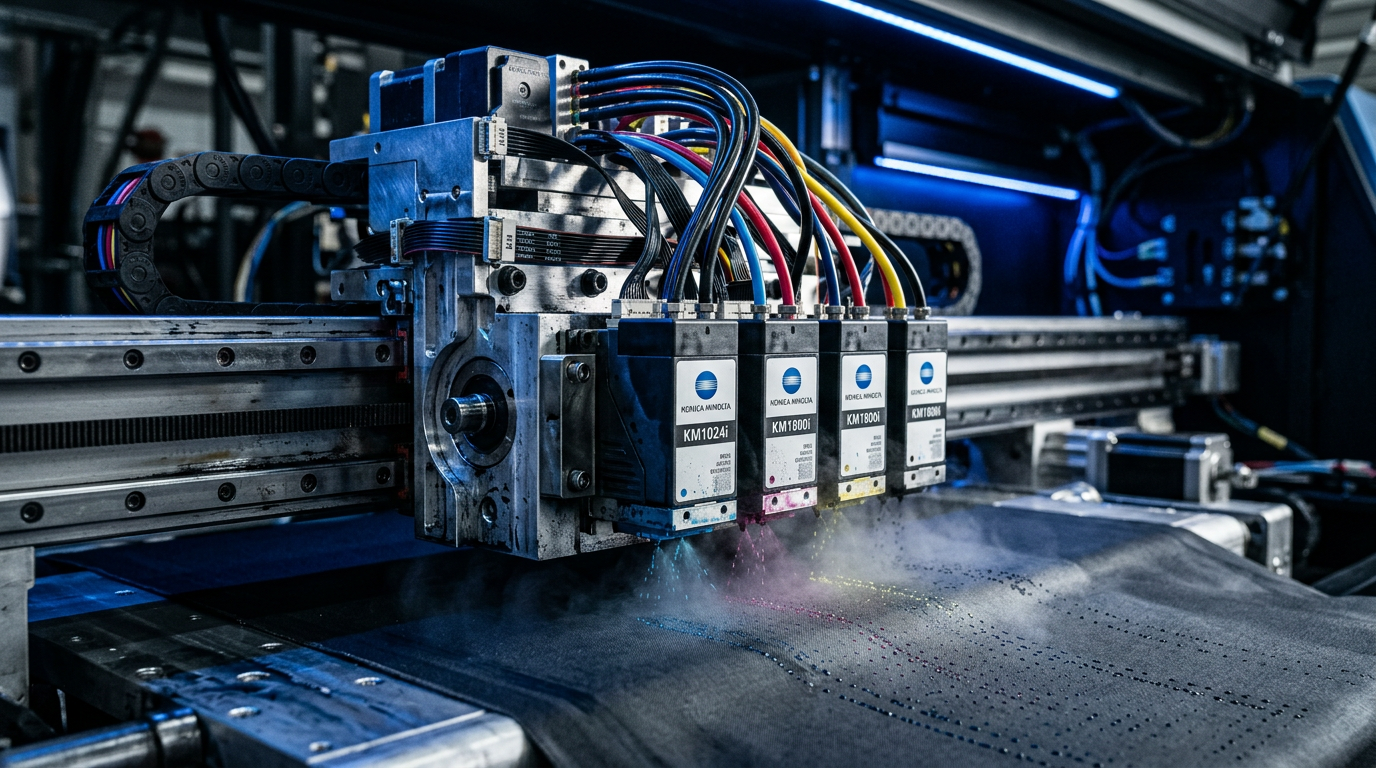
Understanding one mechanical fact makes this entire comparison obvious: a flex printing machine lays ink in horizontal passes as the carriage traverses the media. Each Konica 512i head carries 512 nozzles firing thousands of droplets per second across a swath roughly 36 mm wide. Four heads arranged in a staggered configuration mean one carriage pass covers ~72 mm of print height per colour pass; eight heads cover ~144 mm — twice the media height per traverse, hence twice the square metres per hour at identical carriage speed and pass count.
What the head count does NOT change:
- Resolution — identical heads, identical dpi capability
- Colour gamut — same CMYK ink chemistry
- Ink consumption per sq ft — same droplets per unit area
- Durability of output — chemistry is chemistry
What head count DOES change:
- Square metres per hour — the entire point
- Capital locked in heads — ₹1.3–1.7 lakh vs ₹2.4–3.6 lakh sitting on the carriage
- Maintenance minutes per day — more heads = more nozzles to check and clean
- Graceful degradation — an 8-head machine with one dead head prints at ~87% capacity; a 4-head drops to 75% and the quality banding risk rises
Specifications: 4-Head vs 8-Head Side by Side
| Specification | 4-Head Machine (4× KM 512i) | 8-Head Machine (8× KM 512i) |
|---|---|---|
| Print Head Model | Konica Minolta 512i (30/42 pl) | Konica Minolta 512i (30/42 pl) |
| Head Count / Carriage | 4 (single staggered row) | 8 (dual staggered rows) |
| Max Print Width | 3.2 m | 3.2 m |
| Heads Investment | ₹1.3 – ₹1.7 lakh | ₹2.4 – ₹3.6 lakh |
| Machine Price (2026) | ₹4.0 – ₹6.5 lakh | ₹6.5 – ₹9.0 lakh |
| Machine Weight | ~750–900 kg | ~850–1,000 kg |
| Power Draw (printing) | ~4–4.5 kW with heaters | ~5–5.5 kW with heaters |
| Daily Maintenance Time | 10–15 min | 15–25 min |
| Nozzles to Keep Healthy | 2,048 | 4,096 |
Speed Reality: What Each Machine Actually Prints Per Day
Brochures quote draft mode. Businesses bill production mode. Here are honest, field-observed numbers for well-maintained machines:
| Print Mode | Quality Level | 4-Head Speed | 8-Head Speed | Sellable For |
|---|---|---|---|---|
| 2–3 pass (Draft) | Visible grain/banding | 85–95 sq m/hr | 165–190 sq m/hr | Distant hoardings, political volume |
| 4 pass (Production) | Good commercial quality | 65–75 sq m/hr | 130–150 sq m/hr | 90% of retail banner work |
| 6 pass (Quality) | Smooth, minimal grain | 40–50 sq m/hr | 80–95 sq m/hr | Shop fronts, medium-viewing work |
| 8 pass (Max Quality) | Near-smooth solvent output | 28–35 sq m/hr | 55–65 sq m/hr | Backlit, premium solvent jobs |
Converting to working days (10 operating hours, ~85% practical uptime after loading, cleaning, and file handling):
| Daily Capacity (4-pass) | 4-Head | 8-Head |
|---|---|---|
| Sq metres / day | ~550–640 | ~1,100–1,275 |
| Sq feet / day | ~5,900–6,900 | ~11,800–13,700 |
| Sq feet / month (26 days) | ~153,000–179,000 | ~307,000–356,000 |
| Revenue potential @ ₹13/sq ft | ₹20–23 lakh/month (theoretical max) | ₹40–46 lakh/month (theoretical max) |
Nobody sustains theoretical maximums — real shops average 25–45% of rated daily capacity over a month. But the gap matters precisely where it hurts: deadline day. When 8,000 sq ft must ship by 6 PM, the 4-head machine needs a 12+ hour perfect run; the 8-head finishes by lunch with margin for a breakdown. Speed is insurance against the one day that loses a permanent client.
The Full Price Picture (Purchase + Setup)
| Investment Item | 4-Head Setup | 8-Head Setup |
|---|---|---|
| Machine | ₹4.0 – ₹6.5 lakh | ₹6.5 – ₹9.0 lakh |
| Online UPS (sized for load) | ₹35 – ₹50k (5 kVA) | ₹50 – ₹70k (7.5 kVA) |
| Stabilizer + electrical work | ₹15 – ₹25k | ₹20 – ₹35k |
| Exhaust/ventilation | ₹10 – ₹25k | ₹15 – ₹30k |
| Startup inventory (ink, media, cleaning) | ₹40 – ₹70k | ₹60 – ₹95k (double ink through) |
| RIP + computer | ₹50 – ₹80k | ₹60 – ₹90k (higher spec for throughput) |
| All-In Setup | ₹5.7 – ₹9.2 lakh | ₹8.6 – ₹12.6 lakh |
The ~₹3 lakh delta buys: four extra heads (₹1.4–1.8 lakh), a bigger carriage drive, heavier duty power system, and the doubled ink path — plus the dealer’s premium for the flagship configuration.
Running Cost Comparison per Square Foot
Here’s the subtlety most comparisons miss: at the same pass count, ink and media cost per sq ft are nearly identical. The differences hide in overhead absorbption:
| Cost Component / sq ft | 4-Head @ 25,000 sq ft/mo | 8-Head @ 60,000 sq ft/mo |
|---|---|---|
| Media | ₹4.5 | ₹4.5 |
| Ink | ₹1.6 | ₹1.6 |
| Power | ₹0.55 | ₹0.62 |
| Head depreciation | ₹0.85 | ₹0.80 |
| Labour allocation | ₹1.35 (2 staff) | ₹0.65 (3 staff) |
| Rent allocation | ₹0.90 | ₹0.45 |
| Wastage/cleaning | ₹0.50 | ₹0.45 |
| Total / sq ft | ₹10.2 | ₹9.1 |
Read it carefully: the 8-head machine is cheaper per square foot only when its volume advantage materialises. Run that same 8-head at 25,000 sq ft/month and labour/rent allocation balloons to ₹11+ per sq ft — worse than the 4-head. Big machines earn through utilisation or lose through overhead; there is no middle path.
ROI Comparison: Three Business Scenarios
Scenario A — Typical Start (15,000–20,000 sq ft/month)
| Metric | 4-Head | 8-Head |
|---|---|---|
| Utilisation | ~11% | ~6% |
| Revenue @ ₹13 avg | ₹2.3 lakh/mo | ₹2.3 lakh/mo |
| Net profit (after all costs) | ~₹55–75k/mo | ~₹40–55k/mo |
| Payback on all-in investment | ~11–14 months | ~18–24 months |
Winner: 4-head, decisively. Same revenue, lower overhead, faster payback.
Scenario B — Established Shop (35,000–45,000 sq ft/month)
| Metric | 4-Head | 8-Head |
|---|---|---|
| Utilisation | ~23% | ~13% |
| Urgent-order capability | Strained (all-night runs) | Comfortable (same-day easy) |
| Net profit | ~₹1.4–1.7 lakh/mo | ~₹1.5–1.9 lakh/mo (captures refused surge work) |
| Payback | ~6–8 months | ~6–8 months |
Winner: split decision. The 4-head runs happily; the 8-head starts justifying itself through surge capture and same-day premiums.
Scenario C — Volume/Trade Hub (70,000+ sq ft/month, elections, wholesale)
| Metric | 4-Head | 8-Head |
|---|---|---|
| Feasibility at peak | Refuses work / loses clients | Absorbs surges |
| Election-season capacity | ~1.5 lakh sq ft/mo ceiling | ~3 lakh sq ft/mo ceiling |
| Net profit potential (peak months) | ~₹4–5 lakh | ~₹8–10 lakh |
| Payback | Fast — but caps growth | ~4–6 months at sustained volume |
Winner: 8-head, and it’s not close.
Should You Buy 4 Heads and Upgrade Later?
The smartest middle path in the Indian market: buy a machine on an 8-head-upgradable chassis with 4 heads installed. Most quality 3.2m platforms support doubling the carriage later — the frame, boards, and servo systems already carry the capacity. The upgrade typically costs ₹1.8–2.5 lakh (4 heads + carriage work + calibration) versus the ₹2.5–3 lakh price difference at initial purchase.
Upgrade-path buying works when:
- Your current volume is modest but demonstrably growing quarter over quarter
- The dealer confirms in writing the chassis/board supports 8-head retro-fitment (not all do!)
- You want the option anchored before the purchase, negotiated as part of the original deal: “8-head upgrade within 24 months at ₹X fixed”
Pay attention to the clause that matters: some factory-assembled 4-head machines ship with firmware/boards capped at 4 heads, and “upgradeable” becomes an expensive mainboard replacement story. Written confirmation, always.
Power, Staffing & Day-to-Day Reality
Power Requirements
The 4-head platform runs on a 5 kVA commercial connection with a 5 kVA online UPS. The 8-head platform draws more — plan a 7.5 kVA connection and 7.5 kVA UPS, and expect ₹1,500–₹3,000/month higher electricity bills at equal output levels (heaters and dual carriage drives consume more per machine-hour, though less per sq ft at full utilization).
Staffing
- 4-head: one trained operator + one helper suffices even on busy days; media loading cadence is manageable
- 8-head: at sustained speed, media loading becomes the bottleneck — a 50m roll prints out in ~25–30 production minutes. Full-capacity operation realistically needs one operator, one loader/finisher, and design/billing handled separately.
Maintenance Load
Daily time roughly doubles: 4,096 nozzles to check and flush versus 2,048. Weekend wet-capping discipline matters even more — refilling 8 heads’ cleaning consumption costs more per idle week. Budget: cleaning solution ~₹3,000–₹4,000/month (4-head) vs ~₹5,000–₹7,000/month (8-head) under heavy use.
5 Myths About Head Count (Busted)
Myth 1: “8-head prints better quality.” Identical heads and identical pass counts produce identical quality. What the 8-head allows is running 6–8 pass quality at production speeds — quality mode without the throughput penalty.
Myth 2: “More heads mean more breakdowns.” Breakdown probability per head is constant; 8 heads present twice the exposure but also degrade gracefully — one failed head leaves ~87% capacity, while the same failure on a 4-head leaves 75% with visible banding risk at high coverage.
Myth 3: “8-head wastes ink.” Ink per square foot is definitionally identical at the same pass and coverage. Slightly higher cleaning cycle consumption exists, but it’s single-digit percentages — not a decision factor.
Myth 4: “Start big, grow into it.” The most expensive myth in machinery. Fixed overhead (heads depreciating on calendar time, higher power floor, EMI) runs whether the machine prints or idles. Markets have repeatedly punished over-capacity purchases; buy for confirmed volume +25%, not ambition +200%.
Myth 5: “Two 4-head machines are better than one 8-head.” Sometimes true! Two 4-heads give redundancy (one down, other prints), media flexibility (flex on one, vinyl on other), and location flexibility. It also doubles space, staffing, and maintenance overhead. For surge capacity one 8-head is cheaper; for business continuity, two 4-heads are safer.
The Decision Framework: Which One for You?
Buy the 4-Head if…
- Monthly volume is under 35,000 sq ft with normal seasonality
- Most orders carry 24–48 hour timelines, not same-day emergencies
- This is your first machine or your workhorse in a single-machine shop
- Capital conservation matters — the ₹3 lakh difference funds working capital, laminator, or plotter
- Your market’s ceiling simply doesn’t contain 60,000+ sq ft months
Buy the 8-Head if…
- Confirmed monthly volume already exceeds 40,000 sq ft on another machine
- Your business model includes election/political surge work, wholesale trade printing, or agency SLA contracts with hard deadlines
- You’re deliberately building capacity headroom before a known demand event (political calendar, franchise expansion)
- Downtime costs more than capital: every refused urgent order damages standing trade accounts
- You’ve run the utilisation math and it clears 35–40% of rated capacity in month three
The Underrated Third Option
The upgradeable-chassis 4-head deserves special emphasis for first-time buyers in growing markets: launch at ₹5.5–6 lakh all-in, fill the machine with hustle, and double the heads when the order book proves it. You preserve capital now and surrender only ₹40–60k versus the up-front 8-head price — cheap insurance both ways.
Inside the Machine: What the Extra ₹3 Lakh Actually Buys
Strip both machines to their frames and the price difference becomes a parts list. Understanding it protects you from paying 8-head prices for 4-head machines with cosmetic changes:
- Four additional KM 512i heads (₹1.4–1.8 lakh). The core of the premium — genuine Konica heads in sealed OEM packing, which you should physically verify at installation. Heads are the single most counterfeited/refurbished component in the Indian market.
- A second carriage row and extended head plate (₹30–50k). Dual-row stagger mounting with independent height micro-adjustment, cabling chains, and ink tubing for the second head bank.
- Doubled ink supply path (₹20–40k). Eight sub-tanks, negative-pressure regulation per bank, additional dampers and feed lines. Budget 8-head machines sometimes skimp here — shared sub-tanks cause cross-bank pressure fluctuations and mysterious banding.
- Upgraded boardset and firmware (₹40–75k). The mainboard and head boards must drive 4,096 nozzles of data — a genuine 8-head platform uses different electronics, not just more of the same.
- Heavier-duty media feed (₹20–35k). Faster throughput means the take-up and feed systems cycle media twice as fast; quality builds add motorised take-up as standard at this tier.
- Dealer’s flagship margin (₹30–60k). The premium configuration carries premium markup — the negotiable layer of the price.
When a dealer quotes suspiciously low for an “8-head,” walk the parts list with them. The answers — or the fidgeting — tell you what’s actually inside the frame.
A Day on the Floor: Both Machines, Same 6,000 sq ft Order Book
Abstract specs become obvious when you run a real day. Take a busy Saturday order book: 4,000 sq ft of market banners, 1,500 sq ft of event backdrops, 500 sq ft of urgent same-day shop board work — 6,000 sq ft total.
On the 4-head machine (production mode ~70 sq m/hr): Total print time ≈ 80 sq m × 60 ÷ 70 ≈ 69 minutes per 1,000 sq ft… conversion aside, the day’s 6,000 sq ft ≈ 557 sq m needs ~8 hours of pure print time. Add media loading (8–10 roll changes/lifts), nozzle checks, a lunch-hour idle machine, and two customer walk-ins that interrupt the design queue — the day runs 9 AM to 10 PM, the operator eats standing, and the urgent 500-sq-ft job means re-queueing the event backdrop. Nothing fails, yet everything feels one mishap from missed deadline. This is a machine working at ~70% of daily capacity.
On the 8-head machine (production mode ~140 sq m/hr): The same 557 sq m prints in ~4 hours. The urgent job interrupts nothing — it slots in between roll changes. By 3 PM the day’s revenue work is printed, punched, and stacked; the afternoon becomes installation runs, tomorrow’s pre-production, and — the thing nobody prices — the operator has spare attention to do quality checks properly instead of firefighting. The same order book on the bigger machine reads as an easy day.
Now reverse the volumes: a modest 1,200 sq ft day. On the 4-head, ~1.5 hours of printing and a tidy operation. On the 8-head, 45 minutes of printing and the rest of the day the machine’s ₹3.6 lakh of heads sit depreciating on the calendar. Both truths coexist; the machines themselves are honest — only the utilisation varies.
The Economics of Refused Work (The Hidden 8-Head Justification)
The spreadsheet case for the 8-head rarely survives on steady-state math alone — its real engine is capture of work the 4-head structurally refuses:
- Same-day emergency premiums: +25–50% on rate, available only to shops that can actually deliver same-day. In event-heavy markets this premium work can add ₹40,000–₹80,000/month.
- Trade printing accounts: Agency and reseller clients consolidate with whichever shop absorbs their Friday 4 PM panic. Lose one week’s panic order and the account quietly migrates — permanently.
- Election window concentration: Political work distributes in 48-hour bursts to whoever confirms capacity on the phone. An 8-head shop credibly promises a 25,000 sq ft weekend; a 4-head shop cannot, no matter the will.
- The refusal ripple: A customer turned away once doesn’t just take that order elsewhere — they take their habit elsewhere. Queue-driven refusals compound into client loss that no spreadsheet at purchase time models.
If your order book includes 2–3 “we need it tonight” clients, run their premiums honestly for three months. The arithmetic of refused work often justifies the 8-head where steady-state utilisation math did not.
10 Questions to Ask Current Owners Before You Decide
Data beats dealer talk. Find owners of both configurations (your dealer will share references; trade printers’ associations and local WhatsApp groups will share everyone else) and ask:
- What’s your actual monthly output in sq ft — not what you planned, what you billed last month?
- At what hour of the day does your machine actually stop on busy days?
- How much urgent/same-day work do you accept, and what premium does it carry?
- How many days of production did you lose to faults this quarter? What failed?
- What did your last full head-set replacement cost, downtime included?
- What’s your real ink consumption per month, in litres, at what coverage?
- If you chose 8 heads: knowing your volume, would you buy it again? If 4: same question.
- What work do you refuse today because of capacity — and how often?
- What’s your electricity bill, and what UPS are you running?
- Who fixes your machine, from how far, and how fast do they show up?
Ten honest answers from two or three owners will calibrate your decision better than any amount of showroom time. The pattern to listen for: 4-head owners wish for speed only on peak days; 8-head owners with low volume wish — every single day — for the working capital the extra heads consumed.
Frequently Asked Questions (FAQs)
Q1. Is print quality better on an 8-head machine?
No. Identical KM 512i heads at identical pass counts produce identical output. The 8-head’s advantage is producing 6–8 pass quality at speeds the 4-head can only reach at 4 pass — quality-per-hour, not quality itself.
Q2. How much faster is 8-head vs 4-head in real work?
Production mode: ~130–150 sq m/hr vs ~65–75 sq m/hr — consistently 1.9–2× across operating conditions. A 5,000 sq ft banner batch that runs ~9–10 hours on a 4-head finishes in 4.5–5 hours on an 8-head with margin to spare.
Q3. What minimum monthly volume justifies an 8-head machine?
Practitioner consensus: 40,000+ sq ft/month sustained, or a business model built on surge capacity (elections, trade printing, SLA-driven agency work) where same-day turnaround commands premium rates.
Q4. Can I upgrade my 4-head machine to 8 heads later?
Often yes — most quality 3.2m chassis accept the retrofit for ₹1.8–2.5 lakh including heads, internal work, and calibration. But confirm before buying, in writing, that your specific machine’s mainboard and firmware support it; some factory builds are capped at 4.
Q5. Do 8 heads mean double the head-replacement cost?
Yes — a full head-set renewal runs ₹2.4–3.6 lakh vs ₹1.3–1.7 lakh. But note heads depreciate on usage AND calendar idling alike; a well-maintained 8-head set lasts the same 18–30 months per head, so cost per produced sq ft stays comparable when the machine is properly loaded.
Q6. Which is better for a new printing business?
The 4-head, almost universally. New businesses face volume uncertainty; the 4-head’s lower overhead, faster payback, and simpler operation match the learning curve. Upgrade via chassis or second machine once the order book writes the justification for you.
Q7. Does the 8-head machine consume double the electricity?
No — about 20–30% more per machine-hour (larger heater banks, dual drives), and actually less per square foot at high utilisation since throughput nearly doubles. At equal monthly output, expect only ₹1,500–₹3,000/month difference either way.
Q8. Can one operator run an 8-head machine?
One operator can supervise it, but sustained production needs a loader/finisher — media rolls print out every 25–30 minutes at full speed. Attempting solo operation at capacity is how rolls get misloaded and printed sides ruined.
Q9. What about 12-head or 16-head machines?
They exist (₹12–20 lakh) and serve wholesale/industrial print factories running two shifts. For 95%+ of Indian print businesses, they’re over-capacity. By the time you need one, you’ll be consulting installed-base peers, not blog guides — and you’ll know exactly why.
Q10. Which configuration has better resale value?
4-head machines resell faster (bigger buyer pool, within more budgets) at similar percentages — 40–55% of purchase price after 3 years maintained. 8-head machines fetch good prices but take longer to place. Upgradeable-chassis 4-heads are the used-market sweet spot.
Final Verdict
The 4-head vs 8-head debate resolves into one line: buy the capacity your order book confirms — plus 25%, never plus 200%.
- Under 35,000 sq ft/month: the 4-head machine is the rational choice — lower overhead, faster payback, simpler operation, easier exit.
- Over 40,000 sq ft/month or surge-driven business: the 8-head pays for itself in captured deadlines, trade accounts, and peak-season capacity.
- Growing but unproven: the upgradeable 4-head is the professional’s hedge — capacity option in hand, capital preserved.
The embarrassing secret of the Indian printing industry is how many 8-head machines print four hours a day while their EMI calculates on 24. Buy the machine your P&L asks for — and the day it can’t keep up, congratulations: your business just funded its own upgrade.
Weighing 4-head vs 8-head for your market? Browse our flex machine configurations — both options ship with installation, training, and pan-India parts support. Share your expected monthly volume with our team, and we’ll model the honest payback for each configuration before you commit.