 (+91) 8853765397
 NEWSLETTER


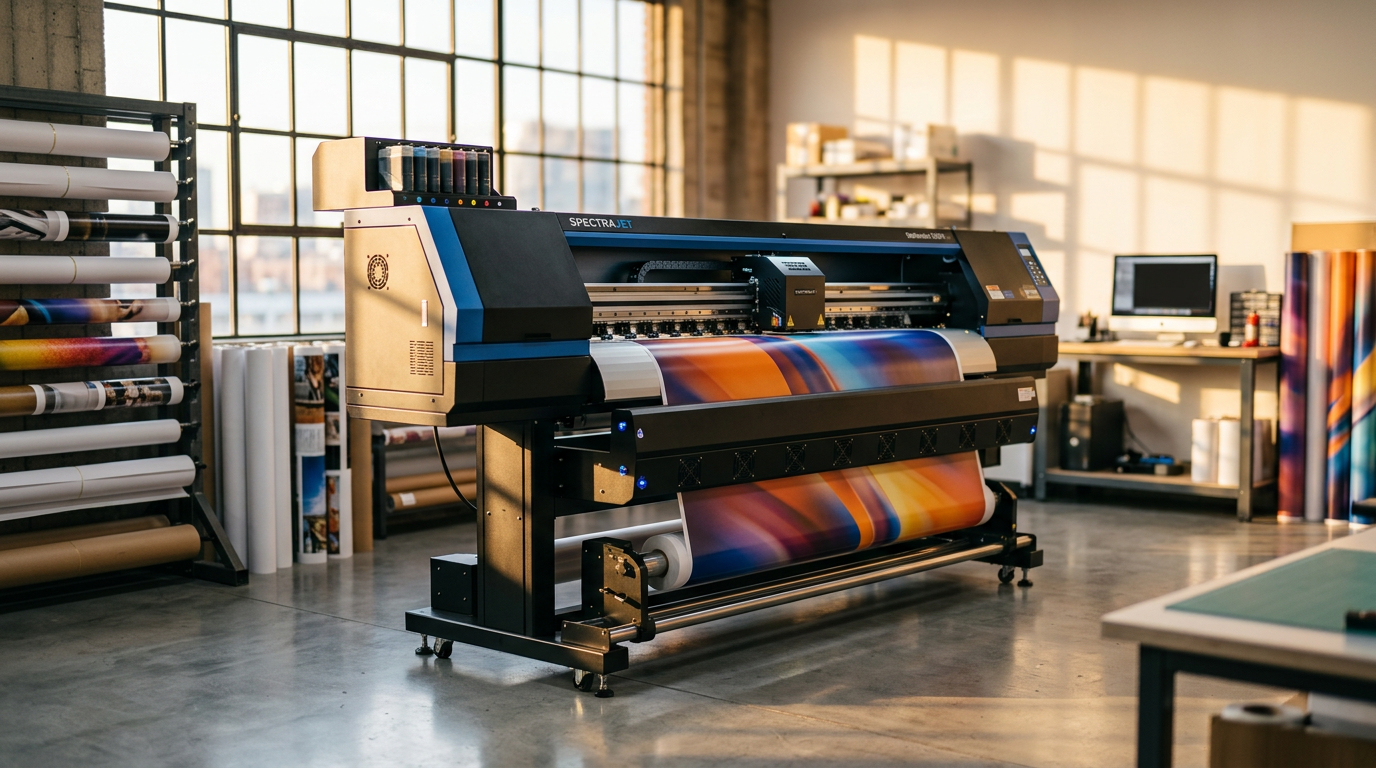
Quick Answer: For most Indian small businesses in 2026, the best flex printing machine is the 3.2m solvent printer with 4× Konica Minolta 512i heads (₹4–6.5 lakh) — it balances price, production speed (65–75 sq m/hr), lowest running cost (₹6–9/sq ft), and unmatched spare-parts availability across India. If your work is photo-quality indoor graphics, the best choice is a dual-head 1.8m eco-solvent machine with Epson i3200 heads (₹2.75–4.25 lakh). Below, we compare the top 7 configurations across every budget with complete specifications, cost-per-sq-ft economics, and honest pros and cons.
Searching “best flex printing machine for small business” in India returns chaos: dealer ads disguised as reviews, model names that change every six months, and ranking articles written by people who have never loaded a media roll in their life. Here’s the uncomfortable truth that makes this guide different — in the Indian market, machines are defined by their configuration, not their brand.
The same Konica 512i platform powers machines sold under a dozen different brand stickers. What actually determines your experience is: which print heads, how many, what chassis quality, bundled RIP software — and above all, the dealer’s service network behind it. So instead of fake brand rankings, this guide compares the seven machine configurations that actually matter for a small business, with current prices, full specs, and the exact buyer each one suits.
How We Judged “Best” (Our Criteria)
Every machine configuration below is scored on the six factors that determine real-world success for a small printing business:
- Cost per sq ft — your daily profit engine, not the sticker price
- Production speed in sellable modes — brochure speed doesn’t pay bills
- Print head economics — replacement cost, availability in India, realistic lifespan
- Media flexibility — how many product lines can you sell from one machine
- Serviceability — can a broken machine in your city be fixed this week?
- Payback speed — months to recover the full investment at realistic volumes
Top 7 Picks at a Glance (2026 Comparison Table)
| Pick | Configuration | Price (₹) | Speed (Production) | Cost / sq ft | Best For |
|---|---|---|---|---|---|
| 🏆 Best Overall | 3.2m Solvent, 4× KM 512i | 4.0–6.5L | 65–75 sq m/hr | ₹6–9 | Most small businesses |
| 💰 Best Budget | 1.6m Eco-Solvent, 1× i3200 | 1.8–2.75L | 12–18 sq m/hr | ₹11–15 | Studios, side-business |
| 🎨 Best Quality | 1.8m Eco-Solvent, 2× i3200 | 2.75–4.25L | 25–30 sq m/hr | ₹10–16 | Showroom/photo clients |
| ⚡ Best for Volume | 3.2m Solvent, 8× KM 512i | 6.5–9.0L | 130–150 sq m/hr | ₹6–8 | Election/wholesale hubs |
| 🚀 Best Premium Solvent | 3.2m Solvent, 4× KM 1024i | 8.0–12.0L | 90–110 sq m/hr | ₹6–8 | Quality + speed together |
| 🖼️ Best Wide Eco-Solvent | 3.2m Eco-Solvent, 2× i3200 | 6.0–10.0L | 25–30 sq m/hr | ₹11–16 | Premium vinyl, wraps, wide décor |
| 💎 Best Upgrade (UV) | 3.2m UV Roll-to-Roll, 3× Ricoh G5 | 14.0–22.0L | 20–35 sq m/hr | ₹15–25 | Established shops adding premium |
🏆 Pick 1 — Best Overall: 3.2m Solvent with 4× Konica 512i (₹4–6.5 Lakh)
If we could recommend exactly one machine to a new Indian printing business, this is it. The 3.2m/4-head KM 512i configuration has dominated Indian small printing businesses for a decade for one reason: nothing else delivers outdoor-grade banners at ₹6–9/sq ft with this reliability and parts availability.
Full Specifications
| Specification | Details |
|---|---|
| Print Heads | 4× Konica Minolta 512i (30 pl or 42 pl) |
| Max Print Width | 3.2 m (10.5 ft) |
| Speed | Draft ~85 sq m/hr · Production 65–75 sq m/hr · Quality 30–40 sq m/hr |
| Resolution | Up to 720×1440 dpi |
| Media | Frontlit/backlit flex, vinyl, blackout, mesh, canvas, one-way vision |
| Ink System | Continuous bulk supply, 5L barrels, negative-pressure controlled |
| RIP | PhotoPRINT / MainTop / UltraPrint bundle (dealer-dependent) |
| Power | ~1.5 kW machine + ~2.5 kW heaters; 5 kVA supply recommended |
| Head Replacement | ₹30–45k each; stocked by virtually every Indian dealer |
| Space Needed | ~14×10 ft machine footprint + working room |
Why It Wins for Small Business
- Profit economics: At ₹14/sq ft average selling rate and ₹8 cost, a single 8-hour production day printing 4,000 sq ft grosses ₹24,000. Even moderate utilization pays the machine back in 5–8 months.
- Survivability: Konica 512i platforms are the Maruti 800 of Indian printing — every technician knows them, every parts shelf stocks them, and YouTube has a fix video for every error code.
- Upgrade headroom: When demand outgrows 4 heads, many chassis accept an 8-head upgrade — cheaper than replacing the machine.
- Resale liquidity: A maintained 512i machine sells in days on the used market at 40–55% of purchase price — your exit option stays open.
Honest Weaknesses
Close-range print grain (avoid for premium indoor work), mandatory exhaust ventilation, and zero output if your operator skips head maintenance. It is also a volume machine — at less than ~15,000 sq ft/month, its economics are wasted.
Best for: Tier-2/3 city banner businesses, event/election work, and anyone whose customers say “jitna sasta, utna accha.”
💰 Pick 2 — Best Budget: 1.6m Eco-Solvent with Single Epson i3200 (₹1.8–2.75 Lakh)
The gateway drug of the printing industry — and we mean that positively. A single-i3200 1.6m machine is the cheapest credible entry into professional large-format printing in India in 2026.
Full Specifications
| Specification | Details |
|---|---|
| Print Head | 1× Epson i3200-A1/E1 (3,200 nozzles) |
| Max Print Width | 1.6 m (5.25 ft) |
| Speed | Production 12–18 sq m/hr · Photo 5–8 sq m/hr |
| Resolution | Up to 1440×1440 dpi, variable 3.5–21 pl droplets |
| Media | Vinyl, PP, photo paper, backlit film, canvas, wallpaper, wrap media |
| Drying | Triple heater + fan system |
| Power | ~1.5–2 kW total; runs on standard connection + 2 kVA UPS |
| Footprint | ~8×6 ft — fits a spare room |
Why It Wins for Budget Buyers
- Total business launch possible under ₹4.5 lakh including everything
- Photographic output quality commands ₹25–50/sq ft rates — the margin-per-hour rivals bigger machines
- Low odour means it works in studios, shops, and even home-adjacent rooms
- The i3200 head is far more forgiving of beginner mistakes than old DX5 heads
- Perfect satellite machine for photo studios, designers, and event companies
Honest Weaknesses
Cannot compete in commodity banner pricing (₹12/sq ft market will eat it alive), single head = no redundancy (head problem = zero production), and slow for big urgent jobs. Outdoor work needs lamination, so budget ₹45–65k more for a laminator.
Best for: Photo studios, graphic designers going physical, entrepreneurs testing the market, side-businesses, and quality-focused niches.
🎨 Pick 3 — Best Quality: 1.8m Eco-Solvent with Dual i3200 (₹2.75–4.25 Lakh)
The dual-head 1.8m upgrade is where eco-solvent stops being a hobby machine and becomes a production business. Twin heads deliver 25–30 sq m/hr in production mode — fast enough for daily commercial work while keeping photographic quality.
Full Specifications
| Specification | Details |
|---|---|
| Print Heads | 2× Epson i3200 (staggered carriage) |
| Max Print Width | 1.8 m (6 ft) |
| Speed | Draft ~38 sq m/hr · Production 25–30 sq m/hr · Photo 10–14 sq m/hr |
| Resolution | Up to 1440×1440 dpi |
| Colour Config | CMYK (some models: +Lc/Lm for highlight finesse) |
| Media Handling | Roll-to-roll, auto take-up, media thickness to ~1mm liner-backed |
| Drying | Pre/platen/post triple heater + IR option |
| Ideal Products | Wall wraps, vehicle graphics, backlit displays, canvas art, premium stickers |
Why It Wins on Quality
- Twin heads halve print time versus single-head — urgent showroom jobs become same-day
- Consistent sellable rate of ₹25–60/sq ft from design-conscious urban clients
- One machine feeds 8–10 premium product lines (wallpaper, wraps, canvas, backlit, stickers…)
- Lower per-unit power and ink overhead than running two single-head machines
Honest Weaknesses
Still not a commodity banner machine. Media costs (coated vinyl/films) run 2–3× commodity flex. And at ₹4+ lakh all-in with laminator, total investment reaches solvent-machine territory — enter only with a quality-paying market confirmed.
Best for: Urban print studios, vehicle wrapping startups, interior-décor print suppliers, and eco-solvent upgraders from single-head machines.
⚡ Pick 4 — Best for Volume: 3.2m Solvent with 8× KM 512i (₹6.5–9 Lakh)
Double the heads, double the draft, nearly double the billing capacity. The 8-head 512i machine exists for one purpose: printing ungodly volumes when everyone else has closed.
Full Specifications
| Specification | Details |
|---|---|
| Print Heads | 8× Konica Minolta 512i (dual carriage rows) |
| Max Print Width | 3.2 m |
| Speed | Draft ~165 sq m/hr · Production 130–150 sq m/hr · Quality 60–80 sq m/hr |
| Daily Capacity | 1,000–1,200 sq m in production mode (10-hr shift) |
| Head Investment | ₹2.4–3.6 lakh of heads on the carriage — protect accordingly |
| Ideal Load | 40,000+ sq ft/month sustained |
Why It Wins for Volume
- Election season (political banners with 48-hour deadlines) is where this machine earns a year of profit in six weeks
- Wholesale printing for smaller shops (“trade printing”): you become the production backend for 5–10 local retailers
- Fastest cost-per-sq-ft floor in the industry at sustained loads
- 8 heads provide graceful degradation — one head fails, you print at 7 while the replacement ships
Honest Weaknesses
An 8-head machine running 3 hours a day is a terrible investment — overhead (₹2.4–3.6 lakh of heads, higher power, more maintenance minutes) needs volume to amortise. Also demands serious power infrastructure (5 kVA+ with online UPS) and two sets of hands on full production days.
Best for: City printing hubs, election-heavy regions, wholesale/trade printers, and 4-head owners hitting capacity ceilings.
🚀 Pick 5 — Best Premium Solvent: 3.2m with 4× KM 1024i (₹8–12 Lakh)
The Konica 1024i head doubles nozzle count (1,024) at a fine 13 pl droplet — delivering near-eco-solvent smoothness at solvent speeds and solvent economics. It is the connoisseur’s solvent machine.
| Specification | KM 512i Machine | KM 1024i Machine |
|---|---|---|
| Droplet Size | 30–42 pl | 13 pl |
| Nozzles / Head | 512 | 1,024 |
| Production Speed (4-head) | 65–75 sq m/hr | 90–110 sq m/hr |
| Close-Range Quality | Visible grain | Noticeably smoother |
| Head Replacement Cost | ₹30–45k | ₹48–65k |
| Machine Price | ₹4–6.5 lakh | ₹8–12 lakh |
Who should buy it: printers in metro and premium Tier-1 markets where clients reject grainy output but volumes still rule out eco-solvent economics — mall advertising vendors, airport/metro media suppliers, and brand-campaign producers. For a small business in a price-driven town, the extra ₹3–5 lakh is better spent on working capital.
🖼️ Pick 6 — Best Wide Eco-Solvent: 3.2m with 2× i3200 (₹6–10 Lakh)
Wide eco-solvent unlocks the premium products 1.8m machines physically cannot print: full-height wall murals in one piece, 10-ft backlit retail displays, wide vehicle panels without seams.
Economics: production cost ₹11–16/sq ft, selling rates ₹35–80/sq ft in metro retail/décor segments. The trap is volume — this machine earns magnificently per square foot but needs a pipeline of premium clients (interior designers, retail chains, expo fabricators) to stay fed. It’s a second machine for established quality printers, rarely a wise first machine.
💎 Pick 7 — Best Upgrade: 3.2m UV Roll-to-Roll (₹14–22 Lakh)
UV is not a flex printing machine in the classic sense — but it is where successful flex printers graduate. UV-LED curing delivers:
- Instant-dry prints on virtually any roll media (including uncoated and specialty films)
- 3–5 year outdoor durability without lamination
- The market’s highest rates: ₹50–120/sq ft for retail and décor work
Buy UV only when: monthly revenue already exceeds ₹4–5 lakh, you have premium clients asking for products you currently refuse, and cash reserves cover 6 months of EMI comfortably. Bought early, UV is an expensive trophy. Bought at the right time, it’s a profit-doubler.
5-Year Ownership Cost: What Each Pick Really Costs You
Sticker price is what you pay on day one; ownership cost is what the machine extracts over five years. This table models realistic small-business usage (running 26 days/month, normal maintenance):
| Cost Head (5 Years) | Eco-Solvent 1.6m (1 head) | Solvent 3.2m (4× 512i) | Solvent 3.2m (8× 512i) | Eco-Solvent 1.8m (2 heads) |
|---|---|---|---|---|
| Machine + install infrastructure | ₹2.4 lakh | ₹6.0 lakh | ₹8.0 lakh | ₹4.0 lakh |
| Laminator (if needed) | ₹0.55 lakh | — | — | ₹0.55 lakh |
| Head replacements | ₹1.35 lakh (3 heads) | ₹2.6 lakh (8 heads) | ₹5.2 lakh (16 heads) | ₹2.7 lakh (6 heads) |
| Ink (volume-adjusted) | ₹3.0 lakh | ₹7.5 lakh | ₹14 lakh | ₹4.2 lakh |
| Parts + service | ₹0.8 lakh | ₹2.1 lakh | ₹3.2 lakh | ₹1.4 lakh |
| 5-Year Total | ₹8.1 lakh | ₹18.2 lakh | ₹30.4 lakh | ₹12.9 lakh |
| Typical 5-yr output | ~40,000 sq m | ~1,80,000 sq m | ~3,60,000 sq m | ~65,000 sq m |
| Cost per sq m | ₹20.2 | ₹10.1 | ₹8.4 | ₹19.8 |
The pattern every machine owner learns: heads and ink eventually cost more than the machine. This is why maintenance discipline and ink quality are profitability decisions, not housekeeping.
Machine Accessories Worth Buying (and Ones to Skip)
Dealers love bundling accessories; some genuinely protect your investment, others are expensive decoration. Spend where it matters:
| Accessory | Cost | Verdict |
|---|---|---|
| Online UPS (3–5 kVA, double conversion) | ₹25–60k | ✅ Essential — power cuts mid-print corrupt jobs and boards |
| Servo stabilizer | ₹8–15k | ✅ Essential in low-voltage areas |
| Hot/cold laminator (64″) | ₹45–65k | ✅ Essential for eco-solvent & vinyl businesses |
| Exhaust duct + blower | ₹10–25k | ✅ Essential for solvent machines |
| Air conditioner (1.5–2 ton) | ₹35–50k | ✅ Strongly recommended — head life insurance |
| Vinyl cutting plotter (2 ft) | ₹15–25k | 🟡 Buy when sticker/decal orders appear |
| Eyelet punching press | ₹4–9k | ✅ Cheap, buys finishing speed daily |
| Flatbed applicator table | ₹60k–1.5L | 🟡 Only for dedicated vinyl-mounting businesses |
| Imported “premium” tool kits | ₹15–30k | ❌ Usually marked-up generic tools |
Product-to-Machine Cheat Sheet
Match the product line you want to sell to the machine that prints it profitably:
| Product Line | Right Machine | Why |
|---|---|---|
| Hoardings & billboards | Solvent 3.2m (4/8-head) | Distance viewing; cost/sq ft decides the contract |
| Shop fascia banners | Solvent 3.2m | Outdoor durability, commodity pricing |
| Election/political volume | Solvent 8-head | 48-hour deadlines need brute speed |
| Showroom wall wraps | Eco-solvent 1.8m dual-head | Close-viewing quality + wrap media compatibility |
| Vehicle wraps | Eco-solvent (dual i3200) | Cast vinyl + photographic finish + lamination |
| Glow-sign backlit film | Eco-solvent or UV | Illuminated graphics expose solvent grain |
| Personalised wallpaper | Eco-solvent / UV | Interior-grade media, odour-sensitive install sites |
| Canvas art & photos | Eco-solvent | Fine droplets, colour fidelity |
| Premium retail displays | UV roll-to-roll | Instant cure, specialty media, top rates |
Financing the Machine Without Strangling Cash Flow
Small businesses rarely fail because the machine didn’t earn — they fail when EMI pressure meets a slow quarter. Follow these guardrails:
- Keep EMI under 30% of your conservative monthly net — the profit you’d make in a bad month, not a good one.
- Prefer 20–30% down payment + 24–36 month tenure from NBFC equipment finance; shorter tenures look cheaper and behave expensively.
- Check MUDRA (up to ₹10–20 lakh collateral-free) and PMEGP subsidy (15–35%) eligibility before signing dealer finance — subsidy money is free money.
- Never finance consumables with long-tenure loans: ink and media are working capital, machinery is capital expenditure — mixing the two is how good businesses drown in interest.
- Insure the machine (fire, theft, transit) — a standard machinery policy costs a few thousand rupees a year against a ₹5–9 lakh asset.
The Smart Buying Sequence for Small Businesses
| Stage | Your Situation | Machine to Buy | Budget |
|---|---|---|---|
| Starting out | New entrant, budget tight, market unproven | 1.6m Eco-Solvent (1× i3200) | ₹1.8–2.75L |
| Core launch | Banner market confirmed | 3.2m Solvent (4× 512i) | ₹4–6.5L |
| Quality expansion | Premium clients emerging | 1.8m Eco-Solvent (2× i3200) | ₹2.75–4.25L |
| Volume expansion | Urgent jobs being refused | 3.2m Solvent (8× 512i) | ₹6.5–9L |
| Premium consolidation | Established, stable cash flow | UV / 1024i solvent / wide eco-solvent | ₹8–22L |
Red Flags: How to Spot a Bad Machine Deal
The Indian printing machine market rewards careful buyers and punishes trusting ones. Walk away — or renegotiate hard — when you see these:
- No live demo on request. Any dealer refusing to print your file on your media in front of you is hiding quality, speed, or both.
- Quotes without head details. “4-head high-speed machine” tells you nothing. If Konica 512i 30-pl vs 42-pl isn’t specified in writing, assume the cheaper one — or worse, refurbished heads.
- “Same as XYZ brand but ₹80,000 cheaper, no bill.” Machines sold without proper GST invoices have no warranty enforceability and no resale value. The saving is fictional.
- Warranty that excludes “all printing parts.” Some warranty cards exclude heads, pumps, dampers, capping stations, and boards — i.e., everything that actually fails. Read the exclusions, not the headline duration.
- No installed customers within 100 km. Whatever the sales pitch promises, service travels from the dealer’s city to yours. No local installations = you’re their experiment in your region.
- Pressure to pay full advance without installation date in writing. Standard terms are 20–40% advance, balance against delivery/installation. Anything beyond that without bank guarantees transfers all risk to you.
What Successful Small Print Shop Owners Do Differently
After watching hundreds of machine installations succeed or stall, the patterns are remarkably consistent. Owners who thrive share five habits:
1. They pre-sell before the machine lands. The best month-one revenue stories come from owners who collected advance commitments from event companies, coaching institutes, and political offices during the machine’s transit period. The machine arrives to orders, not silence.
2. They keep a maintenance register. Date, nozzle check status, cleaning done, ink levels, issues noted. It sounds bureaucratic — until a head warranty claim needs evidence, or a new operator needs history. Ten lines a day protects lakhs.
3. They publish their rate card publicly. On the shop wall, on WhatsApp, on Google Business. Published rates end negotiation fatigue, project professionalism, and quietly filter out the customers who only value price.
4. They sample aggressively. Free 1×1 ft print samples delivered to every potential anchor client’s office. A jeweller holding your vinyl print in hand converts at ten times the rate of a WhatsApp forward of your brochure.
5. They never stop watching cost per sq ft. Monthly, they recalculate: media + ink + power + depreciation against actual selling rate realisation. Markets drift, media prices move, competitors discount — owners who track unit economics adjust before the P&L bleeds; owners who don’t, notice at GST return time.
Buyer’s Checklist: Whichever Machine You Choose
- ✅ Verify heads in sealed OEM packing before paying the balance
- ✅ Time a real 50-sq-ft print at the demo — brochure speeds lie cheerfully
- ✅ Confirm dealer service engineer location and response-time commitment in writing
- ✅ Get the all-inclusive quote: machine + RIP + UPS + installation + training + GST
- ✅ Ask for 3 installed-customer references within 100 km — and actually call them
- ✅ Stock startup consumables: ink, cleaning solution, dampers, capping tops, wiper blade
- ✅ Book 2 days of operator training — maintenance discipline is worth more than any spec
- ✅ Keep 20% of budget as working capital; machines don’t earn on day one
Service Networks & Spare Parts: The India Reality Check
Ask any machine owner what actually determines their satisfaction after six months, and almost nobody says “the machine” — they say the service. Printing machines are mechanical systems full of pumps, belts, sensors, and delicate heads; breakdowns are not a possibility but a schedule. What varies is how many days you stay down.
Before choosing between two machines of similar spec, run this service audit on each dealer:
- Engineer geography: “We have 40 engineers across India” is meaningless. Where does the engineer covering your PIN code live, and how many machines does he cover? An engineer 40 km away beats a famous brand 400 km away, every single breakdown.
- Spare parts stock: Ask specifically: are print heads, capping stations, ink pumps, and mainboards in local stock, or shipped on failure? Waiting 10 days for a ₹2,000 capping station while a ₹5.5 lakh machine idles is a special kind of pain.
- Remote diagnostics: Modern machines on AnyDesk/phone-video diagnosis solve 40–50% of faults in an hour. A dealer set up for remote support changes downtime economics completely.
- Reference calls: Call three owners of the same machine-dealer combination. Ask one question: “When it broke down last time, how many days to fix?” The answer predicts your future better than any brochure.
- Consumables pricing: Confirm ink and spare pricing in writing before purchase. Some dealers sell machines cheap and recoup on marked-up proprietary ink — an honest dealer tells you the ink cost per litre and its open-market equivalent.
This is precisely why “best machine” rankings in India are really “best machine-and-dealer combination” rankings. A mid-tier machine backed by an excellent local service network will out-earn a premium machine with distant support over its five-year life — the uptime difference alone pays for the quality gap.
Frequently Asked Questions (FAQs)
Q1. What is the best flex printing machine for a small business with a low budget?
For budgets under ₹3 lakh, a 1.6m eco-solvent machine with a single Epson i3200 head (₹1.8–2.75 lakh) is the strongest credible option — photographic quality, low odour, and high per-sq-ft rates. For banner-focused work, stretch to a 3.2m solvent machine (₹4 lakh+) rather than buying a used machine with unknown head health.
Q2. Solvent or eco-solvent — which is better for beginners?
Eco-solvent is more forgiving: less head-clogging risk, no ventilation requirement, simpler daily maintenance. But “better” depends on your market — a banner business needs solvent regardless of friendliness. Choose the machine your customers’ orders require, then hire/train discipline.
Q3. How much does a good flex printing machine cost in 2026?
Credible new machines: ₹1.8–2.75L (entry eco-solvent), ₹4–6.5L (standard 4-head solvent — the bestseller), ₹6.5–9L (8-head volume solvent), ₹8–12L (1024i premium solvent), ₹14–22L+ (UV). Under ₹1.5 lakh, only used/refurbished machines exist — with serious risk attached.
Q4. Konica 512i or Epson i3200 — which head is better?
They’re not rivals — they do different jobs. KM 512i: solvent machines, outdoor volume work, ₹30–45k replacement. Epson i3200: eco-solvent/DTF/UV machines, photo-quality work, ₹45–80k replacement. Both are excellent, widely available in India, and proven over lakhs of installations.
Q5. Should I buy a used flex printing machine?
Only with safeguards: a live full-width 20+ minute print test, written nozzle pattern output, verified head hours (print counters exist in most RIPs), and ₹60,000–₹1.2 lakh reserved for immediate head replacement. Never buy a used machine on photographs and promises.
Q6. How soon can a small business recover the machine cost?
Typical payback: entry eco-solvent 4–8 months, 4-head solvent 5–10 months, 8-head solvent 6–12 months (needs volume). The biggest payback accelerant is pre-confirmed anchor customers before installation; the biggest killer is a machine standing idle.
Q7. Which machine is best for vehicle wrapping?
Eco-solvent with Epson i3200 heads is the global standard for wrap printing (cast vinyl compatibility + quality). A 1.8m dual-head machine (₹2.75–4.25L) handles most Indian car/bus work; add a quality laminator — wraps are laminated by default.
Q8. What machine do wedding/event backdrop printers use?
Volume-focused event printers use 3.2m solvent (fast, cheap, viewed from a distance). Premium wedding planners increasingly demand eco-solvent backdrops because close-up photography reveals solvent grain — know which wedding market your city pays for.
Q9. Is a made-in-India assembled machine reliable?
Indian-assembled machines using genuine imported heads, rails, and boards can be excellent value — chassis quality is the variable. Inspect frame rigidity, wiring harness quality, and the assembler’s installed base. A documented 1-year on-site warranty is the minimum acceptable commitment.
Q10. Where can I buy these machines with service support?
Buy from importers/dealers with engineers local to your region and verifiable installed customers. Browse our flex printing machine range — all machines ship with installation, operator training, and pan-India spare-parts support.
Final Verdict: Our Recommendation by Budget
| Your Budget | Our Recommendation |
|---|---|
| Under ₹3 lakh | 1.6m Eco-Solvent, single i3200 — start lean, earn premium rates |
| ₹4–7 lakh | 3.2m Solvent, 4× KM 512i — the small-business king, full stop |
| ₹7–10 lakh | 8-head solvent for volume markets; wide eco-solvent for quality markets — never both impulses at once |
| Above ₹12 lakh | Prove the business first at a lower tier; then UV or 1024i with a clear client pipeline |
The “best” machine is a moving target: it’s the one whose running cost, speed, and quality match the orders your market actually places. Buy for the customers you can see today, keep the upgrade ladder in mind, and protect your heads like the lakh-rupee assets they are.
Want a personalised recommendation? Explore our flex & solvent machines, eco-solvent printers, and UV printers, or contact our team with your city, market, and budget — we’ll map the right configuration and an honest payback estimate for your situation.
