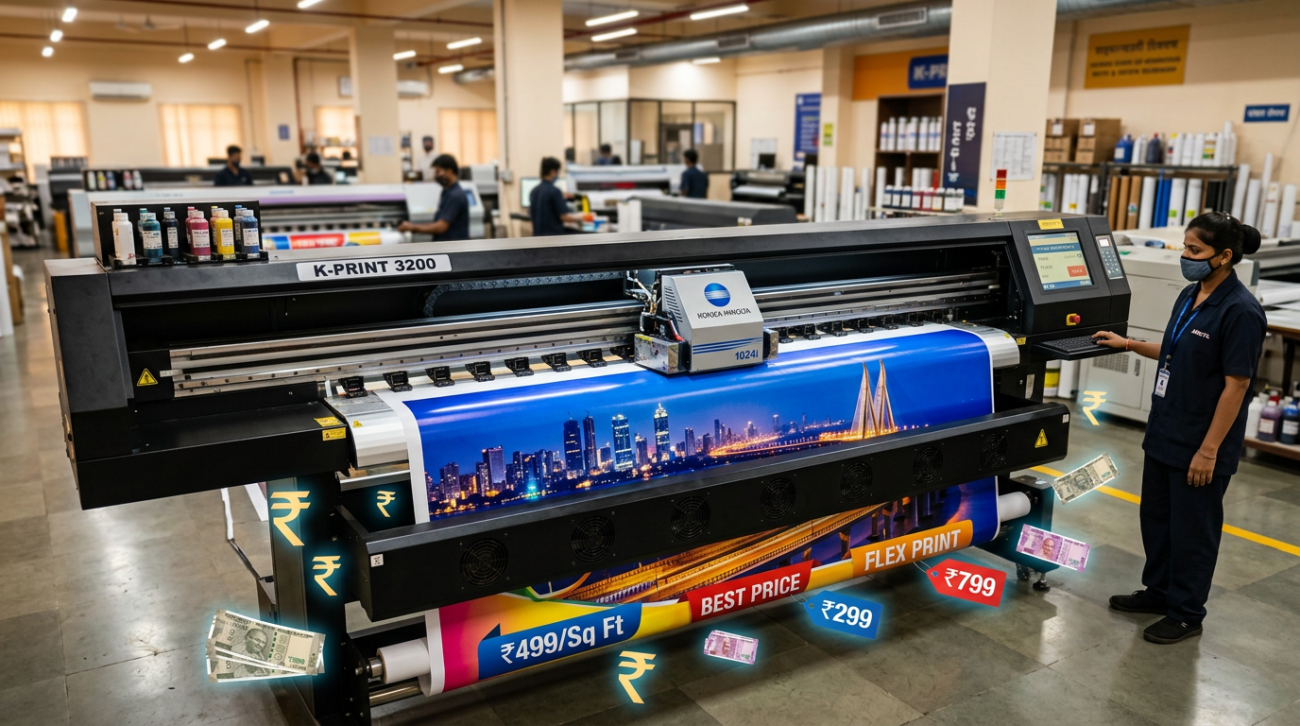


Quick Answer: The eco solvent printer price in India in 2026 starts at ₹1.65–2.75 lakh for a 1.6m single-head machine (Epson i3200), ₹2.75–4.5 lakh for a 1.8m dual-head machine, and ₹6–12 lakh for 3.2m wide-format models. Print head choice (i3200 vs XP600 vs old DX5) and dealer service network matter more than the brand sticker on the chassis. Running cost works out to ₹10–16 per sq ft including vinyl, ink, power, and head wear — against selling rates of ₹25–60 per sq ft. This guide breaks down current market prices by configuration, full specifications, total setup budgets, and realistic payback periods, so you can buy with numbers instead of dealer promises.
Eco solvent printers have quietly become the fastest-selling category of printing machines in India. Walk through any trade show — Media Expo, Sign India, PrintPack — and the busiest stalls are the ones running 1.6m and 1.8m machines with Epson i3200 heads, printing glossy vinyl for vehicle wraps, retail graphics, and personalised wallpaper. The reason is simple economics: this machine class offers the lowest credible entry point into professional large-format printing, while commanding selling rates two to three times higher than commodity flex banner work.
But the price question — “eco solvent printer kitne ka hai?” — has become harder to answer honestly. The same-looking machine is sold at ₹1.65 lakh by one importer and ₹2.6 lakh by another, with real differences hidden inside: print head model, rail quality, RIP software, and after-sales commitments. This guide gives you the actual 2026 market picture — every configuration, what each rupee buys, and the total cost of ownership over five years — so you can negotiate from knowledge.
What Is an Eco Solvent Printer? (60-Second Refresher)
An eco solvent printer is a large-format inkjet machine that prints with refined solvent inks — gentler than full solvent, sharper than water-based — through precision piezo heads, usually Epson’s DX5, XP600, or the current-generation i3200. The output is near-photographic: smooth gradients, accurate skin tones, crisp small text. Prints are water-resistant and, with lamination, survive years outdoors.
What makes this machine class the darling of Indian small businesses is media versatility: self-adhesive vinyl, PVC flex, backlit film, photo paper, canvas, wallpaper media, one-way vision film, window film, canvas, synthetic paper — one machine feeds ten product lines, from ₹30/sq ft stickers to ₹200/sq ft custom wallpaper. And because the ink produces low odour, these machines run happily in studios, shops, and office basements where solvent machines would never be tolerated.
Eco Solvent Printer Price in India 2026: The Full Price Table
| Configuration | Typical Setup | Price Range (2026) | Best For |
|---|---|---|---|
| Entry 1.6m Single-Head | 1× Epson XP600, 1.6m width | ₹1.35 – ₹1.85 lakh | Budget entry, hobby-to-business upgrades |
| Standard 1.6m Single-Head | 1× Epson i3200, 1.6m width | ₹1.65 – ₹2.75 lakh | ⭐ Most popular — studios & new businesses |
| Pro 1.8m Dual-Head | 2× Epson i3200, 1.8m width | ₹2.75 – ₹4.50 lakh | Growing shops needing daily production speed |
| Wide 3.2m Dual-Head | 2× Epson i3200, 3.2m width | ₹6.00 – ₹8.50 lakh | Wide vinyl, seamless murals, bus panels |
| Wide 3.2m Quad-Head | 4× Epson i3200, 3.2m width | ₹8.50 – ₹12.00 lakh | Premium print houses, production volume |
| Legacy DX5 Machines | 1–2× Epson DX5 (older stock/used) | ₹0.90 – ₹2.20 lakh | Risky budget route — see warnings below |
💡 Prices are indicative ex-showroom ranges for new machines, excluding 18% GST. Deals vary by RIP software bundle, ink starter kit, stand/cabinet accessories, warranty length, and — most importantly — the service obligation attached. Always compare written all-inclusive quotations, not headline numbers.
Configuration Deep-Dive: Specs That Matter
1.6m Single i3200 — The Sweet Spot (₹1.65–2.75 Lakh)
This configuration sells more units than all others combined in India, and for good reason — it’s the minimum setup that produces genuinely professional quality at genuinely sustainable economics.
| Specification | Details |
|---|---|
| Print Head | 1× Epson i3200-A1/E1 (3,200 nozzles, 3.5 pl min droplet) |
| Max Print Width | 1.6 m (63 inch) |
| Print Speed | Draft ~20 sq m/hr · Production 12–18 sq m/hr · Photo 5–8 sq m/hr |
| Resolution | Up to 2400 dpi (practical: 720×1440 for production) |
| Colours | CMYK (some models add Lc/Lm) |
| Media Handling | Roll-to-roll, auto take-up, media up to ~1 mm with liner |
| Drying System | Pre/platen/post triple heater + cooling fans |
| RIP Software | MainTop / PhotoPRINT / FlexiPrint (bundle varies) |
| Power | ~1.2–1.8 kW; normal 15A socket + 2 kVA UPS |
| Footprint | ~2.7m × 0.9m — fits small shop rooms |
Realistic output: 80–120 sq m per 8-hour day in production mode — enough for a healthy mix of 20–40 sticker/vinyl jobs daily. If your day regularly exceeds that, buy dual-head from day one.
1.8m Dual i3200 — The Production Upgrade (₹2.75–4.5 Lakh)
| Specification | Details |
|---|---|
| Print Heads | 2× Epson i3200, staggered dual carriage |
| Max Print Width | 1.8 m (72 inch) |
| Print Speed | Draft ~38 sq m/hr · Production 25–30 sq m/hr · Photo 10–14 sq m/hr |
| Daily Capacity | 200–240 sq m per 8-hour shift |
| Width Advantage | 1.8m fits standard 1.83m vehicle panels & wider wall segments |
| Price Premium Over Single | +₹1.1–1.75 lakh for ~2× throughput |
The extra width sounds minor (20 cm) but unlocks full vehicle side panels without vertical seams and drops wastage significantly on two-up vinyl layouts. For wrap-focused and showroom-focused businesses, this is the machine that stops you refusing Friday-evening rush jobs.
3.2m Dual & Quad i3200 — Wide-Format Premium (₹6–12 Lakh)
Wide eco solvent machines serve the top of the market: seamless 10-ft wall murals, full bus-side graphics, exhibition backdrops at print quality. Speed table for the two common builds:
| Mode | 3.2m Dual-Head | 3.2m Quad-Head |
|---|---|---|
| Production | 25–30 sq m/hr | 50–60 sq m/hr |
| Quality | 12–16 sq m/hr | 25–30 sq m/hr |
| Photo (8-pass) | 8–10 sq m/hr | 16–20 sq m/hr |
Buy wide-format eco solvent only when: your client book already includes interior designers, exhibition fabricators, or fleet graphics — and your ₹35–80/sq ft premium rates are proven. For general small-business entry, the 1.6/1.8m machines remain the correct, faster-payback choice.
The Print Head Question: i3200 vs XP600 vs DX5
Two machines at the same price can differ by ₹40,000 in real value purely through the head inside. The 2026 hierarchy:
| Head | Nozzles | Min Droplet | Head Price | Realistic Life | Verdict |
|---|---|---|---|---|---|
| Epson i3200-A1/E1 | 3,200 | 3.5 pl variable | ₹45,000–₹80,000 | 18–36 months | ✅ Buy this — the 2026 standard |
| Epson XP600 | 1,440 | 3.5 pl | ₹15,000–₹22,000 | 8–14 months | 🟡 Budget builds only; slower, shorter-lived |
| Epson DX5 (legacy) | 1,440 | 3.5 pl | ₹38,000–₹55,000 | 12–24 months | ❌ Avoid in 2026 — aging, scarcity-priced |
The math that matters: an i3200 machine at ₹2.3 lakh versus an XP600 machine at ₹1.6 lakh. The XP600 saves ₹70k today but needs head replacement within 8–14 months of real use (₹18k each time) and prints at roughly 40% lower throughput the whole time — costing far more in refused rush work than it saves. In 2026, the i3200 head is the correct answer for any serious business purchase; the XP600 exists for hobbyists and extreme-budget starters who accept its ceiling.
A Word on DX5 Machines in 2026
DX5-powered machines dominated 2015–2022, and dealers still hold chassis/new-old-stock built around them. The problem isn’t print quality — DX5 output is still beautiful — it’s that Epson ended support years ago, heads now come only from remaining OEM stock or “compatible” clones of variable quality, and prices have paradoxically risen with scarcity. If a dealer pushes a DX5 machine in 2026 with “the same quality, cheaper,” understand you are buying yesterday’s parts pipeline. Choose i3200.
What Actually Drives the Price? (7 Factors Beyond the Headline Number)
1. Print Head Model & Count
As shown above — the single biggest variable. 40-50% of machine value sits in the heads.
2. Chassis, Rails & Motion System
A rigid aluminium-extrusion frame with genuine THK/Hiwin linear rails and a servo-driven carriage adds ₹30,000–₹60,000 over budget builds with thin rails and stepper motors — and is the difference between printing straight at metre 50 of a roll in year three, or not.
3. Heater & Drying System Quality
Proper three-zone heaters with even temperature distribution decide ink curing quality and scratch resistance. Budget machines with weak single-fan drying produce prints that smudge under lamination squeeze — check by rubbing a fresh print at the demo.
4. Take-Up System
Motorised take-up with tension control (vs passive rollers) is essential for unattended long runs and any stretch-prone media. Confirm it’s included, not a ₹15k “optional.”
5. RIP Software Bundle
Genuine MainTop/PhotoPRINT/FlexiPrint licenses range ₹20,000–₹80,000. Some headline-cheap machines ship with cracked software or demo modes — an unstable, illegal foundation for a business. Ask for the license card.
6. Ink System Design
Continuous bulk-ink systems with proper negative-pressure regulation and quality dampers protect the ₹50k–80k head. Dodgy tank systems cause pressure spikes and airlocks that quietly kill heads in months.
7. Warranty & Service Network
Twelve months on-site warranty from a dealer with an engineer in your state is worth ₹30,000–₹50,000 of the premium versus a “price-only” seller. A machine down for ten days costs more than the discount ever saved.
Running Costs: The Square-Foot Arithmetic
Machine price is a one-time event; running cost is daily reality. Field-realistic numbers for a dual-i3200 setup in 2026:
| Cost Head | Cost per sq ft | Notes |
|---|---|---|
| Vinyl media (standard SAV) | ₹6.0 – ₹9.0 | 3M/Avery imports higher; quality China opaque standard |
| Eco solvent ink | ₹2.5 – ₹4.5 | At ₹800–1,200/litre, ~8–10 ml/sq m coverage-adjusted |
| Electricity | ₹0.5 – ₹0.9 | Heaters dominate consumption |
| Head depreciation | ₹0.8 – ₹1.4 | i3200 at 24-month life, 1 head per 60k sq ft |
| Cleaning/wastage (6–8%) | ₹0.7 – ₹1.2 | Margin-turns, test strips, trim waste |
| Lamination (when applied) | +₹4.0 – ₹8.0 | Gloss/matte/matt-floor films; vehicle wraps always |
| Total Unlaminated | ₹10.5 – ₹17.0 | vs selling rate ₹25–60 |
The takeaway: eco solvent gross margins of 50–70% are real and sustainable — provided you stay out of the ₹12–15/sq ft commodity-banner trench where solvent machines rule.
Total Setup Budget (Not Just the Machine)
| Item | Budget (₹) |
|---|---|
| 1.6m Single-Head i3200 Machine | 1,65,000 – 2,75,000 |
| 64″ Hot/Cold Laminator (essential) | 45,000 – 70,000 |
| Computer/Design PC + Monitor | 35,000 – 60,000 |
| 2 kVA Online UPS + Stabilizer | 18,000 – 30,000 |
| Vinyl Cutting Plotter (2ft, basic) | 15,000 – 25,000 |
| Startup Inventory (vinyl rolls, ink set, laminate, blades) | 40,000 – 65,000 |
| Room Setup, Electricals, Furniture | 40,000 – 80,000 |
| Working Capital (2 months buffer) | 60,000 – 1,00,000 |
| Total All-In | ₹4.2 – ₹6.8 lakh |
The laminator deserves emphasis: beginners often skip it to save ₹50k, then discover that outdoor vinyl, vehicle wraps, and floor graphics — the highest-margin products — all require lamination, and outsourced lamination destroys both margin and turnaround control. Budget it from day one.
ROI: What the Payback Really Looks Like
| Scenario | Daily Output | Avg Rate | Monthly Net Profit | Payback on ₹5L |
|---|---|---|---|---|
| Slow start | 25 sq m | ₹30/sq ft | ₹25,000 – ₹40,000 | 13–18 months |
| Established single-head | 60 sq m | ₹35/sq ft | ₹70,000 – ₹1,10,000 | 5–8 months |
| Busy dual-head shop | 120 sq m | ₹35/sq ft | ₹1,50,000 – ₹2,20,000 | 3–4 months |
Assumptions: 26 working days, ~₹13/sq ft full production cost, ₹35k/month fixed costs on the small setup. The variables that move these outcomes most: your local rate realisation (metro design clients pay ₹45-60; small towns pay ₹25-30) and whether you bundle design + installation services (which add 30-40% to ticket size on the same print).
New vs Refurbished vs Local Assembly
| Route | Price (1.6m class) | Risk Reality |
|---|---|---|
| New from established importer | ₹1.65 – ₹2.75 lakh | Warranty 12 months, sealed i3200, training included — the default correct choice |
| Local assembler build | ₹1.40 – ₹2.00 lakh | Can be excellent with genuine parts — verify frame quality, ask for 5 local references |
| Refurbished/second-hand | ₹0.80 – ₹1.50 lakh | Highest failure variance; age hits heads, pumps, and encoders together; only with live 30-min print test + new-head budget |
Buyer’s Checklist: 10 Verifications Before You Pay
- ✅ Head model confirmed in writing: i3200, sealed OEM packing, shown before installation
- ✅ Live demo on YOUR target media (vinyl + backlit + wallpaper roll you intend to stock)
- ✅ Timed production print run — measure the real sq m/hr, don’t accept brochure numbers
- ✅ Fresh-print rub test: cured output should resist thumbnail scratching without smearing
- ✅ Written inclusive quote: machine + RIP + take-up + UPS + install + training + GST
- ✅ RIP license card/box with your name registration
- ✅ Warranty document listing coverage AND exclusions (heads are usually excluded — negotiate included months if possible)
- ✅ Service engineer’s city + committed response time + 3 installed-customer references within 100 km (call them)
- ✅ Ink brand/quality bundled — and its per-litre price going forward
- ✅ 2 days operator training included; technician reachable by video call for the first month
5 Expensive Mistakes New Eco Solvent Buyers Make
1. Buying XP600 to save ₹70k. The false economy detailed above — head replacements plus throughput loss outrun the saving within a year of real work.
2. Skipping the laminator. Half the profitable eco-solvent product catalogue requires lamination. Machine without laminator is a half-finished business.
3. Ignoring the room environment. Dust and temperature swings kill i3200 heads faster than any manufacturing defect. Budget the AC and basic dust discipline — they’re cheaper than the head.
4. Choosing on headline price alone. A ₹20k cheaper machine from a dealer 400 km away costs lakhs in downtime over five years. Service distance is a price term, not a footnote.
5. No anchor clients before installation. Line up 3–5 committed buyers (photo studios, signboard shops, gifting stores, car detailers, interior designers) before the trolley arrives. Machines with order books pay back in seasons; machines without them, in years.
One Machine, Fifteen Revenue Streams
The real price-to-profit story of an eco solvent printer is its product breadth. A single 1.6m i3200 machine produces all of this:
| Product | Typical Rate | Margin Quality |
|---|---|---|
| Vinyl stickers & decals | ₹25–45/sq ft | Bread-and-butter volume |
| Shop board vinyl (laminated) | ₹35–50/sq ft | High; repeat business |
| Vehicle wraps/graphics | ₹40–80/sq ft + install | Premium; skill-priced |
| One-way vision (glass branding) | ₹45–90/sq ft | Premium retail demand |
| Backlit film for glow signs | ₹40–70/sq ft | Steady institutional work |
| Custom wallpaper rolls | ₹80–200/sq ft | Luxury interior segment |
| Canvas art prints | ₹60–150/sq ft | Photo/decor margin king |
| Photo poster printing | ₹30–60/sq ft | Studio tie-ups |
| Window/frosted decals | ₹40–70/sq ft | Office & salon demand |
| Floor graphics (laminated) | ₹70–120/sq ft | Event/retail premium |
| Reflective signage vinyl | ₹80–150/sq ft | Safety/commercial niche |
| Banner-grade eco prints | ₹18–30/sq ft | Fill-in volume only |
| Exhibition/roll-up standee prints | ₹900–2,500/piece | Event-season gold |
| Magnetic car signs | ₹400–900/pair | Cab/fleet steady orders |
| Laptop/phone skins | ₹300–600/piece | D2C impulse products |
The strategic lesson: price the machine against a portfolio of products, not a single rate. Shops printing only stickers complain the machine is expensive; shops layering wraps + wallpaper + backlit + canvas discover it pays for itself between festivals.
Financing & Payment Routes for Your Machine
Eco solvent machines sit in the sweet spot of Indian small-equipment finance — almost every route covers them:
- NBFC equipment finance (Tata Capital, Bajaj, Cholamandalam etc.): 20–30% down payment, 12–36 months, 11–16% effective rates. Most machine dealers have same-week tie-up approvals.
- MUDRA loans (PMMY): collateral-free up to ₹10 lakh (₹20 lakh under expanded categories) — the classic route for first-machine buyers, disbursed through banks in 2–6 weeks.
- PMEGP subsidy: new manufacturing/service units can claim 15–35% capital subsidy on project cost — a genuine ₹60k–1.5 lakh reduction that surprising numbers of machine buyers never file.
- Dealer instalment schemes: importers increasingly offer 30–40% advance + 6–12 monthly instalments with simpler paperwork than banks.
Rule that protects you: size the EMI against your conservative-month profit (not festive-month), keeping EMI below one-third of it. A ₹5–6 lakh setup financed calmly out-earns a rushed ₹8 lakh setup drowning in instalments every single time.
The Demo Day Protocol: How to Test a Machine in 90 Minutes
Machine demos are theater unless you run the script. Here’s the sequence professional buyers follow:
- Bring your own file: a 1×1 m test containing photo skin tones, 6pt white-on-black reversed text, solid CMYK bars, and a smooth blue-to-black gradient. Machines hide weaknesses on dealer demo files; yours exposes them.
- Time a 10 sq ft production run with a stopwatch from rip-start to print-finish. Compare against brochure claims; write the number on the quotation.
- Do the rub test: fresh print, firm thumbnail scrape. Cured eco solvent inks should resist without smearing; failure here reveals weak heater engineering.
- Watch a full media load — loading burden decides your operator’s daily pain level. Wobbly loading systems waste metres at every roll change.
- Print the nozzle check yourself (ask for the panel controls). Crisp full patterns show head health; hesitation shows maintenance habits.
- Demand RIP proof: boot the software, check the genuine license, verify color profiles exist for YOUR target media types.
- Photograph the serial plate of the machine and heads — records for warranty, insurance, and resale.
A dealer who welcomes this protocol is a dealer with nothing to hide. A dealer who deflects it has just answered your real question.
State-Wise Price Reality: Why the Same Machine Costs More in Some Cities
The sticker price on a dealer’s quotation is only the beginning. Where you buy — and where the machine will run — changes the real, landed number by ₹30,000 to ₹90,000 on a mid-range build. The drivers are freight, dealer stocking, state-level installation norms, and how far the nearest service engineer lives from your shop.
| Region | Typical Landed Premium vs NCR Base | Why | Service Reality |
|---|---|---|---|
| Delhi NCR / Haryana / West UP | Base price | Most importers and assemblers are here; zero freight | Same-day to next-day engineer visits |
| Maharashtra (Mumbai, Pune) | +₹20,000–40,000 | Freight + local dealer margins; strong demand | Good in Mumbai/Pune, thin elsewhere |
| Karnataka / Tamil Nadu (Bengaluru, Chennai) | +₹25,000–45,000 | Freight from NCR or Mundra port; local distributors | Good in metros, 2–3 day wait in tier-2 |
| Gujarat (Ahmedabad, Surat) | +₹15,000–30,000 | Surat is itself a print hub — competitive local supply | Strong; Surat has deep spares market |
| Telangana / AP (Hyderabad, Vijayawada) | +₹25,000–40,000 | Freight; Hyderabad has decent dealer network | Good in Hyderabad only |
| East & North-East (Kolkata, Patna, Guwahati) | +₹35,000–60,000 | Long freight, fewer stocking dealers | Kolkata workable; further east, plan for remote support |
| Rajasthan / MP (Jaipur, Indore) | +₹20,000–35,000 | Moderate freight; growing dealer base | Next-day in Jaipur/Indore, slower beyond |
The practical move: get quotes from at least one NCR supplier and your nearest regional dealer. A slightly higher headline price from a dealer 60 km away routinely beats a cheaper machine 2,000 km away the first time a printhead behaves oddly on a Sunday before a Monday delivery.
How to Read a Dealer Quotation (Line by Line)
Dealer quotes for eco solvent machines are famously inconsistent — some bundle everything, others strip the price down to win the comparison and bill the rest later. Before you compare two quotes, normalize them against this checklist:
| Line Item | Included or Extra? | Fair Market Value if Billed Separately |
|---|---|---|
| Machine with sealed head(s) | Always included | — |
| RIP software (Maintop/PhotoPrint/Onyx) | Often “free” = cracked or dongle-less trial | ₹15,000–60,000 licensed |
| Freight to your city | Variable | ₹8,000–25,000 |
| Installation & training (2–3 days) | Variable | ₹10,000–20,000 equivalent |
| Starter ink set (4 × 1L CMYK) | Variable | ₹8,000–16,000 |
| Take-up roller / feeding kit | Usually included, confirm | ₹6,000–12,000 |
| Spares starter kit (dampers, cappings, wipers) | Rarely included — ask | ₹5,000–10,000 |
| Onsite warranty (6–12 months) | Get it in writing with response-time clause | Priceless when needed |
| GST invoice (18%) | Insist — no bill, no warranty, no input credit | — |
A “₹1.65 lakh” machine with no RIP license, no ink, no installation, and no GST bill is really a ₹2.1 lakh machine — and an unsupported one. Always ask for the total, running-at-my-shop figure on a GST invoice.
The Second-Hand Market: What Used Eco Solvent Printers Actually Sell For
India’s used large-format market is active — OLX, IndiaMART, dealer trade-ins, and print-shop closures feed it constantly. Used machines can be smart entry points, but pricing is opaque. Fair 2026 benchmarks, assuming a working machine with printable test proof:
| Machine Type & Age | Fair Used Price Band | What to Check Closely |
|---|---|---|
| 1.6m single XP600, 1–2 years | ₹70,000–1.1 lakh | Nozzle test, capping station wear, RIP dongle included? |
| 1.6m single i3200, 1–2 years | ₹1.1–1.6 lakh | Head hours if logged, rail linear wear, mainboard revision |
| 1.8m dual i3200, 2–3 years | ₹1.7–2.6 lakh | Both heads’ nozzle tests, take-up motor, heater zones |
| 3.2m eco solvent, 3–5 years | ₹2.2–4 lakh | Frame alignment, media path, previous ink brand (sludge risk) |
| Any DX5 machine | ₹40,000–90,000 | Assume head is near end-of-life; price replacement into offer |
Three non-negotiables when buying used: (1) print a full-width nozzle test and a 1-metre solid magenta block in front of you — banding and deflections don’t lie; (2) confirm the RIP dongle transfers with the machine, or budget for new software; (3) get the seller’s ink purchase history — a machine fed cheap, unfiltered bulk ink for years carries sediment in lines and dampers that no flush fully cures.
A fair rule: a used machine is worth it only if total cost (price + two fresh heads + service visit + transport) lands at least 35–40% below the equivalent new machine. Below that margin, new-with-warranty wins on risk alone.
Negotiation Playbook: 7 Questions That Shrink the Quote
Dealers expect negotiation — walk in with these and you’ll typically save ₹15,000–50,000 or its equivalent in extras:
- “What is the best price with everything on one GST bill?” — forces the bundled, all-inclusive number first.
- “Which RIP and is the dongle licensed in my name?” — flushes out cracked software before you’re dependent on it.
- “If I pay 100% advance, what’s the discount?” — but pay by traceable means against a proforma invoice, never cash without bill.
- “Throw in the spares kit and first full ink set.” — accessories carry the fattest margins; easiest concession for the dealer.
- “Who is my service engineer, what’s his number, and what response time will you write on the invoice?” — written response time is worth more than a ₹5,000 discount.
- “What did this exact model sell for to a shop in my city?” — dealers respect buyers who’ve done homework; ask for a reference customer and actually call them.
- “I’ll decide this week — I’m comparing two other quotes.” — true or not, it moves you from ‘browsing’ to ‘closing’ pricing.
One warning: never let negotiation push you toward a worse machine. A ₹20,000 discount on a no-name build with unproven boards is expensive savings. Negotiate on the right machine, not against the wrong one.
Frequently Asked Questions (FAQs)
Q1. What is the minimum eco solvent printer price in India?
New machines start around ₹1.35 lakh for 1.6m XP600-head builds and ₹1.65 lakh for single i3200-head builds. Below ₹1 lakh, only used/refurbished machines exist — with corresponding risk. The credible, business-grade entry point in 2026 is the ₹1.65–2.75 lakh single-i3200 segment.
Q2. Is a 1.6m or 1.8m eco solvent printer better?
For general sticker/vinyl/banner work, 1.6m suffices and saves money. Choose 1.8m if vehicle wraps, bus-van panels, or wider wall graphics are your target market — the extra 20cm eliminates seams on standard vehicle panels and improves nesting efficiency.
Q3. How much electricity does an eco solvent printer use?
Typically 1.2–2.0 kW during printing (heaters dominate) — roughly ₹8–15 per hour of production at commercial tariffs, or ₹0.5–0.9 per sq ft. A 2 kVA online UPS is recommended for power-cut protection.
Q4. What ink do eco solvent printers use and what does it cost?
Eco solvent ink formulated for Epson piezo heads — ₹800–1,200/litre for quality compatible brands, up to ₹1,800 for premium OEM-grade. One litre covers roughly 100–130 sq m at production coverage, giving ₹2.5–4.5 ink cost per sq ft.
Q5. Can eco solvent printers print on normal cotton fabric?
Not directly — eco solvent inks require coated/non-absorbent media. For cotton apparel you need DTF or DTG technology. Eco solvent handles banner fabric, polyester canvas, and coated textile media excellently, just not direct-to-cotton printing.
Q6. How long do eco solvent prints last outdoors?
Unlaminated: 6–12 months in Indian sun before visible fading. Laminated with UV-protective film: 2–3 years, and up to 5 on quality cast vinyl for vehicle applications. For permanent outdoor signage, lamination is assumed, not optional.
Q7. i3200 or XP600 — which head should I choose?
i3200 for any business use: roughly double the throughput, 2-3× the head life, finer nozzles. XP600 only for strict-budget, low-volume, or hobby production where ₹70k upfront saving outweighs ₹18k-per-head replacements every year or so.
Q8. How much can I earn monthly with one eco solvent printer?
Established single-machine shops typically net ₹50,000–₹1.5 lakh/month depending on volume and rate realisation. Premium niches (vehicle wraps, wallpaper, corporate gifting) exceed this; commodity sticker pricing in crowded markets falls below.
Q9. Do I need GST registration to run this business?
You can start below the threshold without it, but B2B clients — your most profitable customers — require GST invoices for input tax credit. Register from day one; it costs nothing and unlocks the corporate market.
Q10. Where should I buy — importer, dealer, or online marketplace?
Importer or authorised dealer with local service presence — never anonymous online listings for capital machinery. Verify GST invoices, written warranty, installation included, and engineer availability in your state before any advance payment.
Final Verdict: Which Eco Solvent Printer Should You Buy in 2026?
For most Indian small businesses and new print entrepreneurs, the answer is crystalline: a 1.6m single-head i3200 machine at ₹1.65–2.75 lakh, paired with a 64-inch laminator, from a dealer with provable local service. It is the lowest capital cost per rupee of realistic monthly profit in the entire large-format industry right now.
Upgrade directly to the 1.8m dual-head build (₹2.75–4.5 lakh) if vehicle wrapping or showroom graphics anchor your business plan, or if confirmed daily volume will exceed 100 sq m within your first quarter.
Keep wide-format 3.2m eco solvent for phase two — bought from cash flow, not hope. And walk away from DX5 machines and too-cheap unbranded builds whatever the pitch: in 2026, the i3200 pipeline is where reliability lives.
Ready to see real machines and real prices? Browse our eco solvent printer range — every machine ships with sealed i3200 heads, licensed RIP software, installation, operator training, and pan-India spare-parts support. Tell us your city and target market for a machine recommendation with an honest payback calculation.