
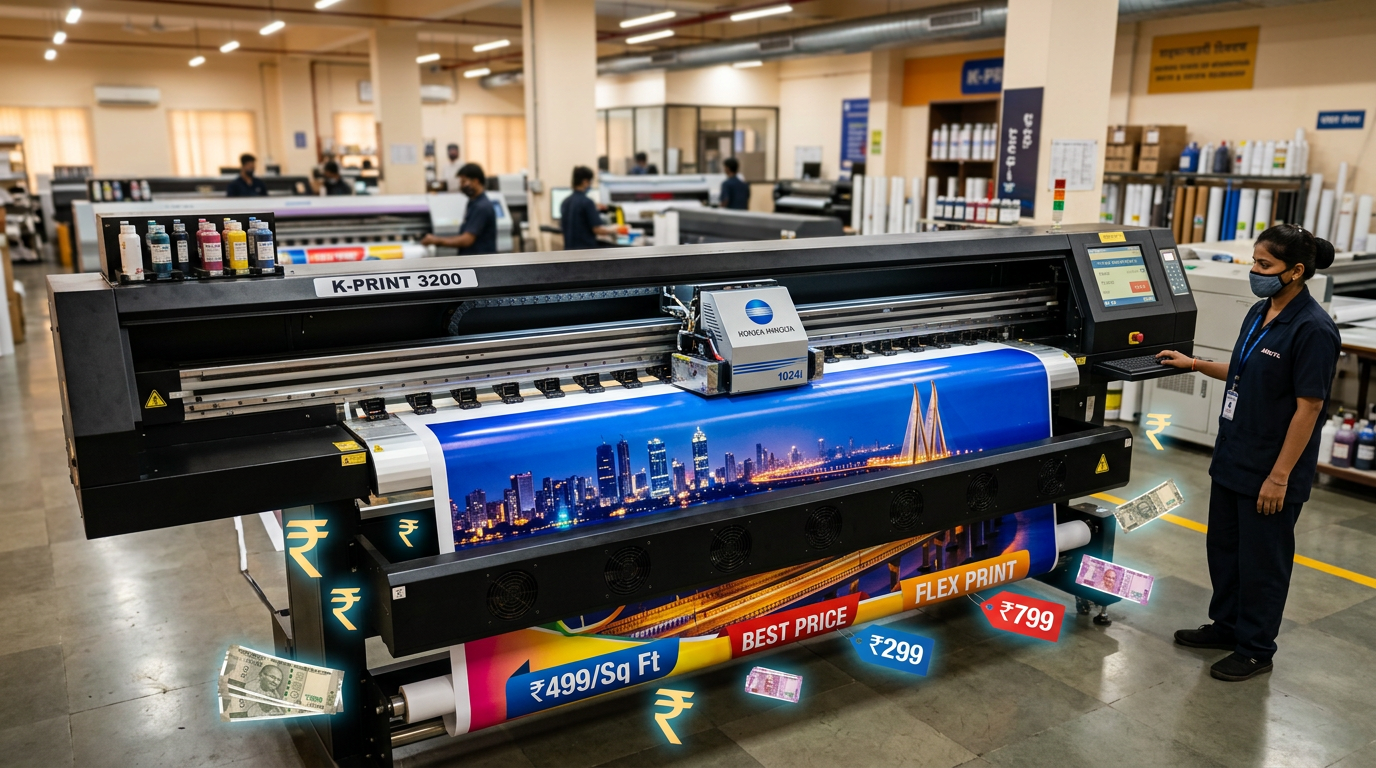
Quick Answer: The flex printing machine price in India in 2026 typically ranges from ₹1.80 lakh to ₹6.5 lakh for entry-level machines, ₹6.5 lakh to ₹15 lakh for mid-range production machines, and ₹15 lakh to ₹30 lakh+ for high-end industrial and UV machines. The exact price depends on the print head technology (Konica Minolta 512i vs 1024i vs Epson i3200), machine width (1.6m, 1.8m, or 3.2m), number of heads, and after-sales support. In this complete buyer’s guide, we break down current market prices, specifications, running costs per square foot, and the ROI you can realistically expect — so you invest in the right machine the first time.
If you are planning to start a flex printing business or upgrade your existing printing setup, the first question on your mind is almost certainly: “What is the flex printing machine price in India?” It is a fair question, because this single decision will decide your print quality, production speed, profit margins, and how fast you recover your investment.
The Indian large-format printing market has changed dramatically over the last five years. Chinese-built machines with Japanese print heads have pushed prices down while print quality has gone up. At the same time, the market is flooded with dozens of models, dealer markups, refurbished machines sold as new, and confusing claims about speed and head life. Buyers who don’t do their homework either overpay by ₹1–2 lakh or, worse, buy a machine that cannot handle their workload.
This guide gives you the actual 2026 price ranges, machine-by-machine comparisons, specification tables, cost-per-square-foot calculations, and a realistic ROI model — everything you need before spending a single rupee.
What Is a Flex Printing Machine? (And Who Should Buy One)
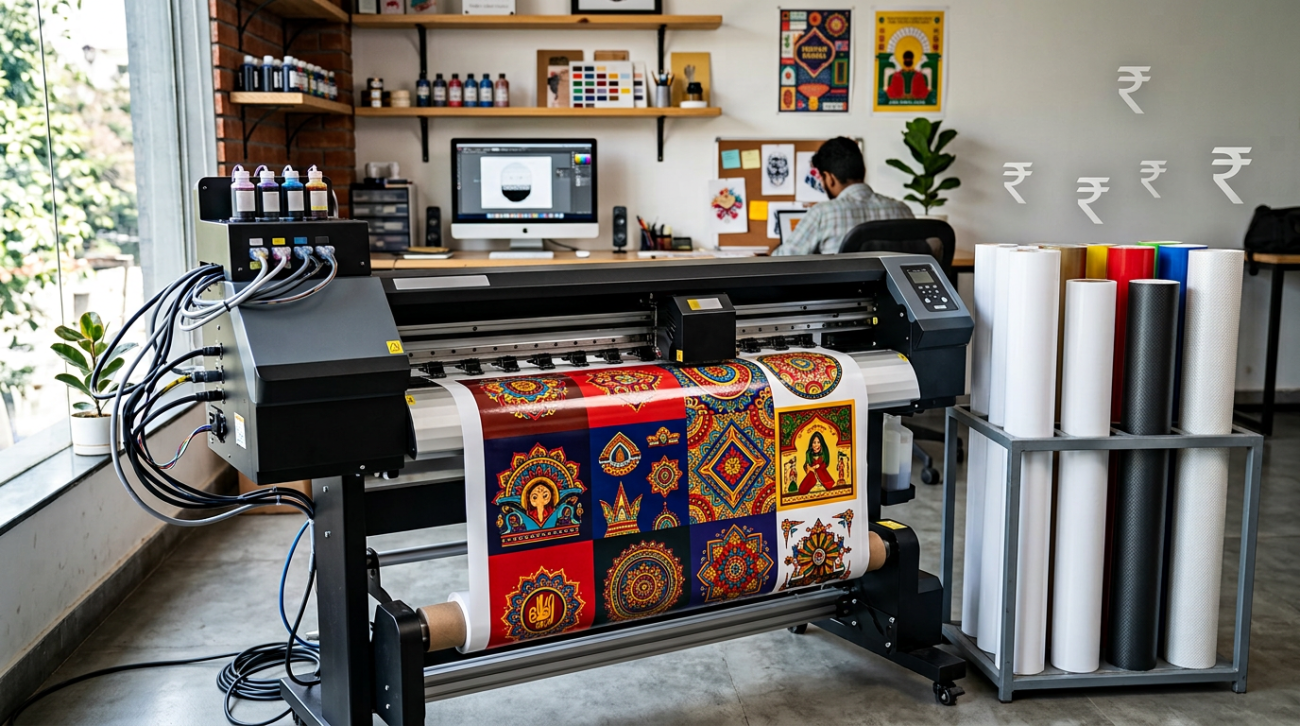
A flex printing machine is a large-format printer designed to print on flexible media — most commonly PVC flex banner material (also called “star flex” or “backlit flex”), but also vinyl, one-way vision film, canvas, polyester fabric, and mesh banners. The name comes from the flexible PVC substrate used for hoardings existing across every Indian street.
Unlike a small photo printer or office printer, a flex printing machine is built for outdoor durability. Prints must survive Indian summers, monsoon humidity, dust, and direct sunlight for months or years. That is why the ink chemistry (solvent, eco-solvent, or UV-curable) and print head technology matter so much.
A flex printing machine makes sense as an investment if you are:
- Starting a new signage/printing business in a city or town with demand for banners, hoardings, and shop boards
- An offset/screen printer who wants to add digital banner printing without outsourcing
- An advertising agency tired of paying vendor margins on every print job
- A photo studio or digital lab expanding into photo-quality vinyl and canvas printing
- An existing print shop replacing an old, slow, or high-maintenance machine
Rule of thumb: If you are currently outsourcing more than ₹80,000–₹1 lakh of printing work per month, buying your own machine usually pays for itself within 12–18 months.
Flex Printing Machine Price in India 2026: Quick Price Table
Here is the current market snapshot. Prices below are ex-showroom indicative ranges for new machines with standard warranty, excluding GST (18%). Actual dealer prices vary by city, negotiation, head brand, and included accessories (RIP software, UPS, heater system, take-up system).
| Machine Segment | Typical Configuration | Price Range (2026) | Best For |
|---|---|---|---|
| Entry Eco-Solvent (1.6m) | 1× Epson i3200/DX5 head, 1.6m width | ₹1.80 – ₹2.75 lakh | Small shops, photo studios, indoor prints |
| Dual-Head Eco-Solvent (1.6/1.8m) | 2× Epson i3200 heads | ₹2.75 – ₹4.25 lakh | Growing shops needing speed + quality |
| Entry Solvent (3.2m) | 4× Konica Minolta 512i heads | ₹4.00 – ₹6.50 lakh | New flex printing businesses |
| Production Solvent (3.2m) | 8× Konica Minolta 512i heads | ₹6.50 – ₹9.00 lakh | High-volume banner units |
| High-Speed Solvent (3.2m) | 4–8× KM 1024i heads | ₹8.00 – ₹15.00 lakh | Wholesale/24×7 production hubs |
| Eco-Solvent Wide (3.2m) | 2–4× i3200 heads, 3.2m width | ₹6.00 – ₹10.00 lakh | Premium vinyl, vehicle wraps, backlit |
| UV Roll-to-Roll (3.2m) | 3–6× Ricoh Gen5/Gen6 heads | ₹14.00 – ₹28.00 lakh | Premium instant-dry specialty printing |
| UV Flatbed Hybrid | Rigid + roll printing, Ricoh heads | ₹16.00 – ₹30.00 lakh | Acrylic, ACP, wood, glass, gifts |
💡 Prices are indicative market ranges for 2026 and vary by dealer, head brand, RIP software bundle, and warranty terms. Always confirm whether the quote includes installation, training, spare parts kit, and GST before comparing two dealers.
Types of Flex Printing Machines (With Prices & Specifications)
The “flex printing machine” label covers three distinct technology families. Choosing the wrong family for your market is the most expensive mistake new buyers make, so let’s look at each in detail.
1. Solvent Flex Printing Machines (The Outdoor Workhorse)
Solvent machines use aggressive solvent-based ink that chemically bonds with PVC flex. The result is extremely durable, waterproof, scratch-resistant printing that survives years outdoors without lamination. This is why 90% of the hoardings and banners you see on Indian roads are printed on solvent machines.
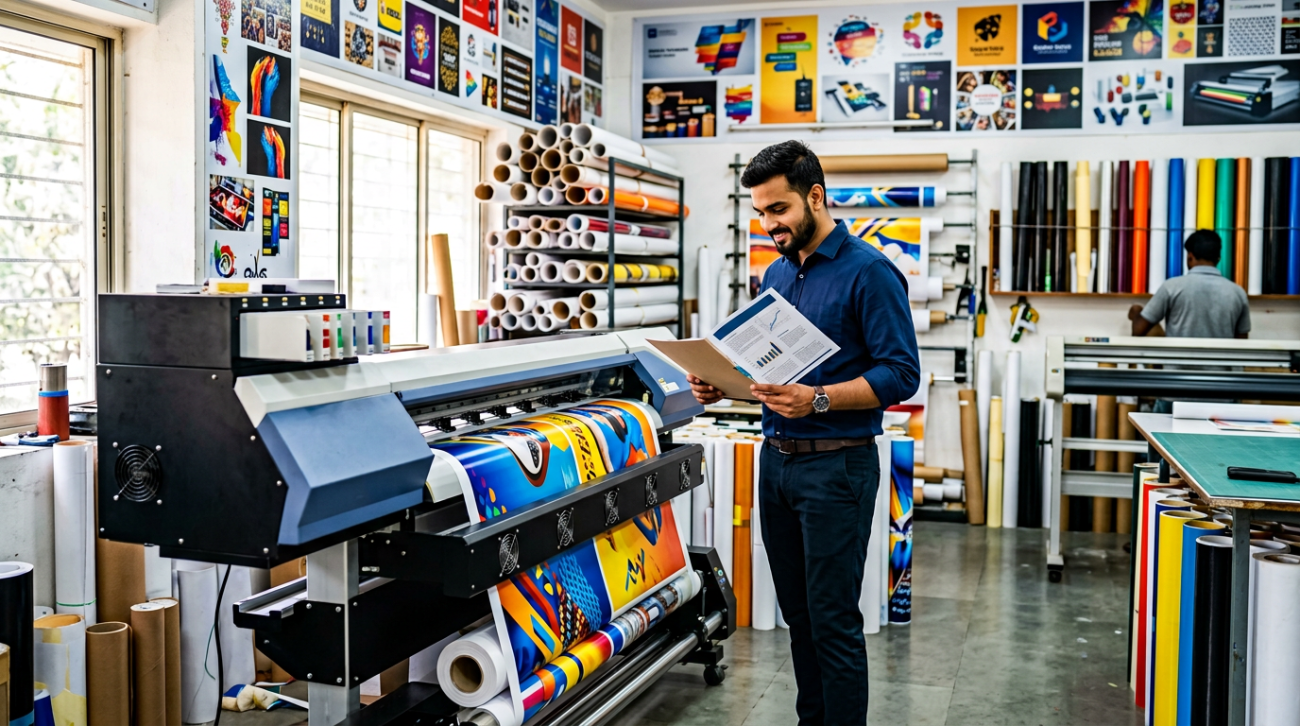
The industry-standard configuration is a 3.2-metre machine with Konica Minolta 512i print heads. Konica heads are favoured because they handle solvent ink reliably, are fast, and replacement heads (₹30,000–₹45,000 each) are widely available across India.
Typical Specifications — 3.2m Solvent Machine (4× KM 512i)
| Specification | Details |
|---|---|
| Print Width | 3.2 metres (10.5 feet) |
| Print Heads | 4× Konica Minolta 512i (42 pl or 30 pl) |
| Print Speed | 4-pass: ~65–75 sq m/hr; 6-pass: ~45 sq m/hr; 8-pass: ~30 sq m/hr |
| Resolution | Up to 720 × 1440 dpi |
| Media | Frontlit/backlit flex, vinyl, one-way vision, mesh, canvas |
| Ink Type | Solvent ink (CMYK), 5L barrel supply |
| RIP Software | PhotoPRINT / MainTop / UltraPrint (bundled) |
| Power Consumption | ~1.2 – 2.0 kW (machine) + heater ~2.5 kW |
| Price (2026) | ₹4.00 – ₹6.50 lakh |
Pros: Lowest cost per square foot (₹6–₹9), fastest outdoor production, media costs are low, machines tolerate tough working environments.
Cons: Visible grain in close-viewing prints, strong ink smell requires ventilation, heads need disciplined daily cleaning, quality not suitable for premium indoor graphics.
2. Eco-Solvent Flex Printing Machines (The Quality Choice)
Eco-solvent machines use milder solvent ink with smaller ink droplets (as small as 3.5 pl), producing near-photo quality output with no strong smell. If your customers include showrooms, malls, photographers, event companies, car wrap installers, or interior decorators, eco-solvent is your technology.
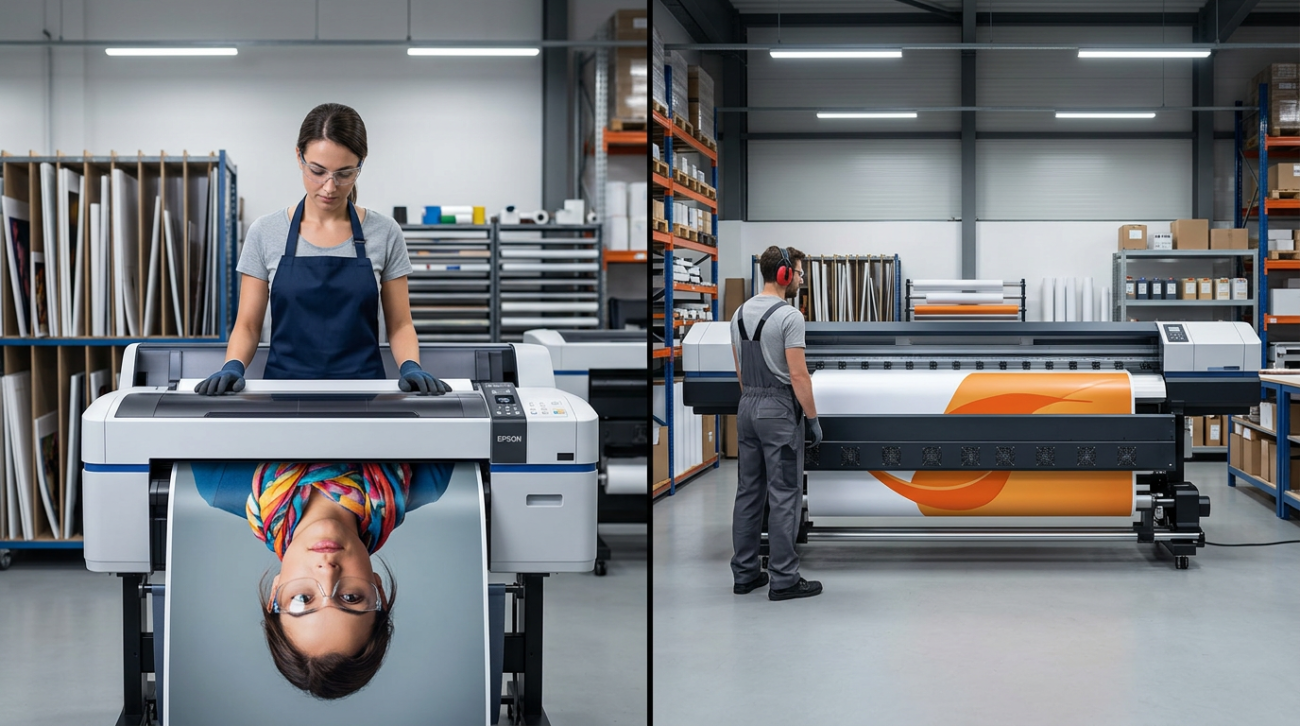
The dominant setup today is a 1.6m or 1.8m machine with one or two Epson i3200 print heads — the successor to the older DX5 heads, offering roughly double the life and noticeably better speed at a similar price.
Typical Specifications — 1.8m Eco-Solvent Machine (2× Epson i3200)
| Specification | Details |
|---|---|
| Print Width | 1.8 metres (6 feet) — also available 1.6m / 3.2m |
| Print Heads | 2× Epson i3200-A1/E1 |
| Print Speed | 4-pass: ~25–30 sq m/hr; 6-pass: ~18 sq m/hr; 8-pass: ~12 sq m/hr |
| Resolution | Up to 1440 × 1440 dpi (photo quality) |
| Media | Vinyl, PP, photo paper, backlit film, canvas, wallpaper, vehicle wrap |
| Ink Type | Eco-solvent ink (CMYK, optional Lc/Lm), 1L bottles |
| Drying System | Triple heater (pre/platen/post) + fan + IR (optional) |
| Price (2026) | ₹2.75 – ₹4.25 lakh |
Pros: Excellent photo-realistic quality, low odour (can run in commercial spaces), versatile media support, lower head replacement anxiety with i3200 heads.
Cons: Higher cost per sq ft (₹10–₹16), slower than multi-head solvent machines, prints need lamination for long outdoor life, PVC flex cartridge compatibility varies.
3. UV Roll-to-Roll Machines (The Premium Segment)
UV machines cure ink instantly with UV-LED lamps. You can print on almost anything — including non-absorbent media like glass film, transparent sheets, leather, and specialty fabrics — with instant drying and no pre-heating. UV printing commands the highest rates per square foot in the market.
The 2026 price for a 3.2m UV roll-to-roll machine with 3–6 Ricoh Gen5/Gen6 heads sits at ₹14–28 lakh. This is not a beginner machine; it suits established print houses adding high-margin premium services like retail graphics, wallpaper, vehicle interiors, and backlit metro displays.
Head-to-Head Comparison: Which Technology Wins?
| Parameter | Solvent (3.2m) | Eco-Solvent (1.6/1.8m) | UV Roll-to-Roll (3.2m) |
|---|---|---|---|
| Machine Price | ₹4–9 lakh | ₹1.8–4.25 lakh | ₹14–28 lakh |
| Print Quality | ★★★ (outdoor standard) | ★★★★★ (photo quality) | ★★★★★ (premium + texture) |
| Production Speed | Up to 150+ sq m/hr (8 heads) | 12–30 sq m/hr | 20–60 sq m/hr |
| Ink Cost / sq ft | ₹1.2 – ₹2.0 | ₹2.5 – ₹4.5 | ₹3.5 – ₹6.0 |
| Total Production Cost / sq ft | ₹6 – ₹9 | ₹10 – ₹16 | ₹15 – ₹25 |
| Typical Selling Rate / sq ft | ₹12 – ₹20 | ₹25 – ₹60 | ₹50 – ₹120 |
| Outdoor Durability | 2–3 years unlaminated | 6–12 months (laminate for more) | 3–5 years |
| Ventilation Needed | Yes, mandatory | Minimal | Minimal |
| Best Market | Hoardings, banners, volume jobs | Indoor branding, wraps, photo | Premium retail, décor, specialty |
Bottom line: For a classic banner/hoarding business in a Tier-2 or Tier-3 city, the 3.2m solvent machine remains king — cheapest cost per sq ft and fastest payback. For urban studios serving brands and photographers, eco-solvent wins on quality and versatility. UV is the profit-maximising add-on once you have stable customer flow.
Print Head Deep-Dive: The Real Price Driver
Two machines that look identical from outside can differ by ₹3–5 lakh purely because of the print heads inside. Understanding heads protects you from overpaying — and from buying a speed you don’t need.
| Print Head | Drop Size | Nozzles | Head Price (approx.) | Typical Use |
|---|---|---|---|---|
| Konica Minolta 512i (30 pl) | 30 pl | 512 | ₹30,000–₹38,000 | Standard solvent flex machines |
| Konica Minolta 512i (42 pl) | 42 pl | 512 | ₹32,000–₹42,000 | Faster, slightly grainier solvent work |
| Konica Minolta 1024i | 13 pl | 1024 | ₹48,000–₹65,000 | High-speed premium solvent |
| Epson i3200-A1/E1 | 3.5–21 pl | 3200 | ₹45,000–₹80,000 | Eco-solvent / DTF / UV |
| Epson DX5 (older) | 3.5 pl | 1440 | ₹38,000–₹55,000 | Legacy eco-solvent machines |
| Ricoh Gen5 / Gen6 | 7 pl | 1280 | ₹65,000–₹95,000 | UV flatbed & roll-to-roll |
Key things to know about heads:
- More heads = more speed, not better quality. Quality depends on pass count and head model; speed depends on head count and firing frequency.
- Head life is a maintenance story. A well-maintained KM 512i head lasts 18–30 months; a neglected one dies in six. Daily nozzle checks and weekly deep cleans matter more than the brand.
- 30 pl vs 42 pl: the 42 pl head prints faster with more ink per drop — great for distant hoardings. The 30 pl gives finer output for shopfront banners viewed up close.
- Beware of “compatible” or refurbished heads sold inside new machines at deep discounts. Ask the dealer to show sealed OEM packing before installation.
What Actually Decides the Flex Printing Machine Price? (7 Factors)
1. Print Heads (40–50% of machine cost)
As the table above shows, heads are the single biggest cost component — a 4-head KM512i machine carries roughly ₹1.3–1.7 lakh of heads alone. This is also where dealers hide margin, so ask exactly which heads, how many, and what drop size.
2. Width: 1.6m vs 1.8m vs 3.2m
Going from 1.6m to 3.2m roughly doubles the chassis, rail, motor and vacuum bed cost. Buy 3.2m if banners/hoardings are your core business (standard flex rolls come in 3.2m width); buy 1.6/1.8m for indoor graphics — you will waste a 3.2m machine’s potential and power on small photo jobs.
3. Chassis & Motion Build Quality
Heavy-duty aluminium extrusion frames, dual THK/Hiwin rails, servo motors (vs stepper), and German/Japanese drag chains add ₹50,000–₹1 lakh but decide whether the machine still prints straight after three years of daily use.
4. RIP Software Bundle
RIP software converts your design file into print data. PhotoPRINT, MainTop, UltraPrint or PrintFactory licenses range from ₹20,000 to ₹1.2 lakh. Many dealers bundle a basic version — confirm what license is included because buying it separately later is painful.
5. Ink Supply System
Continuous bulk ink systems with 5L barrels, negative-pressure control and low-ink alarms reduce production cost and head damage risk. Cheap tank-based systems cause pressure fluctuations that kill print heads early.
6. After-Sales Support & Spare Parts Availability
A machine ₹40,000 cheaper from a dealer with no service engineer in your state will cost you lakhs in downtime. Ask: How many installed machines do you service within 100 km? Where does the nearest engineer live? Is a spare head kept in local stock?
7. Accessories & Installation
Exhaust system, 3–5 kVA online UPS, voltage stabilizer, air conditioner for the head environment, work tables, and a take-up system can add ₹60,000–₹1.5 lakh to “all-in” cost. Get a written list of what the quoted price includes.
Running Cost: Ink, Media & Electricity per Square Foot
The machine price is a one-time decision; running costs decide your actual profit every single day. Here’s a realistic 2026 cost model for a 3.2m solvent machine:
| Cost Head | Cost per sq ft (Solvent) | Cost per sq ft (Eco-Solvent) |
|---|---|---|
| Flex / Vinyl Media | ₹3.5 – ₹6.0 | ₹6.0 – ₹10.0 |
| Ink Consumption | ₹1.2 – ₹2.0 | ₹2.5 – ₹4.5 |
| Electricity (machine + heaters) | ₹0.4 – ₹0.7 | ₹0.5 – ₹0.9 |
| Head Depreciation (over life) | ₹0.6 – ₹1.0 | ₹0.8 – ₹1.4 |
| Wastage & Cleaning (5–8%) | ₹0.4 – ₹0.7 | ₹0.7 – ₹1.2 |
| Total Production Cost | ≈ ₹6 – ₹9 / sq ft | ≈ ₹10 – ₹16 / sq ft |
| Market Selling Rate | ₹12 – ₹20 / sq ft | ₹25 – ₹60 / sq ft |
| Gross Margin | 45–60% | 55–70% |
Pro tip: Never compete on being the cheapest printer in town. Compete on same-day delivery, colour consistency, and finishing (pasting, eyeleting, framing). ₹2/sq ft of finishing work earns more loyalty than ₹2/sq ft of discount.
ROI Calculation: How Fast Will You Recover the Investment?
Let’s model the classic first-time buyer scenario: 3.2m solvent machine, 4× KM 512i heads, ₹5.25 lakh all-in investment (machine ₹4.6L + UPS/stabilizer ₹35k + installation/misc ₹30k).
| Parameter | Conservative | Average | Aggressive |
|---|---|---|---|
| Daily Production | 800 sq ft | 1,500 sq ft | 2,500 sq ft |
| Working Days / Month | 24 | 26 | 28 |
| Monthly Output | 19,200 sq ft | 39,000 sq ft | 70,000 sq ft |
| Avg Selling Rate / sq ft | ₹13 | ₹15 | ₹16 |
| Monthly Revenue | ₹2.50 lakh | ₹5.85 lakh | ₹11.20 lakh |
| Production Cost / sq ft | ₹8.5 | ₹8.0 | ₹7.5 |
| Monthly Gross Profit | ₹0.86 lakh | ₹2.73 lakh | ₹5.95 lakh |
| Rent + Labour + Misc / Month | ₹0.55 lakh | ₹0.90 lakh | ₹1.60 lakh |
| Monthly Net Profit | ₹31,000 | ₹1.83 lakh | ₹4.35 lakh |
| Payback Period | ~17 months | ~3 months | < 2 months |
The brutal truth this table reveals: the machine business is a volume business. An idle machine still needs cleaning, rent, and EMI. Before buying, line up at least 3–4 anchor customers — local ad agencies, event managers, politicians’ printers (election seasons are gold), coaching institutes, and real-estate developers — so the machine never sits silent.
New vs Refurbished vs Indian-Assembled Machines
Since budget is the #1 constraint for most buyers, here’s an honest comparison of the three buying routes:
| Factor | New (Dealer) | Refurbished/Used | Indian-Assembled (New) |
|---|---|---|---|
| Price (3.2m solvent class) | ₹4.0–6.5 lakh | ₹1.8–3.5 lakh | ₹3.0–4.5 lakh |
| Head Condition | Brand new, sealed OEM | Unknown wear; often 40–60% life left | New heads (verify!) |
| Warranty | 12 months typical | None or 30 days | 6–12 months (varies) |
| Risk of Downtime | Low | High — rails, pumps, boards wear out | Medium |
| Resale Value | Good if maintained | Poor | Average |
| Best For | Serious long-term business | Tight-budget trial / backup unit | Budget buyers with local assembler reputation |
If buying used, budget an immediate ₹60,000–₹1.2 lakh for fresh print heads — old heads are a lottery you will usually lose. And always insist on printing a nozzle test pattern live in front of you before payment.
The Complete Buyer’s Checklist (Before You Pay the Advance)
- ✅ Confirm print head model, count, drop size — and see sealed OEM boxes at installation
- ✅ Get the all-inclusive quote: machine + RIP + UPS + stabilizer + installation + training + GST
- ✅ Verify the dealer has a service engineer within 100–150 km, with spare head stock
- ✅ Print test samples on YOUR media before finalising — frontlit flex and backlit both
- ✅ Check warranty terms in writing: what’s covered (heads are often excluded!)
- ✅ Plan the room: 14×10 ft minimum for a 3.2m machine, exhaust duct, 5 kVA power line, AC recommended
- ✅ Stock startup inventory: 2–3 rolls of flex, 10L ink, cleaning solution, syringes, spare dampers and capping stations
- ✅ Negotiate 2 days of operator training — head cleaning discipline decides your machine’s lifespan
5 Expensive Mistakes First-Time Buyers Make
1. Buying maximum speed, using 30% of it. An 8-head machine printing 4 hours a day is a worse investment than a 4-head machine running 8 hours. Buy for the volume you have, not the volume you dream about.
2. Ignoring ventilation and power. Solvent vapour without exhaust will make operators ill and heads clog faster. Voltage fluctuation without an online UPS corrupts mainboards (₹35,000+ repair).
3. Choosing the dealer purely on price. The dealer relationship IS the machine purchase. A ₹30,000 cheaper machine from a far-away dealer costs you days of downtime later.
4. No anchor customers before purchase. Advance-book at least a month of work before the machine lands. Revenue from day one changes the entire ROI equation.
5. Skipping the maintenance schedule. Five minutes of daily nozzle checks and weekly capping-station cleaning is the difference between heads lasting 2 years and 6 months. Head replacement is your biggest running expense — protect it.
Total Setup Budget: What a Complete Flex Printing Unit Actually Costs
The machine price on the dealer’s brochure is never the full story. Here is the realistic all-in budget for launching a 3.2m solvent-based flex printing unit in a Tier-2 Indian city in 2026:
| Investment Item | Budget Range (₹) |
|---|---|
| 3.2m Solvent Machine (4× KM 512i) | 4,00,000 – 6,50,000 |
| RIP Software & Computer | 25,000 – 70,000 |
| Online UPS (5 kVA) + Stabilizer | 35,000 – 60,000 |
| Exhaust Ventilation & Room Electrical Work | 15,000 – 35,000 |
| Air Conditioner (1.5–2 ton, recommended) | 35,000 – 50,000 |
| Startup Inventory (flex rolls, 10–15L ink, cleaning supplies, spare dampers/cappings) | 40,000 – 70,000 |
| Eyelet Punching Machine, Cutter & Tools | 10,000 – 25,000 |
| Rent Deposit + Signage + Basic Furniture | 60,000 – 1,20,000 |
| Working Capital Buffer (2 months) | 80,000 – 1,50,000 |
| Total Setup Budget | ₹7,00,000 – ₹12,30,000 |
Notice that the machine itself is only about 55–65% of the total budget. New buyers who spend their entire capital on the machine and leave nothing for inventory and working capital often stall in the first 90 days. A slightly cheaper machine with healthy working capital outperforms a premium machine in an empty shop.
Financing & Government Schemes for Your Machine Purchase
You don’t necessarily need the full amount in cash. Several financing routes are commonly used by printing business buyers in India:
- NBFC Equipment Finance: Companies like Tata Capital, Bajaj Finserv, and Cholamandalam regularly finance printing machinery at 11–16% annual interest with 20–30% down payment. Dealers often have tie-ups and handle the paperwork.
- MUDRA Loans (PMMY): Micro-units can access up to ₹10 lakh (₹20 lakh under the Tarun Plus category introduced in recent budgets) without collateral for machinery purchase. Processing through banks takes 2–6 weeks.
- PMEGP Subsidy: If you are setting up a new manufacturing/service unit, the Prime Minister’s Employment Generation Programme offers 15–35% capital subsidy on project costs up to ₹50 lakh (service sector). Flex printing units qualify in the service category.
- State MSME Schemes: Several states (Uttar Pradesh, Maharashtra, Gujarat, Tamil Nadu) run their own capital subsidy and interest-subvention schemes for MSME machinery purchases — check your state industries department before finalising.
- Dealer Instalment Plans: Some machine importers offer direct instalments (typically 30–40% advance, balance in 6–12 monthly payments), which avoid bank paperwork entirely.
Smart financing tip: Match your EMI to your conservative revenue case, not the optimistic one. If your worst realistic month nets ₹40,000, keep EMI below ₹15,000–₹18,000 so a slow quarter never threatens the machine payment.
Frequently Asked Questions (FAQs)
Q1. What is the minimum flex printing machine price in India?
Entry-level 1.6m eco-solvent machines with a single Epson i3200 head start around ₹1.80–2.20 lakh. A basic 3.2m solvent machine for banner printing starts around ₹4 lakh. Refurbished solvent machines can be found at ₹1.8–3 lakh, but budget for head replacement.
Q2. Which machine is best for a small flex printing business?
For a banner/hoarding-focused shop, a 3.2m solvent machine with 4× Konica Minolta 512i heads offers the best balance of price (₹4–6.5 lakh), speed, and low running costs. For indoor photo-quality work, a 1.6m single-head eco-solvent machine is the smarter first buy.
Q3. What is the profit margin in flex printing?
Production cost on solvent printing is roughly ₹6–9 per sq ft, while market selling rates range ₹12–20 per sq ft — a gross margin of 45–60%. Eco-solvent indoor prints earn even higher margins (55–70%) because customers pay for quality, not just size.
Q4. How much space and power does a flex machine need?
A 3.2m machine needs at least 14×10 ft of floor space, a dedicated 5 kVA connection, an online UPS/stabilizer, and exhaust ventilation. An air-conditioned or at least dust-controlled room significantly extends print head life.
Q5. How long do print heads last?
With daily maintenance, Konica Minolta 512i heads typically last 18–30 months of production use. Poor cleaning discipline or long idle periods without wet-capping can kill a head in under 6 months. Heads are usually excluded from warranty.
Q6. Is eco-solvent or solvent better for outdoor banners?
Solvent prints are more durable outdoors without lamination (2–3 years) and cheaper per sq ft — ideal for hoardings. Eco-solvent prints look better up close but should be laminated for outdoor use beyond a few months.
Q7. Can I get a flex printing machine on EMI or finance?
Yes. Most established dealers arrange equipment finance through NBFCs and banks, typically requiring 20–30% down payment with 12–48 month tenures. CIBIL score and business vintage decide approval; some dealers also offer their own instalment schemes.
Q8. What other equipment do I need besides the printer?
Budget separately for an online UPS (₹25–40k), stabilizer, exhaust system, a computer with the RIP software, a laminator (essential for eco-solvent/vehicle wrap work), eyelet punching tools, and a cutting/plotter machine if you plan to offer stickers and vinyl cutting.
Q9. How much can a flex printing shop earn per month?
A well-run shop with a ₹5 lakh machine realistically nets ₹30,000–₹1.8 lakh per month depending on daily volume (800–1,500 sq ft/day), local rates, and finishing services. Election seasons, wedding season, and festival retail can double normal volumes.
Q10. Where should I buy a flex printing machine in India?
Buy from an authorised dealer or direct importer with proven installed machines in your region, local service engineers, and bonded spare-parts stock. Visit at least one existing customer of the dealer, watch a live print, and get every promise — heads, warranty, training — in writing on the quotation.
Final Verdict: Which Flex Printing Machine Should You Buy in 2026?
If your market is outdoor banners, hoardings, and event backdrops — buy a 3.2m solvent machine with 4 Konica Minolta 512i heads (₹4–6.5 lakh). It remains the unbeatable king of cost-per-square-foot and the fastest payback in Indian conditions.
If you serve quality-conscious urban customers — showrooms, photographers, vehicle wrapping — buy a 1.6/1.8m eco-solvent machine with dual Epson i3200 heads (₹2.75–4.25 lakh) and command premium rates near ₹30–60/sq ft.
And once cash flow is stable, a UV machine unlocks the ₹50–120/sq ft premium market that competitors with only solvent machines cannot touch.
Whatever you choose, remember: the machine is 50% of the equation. The other half is your dealer’s service, your maintenance discipline, and your order pipeline. Get those right, and a flex printing machine remains one of the most profitable machinery investments a small business can make in India in 2026.
Looking for the right flex printing machine for your business? Browse our range of flex & solvent printing machines, eco-solvent printers, printing inks, and genuine spare parts — with installation support and operator training across India. Contact our team for the latest prices and a free ROI consultation for your city.