(+91) 8853765397
 NEWSLETTER






Quick Answer: The complete spare parts list for a flex printing machine covers five systems: print heads (Konica 512i ₹30,000–45,000; Epson i3200 ₹45,000–80,000), ink system parts (dampers ₹150–400, pumps ₹2,500–6,000, sub-tanks ₹1,500–3,500), maintenance station parts (capping tops ₹250–700, wipers ₹250–600), motion parts (encoder strips ₹500–1,500, belts ₹800–2,500), and electronics (head boards ₹8,000–20,000, mainboards ₹15,000–35,000). Smart owners stock the consumables (dampers, cappings, wipers, cleaning solution) and buy heads/boards genuine-only. This guide gives you the full parts anatomy, current Indian prices, replacement schedules, and how to avoid counterfeit components.
A flex printing machine is 60% mechanical reliability and 40% spare-part logistics. Ask any print shop owner about their worst day, and it usually involves a ₹400 part they didn’t have in stock, a machine idle for four days, and a client who never came back. The shops with bulletproof uptime aren’t running better machines — they’re running better parts discipline.
Whether you own a Konica-based solvent machine, an Epson-based eco-solvent unit, or a mixed fleet, this guide is your complete reference: every part that fails on a schedule, what it costs in 2026, what quality tier to buy it in, when to replace it before it fails, and how to spot the counterfeits that circulate heavily in the Indian market.
Anatomy of a Flex Printing Machine: The 5 Parts Systems
Every 3.2m solvent or eco-solvent machine decomposes into five service systems. Knowing which system a fault lives in halves your diagnosis time:
| System | Key Parts | Failure Signature |
|---|---|---|
| 1. Print Head Assembly | Heads, dampers, head cables, carriage plate | Missing nozzles, colour dropout, jet-outs |
| 2. Ink Supply System | Sub-tanks, ink pumps, tubes, filters, float sensors | Starvation banding, ink overflow, air locks |
| 3. Maintenance (Capping) Station | Capping tops, wiper blades, peristaltic pump, lift mechanism | Morning clogs, drips, heads drying overnight |
| 4. Motion System | Carriage belt, encoder strip + sensor, rails, bearings, servo/stepper motors | Jerky motion, registration drift, thumping, errors |
| 5. Electronics & Control | Mainboard, head boards, power supply, panels, sensors | No-start, mid-print halts, dead channels, comms loss |
System 1: Print Heads — The Heart & The Heaviest Expense
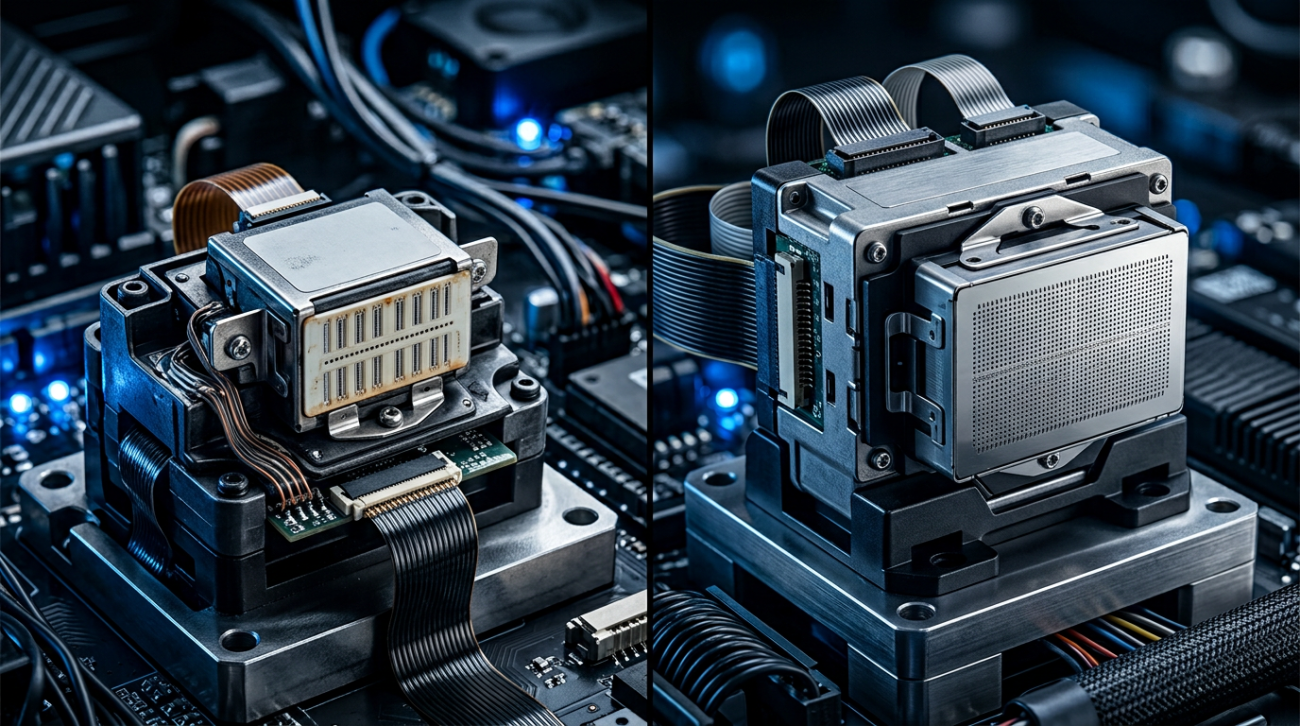
Print heads represent 40–50% of a machine’s replacement-parts spend over its life. This is where quality is non-negotiable and where counterfeits concentrate.
Head Models in the Indian Market (2026 Prices)
| Print Head | Used In | Price (Genuine) | Expected Life (Maintained) | Failure Profile |
|---|---|---|---|---|
| Konica Minolta 512i (30 pl) | Solvent flex machines | ₹30,000 – ₹38,000 | 18–30 months | Gradual nozzle loss; strikes end instantly |
| Konica Minolta 512i (42 pl) | High-speed solvent | ₹32,000 – ₹42,000 | 18–28 months | Same; slightly faster wear at speed |
| Konica Minolta 1024i (13 pl) | Premium production solvent | ₹48,000 – ₹65,000 | 20–30 months | Fine nozzles less clog-forgiving |
| Epson i3200-A1 (water/eco) | Eco-solvent, DTF | ₹45,000 – ₹80,000 | 18–36 months | Sudden channel deaths if dry-fired |
| Epson DX5 (legacy) | Older eco-solvent machines | ₹38,000 – ₹55,000 | 12–24 months | Age + scarcity premium rising |
| Ricoh Gen5 | UV flatbed/roll-to-roll | ₹65,000 – ₹95,000 | 24–36 months | UV cure-related internal wear |
Head Buying Rules
- Genuine, sealed OEM packing only. Physical inspection before installation — holograms, vacuum seals, factory labels intact. The refurbished-head trade in India is industrial-scale and visually convincing.
- Buy from suppliers who warrant installation survivability: a head that dies in its first week due to machine-side faults is contested territory — honest suppliers assist the diagnosis, counterfeiters ghost.
- Record serials: photograph every head’s serial against your maintenance register the day it installs. Warranty discussions evaporate without it.
- Match pl/Board IDs exactly: 30 pl and 42 pl heads are not interchangeable on tuned profiles; head-board pairing matters on some platforms.
Head Cables & Dampers (The Head’s Entourage)
Two small parts cause a disproportionate share of “head failure” diagnoses:
- Dampers (₹150–₹400 each): The small ink-buffer/filter capsule atop each head. Cracked dampers admit air; air-starved nozzles stop firing; the pattern looks like death-by-clogging. Replace annually (or at first symptom), in full colour sets. Always stock: 8–12 pieces.
- Head flat cables (₹400–₹1,200): Carriage flexing fatigues these ribbons over 2–3 years. Dead colour channels that tracking-swaps between heads are cable suspects before board suspects.
System 2: Ink Supply System Parts
| Part | Function | 2026 Price | Replace When |
|---|---|---|---|
| Ink pump (supply) | Moves ink bulk tanks → sub-tanks | ₹2,500 – ₹6,000 | Weak flow / failure (12–24 mo typical) |
| Sub-tanks (with sensors) | Stable reservoir feeding heads | ₹1,500 – ₹3,500 each | Cracks, sensor faults |
| Ink filters (main line) | Captures sediment pre-head | ₹300 – ₹800 | Every 6 months, preventively |
| Ink tubes (per metre) | Supply lines | ₹80 – ₹200/m | Hardening/discolouration (solvent attacks PVC) |
| Float sensors | Sub-tank level control | ₹400 – ₹1,200 | Overflow/false-empty faults |
| Vacuum/negative pressure system parts | Maintains head ink meniscus | ₹1,000 – ₹4,000 | Pressure instability symptoms |
The penny-wise rule: ink filters and dampers on schedule are cheap; the downstream head damage from starving or sediment is not. A ₹500 filter never skipped is ₹3,00,000 of heads sleeping safe.
System 3: Maintenance Station (Capping Assembly) — The Overnight Insurance
This little assembly decides your mornings. Ailing capping stations account for the majority of “heads died for no reason” stories.
| Part | Function | 2026 Price | Replacement Cycle |
|---|---|---|---|
| Capping top/pad | Seals head face when parked | ₹250 – ₹700 each | 3–6 months (heavy use) to 9 months |
| Wiper blade | Cleans nozzle plate surface | ₹250 – ₹600 | Quarterly |
| Peristaltic waste pump + tube | Pulls cleaning ink through caps | ₹2,000 – ₹4,500 (tube ₹300–₹800) | Tube yearly; pump on failure |
| Capping lift mechanism springs/gears | Raises seal to head | ₹500 – ₹2,000 | On sag/mis-seating |
| Scraper/flusher kit (if fitted) | Extra plate cleaning | ₹800 – ₹2,500 | On wear |
Diagnostic truth: if heads dry overnight, examine the capping seal before blaming heads. Nine of ten “mystery morning clogs” resolve with a ₹500 capping top and a thorough station clean.
System 4: Motion System Parts
| Part | Function | 2026 Price | Failure Signs |
|---|---|---|---|
| Encoder strip | Position ruler for carriage | ₹500 – ₹1,500 | Misalignment ghosting, thumps, errors |
| Encoder sensor | Reads the strip | ₹1,500 – ₹3,500 | Persistent position faults post-cleaning |
| Carriage belt | Drives traverse motion | ₹800 – ₹2,500 | Fraying, stretch-slack, sound changes |
| Linear rail bearings/carriage blocks | Smooth head travel | ₹2,000 – ₹6,000 | Rough motion, metal noise, play |
| Servo/stepper motor (carriage) | Traverse power | ₹8,000 – ₹20,000 | Stalls, overheat trips, error codes |
| Pinch rollers | Media grip/feed | ₹300 – ₹900 each | Media skew, feed slip |
| Media feed motor + drive | Steps media forward | ₹4,000 – ₹12,000 | Feed calibration that never holds |
Motion parts telegraph failures in sound and feel long before stopping: a trained ear on carriage traverse is predictive maintenance that costs nothing.
System 5: Electronics & Boards
| Part | Function | 2026 Price | Notes |
|---|---|---|---|
| Mainboard | Machine brain | ₹15,000 – ₹35,000 | Platform-specific; version matters |
| Head board(s) | Drives head firing | ₹8,000 – ₹20,000 | Dead channels unresponsive to swaps point here |
| Power supply units | DC rails for systems | ₹3,000 – ₹9,000 | Voltage-spike casualties; surge protection pays |
| Control panel/keypad | Operator interface | ₹2,500 – ₹8,000 | Button membrane wear-out |
| Sensors assortment (home, media, door) | Safety/position interlocks | ₹400 – ₹2,000 each | Frequent phantom-error sources |
Board guidance: buy boards only through the machine’s dealer/network with firmware-version matching. Generic “compatible boards” of unknown firmware create calibration sagas that out-cost their savings within days.
Inks: The Consumable That Chooses Your Quality
Ink is a spare part too — it moves, it expires, and bad batches damage heads. The 2026 Indian market map:
| Ink Type | Use | Price / Litre | Notes |
|---|---|---|---|
| Solvent ink — standard grade | Konica solvent workhorses | ₹350 – ₹550 | Adequate for commodity banners |
| Solvent ink — OEM/premium grade | Konica machines, colour-critical | ₹600 – ₹900 | Better gamut, gentler on heads |
| Eco-solvent ink — compatible | i3200 eco-solvent machines | ₹650 – ₹1,100 | Verify real-world reputation |
| Eco-solvent ink — premium/OEM | Brand-sensitive output | ₹1,100 – ₹1,800 | Wraps, backlit, showroom work |
| UV-curable ink | UV machines | ₹1,800 – ₹3,500 | Head-specific certification essential |
| Head cleaning solution | All machines | ₹800 – ₹1,500/litre | Never substitute thinners/solvents |
The mathematics of ink tier choices surprises first-time buyers: premium ink at ₹250/litre extra costs roughly ₹0.6–₹1.0/sq ft more — trivially recoverable in rate — while return visits for colour inconsistency and head-side damage cost orders of magnitude more. Print heads grind on cheap-ink sediment the way engines grind on adulterated fuel.
Media & Finishing Consumables (The Other Half of Spares)
- Flex rolls (280–510 GSM): ₹3.5–₹9/sq ft — stock two week-sales volume minimum; monsoon logistics delays strand lean shops every year.
- Vinyl, backlit, one-way vision rolls: ₹6–₹25/sq ft by class — keep one demonstration roll of every product you sell.
- Lamination film: ₹4–₹9/sq ft — eco-solvent businesses forget reorder cycles at their peril.
- Eyelets, ropes, hemming tape: trivial unit costs, deadline-critical when absent.
- Syringes, swabs, gloves, lint-free wipes: the ₹500 kit that does ₹5,000 of maintenance.
The Master Price/Stocking Table (Print & Pin This)
| Part | Price Range | Stock at Shop? | Buy Quality Tier |
|---|---|---|---|
| Dampers | ₹150–400 | ✅ 8–12 pcs | Quality-compatible OK |
| Capping tops | ₹250–700 | ✅ Full set + 2 | Quality-compatible OK |
| Wiper blades | ₹250–600 | ✅ 3–4 | Quality-compatible OK |
| Pump tubes | ₹300–800 | ✅ 2 | Quality-compatible OK |
| Ink filters | ₹300–800 | ✅ 4 | OEM-preferred |
| Cleaning solution | ₹800–1,500/L | ✅ 2 L | OEM-preferred |
| Encoder strip | ₹500–1,500 | ✅ 1 | Exact-spec match required |
| Head cables | ₹400–1,200 | 🟡 1 set | Exact match |
| Pinch rollers | ₹300–900 | 🟡 2 | Compatible OK |
| Print heads | ₹30,000–95,000 | 🔴 Order-on-failure (fast-supplier relationship) | Genuine only, sealed |
| Boards | ₹8,000–35,000 | 🔴 Dealer-sourced | Dealer/genuine only |
| Motors | ₹4,000–20,000 | 🔴 Dealer-sourced | Genuine-preferred |
Genuine vs OEM vs Compatible: Buying Strategy by Part Class
The Indian spares market offers three tiers, and the right tier changes by part:
- Genuine/OEM (heads, boards, critical sensors): Pay the premium. These parts either work perfectly or cost you multiples in machine damage. Head counterfeits labeled as genuine constitute genuine market fraud — sealed packing, verifiable holograms, and reputable suppliers are your only armour.
- Branded-compatible (dampers, cappings, wipers, tubes, filters): The sweet spot. Established compatible suppliers make these to specification at 30–50% below OEM pricing with indistinguishable function. Your maintenance schedule benefits from cheap-enough-to-change-early parts.
- Unbranded economy (avoid for machine parts): Fine for swab sticks and gloves; unwise for anything touching ink or heads. A ₹90 damper that leaks air into a ₹38,000 head is the most expensive saving on this list.
How to Spot Counterfeit Print Heads (5-Minute Field Guide)
- Packaging forensics: genuine vacuum-sealed antistatic bags, crisp print, intact factory holograms. Re-heat-sealed bags, fuzzy print, or “plain OEM box” stories end the transaction.
- Serial verification: register/photograph the serial and confirm with the brand’s regional channel on expensive heads.
- Face inspection: unused heads have pristine nozzle plates under magnification; refurbished ones show microscopic wipe arcs and ink residue at the plate edges.
- Price arithmetic: a “genuine” 512i quoted 35%+ under market is definitionally not genuine. Nobody sells ₹10,000 of their own margin for fun.
- Seller behaviour: legitimate suppliers answer installation-support questions comfortably; counterfeit sellers rush payment and resist documentation.
Replacement Schedule Calendar (Tape This Inside the Machine Cabinet)
| Interval | Replace/Service |
|---|---|
| Weekly | Deep-clean capping/wiper zone |
| Monthly | Encoder strip clean, pinch roller check |
| Quarterly | Wiper blades, dampers (heavy use), capping tops (heavy use) |
| 6 Months | Ink line filters, full capping set, pump tube check |
| 12 Months | Dampers full set, belt tension inspection, lubrication set, PSU fan cleaning |
| 18–30 Months | Print heads (usage-dependent), head cables inspection |
| 36 Months | Carriage bearing/block assessment, tube set refresh |
Where to Buy: The Supplier Strategy
Structure your parts sourcing across three channels deliberately:
- Your machine dealer: heads, boards, platform-specific parts, and anything firmware-paired. You’re buying compatibility certainty and installation support.
- Specialised spares distributors: imported compatible consumables at volume pricing — the right channel for dampers, cappings, and filters by the dozen.
- Direct-from-importer relationship: for two-machine+ shops, establishing a direct account with a national importer cuts consumable costs 20–30% and puts you on priority dispatch.
Whichever channel: same-day dispatch capability, WhatsApp-ordering fluency, and GST invoicing are the three non-negotiables. A parts supplier who ships tomorrow answers deadline-day emergencies; one who ships “next week” answers nothing.
Platform Parts Map: The 3.2m Konica 512i Machine (India’s Commonest Build)
Because the KM 512i-based 3.2m machine powers the majority of Indian shops — under dozens of brand names — here’s its real-world parts map. Part numbers vary by assembler, but the architecture is stable across nearly all of them:
| Location | Part | Common Spec | Interchangeability |
|---|---|---|---|
| Carriage top | Head dampers | KM 512i solvent-type, small-mesh filter | High — dozens of quality compatibles |
| Carriage | Head flat cables | Machine-length specific (measure!) | Medium — length/pin must match |
| Park bay | Capping top | 512i wide-lip solvent cap | High — check lip profile |
| Park bay | Wiper blade | Solvent-grade rubber, ~35–40mm | High |
| Park bay | Peristaltic pump | 24V, machine-connector matched | Medium — connector matters |
| Ink bay | 5L→sub-tank supply pumps | 24V diaphragm or gear type | Medium |
| Ink bay | Inline filters | 10–20 micron solvent rated | High |
| Gantry | Encoder strip | 150LPI or platform spec, exact length | Low — order by machine model |
| Gantry | Carriage belt | Platform length/width | Low — order by machine model |
| Cabinet | Head board / mainboard | Assembler + firmware specific | Very low — dealer channel only |
Operator tip: photograph every part’s label at installation day (damper type, belt length print, strip LPI). These photos convert panicked part-ordering conversations into thirty-second WhatsApp exchanges.
From Symptom to Shopping List: The Reverse Lookup
Diagnose in minutes, order in one message — the table your operator should have pinned at the machine:
| Symptom | Order First | Then Check |
|---|---|---|
| Morning nozzle gaps (whole channel) | Capping tops — full set | Dampers on that channel |
| Banding persisting after clean + align | Encoder strip | Ink filters; head age |
| Ink drops on prints mid-run | Wiper blade | Capping station clean + seal |
| Cleaning cycles pull no ink | Pump tube | Waste pump itself |
| One colour fades mid-roll, recovers after rest | Damper (air leak) | Sub-tank float sensor |
| Carriage thump at fixed position | Inspection first; belt if frayed | Rail bearings; strip end seating |
| Registration ghosts after strip cleaning | Encoder sensor | Strip seating depth |
| Machine dead after power event | Fuses; PSU | Board-level diagnosis (dealer) |
| Phantom “cover open” / “media” errors | Interlock sensors | Sensor cabling |
Buying Tactics: How Indian Pros Buy Parts Cheaper Without Risk
Parts procurement rewards the same discipline as media buying. Field-tested tactics from shops that run lean:
- Annual consumables contracts: Commit your year’s dampers/cappings/filters to one distributor for a 10–15% volume rate and standing monthly dispatch. Predictability earns pricing no single-order bargaining reaches.
- Lot consolidation: Courier economics penalise scattered ₹500 orders; run a monthly consolidated parts order off a checklist and save 5–8% on freight alone, plus the hidden cost of emergency orders.
- Two-supplier policy on consumables: Qualify a primary and backup supplier per category. Parts droughts and courier strikes hit single-sourced shops hardest; the backup exists for insurance, not daily spread.
- Never bargain on heads: The negotiation victory of ₹2,000 on a ₹38,000 head introduces vendor motivations you don’t want adjacent to your machine. Negotiate service, dispatch speed, and payment terms — not component integrity.
- GST input discipline: Buy only GST-billed parts (input credit recovers 18% systematically) — the no-bill discount is arithmetic folly at annual scale.
- Warranty paper trails: Register head serials and keep invoices filed by machine. Boards and pumps carry real warranties when you can produce the paper in one minute.
Emergency Playbook: Machine Down, Deadline in 24 Hours
Every owner eventually faces the nightmare iteration: critical fault, committed job, overnight deadline. The playbook built from others’ scars:
- Triage in 30 minutes, honestly. Is this a stock-part fix (damper, wiper, tube — under one hour) or a machine-down fault (pump, board, head)? Declare it internally by minute thirty to trigger Track B without ego.
- Track B is capacity, not heroics: every serious shop pre-identifies one nearby shop or trade printer for mutual emergency outsourcing at agreed trade rates. Diverted work keeps the client; ego-driven machine-camping loses both the deadline and often the next month of client trust.
- Communicate early, concretely: clients forgive “your banner moves to our partner unit tonight, delivery holds 10 AM” — they don’t forgive silence followed by morning failure.
- Expedite parts by whatever moves: counter-to-counter bus parcel, overnight courier, staff pickup run to the dealer’s city. A ₹2,000 logistics sprint routinely protects ₹20,000 jobs.
- Post-mortem within 48 hours: what part failed, why wasn’t it stocked, what schedule missed its wear signal? Every emergency either upgrades the parts bench or repeats itself.
Organising Your Parts Inventory (So Nothing Is Ever Missing)
A parts shelf without a system degenerates into a box of mystery items within six months. Run a deliberately boring setup instead:
1. The labelled-bin wall. Small stackable bins, one per part class — DAMPERS / CAPPINGS / WIPERS / TUBES / FILTERS / STRIPS / SENSORS — with the part photo taped to the front. Any operator finds any part in seconds, including the one hired last Tuesday.
2. The register that actually gets used. One notebook or simple spreadsheet — date, part out, quantity left, machine serviced, initials. The count matters less than the habit; five seconds per withdrawal keeps inventory honest without software subscriptions.
3. Reorder lines, not reorder vibes. On each bin a marker line or minimum count (dampers = 4, wipers = 2, cappings = 2, solution = 1L). Crossing the line triggers the monthly consolidated order — never the 9 PM discovery of an empty bin.
4. Consumables FIFO. Ink and solution rotate first-in-first-out; solvent products age on shelves and degraded rings on labels reveal aged stock before it reaches a machine.
5. Quarterly five-minute audit. Physical count versus the register, expiry sweep, bin labels fixed. Pair it with the quarterly maintenance day so the audit rides an existing habit rather than founding a new one.
Shops running this kindergarten-simple system cut emergency part orders by 80%+ — and eliminate nearly all parts-driven downtime. The investment is one Sunday afternoon; the return accrues for the machine’s entire life.
Frequently Asked Questions (FAQs)
Q1. How much should I budget annually for flex machine spare parts?
Plan ₹40,000–₹80,000/year for consumables and wear parts on a single machine in normal commercial use, plus head replacement amortisation of ₹60,000–₹1,20,000/year depending on head count and maintenance discipline.
Q2. Which spare parts should every machine owner keep in stock?
Dampers (8–12), capping tops (full set + spares), wiper blades (3–4), pump tubes (2), ink filters (4), cleaning solution (2L), and one encoder strip. This ₹15,000 bench covers 80% of common failures with zero downtime.
Q3. Are compatible dampers and capping stations safe to use?
Yes, from established compatible-parts suppliers — these are consumables engineered to specification. Avoid unbranded no-name versions; the savings are rupees and the failure modes cost heads.
Q4. How do I know if a Konica 512i head is genuine?
Sealed vacuum antistatic packing, intact holograms, verifiable serials, pristine nozzle plate under magnification, market-sane pricing, and a supplier who answers installation questions. Any one failing — walk away.
Q5. Why do my dampers keep cracking?
Solvent exposure ages plastic dampers over months — cracking is wear, not defect. Replace the full set annually as calendar maintenance rather than waiting for one to announce itself at 9 PM before a deadline.
Q6. Can I use any cleaning solution in an emergency?
No. Thinners and general solvents destroy head internals and seals. Only machine-grade head cleaning fluid matched to your ink chemistry. Stocking two litres permanently is the answer to this emergency.
Q7. What’s the lifespan of a Konica 512i head really?
Range: 9–14 months under neglect, 18–30 months under discipline, occasionally longer. The variables are cleaning consistency, idle wet-capping, ink quality, and operator care around head strikes. The head’s life is mostly written by its maintenance.
Q8. Is it cheaper to repair or replace an aging machine?
Rule of thumb: when a single repair approaches 25–30% of the machine’s used-market value, or when electronics-platform parts are going out of production, run the replacement math. A well-timed upgrade often beats stacked old-platform repairs.
Q9. Where do I buy flex printing machine spare parts online in India?
Specialised machinery suppliers with parts divisions stock and ship pan-India. Our own range carries genuine and quality-compatible spare parts with same-day dispatch on consumables.
Q10. My supplier’s price is far below market. Am I lucky?
For heads and boards: no — you’re being set up. For consumables: maybe, if the brand is established; perform fit/function verification on first batches. Deep-discount electronics and heads in India are the single highest-fraud category in this market.
Final Word: Parts Discipline Is Production Discipline
The unglamorous truth of profitable printing: machines earn when they run, and they run when ₹400 parts live on your shelf instead of four days away in a courier network. Build the bench stock, pin the schedule inside the cabinet, buy heads genuine-only, and treat your parts supplier as a business partner. The shops that master this boring arithmetic are the ones whose clients never hear the word “machine down.”
Stock up today: browse our flex printing machine spare parts and printing inks — genuine heads, quality consumables, and expert fitment guidance for Konica, Epson, and Ricoh platforms. Send us your machine model for a custom spare-parts kit quote with same-day dispatch.