


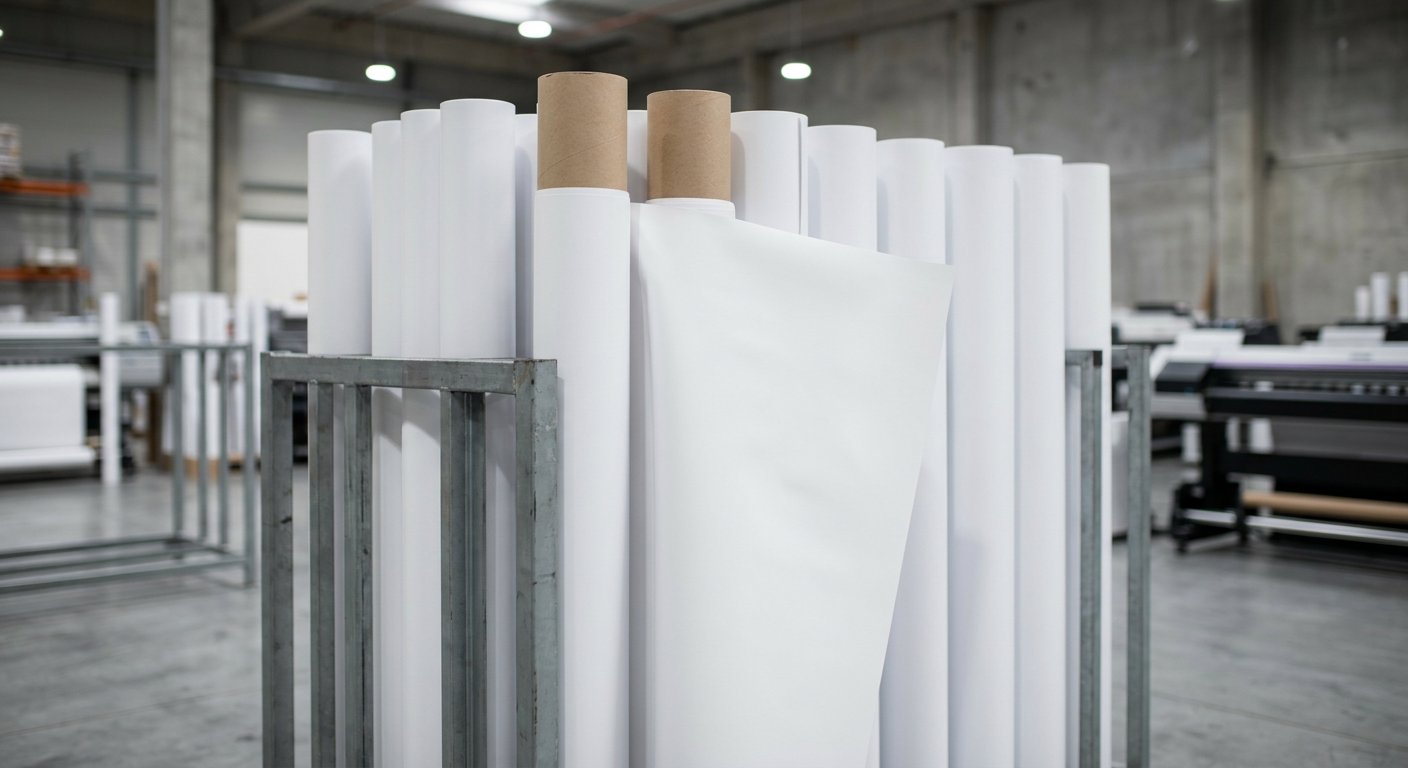
Star Flex vs normal flex — which is better for your banner or shop board? Both are PVC banner materials printed on the same machines, but they behave very differently in the real world. Star Flex carries a smoother, gloss-coated surface that prints brighter colours and lasts 1–2 years outdoors, while normal flex is a matte-finish economy material built for short-duration, budget jobs. This guide compares the two across finish, print quality, durability, price, and applications — so you stop overpaying for the wrong material (or losing money on a banner that fades in six weeks).
The Core Difference: Surface Coating
Both materials share the same skeleton — a polyester scrim between PVC layers. The difference is the top coating:
- Normal flex has a standard matte PVC surface. Ink soaks slightly into the coating, softening fine detail and muting brightness.
- Star Flex (also sold as “gloss flex” or “high-gloss banner”) adds an extra smooth coating layer. Ink sits on top, dots stay sharp, whites stay brilliant, and colours appear saturated — almost photo-like for a banner material.
Hold the two side by side and you’ll spot it instantly: Star Flex has a subtle sheen and a silky texture; normal flex looks flat and slightly grainy.
Star Flex vs Normal Flex: Full Comparison
| Parameter | Normal Flex | Star Flex |
|---|---|---|
| Surface finish | Matte, slightly textured | Smooth, glossy |
| Colour vibrancy | Good | Excellent — brighter, deeper colours |
| White brightness | Off-white | Brilliant white |
| Close-view quality | Texture visible within 3–4 ft | Clean up to 1–2 ft |
| Common GSM | 240, 280, 340 | 280, 340, 440 |
| Printing rate (retail) | ₹10–18/sq ft | ₹18–30/sq ft |
| Outdoor life | 6–12 months | 1–2 years |
| Wrinkle resistance | Moderate | Better (stiffer, holds tension) |
| Best use | Events, political, short promotions | Shop boards, premium branding, exhibitions |
Print Quality: The Side-by-Side Test
Print the identical design on both and compare:
- Blacks: Star Flex produces deeper, richer blacks; normal flex blacks can look slightly charcoal.
- Skin tones & gradients: noticeably smoother on Star Flex — critical when the banner carries a person’s photograph (weddings, political leaders, brand ambassadors).
- Small text: stays crisp on Star Flex; on normal flex, text below ~1 inch can blur at edges.
- At night: under shop lights, Star Flex’s gloss reflects evenly; matte flex can look dull or patchy.
From 20+ feet away (typical banner viewing distance), the gap narrows — which is exactly why normal flex is fine for roadside hoardings.
Durability: Where the Extra Money Goes
Star Flex isn’t just prettier — it’s built tougher:
- Thicker coating shields printed pigments from UV, slowing fading by roughly 50–100% compared to standard flex.
- Higher standard GSM: Star Flex starts at 280 GSM and commonly comes in 340–440 GSM, resisting wind-flap tearing.
- Better ink adhesion: colours resist washing and rubbing through monsoon rains.
In practice: a 280 GSM normal flex banner typically survives one season (6–12 months) outdoors in Indian sun and rain. A 340 GSM Star Flex board regularly crosses 18–24 months before noticeable fading.
Price Difference: Is Star Flex Worth ₹8–12/sq ft More?
Let’s do the math on a typical 8×4 ft (32 sq ft) shop board:
| Material | Rate | Total Print Cost | Expected Life | Cost Per Year |
|---|---|---|---|---|
| Normal flex 280 GSM | ₹14/sq ft | ₹450 | ~9 months | ₹600/year |
| Star Flex 340 GSM | ₹24/sq ft | ₹770 | ~20 months | ₹460/year |
Star Flex actually costs less per year for any signage that stays up beyond a few months — plus your branding never goes through a faded, torn phase. For a one-week event banner, of course, normal flex at ₹450 is the obvious choice.
When to Choose Normal Flex
- Political hoardings & election work — volume jobs lasting days to weeks
- Event banners — weddings, birthdays, religious functions (1–7 day use)
- Short promotions — sales, openings, seasonal offers under 2 months
- Budget constraints — when the board is a placeholder for later upgrades
- Large hoardings viewed from distance — the gloss advantage disappears at 20+ ft
When to Choose Star Flex
- Shop boards & fascia boards — your 24×7 salesman deserves premium finish
- Photo-heavy boards — salons, studios, clinics, restaurants with food photography
- Exhibition stalls & mall activations — close viewing, brand image critical
- Franchise branding — chains standardise on Star Flex for uniform, premium look
- Any signage meant to last 1+ year
Common Myths Cleared
Myth 1: “Star Flex is a different printing technology”
No. It’s the same solvent/eco-solvent printing on a better media. Any flex printer can run both — the difference is purely in the roll loaded on the machine.
Myth 2: “Glossy means it will shine distractingly”
Star Flex has a soft sheen, not a mirror finish. Under normal shop lighting it reads as vibrant, not glaring.
Myth 3: “Normal flex can’t look good”
It can — at banner scale, viewed from distance, printed in high-resolution mode. Where it fails is close-up premium use.
Myth 4: “Star Flex never fades”
Everything fades in UV light. Star Flex simply fades slower — typically doubling normal flex’s colour life.
A Printer’s Tips for Getting the Best From Both
- Use 4–6 pass quality mode for Star Flex shop boards — the smooth coating rewards high-resolution printing.
- Bump ink limits slightly on Star Flex for richer blacks; matte normal flex needs less ink to avoid smearing.
- Heat settings: 340–440 GSM Star Flex needs mid/post heaters at 45–50°C to dry fully and prevent set-off on the roll.
- Tension matters: Star Flex’s stiffness holds frame tension better — use it stretched, not pasted, for boards.
- Quote honestly: tell customers which material they’re getting. Unbranded “star flex” at normal-flex prices is a common shortcut that fades fast.
Frequently Asked Questions (FAQs)
Q1. How can I tell Star Flex from normal flex before printing?
Look and touch: Star Flex has a smooth, slightly glossy surface and brilliant white; normal flex is matte with a faint fabric texture. Ask for the brand name — genuine Star Flex rolls are branded.
Q2. What is the price difference between Star Flex and normal flex?
Typically ₹8–12/sq ft at retail — normal flex runs ₹10–18/sq ft, Star Flex ₹18–30/sq ft depending on GSM and city.
Q3. Which flex is best for a shop board?
Star Flex 280–340 GSM. It prints vibrant colours, holds frame tension well, and lasts 1–2 years outdoors — cheaper per year than normal flex.
Q4. Is Star Flex good for political banners?
Overkill. Political banners last weeks; normal flex 240–280 GSM delivers the same visibility at half the cost.
Q5. Does Star Flex last longer than normal flex?
Yes. Expect 1–2 years outdoors versus 6–12 months for normal flex, thanks to thicker coating, higher GSM, and better UV resistance.
Q6. Can both be printed on the same machine?
Yes — any solvent or eco-solvent flex printer handles both. Printers simply adjust heater temperature and ink load between materials.
Q7. Is glossy flex the same as Star Flex?
“Star Flex” is a popular brand name that became the generic term for high-gloss flex. Any glossy banner material sold as “star quality” behaves similarly — but branded rolls are more consistent.
Q8. Why does my old banner look pink/faded?
UV light breaks down cyan and yellow pigments first, shifting colours pinkish. Premium media + quality inks delay this significantly.
Q9. Which GSM should I pick in Star Flex?
280 GSM for framed boards up to ~40 sq ft; 340 GSM for larger or windier locations; 440 GSM for big hoardings.
Q10. Should I laminate Star Flex?
Usually unnecessary — its coating already protects well. Lamination makes sense only for vandalism-prone or high-touch locations.
Print Premium Boards With the Right Machine
Star Flex demands crisp, high-resolution printing — and that starts with your printer. UED supplies flex & solvent printers with genuine inks, spare parts, installation, and free training across India.
Final Verdict
Neither material is “better” in absolute terms — normal flex wins short-duration, budget, and long-distance jobs; Star Flex wins everything close-up, photographic, or meant to last over a year. The smartest buyers match the material to the job’s lifespan: normal flex for weeks, Star Flex for years. When in doubt for shop branding, spend the extra ₹8–12/sq ft — your board is your storefront’s face, and it should look fresh, not faded.
