

Signage is the original home of large-format printing, and UV flatbed and roll-to-roll have reshaped how signs are made: print direct on acrylic, ACP, foam board, glass, metal and vinyl, cure instantly, and skip lamination on many jobs. This guide explains where UV wins in signage, how to build durable outdoor work, the machine mix a sign shop needs, and how to price a signage business that ranges from a single shop board to a city-wide wayfinding programme.
The signage substrates UV handles
UV prints directly on the rigid materials that make up most signage: acrylic for premium and backlit faces, aluminium composite panel for outdoor boards, PVC foam board for indoor and exhibition panels, metal for industrial and durable signs, glass for architectural features, and corrugated plastic for site and hoarding boards. On the flexible side, UV roll-to-roll handles banner and vinyl for banners, hoardings and vehicle graphics. Because one UV platform spans rigid and flexible, a sign shop can consolidate what used to need multiple machines and processes.
White ink and varnish: the two capabilities that matter most
Two ink features define quality signage. White ink lets you print on clear acrylic for backlit signs, on dark ACP and metal, and produce double-sided glass graphics. Varnish adds gloss, matte or textured finishes and a protective top-coat that extends outdoor life. A machine with reliable white and varnish channels, plus a flatbed with good registration for double-sided work, covers the overwhelming majority of signage applications. Prioritise these two features over headline print speed when choosing a signage machine.
Outdoor durability: the difference between a sign and a sign that lasts
Outdoor signage is bought on longevity. The durable recipe is substrate-appropriate preparation, a flexible or durable UV ink set, and a UV-protective varnish; on metal and coated surfaces add adhesion promoter. State a realistic service life per exposure — full sun, coastal, or sheltered — and build maintenance into multi-year contracts. A sign that survives seasons is your best advertisement, and shops that can demonstrate durability win the premium, repeat, and multi-site work that defines a healthy signage trade.
Backlit and illuminated signage
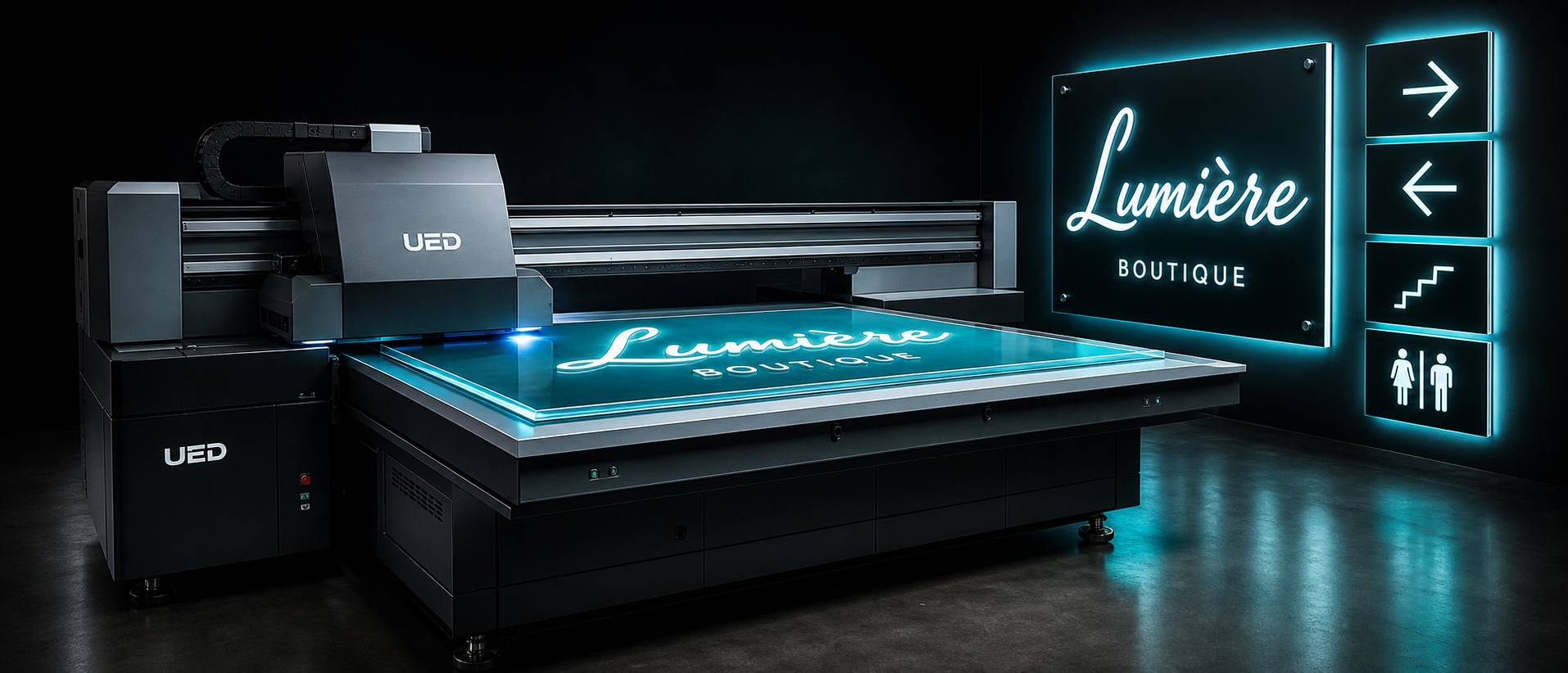
Backlit signs — lightboxes, illuminated shopfronts, mall directories, menu boards — are a premium, high-margin niche. UV prints on clear acrylic or backlit flex with the white–colour–white sandwich that controls opacity under illumination, and produces one-off backlit panels far faster than older methods. Because illuminated signage is visible day and night and highly specified by brands and retailers, it commands strong prices. Build a sample lightbox for the showroom; a glowing panel sells the job better than any quote.
Wayfinding and multi-site programmes
Wayfinding — directional and informational signage for campuses, hospitals, malls, offices and industrial sites — is a systems business. It rewards standardised templates, variable data (room numbers, floor maps), and consistent materials across hundreds of signs. UV flatbed printing is ideal because it prints variable data, small batches and mixed sizes without plates, and because durable prints suit long-life installations. Landing one wayfinding programme can anchor a shop for years and generate ongoing replacement and expansion work. Approach it as a specification-and-service relationship, not a one-off print job.
Machine mix for a sign shop
Most profitable sign shops run a flatbed plus a roll-to-roll, or a UV hybrid printer that covers both on one frame. The flatbed handles rigid boards and direct-to-substrate faces; the roll-to-roll handles banner and vinyl for banners, hoardings and vehicle graphics. Size the flatbed to your largest common ACP or acrylic sheet, and prioritise white, varnish and registration. Adding a router or laser cutter for cutting boards to shape completes the chain from artwork to installed sign and captures the fabrication margin too.
Pricing signage profitably
Price by substrate, size, durability spec and installation, not just square footage. Premium acrylic and backlit faces earn more than foam board; outdoor durable systems earn more than indoor; multi-site programmes earn through volume and service contracts. Charge for design, installation and maintenance separately so customers understand value. Track cost per job honestly including waste and fitting, because signage that looks profitable per square foot can be unprofitable once installation time is counted.
Common signage mistakes
- Quoting foam board for permanent outdoor and absorbing warp and fade complaints.
- Skipping varnish and promoter outdoors, then repainting failed signs free.
- Buying for headline speed and discovering weak white and registration.
- Not standardising wayfinding templates, then re-designing every sign.
- Ignoring installation cost in the quote and eroding the whole margin.
Frequently asked questions
Is UV signage better than vinyl-applied signage?
Different tools. UV direct-to-substrate avoids bubble-lifting on rigid faces and prints white and varnish in-line, while cut vinyl remains excellent for vehicle wraps and large flat panels. Many sign shops use both.
Can UV print channel letters and backlit boxes?
Yes — UV prints the acrylic faces for channel letters and lightbox panels. Fabrication of the box or channel is separate, but the printed faces are a core UV job.
How long does UV signage last outdoors?
With durable ink and varnish on a suitable substrate, multi-year outdoor life is typical; quote a realistic range per exposure and offer varnish for harsh sun.
The two signage markets: trade and retail
Signage demand splits into trade and retail, and healthy shops serve both. Trade work is other businesses — shops, restaurants, offices, factories — buying durable external signage, wayfinding and interior branding; it is higher value, more specification-driven and rewards durability credentials and installation capability. Retail and consumer work is house numbers, small shop boards, event graphics and property signs; it is price-sensitive, fast-turnaround and keeps volume moving. Trade builds margin and reputation; retail builds cash flow and machine utilisation. Balancing the two smooths the peaks and troughs that a pure-trade or pure-retail shop suffers.
Installation and fitting: the margin and the risk
A sign is not finished until it is installed, and installation is both a margin source and a liability. Fixing methods vary by substrate and location — adhesives and spacers on acrylic, mechanical fixings on ACP and metal, structural support for large boards — and outdoor work must withstand wind and weather. Either build a competent fitting capability or partner with reliable installers, but always specify the fixing method and warranty clearly. Poor installation damages your reputation more than a print defect, because the customer sees the sign fall, not the RIP file. Treat fitting as a core part of the signage product.
Vehicle graphics and the roll-to-roll role
Vehicle graphics — car wraps, van lettering, fleet branding — are a roll-to-roll and vinyl application rather than direct UV, but they belong in a sign shop’s portfolio because fleet customers buy signage and vehicles together. UV roll-to-roll prints the vinyl and laminates for wraps, with white ink for effects, while the flatbed handles the rigid boards and internal branding for the same client. Offering the whole branded-vehicle-plus-signage package makes you the single supplier for a growing business’s entire visual identity, which is far stickier than selling signs alone.
Safety and industrial signage as a steady line
Industrial and safety signage — mandatory signs, hazard warnings, pipe markers, machine labels and site rules — is unglamorous but reliable: it is regulation-driven, renews constantly, and buyers value durability and fast turnaround over design flair. UV flatbed printing on metal, polycarbonate and foam board is ideal, and because the signage is compliance-driven, demand is steady regardless of economic cycles. Build a standard library of compliant safety designs, keep durable stock on hand, and target facility and maintenance managers. It is one of the most recession-proof lines a sign shop can hold.
Retail and mall programmes: multi-site at scale
Large-format retail and mall programmes — in-store branding, window graphics, directory boards, promotional displays across many locations — are where signage volume and value peak. They demand consistent colour across sites, standardised templates, variable data per location, and reliable logistics. UV flatbed and roll-to-roll handle the mix of rigid and flexible pieces, and digital workflows keep hundreds of pieces consistent. Winning one programme anchors a shop for years and generates ongoing refresh work. Approach retail as a systems-and-service relationship with a single accountable contact, and it becomes the most valuable account type in the business.
Maintaining a signage fleet of machines
Signage keeps machines hard at work across rigid boards and rolls, so maintenance discipline directly affects throughput and uptime. Clean print heads and cappings daily, keep white ink circulated, maintain vacuum beds and media clamps, and stock the consumables and spares that cause downtime — wipers, dampers, fuses, and the specific white and varnish inks. A machine stopped for a missing part costs more than the part, so a small critical-spares kit is cheap insurance. Track maintenance and nozzle health so you can spot degradation before it ruins a large outdoor board.
Troubleshooting common signage problems
- Banding on large outdoor boards — nozzle health or profile drift; run a nozzle check and re-profile before long runs.
- Peeling on coated metal or ACP — insufficient prep or promoter; degrease, abrade, promote and re-tape-test.
- Mis-registered double-sided signs — use pin or jig registration rather than eyeballing flip alignment.
- Warping foam board outdoors — wrong substrate for the exposure; specify ACP or metal for permanent outdoor.
- Early fade — missing varnish or wrong ink set; add UV-protective varnish and verify ink outdoor data.
Choosing a signage machine: a practical checklist
Specify a signage machine against the work you actually win, not headline specifications. Confirm the largest rigid sheet and roll width you need, reliable white and varnish channels, registration for double-sided work, and media handling that won’t mark expensive acrylic or ACP. Ask suppliers for outdoor durability data on your substrates and for a demonstration on a real signage board rather than a glossy sample. Plan the workshop for board storage, prep and finishing, and confirm local service support, because signage deadlines are unforgiving. A machine chosen around your signage mix earns steadily; one chosen on paper specs disappoints.
Return on investment in a signage-focused shop
Signage returns are strong when durability and service are right, because the work is repeatable and visible. A UV flatbed plus roll-to-roll covers most of the market and pays back through a mix of trade boards, wayfinding programmes, backlit signage and retail work. Keep an exposure rack of test coupons so your durability claims stay provable, photograph every installation for the portfolio, and ask satisfied trade clients for referrals. Signage is the backbone of most UV businesses, and shops that engineer durability, standardise templates and price the whole job consistently outperform those that compete on square footage alone.
The portfolio strategy: balancing the signage lines
The most resilient sign shops do not bet on one type of signage. They balance durable trade boards that build reputation, retail and mall programmes that bring volume, safety and industrial signage that recur regardless of the economy, and consumer retail work that keeps machines busy between larger jobs. Each line uses the same flatbed, roll-to-roll, inks and skills, so diversification costs little and protects against any single market slowing. Photograph every installation, standardise templates across lines, and let satisfied clients in one segment refer you into another. A balanced signage portfolio, built on durable engineering and honest service, is what turns a print shop into a lasting signage business.
Ultimately, signage rewards the shop that treats every board as a long-term statement of its own craft. A sign that survives seasons, holds its colour and was fitted properly is silent advertising for your business wherever it stands. Engineer durability, standardise your templates, price the whole job honestly, and let each installed sign build the reputation that brings the next one.
Whether the job is a single shopfront board or a campus-wide wayfinding scheme, the same principles hold: the right substrate for the exposure, engineered adhesion and durability, honest service-life claims, and a price that reflects the whole job including fitting. Get those right and signage becomes the dependable backbone of the business.
Conclusion
Signage is where UV’s substrate range, white ink, varnish and instant cure combine into a genuinely competitive advantage, from a single shop board to a campus-wide wayfinding system. Build the right machine mix, engineer durability honestly, and price the whole job. Review our digital UV printer range or contact us to spec a signage-ready flatbed and roll-to-roll.
