

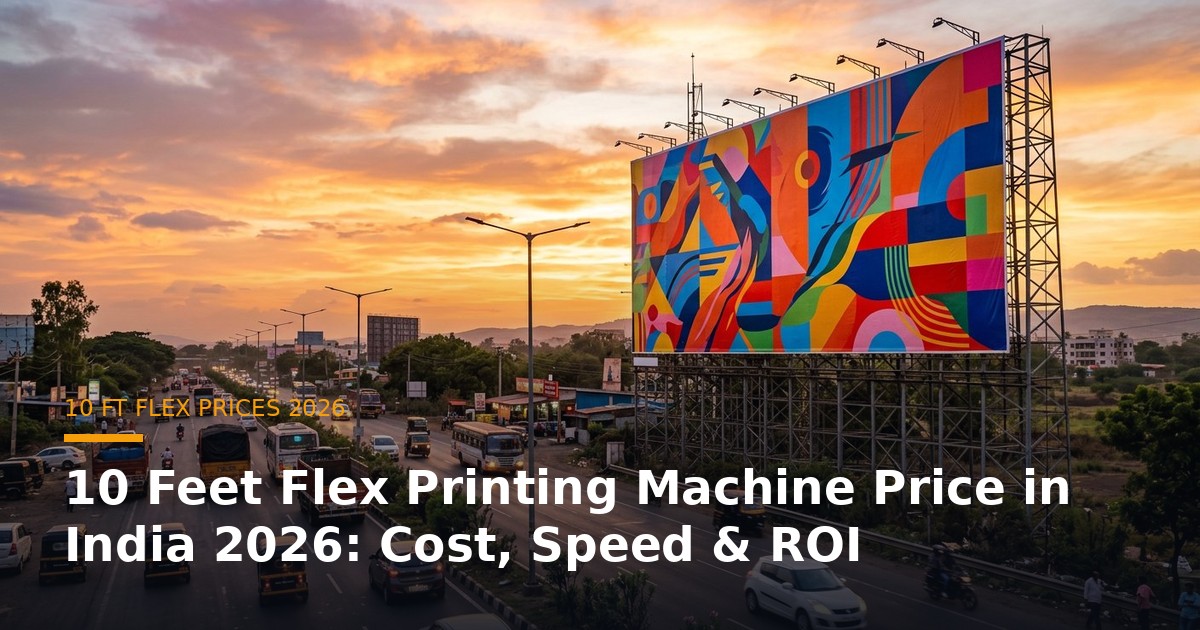
A 10 feet flex printing machine is the choice for printers who handle large hoardings, wide backlit panels and high-volume campaign work. At roughly 3.2 metres of printable width, a 10 ft machine produces big jobs in a single pass, without the joining and labour that smaller widths require. This guide covers the 10 feet flex printing machine price in India for 2026, with a focus on cost, speed and return on investment, so you can decide whether a 10 ft line is the right step for your business.
Moving to 10 ft is a significant investment, and it only makes sense when your order book justifies it. For the right printer — one serving advertising agencies, hoarding contractors and large retail or corporate clients — a 10 ft machine is a genuine competitive weapon that wins work smaller shops cannot take on.
10 Feet Flex Printing Machine Price in India 2026 — Snapshot
| Configuration | Printhead | Indicative Price (2026) |
|---|---|---|
| 10 ft dual-head | Konica 512i | ₹4.5L – ₹7.0L |
| 10 ft four-head | Konica 512i | ₹6.5L – ₹10.0L |
| 10 ft eight-head | Konica 512i | ₹10.0L – ₹16.0L |
| 10 ft high-speed line | Konica 1024i | ₹14.0L – ₹22.0L |
Because 10 ft machines are bought for throughput, most are built on the durable Konica 512i head, and the price scales with head count. The right configuration depends on the volume you need to produce per shift.
Who Needs a 10 Feet Machine?
A 10 ft machine is for established printers with steady, large-format demand. If you regularly produce hoardings, building wraps, wide backlit panels, large event backdrops or bulk banner runs, a 10 ft machine lets you print these in a single pass, saving joining time and material and improving finish quality. It is also the right choice if you are winning volume tenders from agencies and corporates that smaller machines cannot fulfil quickly enough. For a small shop focused on local signage, a 10 ft machine is usually overkill; for a high-volume commercial printer, it is essential.
Cost, Speed and ROI: The Core Considerations
The economics of a 10 ft machine centre on throughput. More width and more heads mean more square feet per hour, which lowers your cost per square foot as volume rises. A four-head or eight-head 10 ft Konica 512i line can produce several times the output of a smaller machine, so even at a higher purchase price, the cost per saleable square foot often falls. The return on investment therefore depends on utilisation: a 10 ft line kept busy with large, high-value jobs repays itself quickly, while one that sits idle is an expensive mistake. Model your realistic monthly volume and peak demand before committing, and buy the head count that meets your peak with modest headroom.
Choosing the Right Head Count for a 10 Feet Machine
A dual-head 10 ft machine suits printers moving up from 8 ft who need the extra width but not maximum speed. A four-head 10 ft machine is the commercial workhorse for steady high-volume work. An eight-head 10 ft line is for genuine high-throughput, multi-shift operations. A Konica 1024i machine is the premium option for the very highest volume. Match the head count to your sellable volume — not to aspiration — so the machine earns rather than idles.
What Affects the Price of a 10 Feet Machine?
Beyond head count, price is driven by automation and build quality: servo drives, automatic media take-up for heavy rolls, multi-zone heaters and dryers, media sensors, a rigid frame and a professional RIP. A 10 ft machine handles large, heavy media, so robust media handling is especially important to avoid misfeeds and wastage on expensive jobs. Compare the full installed specification across quotations, and prioritise a supplier with strong service and genuine spares, because downtime on a production line is very costly.
Why Buy Your 10 Feet Flex Machine from UED?
Unified Engineering Dynamics (UED) supplies, installs and services 10 feet flex printing machines across India, built on genuine Konica 512i and 1024i printheads in dual, four and eight-head configurations. We help high-volume printers choose the right head count for their throughput needs, provide professional installation and operator training, and back every machine with responsive after-sales support and ready spares — so your production line delivers from day one.
10 Feet Machine: Space, Power and Installation
A 10 ft flex machine is a serious piece of industrial equipment and demands more from your premises than a smaller unit. You will need a wide, clear area with room at both ends to load heavy media rolls and collect large finished prints, plus dedicated space for finishing large-format work. The floor must be level and able to support the machine’s weight, and the environment should be clean and reasonably climate-controlled to protect print quality on big jobs. Power requirements are higher than for a 6 ft or 8 ft machine, so a stable, adequately rated supply with proper protection is essential. Professional installation and commissioning are strongly advised: correct alignment, media-path setup and profile calibration make a major difference to output consistency on wide-format work. Planning your space and power before the machine arrives avoids costly delays and rework.
Maximising ROI on a 10 Feet Line
The return on a 10 ft machine comes from keeping it busy with high-value work. Focus on the jobs that need the width — hoardings, building wraps, wide backlit panels and large event graphics — because these command better rates and fewer competitors can produce them. Schedule work efficiently to minimise changeovers and media waste, and maintain the machine rigorously so uptime stays high; on a production line, every idle hour is significant revenue lost. Track your true cost per square foot across jobs so you price profitably and know which work to prioritise. Many high-volume printers also add installation services, which increases margin and locks in repeat agency and corporate clients. A 10 ft line run at good utilisation is one of the strongest earners in the flex printing business.
10 Feet vs Running Multiple Smaller Machines
Some printers wonder whether one 10 ft line is better than two smaller machines. A single 10 ft machine offers greater width and, with more heads, higher throughput in one footprint, with simpler workflow and one set of operators. Multiple smaller machines offer redundancy — if one is down, the other can still run — and flexibility to handle different job types simultaneously. The right answer depends on your work mix: if you need width and volume, a 10 ft line is more efficient; if you value redundancy and job variety, a combination of machines may suit you better. UED can help you model both options against your actual order book.
Financing and Total Cost of Ownership for a 10 Feet Line
A 10 ft flex machine is a major capital investment, so how you structure the purchase matters as much as the configuration you choose. Most high-volume printers finance these machines through EMI or equipment-loan arrangements, which spread the cost while preserving working capital for the media, ink and labour needed to keep the line busy. When you finance, compare the total interest payable against the additional revenue the extra width and head count will generate; a larger line that wins hoarding and bulk-campaign work often repays its financing comfortably through the higher-value jobs it can take on. Beyond the purchase price, model your three-year total cost of ownership: add ink, media, power, routine maintenance, periodic parts and eventual printhead replacement, then divide by the square footage you expect to produce. Viewed this way, a well-utilised 10 ft line frequently achieves a lower cost per square foot than a smaller machine pushed beyond its capacity, because it wastes less time and material per job and completes large orders faster.
Winning Large-Format and Hoarding Work with a 10 Feet Machine
The commercial advantage of a 10 ft machine is that it lets you compete for work smaller shops simply cannot produce. Hoardings, building wraps, wide backlit panels and large event backdrops command premium rates because of their scale, visibility and the skill involved in producing and installing them. Advertising agencies and corporate brands regularly tender large campaign work with tight deadlines, and a printer who can deliver wide-format output quickly and consistently wins repeat business. To capture this work, pair your machine with reliable finishing — welding and eyeleting for large flex, proper mounting for backlit panels — and, where possible, installation services, which add margin and lock in clients. Position your business around these high-value capabilities rather than competing on commodity banner prices, and a 10 ft line becomes the engine of a genuinely profitable, differentiated printing business.
Comparing 10 Feet Konica 512i and 1024i Lines
Within the 10 ft category, the choice between a Konica 512i line and a Konica 1024i line comes down to volume and budget. The 512i is the proven workhorse of Indian flex printing, offering strong speed and durability at a sensible price, and in four-head or eight-head form it satisfies most high-volume commercial printers. The 1024i is a larger, higher-throughput head designed for genuine industrial, multi-shift operation; machines built on it cost significantly more but deliver the lowest cost per square foot at very high volume. For most businesses, an eight-head 512i line is the sweet spot; only printers with relentless bulk demand and round-the-clock schedules justify the 1024i premium. Match the head to your realistic throughput, not to the biggest machine available.
Operator Training and Workflow for a 10 Feet Line
A 10 ft production line is only as efficient as the team running it. Proper operator training covers media loading and alignment for heavy rolls, RIP operation and job nesting to minimise waste, colour management and profile selection, routine head maintenance, and troubleshooting common issues like banding and misfeeds. A well-trained operator keeps uptime high, waste low and output consistent, which directly protects your margins on large, expensive jobs. Establish a clear workflow with job sheets, quality checks and scheduled maintenance, and cross-train staff so the line is not dependent on a single person. UED provides structured operator training with every machine, because a production asset delivers its return only when it is run well.
Common Mistakes When Buying a 10 Feet Machine
High-value purchases attract costly errors. The most common is buying more capacity than your order book supports, leaving an expensive line idle. The second is underestimating the space, power and finishing capability a 10 ft machine needs, causing delays and compromised output. The third is choosing on price while neglecting service and spares, which turns every breakdown into major lost revenue on a production asset. The fourth is skimping on operator training, so the machine never runs at its potential. Avoid these by modelling your real volume, preparing your premises, buying from a supplier with strong local support, and investing in proper training from day one.
Frequently Asked Questions
What is the 10 feet flex printing machine price in India in 2026?
A 10 ft flex printing machine typically ranges from about ₹4.5 lakh for a dual-head Konica 512i machine to ₹16 lakh for an eight-head line, with Konica 1024i high-speed machines reaching ₹22 lakh.
Is a 10 feet machine worth it for a small business?
Usually not. A 10 ft machine is for printers with steady large-format or high-volume demand. Small shops focused on local signage are better served by a 6 ft or 8 ft machine.
Which head count should I choose for a 10 feet machine?
Match head count to your peak sellable volume: dual-head for moderate volume, four-head for steady commercial work, eight-head for high-throughput multi-shift operation.
Do these prices include GST and installation?
Usually not. Prices are typically ex-GST and may exclude installation and training. Always request a written, configuration-specific quotation.
Want an exact, configuration-specific quote? Talk to UED’s printing specialists — share your print width, monthly volume and budget, and we’ll recommend the right machine with transparent pricing. Request a quote →
Prices on this page are indicative 2026 market ranges (ex-GST) and vary with configuration, printhead count, automation, accessories, installation and location. Always confirm a written, configuration-specific quotation before purchase.
