

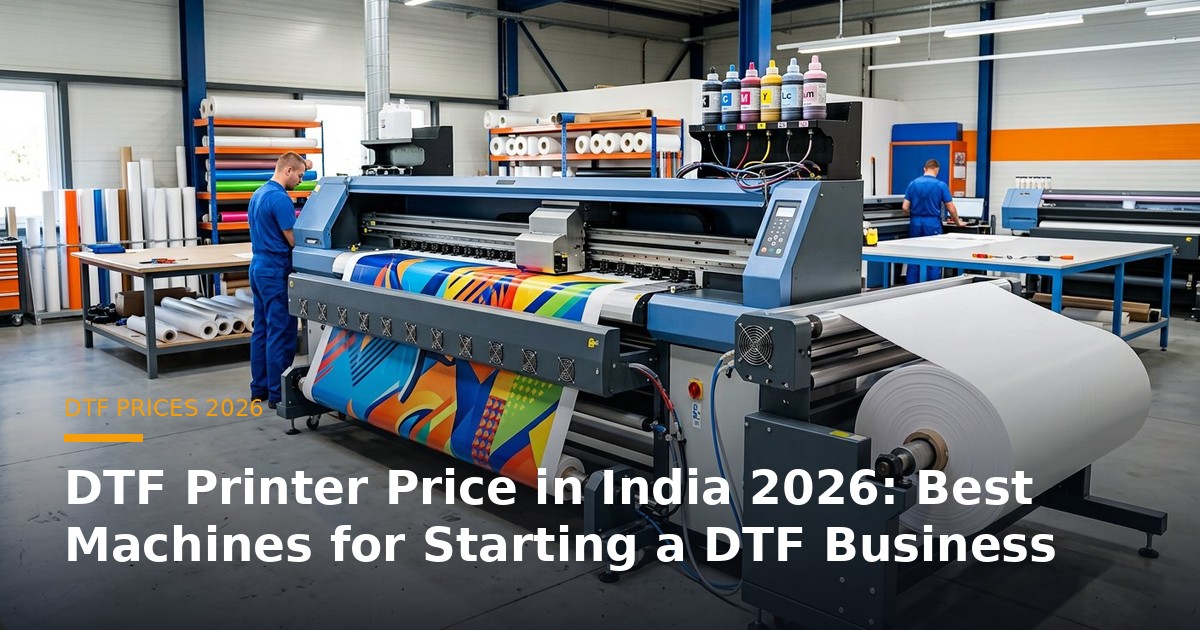
DTF (Direct-to-Film) printing has become one of the fastest-growing segments of the Indian printing industry, because it lets businesses print vibrant, durable transfers for garments and textiles without the setup costs of screen printing. If you are researching the DTF printer price in India for 2026, this guide explains what DTF machines cost, what you need to get started, and why DTF is such an attractive business opportunity.
DTF’s appeal is simple: it prints full-colour designs onto a special film, which are then transferred onto cotton, polyester and blends with a heat press. There are no screens, no colour limits and no minimum orders, making it ideal for custom apparel, small batches and on-demand printing — a perfect fit for the growing customisation market.
DTF Printer Price in India 2026 — Snapshot
| Configuration | What’s Included | Indicative Price (2026) |
|---|---|---|
| Entry DTF printer | Printer only (i3200/XP600) | ₹1.5L – ₹3.0L |
| DTF printer + powder shaker | Printer + dryer/shaker | ₹3.0L – ₹5.0L |
| DTF bundle with heat press | Complete starter setup | ₹3.5L – ₹6.0L |
A complete DTF setup — printer, powder shaker/dryer and heat press — typically lands between ₹3.5 lakh and ₹6 lakh, making it one of the most accessible garment-printing businesses to start.
What You Need to Start a DTF Business
Unlike screen printing, DTF needs very little equipment: a DTF printer, a powder shaker and dryer (or a manual oven for small setups), a heat press, DTF film, DTF inks and adhesive powder. That’s it. There are no screens to make, no colour separations and no lengthy setup, so you can go from design to finished transfer quickly. This low equipment and space requirement makes DTF ideal for small businesses, home-based operations and custom apparel start-ups.
What You Can Print with DTF
DTF works on a remarkably wide range of fabrics and products: cotton, polyester and blended t-shirts, hoodies, caps, bags, sportswear, uniforms and fashion apparel. Because it handles full-colour, detailed designs with no colour limits, it is perfect for photographic prints, gradients and complex graphics that screen printing struggles with. It also works on dark garments without the limitations of some other digital methods. This versatility makes DTF ideal for custom apparel brands, merchandisers, event and team wear, and on-demand printing services.
DTF vs Screen Printing vs Other Methods
Compared with screen printing, DTF has no setup cost per design and no minimum order, making it far more economical for small batches and one-off custom orders, though screen printing remains cheaper for very large runs of a single design. Compared with DTG (direct-to-garment), DTF is more versatile across fabric types and often more durable, without the pretreatment DTG requires on cotton. Compared with vinyl, DTF handles full-colour, detailed designs that vinyl cannot. For a business focused on custom, short-run and on-demand apparel, DTF offers the best balance of versatility, quality and low setup cost.
Running Costs and Profitability
DTF running costs are modest: film, ink and powder per transfer are inexpensive, and the cost per print stays low even for small, detailed designs. Because custom apparel commands good prices — often ₹100–300 or more per printed garment depending on size and market — margins are attractive. The low equipment cost means a DTF business can break even quickly, especially in the booming customisation and on-demand market. As with any print business, profitability comes from keeping the equipment busy and marketing your custom apparel services effectively.
Why Buy Your DTF Setup from UED?
Unified Engineering Dynamics (UED) supplies, installs and services DTF printing setups across India, including printers, powder shakers, dryers and heat presses. We help you choose the right configuration for your volume and budget, provide genuine printheads, inks and consumables, professional installation and training, and dependable after-sales support — so your DTF business starts producing saleable custom apparel quickly and reliably.
Setting Up Your DTF Workflow
A smooth DTF workflow is simple but benefits from good organisation. Design or receive artwork, print it mirrored onto DTF film, apply adhesive powder while the ink is wet, cure the powder in the shaker-dryer or oven, then heat-press the transfer onto the garment. For consistent quality, use good DTF film and inks, control your curing temperature and time, and press at the right temperature, pressure and duration for each fabric. Keep your printer maintained with regular head cleans and proper capping. Printers who standardise their settings and maintain their equipment produce consistent, durable transfers that wash well and keep customers coming back.
DTF Business Opportunities in India 2026
The demand drivers for DTF in India are strong. The customisation boom — personalised t-shirts, team wear, corporate merchandising, event and festival apparel — continues to grow, fuelled by e-commerce and social media. Schools, colleges, sports teams and companies regularly order bulk custom apparel. Fashion start-ups and print-on-demand services need short-run, full-colour printing with no minimums. DTF’s ability to print detailed, full-colour designs on any fabric, with no screens and no setup cost, positions it perfectly for this market. A DTF business that markets itself well to custom apparel customers can grow quickly from a small, low-cost setup.
Common DTF Problems and How to Fix Them
Most DTF issues are easy to resolve once you know the causes. Poor adhesion or cracking usually means incorrect curing temperature, insufficient powder or wrong press settings, so calibrate your dryer and press for each fabric. Dull or inconsistent colour points to old ink, wrong profiles or a partially clogged head, fixed with fresh ink, proper profiles and a head clean. Film feeding problems come from humidity or incorrect tension. White ink settling can cause uneven coverage, so keep white ink agitated as recommended. Learning these basics keeps your output consistent and your customers satisfied.
Growing Your DTF Business
DTF scales naturally as demand grows. You can start with a single printer and heat press for custom and small-batch work, then add a powder shaker-dryer for faster curing and higher throughput as volume increases. Many businesses add a second printer or an automated shaker-dryer line once orders justify it. Because DTF serves the booming customisation market, growth often comes quickly through repeat customers, bulk team and corporate orders, and print-on-demand partnerships. Start lean, deliver consistent quality, market your custom apparel services actively, and reinvest profits to scale — a proven, low-risk path into one of printing’s fastest-growing segments.
Why DTF Is Booming in India in 2026
DTF printing has exploded in popularity across India because it aligns perfectly with several powerful market trends. The rise of e-commerce and social-media-driven fashion has created huge demand for custom, small-batch and on-demand apparel that screen printing cannot serve economically. Young consumers want personalised t-shirts, hoodies and merch in any design and any quantity, and DTF delivers exactly that with no screens, no setup cost and no minimum orders. Schools, colleges, sports teams, startups and corporate brands regularly order custom apparel in modest quantities, and DTF handles full-colour, detailed designs on cotton, polyester and blends — including dark garments — without the limitations of other digital methods. The equipment is affordable and compact, so even a home-based or small-shop operation can start profitably. For an entrepreneur looking for an accessible, high-growth printing niche in 2026, DTF is arguably the best opportunity in the industry right now.
DTF Quality, Durability and Wash Performance
Modern DTF transfers are remarkably durable when produced correctly. The design is printed onto film, bonded with adhesive powder, cured, and heat-pressed into the fabric, where it forms a flexible, vibrant layer that stretches with the material and withstands repeated washing without cracking or peeling. Print quality is excellent — full colour, fine detail and smooth gradients — rivalling or exceeding screen printing for complex designs, and far surpassing vinyl for photographic work. Wash performance depends on using good film, ink and powder, curing and pressing at the correct temperature and time, and following proper garment-care guidance. When these steps are right, DTF prints routinely last the lifetime of the garment through dozens of washes. This durability, combined with low setup cost and design flexibility, is why DTF has become the go-to method for custom apparel businesses that want to deliver quality their customers will recommend.
Choosing DTF Film, Ink and Powder
Consumable quality has a direct impact on your DTF output, so it is worth understanding your options. DTF film comes in hot-peel and cold-peel varieties; choose the type that suits your workflow and press, and buy consistent, good-quality film to avoid feeding and transfer problems. DTF inks — including the crucial white ink that makes designs opaque on dark garments — should be fresh and from a reliable supplier, because old or poor ink causes dull colour and head clogs. Adhesive powder, which bonds the design to the fabric, comes in different grades; a good powder ensures strong, flexible adhesion that survives washing. Using consistent, quality consumables and storing them properly keeps your output reliable and your printhead healthy, which protects both your reputation and your margins.
Pricing DTF Transfers and Apparel Profitably
Profitable DTF pricing starts with knowing your true cost per transfer — film, ink, powder, power and labour — then pricing according to the value of the finished product rather than simply marking up cost. Plain transfers sold to other printers compete on price, while finished, pressed garments and custom orders command much higher margins because customers value the design, quality and convenience. Offer tiered pricing for single pieces, small batches and bulk orders, and charge appropriately for complex, full-colour designs that showcase DTF’s strengths. Many new DTF businesses undercharge for detailed work; pricing confidently for quality and customisation, while staying competitive on simple bulk orders, builds a healthier and more sustainable business.
DTF vs DTG: Which Should You Choose?
DTF and DTG (direct-to-garment) are both digital garment-printing methods, but they differ in important ways. DTG prints directly onto the garment and requires pretreatment on cotton, works best on light cotton fabrics, and has higher per-print ink costs. DTF prints onto film first and transfers onto almost any fabric — cotton, polyester, blends and dark garments — without pretreatment, with greater versatility and often better durability and vibrancy on a wider range of materials. DTF equipment is also generally more affordable and easier to maintain than DTG. For a new business focused on custom apparel across varied fabrics and colours, DTF is usually the more versatile and cost-effective choice, which is why it has become the dominant method in India’s booming customisation market.
Your First Steps with a DTF Setup
Getting started with DTF is straightforward. Once your machine, powder shaker or dryer and heat press are installed, run test prints to dial in your curing temperature, powder coverage and press settings for the fabrics you will use most. Keep good film, fresh ink and quality powder on hand, and maintain the printer with regular head cleans and proper capping. Start by fulfilling custom orders for friends, local businesses and online customers, gather feedback, and refine your settings for consistent, wash-durable results. With a little practice you will produce professional transfers quickly, and the low setup cost means your DTF business can become profitable from the very first orders.
Frequently Asked Questions
What is the DTF printer price in India in 2026?
An entry DTF printer costs around ₹1.5–3 lakh, while a complete setup with powder shaker, dryer and heat press typically ranges from ₹3.5 lakh to ₹6 lakh depending on configuration and automation.
Is DTF printing a profitable business?
Yes. With low equipment and setup costs, no minimum orders and strong demand for custom apparel, DTF offers attractive margins and a quick break-even, especially in the on-demand customisation market.
What fabrics can DTF print on?
DTF works on cotton, polyester and blends, and on products like t-shirts, hoodies, caps, bags and sportswear, including dark garments, with no colour limits.
Do these prices include GST and installation?
Usually not. Prices are typically ex-GST and may exclude installation and training. Always request a written, configuration-specific quotation.
Want an exact, configuration-specific quote? Talk to UED’s printing specialists — share your requirements and budget, and we’ll recommend the right machine with transparent pricing. Request a quote →
Prices on this page are indicative 2026 market ranges (ex-GST) and vary with configuration, accessories, installation and location. Always confirm a written, configuration-specific quotation before purchase.
