

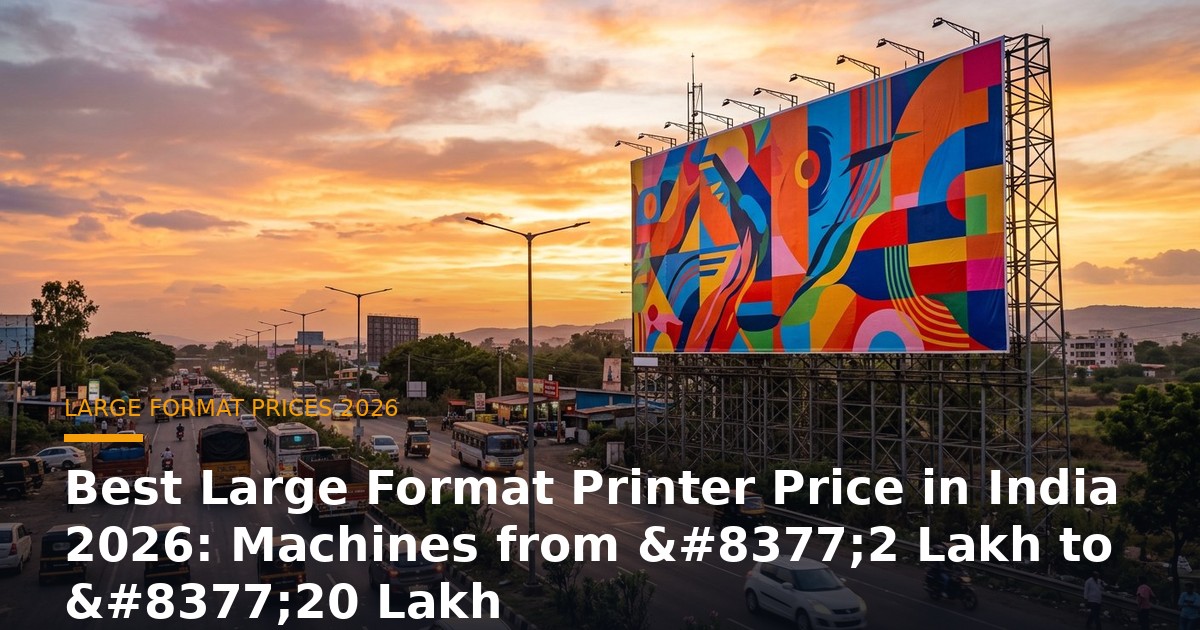
Large format printing covers everything from shop boards and banners to building wraps, hoardings, exhibition graphics and backlit displays — and the machines that produce it span an enormous price range. In India in 2026, a large format printer can cost anywhere from about ₹2 lakh for an entry eco-solvent machine to ₹20 lakh or more for a high-speed industrial line. This guide breaks the market into clear price tiers, explains what each tier gets you, and helps you choose the right machine for the work you want to win.
The term “large format” simply means printing wider than a standard office or small commercial printer can handle — typically 6 ft, 8 ft, 10 ft or more. Because the applications are so varied, the right machine depends less on size alone and more on the technology, speed and quality your target jobs demand.
Large Format Printer Price Tiers in India 2026
| Tier | Typical Machine | Indicative Price | Best For |
|---|---|---|---|
| Entry (₹2L–₹5L) | XP600 / i3200 eco-solvent, 6–8 ft | ₹2.0L – ₹5.0L | Start-ups, local signage |
| Mid (₹5L–₹10L) | Konica 512i 2–4 head, 10 ft | ₹5.0L – ₹10.0L | Growing commercial printers |
| Production (₹10L–₹20L) | Konica 512i 8-head / 1024i, 10 ft | ₹10.0L – ₹20.0L | High-volume, multi-shift |
Each tier roughly doubles the capability and cost of the one below it. The right tier is the one that matches your sellable volume and the quality expectations of your customers — not the biggest machine you can finance.
Entry Tier (₹2–5 Lakh): Getting Started
At the entry level you will find 6–8 ft eco-solvent machines built on XP600 or Epson i3200 printheads. These produce perfectly saleable output for shop boards, banners, stickers, backlit panels and local advertising, at a cost that keeps a new business’s break-even achievable. The trade-off is lower speed and narrower width, which suits printers building a local customer base rather than chasing large hoarding contracts. For most first-time large format buyers, this tier is the sensible starting point.
Mid Tier (₹5–10 Lakh): The Commercial Sweet Spot
The mid tier is where most established Indian large format printers operate. These are typically 10 ft Konica 512i machines in two-head or four-head configurations, offering the speed, width and durability to serve advertising agencies, retail chains and event companies with fast turnaround. At ₹5–10 lakh, a mid-tier machine is a serious production asset that pays for itself through throughput and the ability to take on larger, more profitable jobs that entry machines cannot handle.
Production Tier (₹10–20 Lakh): High-Volume Output
The production tier includes eight-head Konica 512i lines and Konica 1024i machines built for genuine high-volume, multi-shift operation. These deliver the lowest cost per square foot at scale and let printers win large hoarding tenders and bulk campaign work. At ₹10–20 lakh they are major investments, justified only when you have consistent volume to keep them busy — but for a high-demand operation, the throughput advantage is decisive.
Large Format Technologies Compared
Most large format machines in this price range are eco-solvent, which is ideal for flexible media like flex, vinyl and backlit film — the core of Indian signage work. UV roll-to-roll machines occupy a similar price band but can also print on rigid and specialty substrates, opening additional product lines. Dye-sublimation machines serve the textile and soft-signage market. For a printer focused on conventional signage and advertising, eco-solvent remains the most cost-effective large format technology; if you want to print on rigid boards, acrylic or glass as well, a UV machine is worth considering.
Choosing by Application
- Shop boards, banners, local signage: an entry-tier 6–8 ft eco-solvent machine.
- Agency work, retail chains, events, backlit: a mid-tier 10 ft Konica 512i machine.
- Hoardings, bulk campaigns, multi-shift volume: a production-tier 8-head 512i or 1024i line.
- Rigid substrates and premium products: consider a UV roll-to-roll or flatbed machine.
Return on Investment Across Tiers
Higher-tier machines cost more but produce more saleable area per hour, so their cost per square foot falls as volume rises. The key to a good return in any tier is utilisation: a mid-tier machine kept busy outperforms a production line that idles. Estimate your realistic monthly volume, work out the payback for each tier, and buy the one that meets your peak demand with modest headroom. Remember to budget for media, ink, power protection and finishing alongside the machine itself.
Buying Guide: What to Check Before You Buy
Whatever tier you choose, verify the exact printhead model and count, the print width, the automation features (servo drives, media take-up, heaters and dryers), the RIP software included, and the supplier’s warranty and service coverage. Get at least three written, configuration-specific quotations and compare them line by line. Prioritise a supplier with responsive local service and ready spares, because in large format printing, downtime directly costs you revenue and customer trust.
Why Buy Your Large Format Printer from UED?
Unified Engineering Dynamics (UED) supplies, installs and services large format printers across India, from entry eco-solvent machines to high-speed Konica production lines. We help you choose the right technology, width and head count for your applications and volume, provide genuine printheads and inks, and back every machine with professional installation, training and dependable after-sales support — so your large format investment performs from day one.
Large Format Applications and What They Pay
Large format output is valuable precisely because it is visible and high-impact. Shop boards and fascia signage are a constant, recurring need for every retail business. Hoardings and building wraps command premium rates because of their scale and installation complexity. Backlit displays for malls, airports and retail are high-margin, quality-sensitive work. Exhibition and event graphics are seasonal but lucrative, and vehicle wraps and fleet branding reward skilled finishing. Point-of-sale and promotional graphics for brands provide steady repeat volume. Understanding which of these you can credibly serve — and what each pays in your market — tells you which tier of machine to buy. A printer targeting premium backlit and wrap work should prioritise quality; one chasing hoarding volume should prioritise speed.
Width, Speed and Quality Trade-Offs
These three factors pull against each other, and every purchase is a balance. Wider machines handle bigger jobs in one pass and reduce joining, but cost more and need more space. Faster machines produce more per hour, but pushing speed too far can compromise quality if the media, curing and profiles are not matched to it. Higher quality usually means more passes and slower output. The right balance depends on your work: detail-sensitive retail and backlit jobs favour quality, while bulk banners and hoardings favour speed. Buy a machine whose sweet spot matches the majority of your order book, and use profiles and pass settings to fine-tune individual jobs.
Setting Up a Large Format Print Business
Beyond the printer, a viable large format business needs supporting capability. You will need finishing equipment — cutting, laminating, eyeleting, welding for flex, and framing or mounting for rigid work. You will need a RIP with good colour management, a clean and climate-controlled print area, reliable power with protection, and an initial stock of media and inks. Just as important, you need a route to market: relationships with advertising agencies, retailers, builders and event companies generate the steady volume that makes the machine pay. Many successful large format printers pair the hardware with installation services, which adds margin and locks in repeat customers.
Imported vs India-Assembled Machines
Buyers sometimes weigh fully imported machines against those assembled or integrated in India. The practical differences come down to price, spares availability and service. What matters most is that the printheads are genuine, the specification is clear and in writing, and the supplier can service the machine quickly with ready spares. A well-supported machine with genuine Konica or Epson heads and responsive local service is worth more than a marginally cheaper alternative that leaves you waiting for parts. Always buy from a supplier who stands behind the machine with installation, training and after-sales support.
Large Format Printing Trends in India 2026
Several trends are shaping the large format market in India heading into 2026, and aligning your purchase with them improves your odds of a strong return. Retail and quick-commerce expansion into smaller towns continues to drive demand for shop signage, in-store graphics and promotional material. Brands are investing more in experiential and out-of-home advertising, which favours high-impact hoardings, building wraps and backlit displays. Sustainability is becoming a purchasing criterion, so lower-odour eco-solvent and the ability to print on recyclable media is an advantage when pitching to environmentally conscious clients. Shorter, faster campaign cycles reward printers who can turn jobs around quickly, which argues for adequate speed and reliable automation. And the growth of events, exhibitions and regional festivals sustains seasonal but lucrative demand for large graphics. Buying a machine that can serve these trends — good quality, decent speed, flexible media handling — positions you for the next few years rather than just today.
Common Large Format Buying Mistakes
First-time large format buyers repeat a few costly errors. The most common is buying on price alone and discovering too late that service and spares are poor, turning every breakdown into weeks of lost revenue. The second is buying too small and outgrowing the machine within a year, forcing an expensive early replacement; if you already have demand waiting, buy a little more capacity than you need today. The third is underestimating the finishing side — a printer without proper cutting, laminating and mounting capability cannot deliver finished, high-margin work. The fourth is neglecting power protection and a clean print environment, which are leading causes of premature head and electronic failure in Indian conditions. The fifth is competing purely on price for commodity work instead of building a reputation for quality and reliability. Avoiding these mistakes does more for your profitability than any single hardware specification, and a good supplier will help you sidestep all of them.
Quick Verdict: Which Large Format Machine Should You Buy?
If you are just starting out, an entry-tier 6–8 ft eco-solvent machine on an XP600 or Epson i3200 head gets you producing saleable signage, banners and backlit work for around ₹2–5 lakh. If you already serve advertising agencies, retail chains or event companies, a mid-tier 10 ft Konica 512i machine at ₹5–10 lakh is the commercial sweet spot that pays for itself through throughput and faster turnaround. If you run multiple shifts on bulk hoardings and campaigns, a production-tier eight-head 512i or Konica 1024i line at ₹10–20 lakh delivers the lowest cost per square foot and lets you win volume tenders. Whatever tier you choose, buy from a supplier who provides genuine printheads, clear written specifications and responsive local service, and budget for media, ink, finishing equipment and power protection alongside the machine itself so you can actually run it from day one.
Frequently Asked Questions
What is the large format printer price in India in 2026?
Large format printers range from about ₹2 lakh for an entry 6–8 ft eco-solvent machine to ₹20 lakh or more for a high-speed eight-head Konica or 1024i production line, with most commercial printers investing in the ₹5–10 lakh mid tier.
Which large format machine is best for a new business?
An entry-tier 6–8 ft eco-solvent machine on an XP600 or Epson i3200 head is the most affordable way to start producing saleable signage, backlit and banner work.
What is the difference between eco-solvent and UV large format printers?
Eco-solvent machines excel on flexible media like flex and vinyl and are generally cheaper to run for signage. UV machines can also print on rigid substrates such as acrylic, board and glass, opening more product lines at a higher cost.
How wide a machine do I need?
Most signage and banner work is well served by an 8 ft machine. If you regularly print large hoardings or wide backlit panels, a 10 ft machine saves joining time and material.
Do these prices include GST and installation?
Usually not. Prices are typically ex-GST and may exclude installation and training. Always request a written, configuration-specific quotation.
Want an exact, configuration-specific quote? Talk to UED’s printing specialists — share your print width, monthly volume and budget, and we’ll recommend the right machine with transparent pricing. Request a quote →
Prices on this page are indicative 2026 market ranges (ex-GST) and vary with configuration, printhead count, automation, accessories, installation and location. Always confirm a written, configuration-specific quotation before purchase.
