

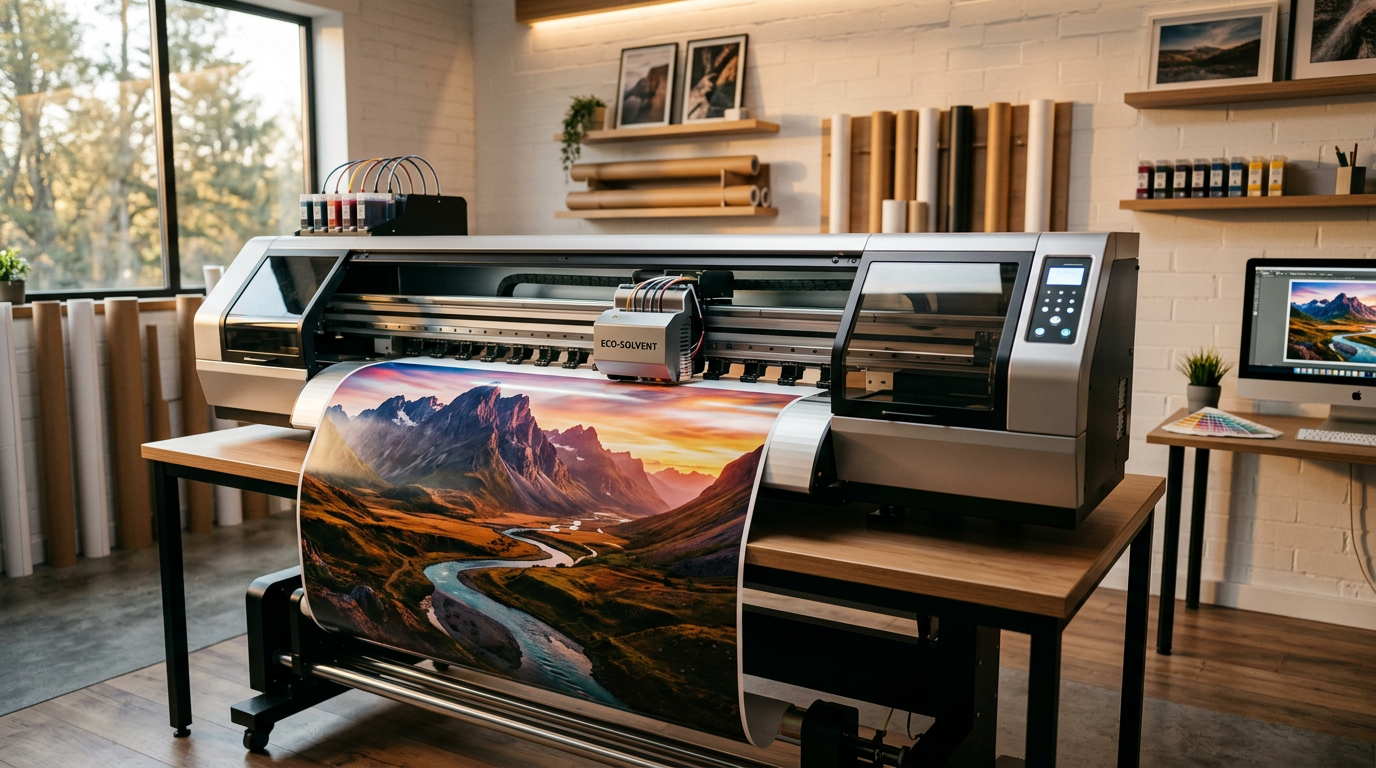
Quick Answer: The best eco solvent printer for a small business in India in 2026 is the 1.6m single-head machine with an Epson i3200 print head (₹1.65–2.75 lakh) — it delivers professional photo quality, the lowest credible entry cost, greast parts availability, and payback within 5–8 months at moderate volumes. Upgrade straight to a 1.8m dual-head i3200 (₹2.75–4.5 lakh) if vehicle wraps or daily volumes above 100 sq m anchor your plan, and avoid DX5 and unbranded ultra-cheap builds entirely. Below: all six configurations compared with specs, true costs, and the exact buyer each one fits.
Type “best eco solvent printer” into Google in India and you’ll drown in dealer listicles, rebranded Chinese chassis with identical specs, and “top 10” articles written by people whose qualification is a keyboard. The honest reality of this market: brands matter less than builds. The same Epson i3200 head powers machines sold under twenty names; what decides your next five years is the head generation, chassis rigidity, heater quality, RIP license — and above all, the service network standing behind the machine.
So instead of a fake brand ranking, this guide compares the six configurations a small business actually has to choose between in 2026 — with current prices, real production speeds, running costs, five-year ownership math, and no mercy for marketing fluff. By the end, “best” will have a specific meaning for your budget and order book.
How We Judged “Best” for Small Business
Big factories optimise for throughput; small businesses optimise for survival-plus-growth. Every pick below is scored on what actually matters at your scale:
- Entry price relative to earning power — months to payback, not sticker bragging rights
- Print quality — your entire premium-rate story rests on visible output excellence
- Head economics — replacement cost, availability, realistic lifespan in Indian conditions
- Media range — how many revenue streams one machine can carry
- Serviceability — can it be fixed this week in your city?
- Failure forgiveness — how kindly it treats operator mistakes while you’re learning
Top 6 Picks at a Glance
| Pick | Configuration | Price (₹) | Production Speed | Cost/sq ft | Best For |
|---|---|---|---|---|---|
| 🏆 Best Overall | 1.6m, 1× Epson i3200 | 1.65–2.75L | 12–18 sq m/hr | ₹10–16 | Most small businesses |
| ⚡ Best Production | 1.8m, 2× Epson i3200 | 2.75–4.5L | 25–30 sq m/hr | ₹10–15 | Wraps, daily volume shops |
| 💰 Tightest Budget | 1.6m, 1× Epson XP600 | 1.35–1.85L | 8–14 sq m/hr | ₹11–17 | Hobby-to-business testing |
| 🖼️ Best Wide-Format | 3.2m, 2× i3200 | 6–8.5L | 25–30 sq m/hr | ₹11–16 | Murals, bus graphics, exhibitions |
| 🏭 Best Mini-Factory | 3.2m, 4× i3200 | 8.5–12L | 50–60 sq m/hr | ₹10–14 | Established premium print houses |
| ⚠️ Only-if-Forced | 1.6m, legacy DX5 | 0.9–2.2L | 8–12 sq m/hr | ₹12–18 | Extreme budget, with full risk awareness |
🏆 Pick 1 — Best Overall: 1.6m Single i3200 (₹1.65–2.75 Lakh)
If we could recommend only one machine to every small printing business in India, this is it — and it’s not close. The 1.6m single-head i3200 build is the highest-volume eco solvent configuration sold in the country for one reason: it converts the smallest capital into the broadest credible product range at genuinely professional quality.
Complete Specifications
| Specification | Details |
|---|---|
| Print Head | 1× Epson i3200-A1/E1 — 3,200 nozzles, 3.5 pl minimum droplet |
| Max Print Width | 1.6 m (63″) |
| Speed (field-verified) | Draft ~20 sq m/hr · Production 12–18 · Photo 5–8 |
| Resolution | Up to 2400 dpi (production sweet spot 720×1440) |
| Colors | CMYK standard; Lc/Lm on select builds |
| Drying | Three-zone heater + fan system |
| Media | SAV vinyl, backlit film, canvas, wallpaper, photo paper, OWV, mesh, PP |
| Power Draw | ~1.2–1.8 kW with heaters; runs on standard 15A + 2 kVA UPS |
| Footprint | ~2.7 × 0.9 m — genuinely fits a spare room |
| Head Replacement | ₹45,000–80,000, every serious dealer stocks it |
Why It Wins
- Photographic output at business-viable speed: this head produces prints that jewellers, photographers, and brand stores accept without negotiation — the entire eco-solvent business case.
- Healthy economics: ₹11–13/sq ft all-in running cost against ₹25–60/sq ft selling rates; 55–70% gross margin on most product lines.
- Forgiving learning curve: mild-eco solvent chemistry plus precision head equals survival of beginner mistakes that kill solvent heads.
- Fastest payback in class: 5–8 months at average shop volumes; fastest in this entire list.
- Deep used-market: maintained units resell quickly at 40–55% of purchase price — your downside stays protected.
Honest Weaknesses
One head means zero redundancy — head faults stop billing completely until parts arrive. Production speed caps out at ~120 sq m/day, refusing genuinely big rush orders. And 1.6m width forces vertical seams on standard vehicle side panels. All three are the true costs of its class-leading price.
Buy this if: you’re entering the business, your capital is under ₹7 lakh all-in, and your product mix is stickers, boards, backlit, canvas, wallpaper for local clients. This is the default-correct answer.
⚡ Pick 2 — Best Production: 1.8m Dual i3200 (₹2.75–4.5 Lakh)
The dual-head 1.8m is where an eco solvent setup stops being a craft tool and becomes a daily production business. Two staggered i3200 heads nearly double throughput, and the wider bed erases the seam problem on vehicle panels.
Complete Specifications
| Specification | Details |
|---|---|
| Print Heads | 2× Epson i3200 (staggered) |
| Max Print Width | 1.8 m (72″) |
| Speed | Draft ~38 sq m/hr · Production 25–30 · Photo 10–14 |
| Daily Capacity | 200–240 sq m per shift |
| Take-Up | Motorised, tension-controlled (mandatory at this duty) |
| Head Investment on Carriage | ₹90,000–1,60,000 — insure and maintain accordingly |
| Space | ~3 × 1.1 m machine + working space |
Why It Wins for Established Shops
- 2× speed changes the business you can accept: same-day wrap jobs, Friday evening retail rollouts, 200-sq-ft sticker batches before lunch.
- 1.8m width = seamless vehicle panels and folded-two-up nesting that cuts media waste 10–15%.
- Graceful degradation: one head issue means printing at reduced speed, not zero billing.
- Better cost/sq ft at volume: fixed overheads (power dust discipline, one operator) divide across double output.
Honest Weaknesses
The ∼₹1.2–1.75 lakh premium over single-head buys nothing if your daily volume stays under 60–80 sq m — capacity without orders is just depreciation. Two heads double maintenance minutes and cleaning-solution consumption. And the bigger machine quietly demands sturdier flooring planning and more working room than first-time buyers expect.
Buy this if: your order book already proves 100+ sq m daily peaks, wraps/vehicle graphics are core revenue, or you’re upgrading a saturated single-head machine that’s refusing work weekly.
💰 Pick 3 — Tightest Budget: 1.6m Single XP600 (₹1.35–1.85 Lakh)
The XP600 build exists for one legitimate purpose: market-testing at minimum capital. Same 3.5-pl-droplet photo quality as its bigger siblings, roughly half the speed, roughly a third of head price, roughly a year of realistic head life.
| vs i3200 Build | XP600 Build |
|---|---|
| Machine saves | ₹40–90k upfront |
| Head replacement | ₹15–22k every 8–14 months (vs 18–36 for i3200) |
| Production speed | ~40–60% of i3200 — rush orders slip |
| Best case | Boutique/low-volume niche work where speed never binds |
| Worst case | Growing shop that outgrows it in six months and re-buys anyway |
Buy this if: your budget genuinely caps below ₹2 lakh, volume is modest and predictable, and you accept the head-replacement rhythm as a cost of entry. Otherwise, stretch to i3200 — nearly every XP600 owner we meet eventually wishes they had.
🖼️ Pick 4 — Best Wide-Format: 3.2m Dual i3200 (₹6–8.5 Lakh)
Wide eco solvent is where premium interiors get made: full-height seamless wall murals, complete bus/van graphics in single panels, exhibition walls at photographic quality. It earns at ₹40–120/sq ft in markets where that demand demonstrably exists.
Buy this only when: relationships with interior designers, exhibition fabricators, or fleet owners are already billing, and the premium-rate pipeline is written, not imagined. As a first machine on speculative premium demand, the wide format is the industry’s prettiest way to park ₹7 lakh.
🏭 Pick 5 — Best Mini-Factory: 3.2m Quad i3200 (₹8.5–12 Lakh)
Four i3200 heads at 50–60 sq m/hr production speed — this is print-house hardware for established businesses adding premium wide-format production next to solvent banner volume. It requires the full industrial environment: climate control, dedicated power, trained operators, service contracts. Small businesses should neither start here nor aspire here until 1.8m machines are demonstrably saturated with work.
⚠️ Pick 6 — Only-If-Forced: Legacy DX5 Machines (₹0.9–2.2 Lakh)
We include the DX5 class only because the market still sells it aggressively. Honest position in 2026: Epson ended this head’s production years ago; available heads come from residual OEM stock at scarcity prices (₹38–55k — more per head than a new XP600 machine’s engine room) or from clone suppliers with lottery-grade reliability. The chassis may print beautifully for years — right until its first head failure strands you hunting rare parts with money in hand and nothing to buy.
Buy this only if: the deal is exceptional, a full live test passes under your watch, you’re mechanically self-reliant, and you’ve priced in early head replacement. For 90% of buyers in 2026, the correct answer on DX5 is a polite decline.
The Real Comparison: 5-Year Ownership Costs
| Cost Head (5 Years) | 1.6m XP600 | 1.6m i3200 | 1.8m Dual i3200 | 3.2m Dual |
|---|---|---|---|---|
| Machine + infrastructure | ₹1.7L | ₹2.4L | ₹3.9L | ₹7.6L |
| Laminator | ₹0.55L | ₹0.55L | ₹0.6L | ₹0.8L |
| Heads (replacements) | ₹0.9L (5 × ~18k) | ₹1.5L (2 × 75k) | ₹3.0L (4 × 75k) | ₹3.0L |
| Ink (volume-adjusted) | ₹2.6L | ₹3.5L | ₹6.8L | ₹7.2L |
| Parts + service | ₹0.8L | ₹0.9L | ₹1.4L | ₹1.9L |
| 5-Year Total | ₹6.55L | ₹8.85L | ₹16.3L | ₹20.5L |
| Realistic 5-yr output | ~35,000 sq m | ~45,000 sq m | ~90,000 sq m | ~95,000 sq m |
| Cost per sq m | ₹18.7 | ₹19.7 | ₹18.1 | ₹21.6 |
The table’s surprise: per-square-metre costs across the mainline picks cluster tightly (₹18–22). Machines don’t differ on cost efficiency nearly as much as they differ on revenue capture per day. The dual-head doesn’t print cheaper — it prints more billable metres before the day ends. Choose capacity against your real daily demand curve, not against imaginary future growth.
Buyer’s Checklist (Any Configuration)
- ✅ Head model + sealed OEM packing verified physically before final payment
- ✅ Live production-speed test with your file, your media, your stopwatch
- ✅ Rub test on fresh print (curing quality) and water beading test (ink quality)
- ✅ Genuine licensed RIP with license card, profiles for your intended media
- ✅ Motorised take-up included, not optional
- ✅ Written all-inclusive quote: machine, heads, RIP, UPS, install, training, GST
- ✅ Warranty scope + exclusions in writing (ask specifically about head coverage)
- ✅ Service engineer location, response SLA, spare head stock confirmed
- ✅ Three installed-customer references within your state — called, not noted
- ✅ Startup consumables priced with the machine (ink set, dampers, cappings, solution)
Entry Budget Blueprints: Three Ready Sums
Quotations make decisions concrete. Three whole-business budgets against today’s prices:
| Blueprint | Machine | Total All-In | Best Suited To |
|---|---|---|---|
| Bootstrap Studio | 1.6m single i3200 + desktop plotter | ₹3.8–4.8L | Design-led small shop, city commerce sites, sticker/boards weighting |
| Quality Workhorse | 1.6m single i3200 + contour plotter + 64″ laminator | ₹5.5–7L | The mainstream start; full product ladder ready |
| Production Pro | 1.8m dual i3200 + pro contour + laminator | ₹7.5–9.5L | Wraps/panels plan, confirmed volume, urgent-cycle clients |
Guideline through every blueprint: reserve at least 15% for working capital. A fully-tooled shop with an empty float limits its own first months harder than any machine spec does.
The Indian Brand Landscape: Who Actually Sells These Machines?
Understanding the market structure makes you a harder target for sales tactics. Eco solvent machines in India flow through four channels:
1. Direct importers with brand lines. The top tier imports container volumes of Chinese chassis, specifies their own head/RIP build, brands the machine, and maintains spare parts warehouses and engineer rosters. Their machines cost 5–10% more than grey-channel equivalents — a premium buying installation quality, training days, warranty honor, and pickup-the-phone permanence. For first-machine buyers, this is the correct channel almost always.
2. Regional assemblers. Smaller operations building frames domestically around genuine imported heads. Quality varies from excellent to opportunistic; the good ones survive on references. Audit their installed base aggressively (five local owners phoned beats five showroom demos) and confirm state-duty plumbing details like take-up motors, rail brands, and PSU build before commitment.
3. Dealer/resellers. Multi-brand shops selling whatever monthly scheme benefits. Fine if the same dealer services what they sell locally; dangerous when they’re a sales front for another city’s importer with no committed engineer.
4. Marketplace sellers. Machine listings on generic B2B marketplaces with no on-site service commitments behind them. The single most common regret-purchase channel in Indian printing — machines arrive, training doesn’t, warranty numbers ring out by month three.
Small Print, Big Difference: Details That Separate Good Builds
When two i3200 machines quote within ₹15,000 of each other, these engineering details are what you’re actually comparing:
- Rails and guide blocks: genuine Hiwin/THK linear rails run straight for years; anonymous rails develop the vertical banding no calibration ever cures. Ask the rail brand by name.
- Heater plate construction: cast heated platens hold set temperature evenly; thin plates hot-spot and cold-spot, shifting color mid-roll.
- Take-up motion: dual-motor synchronized take-ups track 50 m rolls without edge-pull taper; single passive rollers skew under load.
- Cabling and drag-chain quality: print-carriage looms flex fifty thousand times a month — industrial drag-chain builds survive; strapped ribbon builds intermittent-fault in year two.
- RIP and control software firmware status — current-generation boardsets with field-upgradeable firmware age gracefully; static legacy boards strand you for features and fixes.
Match the Machine to the Business Model (Not the Other Way Round)
Most first-time buyers shop machines first and invent the business later. The survivors do it backwards: they know exactly what they’ll sell, to whom, at what volume — then pick the smallest machine that serves that plan with 30% headroom. Use this mapping:
| Your Business Model | Core Products | Right Machine | Budget (Machine + Essentials) |
|---|---|---|---|
| Local job shop (market area / high street) | Flex boards, vinyl stickers, one-way vision, shop-front signage | 1.6m single i3200 | ₹2.2–3.2 lakh |
| Offset/digital printer adding large-format | Banners, posters, exhibition panels for existing clients | 1.6m single or dual i3200 | ₹2.4–4.2 lakh |
| Vehicle graphics & wraps | Car wraps, fleet branding, auto decals | 1.8m dual i3200 + laminator (mandatory) | ₹4.5–7 lakh |
| Events & exhibition supplier | Backdrops, standees, fabric frames, stage branding | 1.8m dual i3200 (speed matters, deadlines are brutal) | ₹4–6.5 lakh |
| Sticker/label specialist (online + local) | Die-cut stickers, wall decals, product labels, laptop skins | 1.3–1.6m single XP600/i3200 + cutting plotter | ₹2–3.5 lakh |
| Wholesale/trade printer | Volume banners for resellers, 100+ sq m/day | 3.2m dual-head or two 1.8m machines | ₹6–12 lakh |
Notice how often the answer is the humble 1.6–1.8m i3200 build. That is not a coincidence — it is the segment with the deepest parts pipeline, the most trained technicians, and the fastest payback math in India right now.
Space, Power & Ventilation: Preparing a Small Shop Before Delivery Day
A 1.6m eco solvent machine is bigger and fussier than it looks in photos. Prepare these four things before the truck arrives — most installation disasters trace back to skipped site prep:
- Footprint: the machine body is ~2.6m wide; you need 3.5–4m of clear wall length plus 1.2m in front for loading media rolls and 1m behind for heater exhaust and servicing. Realistic minimum room: 4m × 3m. Ceiling height 2.6m+ helps with roll handling.
- Power: a dedicated 16A line with proper earthing, a 2–3 kVA online UPS or servo stabilizer (voltage fluctuation kills mainboards — non-negotiable in most Indian towns), and a separate line for the laminator. Budget ₹25,000–45,000 for clean power infrastructure. It is cheaper than one board replacement.
- Ventilation: eco solvent ink is mild, not odourless. One exhaust fan (12″ minimum) venting outdoors, cross-ventilation, and no sleeping quarters attached to the print room. For AC rooms — fine, and actually good for ink stability — but still exhaust during long runs.
- Environment: dust is the printhead’s enemy. A room that can be kept reasonably sealed, mopped daily, with media rolls stored upright off the floor, will outlast a dusty godown setup by years.
The First 90 Days: A Realistic Ramp Plan
Nobody opens the shutters to a queue. Here is what a disciplined first quarter looks like for a typical small-town shop:
| Phase | Focus | Targets |
|---|---|---|
| Days 1–15 | Installation, operator practice, media/ink profiling | 50+ test prints on every media type you’ll sell; a printed rate card; lamination practice |
| Days 16–30 | Soft launch to warm network | Free/discounted boards for 10 local shops in exchange for referrals; WhatsApp Business catalogue live; Google Business Profile with photos |
| Month 2 | Volume building | ₹40,000–70,000 billing; 2–3 repeat trade customers (event decorators, other printers who don’t own machines); daily posting of work photos |
| Month 3 | Stabilizing | ₹90,000–1.4 lakh billing; one anchor B2B account (coaching institute chain, real-estate developer, auto dealer group); inquiry log for demand patterns |
By day 90, a well-run single-head shop should be printing 400–800 sq m/month against a break-even of roughly 300–400 sq m. If you’re consistently behind that, the machine is rarely the problem — distribution and pricing are. Fix sales before buying speed.
When One Machine Becomes Two: The Scaling Triggers
Buy machine #2 when data, not optimism, says so. The reliable triggers:
- Utilization: the current machine runs 6+ productive hours daily, 25+ days a month, for two consecutive months.
- Refused work: you’re declining or delaying 20%+ of quoted jobs due to capacity, not price.
- Rush premiums: customers regularly pay extra for same-day delivery — proof that speed, the second machine’s product, has paying demand.
- Cash position: machine #2 should be fundable with ≤50% debt. Your first machine’s EMI should already be retiring comfortably.
When you do scale, the smart second purchase is usually a different capability — add a 1.8m dual-head to a 1.6m single-head shop (bigger, faster jobs), or add a cutting plotter/laminator first if finishing, not printing, is the bottleneck. Diversified capacity beats duplicated capacity.
Five Questions to Ask Every Machine Seller (Small-Business Edition)
- “Show me three customers within 100 km running this exact model.” — then visit or call at least one, unannounced if possible.
- “What’s the printed, itemized list of every consumable I’ll replace in year one and its price?” — heads, dampers, cappings, wipers, pumps. If the seller can’t list it, they don’t service it.
- “If the mainboard dies in month 8, what’s the process and the worst-case cost to me?” — the answer reveals the warranty’s teeth.
- “Who trains my operator, for how many days, and what happens if he quits in month 3?” — retraining support matters; operator churn is real.
- “What ink brand will you supply at what rate, in writing, for 12 months?” — ink is the annuity; lock the price and the grade.
A seller who answers all five crisply, in writing, is a partner. One who deflects two or more is a trader. Both will happily take your money — only one will answer the phone in month nine.
The 7 First-Year Mistakes That Kill Small Print Shops (And the Fixes)
After watching dozens of small-format shops launch, the failure patterns repeat with eerie consistency. All seven are avoidable:
| Mistake | Why It Happens | The Fix |
|---|---|---|
| 1. Pricing by “what the guy nearby charges” | No cost model, fear of losing quotes | Build your rate card from media+ink+time+overhead with a target margin — then hold it |
| 2. Buying every media roll the dealer pushes | Opening-day enthusiasm, dealer sales targets | Stock 4–5 core SKUs deep (vinyl, flex, one-way vision, backlit, lamination); special-order the rest |
| 3. Saying yes to every deadline | Revenue hunger | Promise the deadline you can beat; a shop’s reputation is built on kept dates, not heroic failures |
| 4. Extending informal credit to everyone | Fear of losing B2B accounts | Written terms from job one: advance for new customers, 15–30 days only for proven accounts, escalation script for overdue |
| 5. Zero marketing budget/month beyond launch week | “Work will speak for itself” | Work whispers; marketing repeats it loudly. Fixed monthly habit: reviews, WhatsApp updates, 10 B2B visits |
| 6. Deferring maintenance “because the machine is running fine” | Busiest shops skip the 20-minute daily care | Maintenance is non-negotiable calendar time, like rent. A ₹60,000 head doesn’t care how busy you were |
| 7. No cash buffer for the lean months | Assuming linear growth | Keep 2 months of fixed costs parked; print demand is seasonal even in good years |
A Small Shop’s Monthly P&L: What Healthy Actually Looks Like
Benchmark a single-head 1.6m operation at steady state (Year 1, Month 9+). If your numbers drift far from this shape, the shape tells you where to look:
| Line | Healthy Range (Monthly) | % of Revenue |
|---|---|---|
| Revenue (350–600 sq m mixed work) | ₹1,00,000–1,80,000 | 100% |
| Media + ink (cost of goods) | ₹35,000–65,000 | 32–38% |
| Rent + power + internet | ₹12,000–22,000 | 10–14% |
| Labour (operator/helper; owner unpaid initially) | ₹12,000–25,000 | 12–16% |
| EMI on machine (if financed) | ₹8,000–15,000 | 7–10% |
| Maintenance kit + misc | ₹2,000–4,000 | ~2% |
| Owner’s profit | ₹25,000–55,000 | 22–32% |
The diagnostic reads: COGS above 40% → pricing too low or waste too high. Labour above 20% at this scale → overstaffed for volume. Profit below 15% with a healthy order book → raise prices 8–12% on your top three products and watch demand barely notice — small-format printing is far less price-elastic than new owners fear, because customers buy trust and turnaround, not ₹2/sq ft differences.
Frequently Asked Questions (FAQs)
Q1. Which eco solvent printer is best overall for a small business?
The 1.6m single-head Epson i3200 build at ₹1.65–2.75 lakh. It balances entry price, photographic quality, head availability, forgiveness for learners, and payback speed better than any alternative in the 2026 market.
Q2. How much should a small business budget in total?
₹4.2–6.8 lakh all-in: machine ₹1.65–2.75L, laminator ₹45–70k, design PC ₹35–60k, UPS ₹18–30k, startup inventory ₹40–65k, room setup, and two months of working capital. Budgets that omit the laminator and working capital stall in month one.
Q3. Is a Chinese machine with genuine Epson head reliable?
Yes — the industry’s open secret is that virtually every eco solvent machine sold in India pairs a Chinese chassis with genuine Epson heads. Reliability is decided by chassis/rail/heater quality plus the service network, not by the sticker on the cover.
Q4. Eco solvent or solvent machine for a small business?
Eco solvent suits quality-rate products (stickers, wraps, wallpaper, canvas) in cleaner premises with premium clients; solvent suits high-volume outdoor banner commodity work. Deep comparison in our eco solvent vs solvent guide — in short, know your market’s rate card before you choose its machine.
Q5. How long does the i3200 head actually last?
With daily nozzle checks, wet-cap parking, quality ink, and dust discipline: 18–36 months of commercial use is the realistic band, occasionally longer. Neglect routinely kills the same head in under 8 months — the maintenance schedule is the warranty card.
Q6. Should I buy single-head and upgrade later, or dual-head now?
If confirmed daily demand already exceeds ~80 sq m or wraps are core revenue: dual-head now. Otherwise single-head first — dedicated; upgrade when the queue, not the brochure, tells you to. Dual-head machines that idle depreciate exactly as fast as busy ones.
Q7. What space does a small eco solvent setup need?
Minimum ~10×12 ft room for a 1.6m machine + laminator + worktable, with air conditioning or solid dust/heat control. The machine itself measures around 2.7×0.9 m; underestimate working room and every roll change becomes a furniture negotiation.
Q8. What monthly income can one machine realistically generate?
Established single-head shops typically net ₹50,000–1,50,000/month across mixed product lines; early months run lower while you build anchor clients. Highest actual earners share two traits: laminated premium products and institutional repeat accounts, not walk-in retail alone.
Q9. New or used eco solvent printer for a first business?
New, in this class specifically. Entry pricing is already modest, i3200 heads are expensive enough that a used machine needing a head erases its discount instantly, and beginner operators need the warranty/training structure far more than experienced ones do.
Q10. Which products earn fastest on these machines?
Historically quickest to pay back: laminated shop boards, vehicle graphics, backlit film, standees, and custom wallpapers — roughly in that order for most Indian cities. Commodity un-laminated stickers move volume but shouldn’t carry the business plan.
Final Verdict
- Starting out, capital-cautious, mixed local work: 1.6m single i3200 — the small-business king of 2026.
- Proven volume, wraps/panels, urgent-order clients: 1.8m dual i3200 — production muscle at still-sane money.
- Hard budget ceiling, gentle volumes: XP600 build — knowing exactly which compromises you accepted.
- Established, premium pipeline proven: wide-format 3.2m territory — from cash flow, never from hope.
- DX5 offers: decline politely.
The best machine is the one whose daily capacity meets your daily order book at a price your conservative month can service. Buy for today’s orders plus a quarter, service it like the lakh-rupee asset it is, and the machine writes its own upgrade cheque.
Compare live configurations & pricing: our eco solvent printer range lists single and dual-head i3200 machines with installation, training, and spare-parts support across India. Share your city and target products — we’ll recommend the configuration and show the payback math before you commit.
