

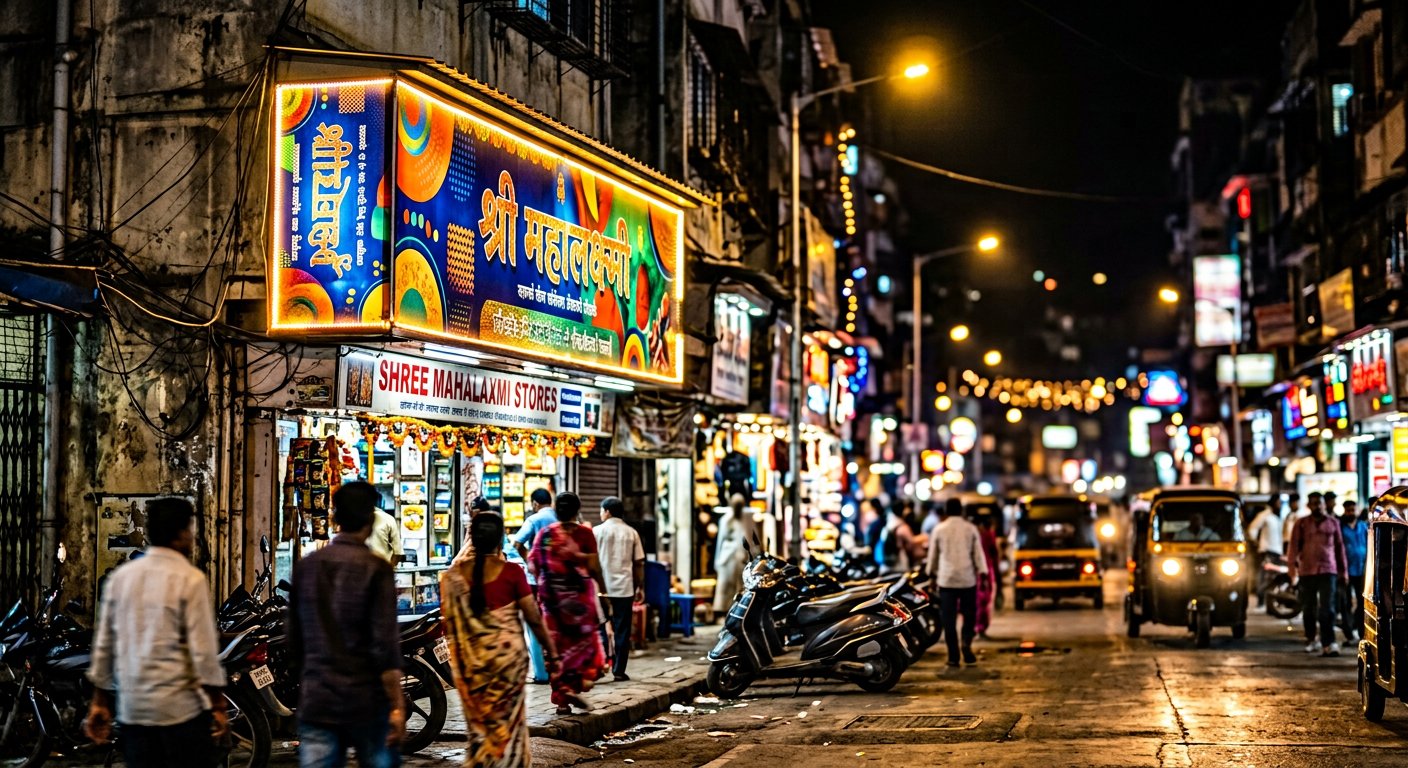
Backlit flex vs frontlit flex — what’s the difference, and which one does your sign board need? The short version: frontlit flex is lit from the outside (or not lit at all) and works for hoardings and daytime signage, while backlit flex is translucent, designed to glow with lights placed behind it — the material behind every glowing shop board you see at night. Choosing wrong is expensive: backlit flex in an unlit frame looks washed out, and frontlit flex in a glow box shows dark patches and visible bulbs. This guide explains both materials, their construction, prices, and exactly where each should be used. (New to flex media? Start with our types of flex printing media overview.)
The Fundamental Difference: How They Handle Light
| Property | Frontlit Flex | Backlit Flex |
|---|---|---|
| Light behaviour | Opaque — reflects light back | Translucent — diffuses light through |
| Light source position | In front (floodlights) or none | Behind (LED/tubelights inside box) |
| Daytime look | Bright, vibrant | Slightly deeper/heavier colours (extra ink load) |
| Night look | Needs external lighting to be visible | Glows evenly from within |
| Typical GSM | 440–610 | 510–610 |
| Retail rate | ₹25–40/sq ft | ₹35–60/sq ft |
| Outdoor life | 2–3 years | 2–3 years |
| Typical uses | Hoarding, highway signage, building wraps | Glow sign boards, light boxes, mall signage |
Frontlit Flex Explained
Frontlit media is engineered to be viewed with light falling on its front face. Its backside is white or grey to reflect ambient light forward, keeping colours bright in daylight. It’s thick (440–610 GSM) to survive wind loads on large structures.
- Construction: heavy polyester scrim + PVC coating, opaque white/grey rear layer
- Printing: normal ink coverage — the same print you’d make on standard flex, just on heavier media
- Lighting: relies on sunlight, floodlights, or spotlights aimed at the face
- Strengths: excellent wind durability, crisp daytime colour, economical for large areas
- Weakness: invisible or dull at night without external lights
Backlit Flex Explained
Backlit media is translucent — light passes through it and is scattered evenly, creating a smooth glowing surface. It’s the standard material for glow sign boards, light boxes, petrol pump signage, and illuminated displays.
- Construction: heavy scrim with a light-diffusing PVC formulation (510–610 GSM)
- Printing: printed with higher ink load (20–30% more in the RIP) — because backlighting “washes through” normal ink density, making it look pale when lit
- Lighting: LED modules or tubelights inside a sealed box behind the flex
- Strengths: stunning 24-hour visibility, even glow, premium brand presence at night
- Weakness: costs more; needs a well-built box with even light spacing or you get hot-spots and shadows
Why You Can’t Swap Them
What happens if you use frontlit in a glow box?
Frontlit is opaque — it blocks the lights. You’ll see bulb shadows and dark patches instead of a glow, wasting the entire box construction.
What happens if you use backlit on an unlit hoarding?
Backlit’s translucent surface reflects less light, so daytime colours look duller and thinner than on frontlit — and you’ve paid ₹10–20/sq ft extra for the privilege.
Rule: light behind = backlit; light in front (or none) = frontlit.
Cost Comparison: Glow Boards vs Hoardings
| Component | Frontlit Signage | Backlit Signage |
|---|---|---|
| Printing (per sq ft) | ₹25–40 | ₹35–60 |
| Frame/box fabrication | ₹60–100/sq ft (open frame) | ₹100–180/sq ft (closed box) |
| Lighting | Floodlights ₹1,500–4,000 each (optional) | LED modules ₹8–20/sq ft of box area |
| Electricity | Only if floodlit | Continuous (LED = low cost, ~₹200–600/month) |
| Maintenance | Low | Medium (LED driver/bulb replacement) |
A 6×3 ft glow sign board in a Tier-2 city typically lands at ₹4,500–9,000 complete (box + backlit print + LEDs). The same size frontlit board on an open frame costs ₹2,500–5,000 but only works in daylight unless floodlit.
Applications: Which One to Use Where
| Application | Choose | Reason |
|---|---|---|
| Shop glow sign board | Backlit 510 GSM | Night visibility drives walk-ins |
| Highway hoarding | Frontlit 440–510 GSM | Day/dusk floodlit visibility, wind strength |
| Mall & metro signage | Backlit | Premium indoor illumination |
| Petrol pump canopy fascia | Backlit | 24×7 glowing brand presence |
| Building wrap | Mesh (frontlit family) | Wind load; illumination impractical |
| Bus shelter panel | Backlit | Illuminated at night for commuters |
| Real estate site wall | Frontlit/Star Flex | Daytime visibility, lower cost |
| Restaurant/café board | Backlit | Evening crowds = evening visibility |
Print Quality Tips for Each Material
For backlit jobs
- Increase ink limit 20–30% in your RIP (“backlit profile”) so colours stay rich when lit.
- Check the lit preview: hold the wet print near a light before final delivery — pale areas need another pass.
- Use consistent LED colour temperature (6500K cool white is standard in India) for accurate brand colours.
- Space LEDs by the box-depth rule (deeper box = wider spacing) to avoid bulb hot-spots.
For frontlit jobs
- Standard ink profiles work perfectly — no extra ink needed.
- For floodlit hoardings, slightly increase contrast in the design; angled light washes subtle gradients.
- Use 4–6 pass quality printing on large formats for even colour under bright floodlights.
Durability & Maintenance
- Both last 2–3 years outdoors with quality inks — the heavy GSM protects against wind and UV.
- Frontlit maintenance: occasional washing removes dust that dulls the face.
- Backlit maintenance: keep the box sealed against insects and moisture; replace failed LED modules promptly — a half-dark sign board hurts brand perception more than no board at all.
- Monsoon note: ensure glow boxes have drainage holes; trapped water stains the backside of the print.
Frequently Asked Questions (FAQs)
Q1. What is the difference between backlit and frontlit flex?
Backlit flex is translucent and glows when lit from behind; frontlit flex is opaque and designed to be lit from the front or viewed in daylight. Backlit costs ₹10–20/sq ft more and needs a light box.
Q2. Which flex is used for glow sign boards?
Backlit flex, typically 510 GSM, printed with a higher ink load and stretched over an LED or tubelight box.
Q3. Can I use normal flex for a glow board to save money?
It will glow poorly and unevenly — standard flex isn’t designed to diffuse light. You’ll see bulb shadows and washed-out colours. Backlit flex is the only material that glows evenly.
Q4. How much does backlit flex printing cost?
Retail rates run ₹35–60/sq ft in 2026 depending on city and GSM. A complete 6×3 ft glow board with box and LEDs costs ₹4,500–9,000 in Tier-2 cities.
Q5. Which is better for highway hoardings?
Frontlit 440–510 GSM with floodlights. Backlit hoardings of that size would need enormous electrical infrastructure.
Q6. Does backlit flex look different in daytime?
Slightly deeper in colour since the print carries extra ink — designed so it looks balanced when lit at night. The difference is minor in daylight.
Q7. What lights work best inside a glow box?
LED modules (6500K) — they run cool, last 30,000+ hours, and consume ~80% less power than tubelights.
Q8. Can backlit flex be printed on any printer?
Yes — solvent and eco-solvent printers handle it; the printer just needs higher heater settings for the thick media and a backlit ink profile in the RIP.
Q9. How long does a glow sign board last?
The backlit print lasts 2–3 years; LEDs last 3–5 years. Expect one print replacement over the box’s lifetime.
Q10. My shop is only open during the day — do I still need backlit?
No. A frontlit or Star Flex board saves money. Choose backlit only if evening/night visibility matters to your business.
Deliver Perfect Glow Boards From Your Print Shop
Backlit printing needs stable heater control and accurate ink profiles — UED’s flex & solvent printers are tuned for exactly that, with installation, RIP setup, and training included. Serve every customer: hoardings and glow boards.
Final Verdict
Frontlit = light on the face; backlit = light through the material. Hoardings, site walls, and daytime signage take frontlit. Glow boards, light boxes, and 24×7 brands take backlit. Match the material to the lighting plan — and the lighting plan to when your customers actually look at your sign.
