



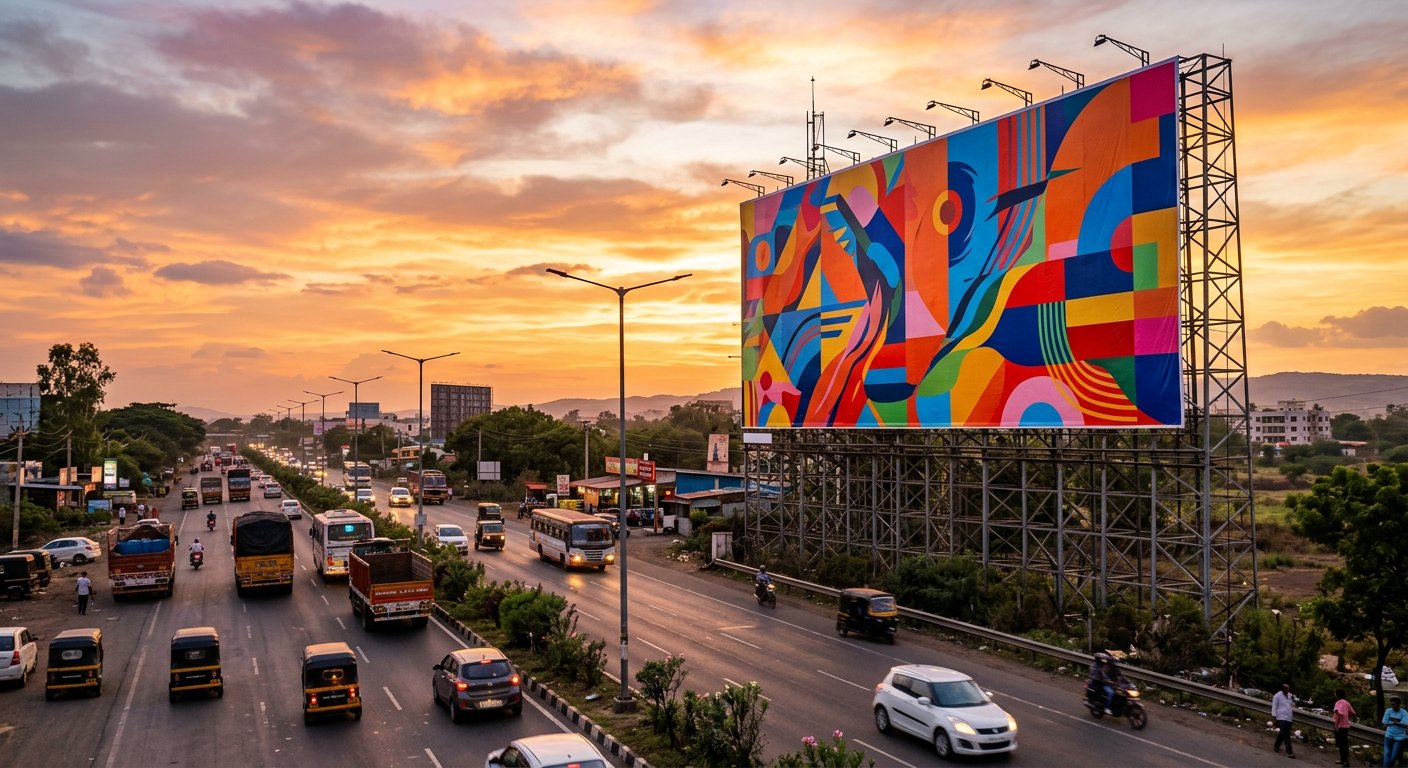
Choosing the right flex material for outdoor advertising is the difference between signage that sells for two years and a faded, flapping embarrassment torn down in two months. Every flex decision comes down to five factors: location (wind, sun, rain), duration, viewing distance, lighting, and budget. This guide walks you through each factor with a practical decision framework, material recommendations for every common outdoor job, and the mistakes that cost Indian advertisers the most money.
The 5 Factors That Decide Your Flex Choice
1. Location & Wind Exposure
Wind is flex’s biggest enemy. An untensioned banner flapping in wind fails at the eyelets and tears within weeks.
- Low wind (streets, courtyards, tied between poles): standard or Star Flex, hemmed edges, eyelets every 2 ft.
- High wind (rooftops, open fields, highway sides): heavier 440+ GSM, mesh flex above 60–80 sq ft, professional framing.
- Building wraps: always mesh flex — perforations cut wind load ~70%.
2. Duration of Display
| Display Duration | Recommended Flex | GSM |
|---|---|---|
| Days – 1 month | Standard flex | 240–280 |
| 1–6 months | Standard or Star Flex | 280–340 |
| 6–18 months | Star Flex / frontlit | 340–440 |
| 2–3 years | Frontlit premium / backlit | 440–610 |
3. Viewing Distance
- Under 10 ft (shop boards, stalls, standees): Star Flex — smooth surface, crisp text, vibrant photos.
- 10–50 ft (street banners, fascia): Star Flex or good 280 GSM standard flex in quality print mode.
- 50+ ft (hoardings, highway): standard/frontlit flex is visually identical to premium at that distance — save money.
4. Lighting Conditions
- No external lighting: standard flex; bright colours and bold contrast matter most.
- Floodlit at night: frontlit flex reflects light back evenly.
- Lit from behind (glow boards): backlit flex 510 GSM with extra ink load — the only way to get even glow.
5. Budget & Cost-Per-Year Thinking
Don’t compare per-sq-ft rates alone — compare cost per year of display. A ₹14/sq ft banner lasting 9 months costs ₹18.7/sq ft/year; a ₹24/sq ft Star Flex board lasting 20 months costs ₹14.4/sq ft/year. Premium material is often the cheaper choice over time.
Material Recommendation by Application
| Outdoor Job | Best Flex Material | GSM | Why |
|---|---|---|---|
| Shop fascia board | Star Flex | 280–340 | Close viewing, brand image, 1–2 yr life |
| Glow sign board | Backlit | 510 | Even illumination at night |
| Street pole banner | Standard/Star Flex | 280–340 | Economy with decent life |
| Event/wedding gate banner | Standard flex | 240–280 | Days-long use; premium is waste |
| Political hoarding | Standard flex | 280 | Volume economics, short duration |
| Highway hoarding | Frontlit premium | 440–510 | Wind strength + 2–3 yr life |
| Building wrap | Mesh flex | 270–370 | Wind passes through |
| Real estate site wall | Star Flex / frontlit | 340–440 | Months-long premium branding |
| Bus shelter panel | Backlit / frontlit | 440–510 | Illuminated, vandalism-resistant frame |
| Exhibition outdoor stall | Star Flex | 280 | Photo-quality close viewing |
GSM Selection Made Simple
GSM (grams per square metre) is the flex equivalent of paper weight. Rule of thumb:
- 240 GSM: throwaway banners — events, rallies, one-month offers.
- 280 GSM: the all-rounder — most shop banners and street banners.
- 340 GSM: the upgrade — framed boards, windy locations, 6–18 month jobs.
- 440 GSM: hoarding grade — large panels, 1–2 year outdoor contracts.
- 510–610 GSM: premium frontlit/backlit — glow boards and long-duration signage.
Every GSM step up costs roughly ₹2–4/sq ft extra and adds months of life. Above 40 sq ft, never go below 280 GSM; above 100 sq ft, start at 440 GSM.
Branded vs Unbranded Flex: The Hidden Variable
Two rolls labelled “340 GSM” can perform completely differently. Branded media (Star Flex, Flexit, Uniflex, Winsome, Galaxy, Korean imports) offers:
- Consistent coating → no patchy ink absorption or banding
- Better UV stabilisers → 30–50% slower fading
- Stronger scrim → resists tearing at eyelets
- Flat, wrinkle-free unwinding → cleaner prints
The price gap is only ₹1–3/sq ft on the raw roll. Always ask your printer which brand they’re loading — it’s the cheapest insurance in outdoor advertising.
Finishing Choices That Extend Outdoor Life
- Hemming (edge folding): doubles eyelet-holding strength — mandatory for anything over 20 sq ft.
- Eyelet spacing: every 2 ft standard; every 1 ft in windy areas.
- Lamination: adds 6+ months of UV and abrasion protection; worth it for premium boards.
- Frame tensioning: a drum-tight board doesn’t flap; flapping is what actually kills most outdoor flex.
- Rope quality: use nylon or GI wire for permanent installations — jute rots in one monsoon.
Print Quality Settings That Matter Outdoors
Material is half the job; the print itself is the other half:
- 4–6 pass printing for saturated, weather-resistant colour (2–3 pass “draft” fades faster because ink coverage is thinner).
- Quality solvent inks — cheap inks fade in 2–3 months regardless of media.
- Proper drying — under-dried prints smudge during installation and wash early.
- Design for distance: minimum 1-inch letter height per 10 ft of viewing distance; high contrast beats subtle gradients outdoors.
Common Mistakes That Waste Money
- Buying the cheapest quote without asking GSM and brand — you’ll get thin unbranded flex in draft mode.
- Using light flex on big hoardings — it tears in the first storm; pay for 440+ GSM or mesh.
- Skipping hemming and tying with low-quality rope — the banner fails at the edges.
- Expecting premium life from draft-mode prints — thin ink films fade twice as fast.
- Installing during rain — wet installation traps moisture and causes staining and mould on the backside.
- Reusing an old frame without checking rust — rust stains bleed onto new flex within weeks.
Quick Decision Checklist
- How long must it last? → sets GSM and grade
- How windy is the location? → sets weight/mesh and fixing method
- How close will people view it? → sets Star Flex vs standard
- Is it lit from behind? → backlit, full stop
- What’s the budget per year, not per job? → often upgrades you to premium
- Which media brand is being used? → insist on branded rolls
Frequently Asked Questions (FAQs)
Q1. Which flex is best for outdoor advertising?
Star Flex 340 GSM for close-viewing boards (1–2 year life), frontlit 440–510 GSM for large hoardings, and mesh for building wraps or very windy sites.
Q2. What GSM should outdoor flex be?
Minimum 280 GSM for banners, 340 for framed boards, 440+ for hoardings. Thinner flex saves ₹2–3/sq ft but fails months earlier.
Q3. Does flex survive Indian monsoons?
Yes — flex is waterproof by construction. Monsoon failures come from wind flapping and poor fixing, not water. Hem edges, space eyelets closely, and tension well.
Q4. How long does outdoor flex printing last?
6–12 months for standard flex, 1–2 years for Star Flex, 2–3 years for premium frontlit/backlit — assuming quality inks and proper installation.
Q5. Is mesh flex weaker because it has holes?
No — its tensile strength is comparable, and in wind it’s actually stronger in practice because wind passes through instead of loading the panel.
Q6. Should I laminate outdoor flex?
For jobs meant to exceed 12 months or in high-abrasion spots, yes. Lamination adds UV and scratch protection worth the ₹5–10/sq ft.
Q7. What flex is used for glow sign boards?
Backlit flex 510 GSM printed with extra ink load, stretched over an LED/tubelight box.
Q8. Can the same flex be used for wall pasting and framing?
Pasting suits thinner 240–280 GSM flex; framing needs 280+ GSM that can hold tension without wrinkles.
Q9. Why do hoardings look patchy after some months?
Usually cheap unbranded media, draft-mode printing, or low-grade ink — all fading unevenly. Branded media + quality printing delays this dramatically.
Q10. Who decides the material — me or the printer?
You should. Specify GSM, grade (standard/Star/frontlit/backlit/mesh), and brand if possible — then compare quotes on identical specs.
Printing Outdoor Flex at Scale?
Heavy media demands a capable machine. UED’s solvent flex printers handle 240–610 GSM rolls with stable tension and heater control — built for Indian hoarding workloads, backed by pan-India service.
Final Word
There’s no single “best” flex material — there’s the right flex for your location, duration, viewing distance, lighting, and budget. Run every job through the five-factor checklist, insist on branded media and quality printing, and your outdoor advertising will look fresh long after the competition’s banners have faded and torn.
