



Flex vs vinyl printing — which one should you choose? It’s the most common question we hear at print shops and from customers alike. The short answer: flex is the economical king of large outdoor banners and hoardings (see the full flex printing rate per sq ft price list), while vinyl delivers sharper, photo-quality prints for smooth surfaces like glass, vehicles, walls, and boards (₹25–60/sq ft, 1–5 years life). In this guide we compare flex vs vinyl printing across cost, durability, quality, applications, and finish — so you pick the right material for your project the first time.
What Are Flex and Vinyl, Exactly?
Flex (PVC banner fabric)
Flex is a woven polyester scrim coated on both sides with PVC. It’s flexible, fabric-like, waterproof, and comes in rolls from 3.2 ft to 10 ft wide. It’s the material behind nearly every banner, hoarding, and framed shop board in India.
Vinyl (PVC film)
Vinyl is a smooth, non-woven PVC film — think of it as a high-quality sticker material. It comes in glossy, matte, transparent, and reflective variants, usually 3.2–5 ft wide, and is applied (pasted) onto flat surfaces or used for standees and vehicle graphics.
Head-to-Head Comparison: Flex vs Vinyl Printing
| Parameter | Flex Printing | Vinyl Printing |
|---|---|---|
| Material | PVC-coated woven fabric | Smooth PVC film |
| Retail rate | ₹10–30/sq ft | ₹25–60/sq ft |
| Print sharpness | Good (coarse texture visible up close) | Excellent (photo-quality up close) |
| Outdoor life | 6 months – 2 years | 1 – 5 years |
| Waterproof | Yes | Yes |
| Flexibility | Very flexible, foldable, rollable | Semi-rigid, bends but creases |
| Mounting | Tied, framed, pasted | Pasted on smooth surfaces / boards |
| Large sizes | Unlimited (panels joined) | Limited, panels overlap visibly |
| Wind resistance | Flaps/tears unless mesh or well-tensioned | Best when pasted on a rigid surface |
| Best for | Banners, hoardings, shop frames | Board signage, vehicles, glass, walls |
Cost Comparison: What You’ll Actually Pay in 2026
| Job Example | Flex Cost | Vinyl Cost |
|---|---|---|
| 8×4 ft shop banner (32 sq ft) | ₹600–900 | ₹1,200–1,800 (needs board backing) |
| 4×3 ft shop board on sunboard | ₹400–600 (pasted flex) | ₹700–1,200 (vinyl on board) |
| Vehicle door branding (per side) | Not recommended | ₹800–2,000 |
| 20×10 ft hoarding (200 sq ft) | ₹2,500–4,500 | Impractical |
Rule of thumb: as the size grows, flex wins overwhelmingly. As the viewing distance shrinks, vinyl wins on quality.
Print Quality: Where Vinyl Wins
Because vinyl is a smooth film, ink dots land precisely, gradients stay clean, and small text stays crisp. That’s why:
- Photorealistic images look dramatically better on vinyl
- Small lettering and barcodes stay readable at arm’s length
- Brand colours match more accurately on consistent white vinyl
Flex’s woven texture absorbs slightly more ink and shows a faint fabric pattern within a couple of feet — irrelevant for a banner viewed from 10+ ft, but visible on close inspection.
Durability: Both Are Tough, Differently
- Flex outdoors: standard flex survives 6–12 months of sun and rain; Star Flex and frontlit grades last 1–3 years. The main killers are wind flapping (mechanical tearing) and UV fading.
- Vinyl outdoors: cast vinyl lasts 3–5 years on vehicles and boards; calendered vinyl lasts 1–3 years. Vinyl’s weakness is edges — once water gets under a lifted edge, peeling accelerates.
- Lamination extends both: a laminated vinyl vehicle graphic gains scratch protection; laminated flex banners gain 6+ months of extra life.
When to Choose Flex Printing
- Banners tied to poles, railings, or walls — flex’s flexibility is the whole point
- Hoarding & large outdoor advertising — nothing else scales to 100+ sq ft economically
- Framed shop boards — flex stretched over an angle-iron frame is India’s default shop sign
- Short-to-medium campaigns — events, elections, sales, launches
- Budget-sensitive projects — flex costs 40–60% less per sq ft
When to Choose Vinyl Printing
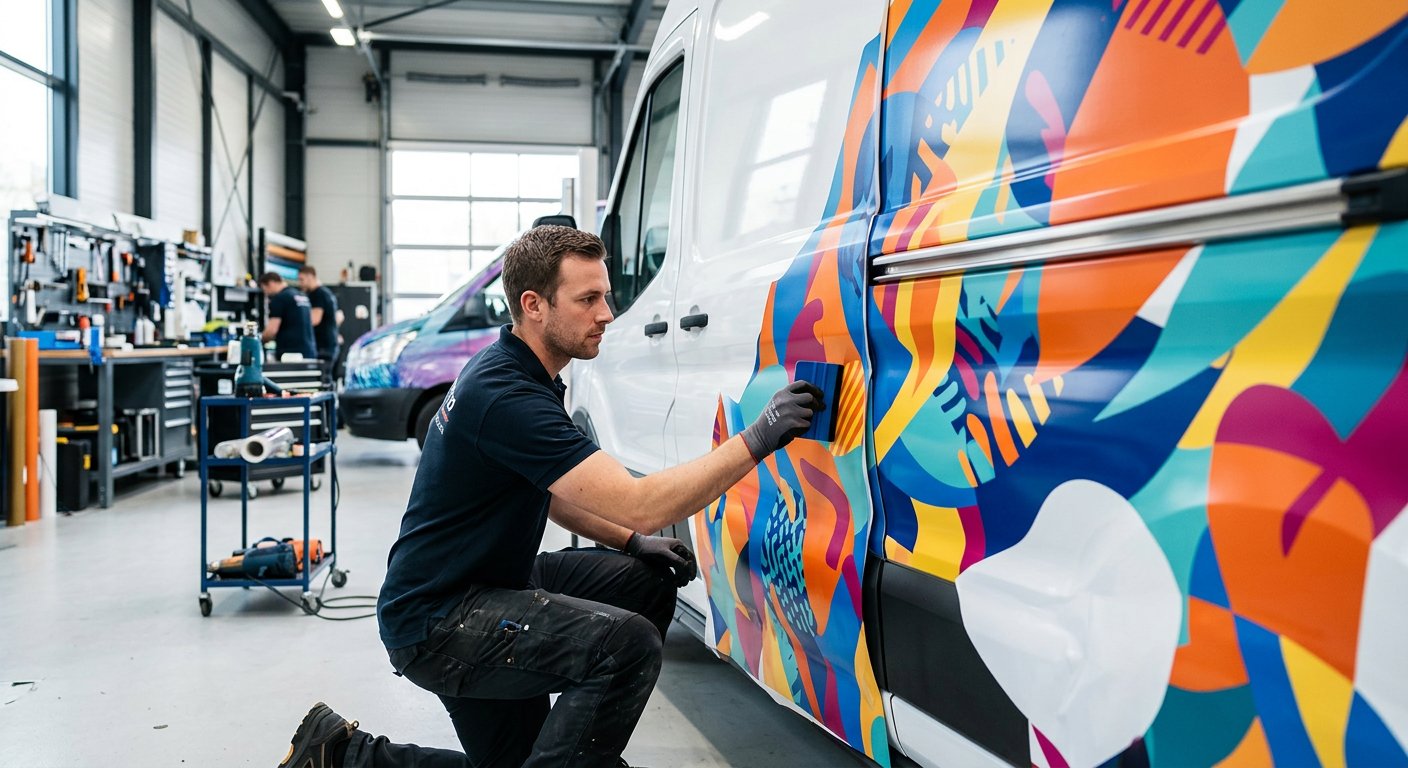
- Vehicle branding — cars, tempos, trucks, buses (vinyl wraps & decals — more in our vinyl & sticker printing business guide)
- Glass signage — one-way vision, frosted effects, window graphics
- Boards — vinyl pasted on sunboard, ACP, or acrylic for clean close-up signage
- Wall graphics & interiors — offices, showrooms, photo walls
- Stickers, labels & die-cut lettering — product branding, floor graphics
- Anything with photographs viewed up close
Can You Combine Flex and Vinyl? (Smart Hybrids)
Yes — and many jobs use both:
- A shop might use a flex fascia board (big, economical) plus vinyl cut-lettering for the shop name on glass.
- Exhibition stalls pair flex backdrops with vinyl-printed counters and standees.
- Hoarding sites often carry a flex main panel with a vinyl-laminated spotlight box for the logo.
Which One Lasts Longer in Indian Weather?
For pure outdoor endurance on a rigid surface, laminated cast vinyl wins (3–5 years). But vinyl needs a smooth surface to stick to, and large structures make it expensive. For hanging or framed signage, flex is the only practical choice, and premium grades (Star Flex, frontlit 510 GSM) comfortably cross 2 years outdoors. In monsoon-heavy regions, ensure hemmed edges and quality eyelets on flex, and sealed edges on vinyl.
Printer’s Perspective: Margins and Machines
For print shop owners, the two materials need similar but not identical setups:
- Solvent/eco-solvent printers handle both flex and vinyl — one machine can run the full range.
- Vinyl jobs carry better margins: retail ₹25–60/sq ft against media+ink cost of ₹10–18/sq ft, plus lamination and installation revenue.
- Flex jobs bring volume: hoardings and political orders move hundreds of sq ft per job.
- A healthy shop runs both: flex for volume, vinyl for value.
Frequently Asked Questions (FAQs)
Q1. Is flex printing cheaper than vinyl printing?
Yes. Flex costs ₹10–30/sq ft versus ₹25–60/sq ft for vinyl. For large banners and hoardings, flex is 40–60% cheaper.
Q2. Which is better for a shop board?
For large framed boards, flex (Star Flex) is the standard and best value. For smaller boards or boards with photos viewed up close, vinyl pasted on sunboard/ACP looks sharper.
Q3. Can vinyl be used for banners tied with rope?
Not really — vinyl creases and tears at eyelets. Flex is made for tying, folding, and framing; vinyl is made for pasting on smooth surfaces.
Q4. Which lasts longer outdoors?
On a rigid surface, laminated cast vinyl lasts 3–5 years, longer than flex’s 1–3 years. But for hanging/framed outdoor signage, only flex is practical.
Q5. What is one-way vision vinyl?
A perforated vinyl used on glass — people outside see your print, people inside see through. Common for shop windows, offices, and bus windows.
Q6. Can the same printer print flex and vinyl?
Yes. Solvent and eco-solvent large-format printers print both materials; you just change media settings (heat, pass count, ink load) in the RIP.
Q7. Which material is used for vehicle branding?
Always vinyl (calendered for short-term, cast for long-term wraps). Flex cannot conform to vehicle curves and edges.
Q8. Should my new print shop buy media for both?
Yes — flex brings the daily volume orders (banners, hoardings), vinyl brings the high-margin work (boards, vehicles, stickers). One eco-solvent or solvent machine handles both.
Q9. Does vinyl fade faster than flex in sunlight?
No — quality vinyl with UV lamination outlasts flex in direct sun. Unlaminated vinyl, however, scratches and fades faster than laminated versions.
Q10. What’s the best all-round material for a new business’s signage?
Star Flex framed board for the fascia (big, visible, economical) plus vinyl lettering/logo on glass or door — the combination covers durability, quality, and budget.
Print Both Flex & Vinyl From One Machine
UED’s solvent and eco-solvent printers handle flex banners, vinyl graphics, and everything between — with installation, training, and pan-India service support.
Explore Flex & Solvent Printers → | Genuine Inks → | Get Expert Advice →
Final Verdict
There’s no universal winner in flex vs vinyl printing — only the right material for the job. Big, outdoor, tied or framed, budget-conscious → flex. Smooth surfaces, close viewing, photographs, vehicles, glass → vinyl. Understand the job, match the material, and both will deliver years of reliable service.
