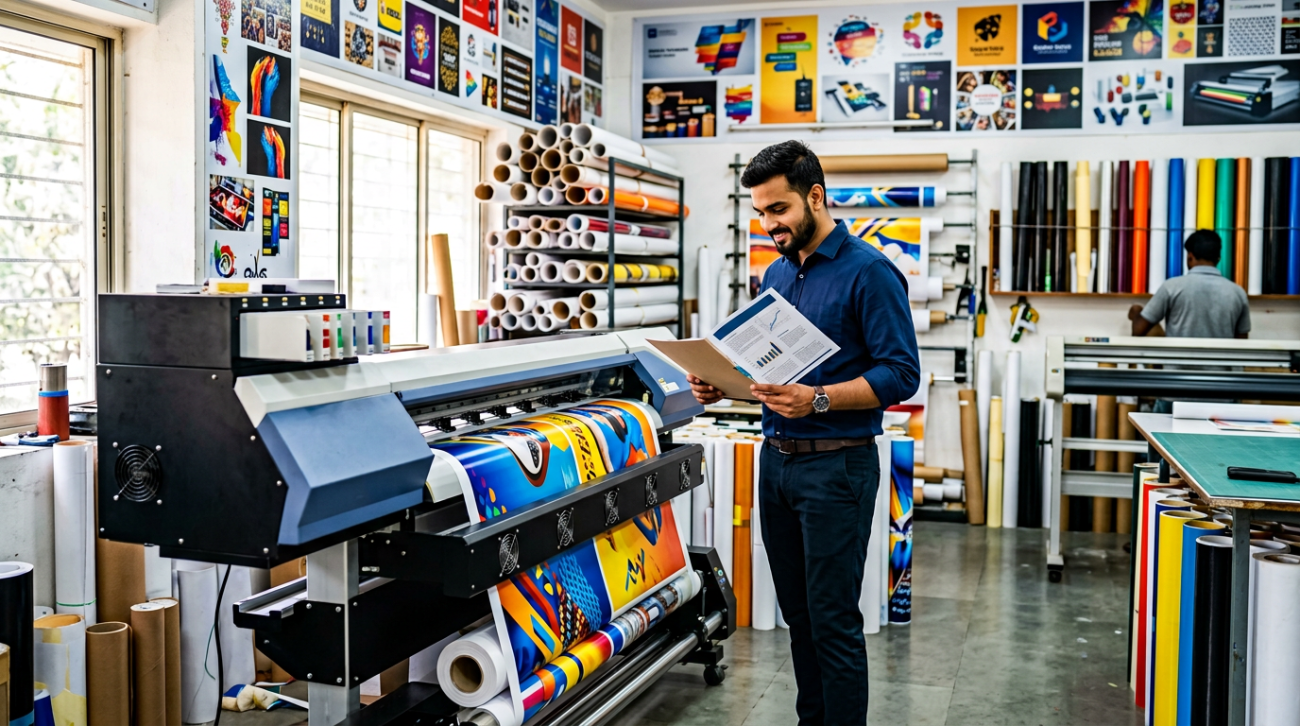

Quick Answer: A vinyl & sticker printing business in India starts with ₹4–7 lakh — an eco solvent printer (₹1.65–2.75 lakh), cutting plotter, laminator, and basic setup. Printed stickers cost ₹10–15 per sq ft to produce and sell at ₹25–60 per sq ft; laminated shop boards and vehicle stickers go higher. A well-run single-machine unit nets ₹40,000–₹1.5 lakh per month once anchor clients are in place, with machine payback typically inside 8 months. This guide covers the complete plan: equipment, licenses, raw material, rate cards, customer acquisition, and the mistakes that sink beginners.
Stickers are the most underestimated product in Indian printing. Every product jar in D-Mart carries one. Every scooter on the road wears several. Every kirana fridge, laptop lid, water bottle, helmet, shop shutter, and auto-rickshaw back panel is a sticker that somebody printed and somebody paid for. Behind this silent ubiquity sits an industry with some of the friendliest economics in all of printing: low material costs, tiny storage needs, postal-friendly products, and customers who reorder by design.
The vinyl & sticker business is where an eco solvent printer earns its keep most naturally. Unlike flex banner printing (bulky, price-warred, installation-dependent), sticker work ships in envelopes, commands photo-quality premiums, and scales cleanly from hand-cut orders to die-cut batches for corporate clients. If you are evaluating machine-based businesses for 2026, this one deserves its own honest business plan — here it is.
What Exactly Is the Vinyl & Sticker Printing Business?
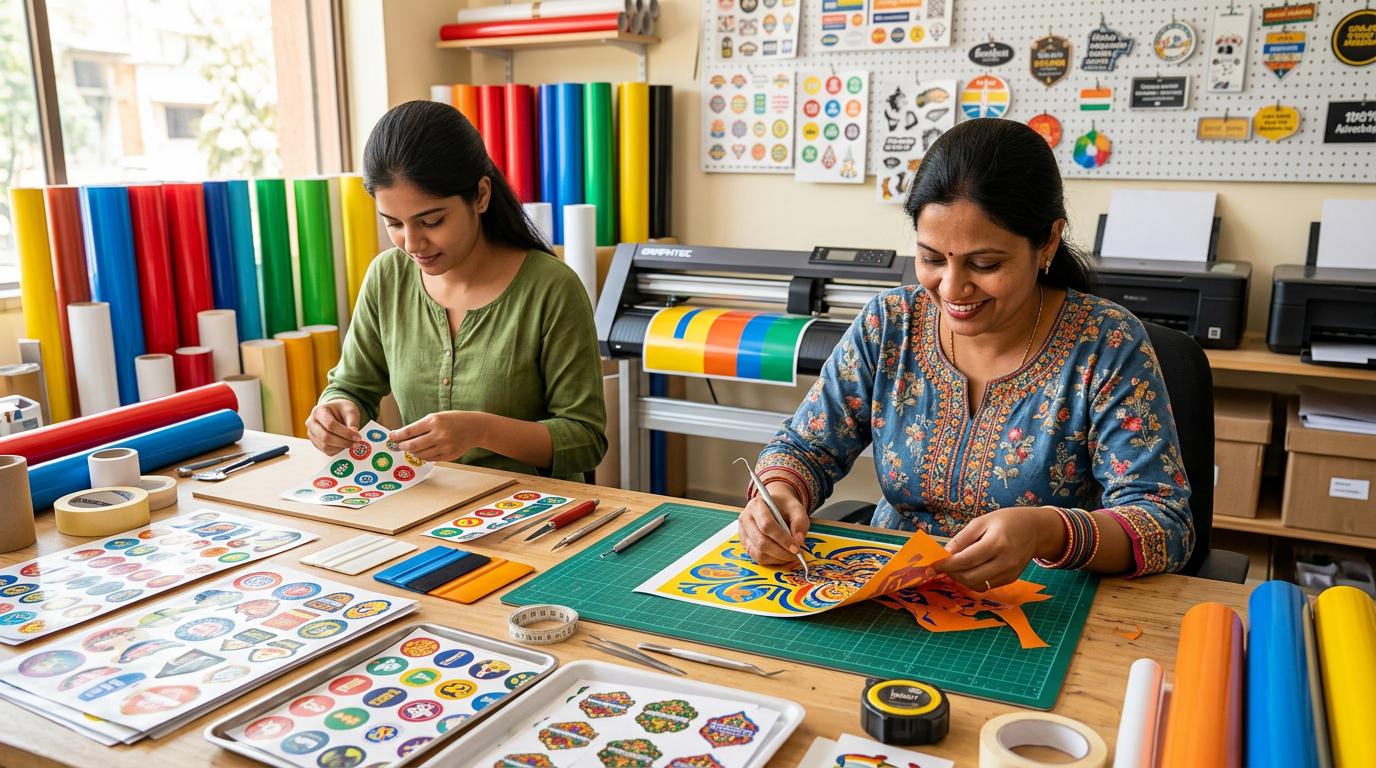
The core of the business is deceptively simple: print onto self-adhesive vinyl (SAV) with an eco solvent printer, cut the prints to shape, and deliver. The sophistication — and the margin — lives in the variations:
- Product/branding stickers: labels for jars, bottles, boxes, cosmetics — the eternal repeat-order engine
- Shop boards & wall graphics: laminated vinyl mounted on ACP/sunboard — every new shop, every relocation
- Vehicle graphics: car decals, auto-rickshaw advertising, delivery fleet branding, commercial vehicle numbers
- Transparent/one-way vision glass films: shopfronts, offices, salons, clinics
- Safety & industrial labels: factory signage, electrical panel labels, machine stickers, QR asset tags
- décor decals: wall quotes, kids’ rooms, cafe interiors, glass frosting films
- Photo-quality products: laptop skins, phone skins, fridge magnets, custom merchandise
Every category shares the same machine, the same skills, and mostly the same media — but not the same rates. The craft of this business is guiding customers upward through that ladder.
Investment Breakdown: Three Setup Levels (2026)
Setup A — Lean Start (₹2.5–4 lakh)
Home/spare-room friendly, hobby-to-business bridge, hand-cutting + small plotter:
| Item | Cost (₹) |
|---|---|
| 1.6m Eco Solvent Printer (single i3200) | 1,65,000 – 2,20,000 |
| Desktop vinyl plotter (14–24″) | 12,000 – 22,000 |
| Computer + design software setup | 30,000 – 45,000 |
| 2 kVA UPS + stabilizer | 18,000 – 28,000 |
| Startup media/ink inventory | 25,000 – 40,000 |
| Tools, weeding kits, squeegees, table | 8,000 – 15,000 |
| Total | ₹2.6 – ₹3.7 lakh |
Setup B — Standard Shop (₹4.5–7 lakh) ⭐ Recommended
| Item | Cost (₹) |
|---|---|
| 1.6/1.8m Eco Solvent Printer (i3200) | 2,00,000 – 3,50,000 |
| 24–48″ plotter with contour-cut sensor | 22,000 – 45,000 |
| 64″ hot/cold laminator | 45,000 – 70,000 |
| Computer + RIP licensed bundle | 45,000 – 70,000 |
| UPS, electrical, worktables, exhaust fan | 35,000 – 55,000 |
| Startup inventory (deep: SAV types, laminate, backlit, OWV) | 45,000 – 70,000 |
| Room deposit + shopfront basics | 60,000 – 1,00,000 |
| Working capital (2 months) | 50,000 – 80,000 |
| Total | ₹5.0 – ₹8.4 lakh |
Setup C — Production Unit (₹9–14 lakh)
Dual-head printer (₹2.75–4.5L), 48–64″ professional plotter with registration marks (₹60k–1.2L), cold laminator + hot-assist, mounting table, part-time designer + operator; focused on B2B batch work and trade supply.
The Market You’re Entering (2026 Demand Map)
India’s sticker/vinyl demand sorts into five durable pools — knowing which pools your city holds tells you which inventory to stock and which clients to hunt:
- Product labeling: the MSME manufacturing boom (food, ayurveda, cosmetics, cleaning supplies) generates label demand that renews monthly by physics. Every small manufacturer within 50 km is a prospect.
- Retail & local commerce branding: shops shutter-opening at record pace post-2023 need boards, glass films, standees — visible to you on every commute.
- Vehicle personalization & fleet commerce: India’s two-wheeler culture plus delivery-fleet economics produce both directions simultaneously: cosmetic customization and contract livery.
- Events & celebrations: weddings, fests, political cycles—printed vinyl’s volume heartbeat spiking reliably on the calendar you already know.
- Digital-driven personalization: pandemic-taught buying habits mean Instagram-discovered custom skins, decals, and décor arrive as D2C demand in your city already.
Whichever pools are deep where you operate, structure your opening menu around them — and your shop’s sample wall for them.
The Machines That Make the Money
1. The Eco Solvent Printer (Your Engine)
One decision governs: Epson i3200 head. It costs ₹45–80k for genuine replacement, survives 18–36 months under cleaning discipline, and produces the photographic print quality this business’s rates depend on. XP600 builds save ~₹50k upfront and repay it twice over in slower speed and yearly head swaps. For a fuller machine comparison, see our best eco solvent printer guide.
2. The Cutting Plotter (Your Other Half)
Stickers are cut products; printing is only half the job. Your plotter options:
| Plotter Class | Price | Capability |
|---|---|---|
| Desktop 14–24″ | ₹12–25k | Basic kiss-cutting, small decals, hobby scale |
| 24″ with optical eye (contour) | ₹22–45k | Die-cut shapes around printed graphics — the real sticker standard |
| 48–64″ pro contour | ₹60k–1.2L | Long banners, big vinyl runs, batch production |
| Flatbed cutter (later stage) | ₹2–6L | Board cutting, sampling, packaging — scale-up territory |
The contour-cut sensor (optical eye) is non-negotiable once you print then cut: it reads registration marks and cuts exactly around your printed shape. Plotters without it force rectangular cuts only — instantly excluding half your product catalogue.
3. The Laminator (Your Margin Multiplier)
Cold-roll 64″ laminators (₹45–70k) apply protective film over prints, converting ₹25/sq ft stickers into ₹40–60/sq ft outdoor-grade products: shop boards, vehicle livery, floor graphics, reflective signs. No laminator, no premium catalogue. It’s that simple.
Licenses & Registrations (30 Minutes of Reality)
- Udyam/MSME registration: free, online, unlocks loan and subsidy schemes.
- GST registration: register at start even below threshold — your best customers (businesses) insist on GST invoices for input credit.
- Shops & Establishment / trade license: municipal formality, minor fee.
- Current account in business name: for B2B cheques, NEFT, and financial history.
- No pollution NOC dramas at small scale — eco solvent units fall in light categories in most states; verify locally if your unit is attached to a residence.
Raw Materials: What You’ll Stock and What It Costs
| Material | Use | Cost Basis |
|---|---|---|
| White SAV (gloss/matte, 100gsm liner) | General stickers, boards | ₹6–10/sq ft |
| Grey-back/black-back opaque SAV | Cover-up graphics, dark surfaces | ₹8–12/sq ft |
| Clear/transparent vinyl | Glass decals, window stickers | ₹8–13/sq ft |
| One-way vision film | See-through shopfront branding | ₹12–18/sq ft |
| Reflective vinyl | Safety, night-visibility signage | ₹18–35/sq ft |
| Cast wrap vinyl (vehicle-grade) | Full wraps, long-life livery | ₹25–60/sq ft |
| Cold laminate film (gloss/matte/UV) | Protection layer | ₹4–9/sq ft |
| Eco solvent ink (CMYK) | Printing | ₹800–1,200/litre ≈ ₹2.5–4.5/sq ft |
| Application tape | Decal transfer | ₹1–3/sq ft usage |
Stock discipline: two weeks of fast movers (white SAV, laminate) always on hand; specialty media ordered per confirmed job; ink below 30% never reaches morning. Stockouts in this business don’t pause you — they reroute customers.
Sticker Rate Card 2026: What the Market Actually Pays
| Product | Tier-1 City Rate | Tier-2/3 Rate | Production Cost | Gross Margin |
|---|---|---|---|---|
| Plain vinyl sticker (unlaminated) | ₹25–40/sq ft | ₹20–30/sq ft | ₹10–15/sq ft | 45–60% |
| Laminated sticker/decal | ₹35–55/sq ft | ₹28–45/sq ft | ₹14–22/sq ft | 50–65% |
| Die-cut custom shapes | ₹40–70/sq ft equiv. | ₹35–55/sq ft | ₹16–24/sq ft | 55–70% |
| Shop board vinyl on ACP (fitted) | ₹60–120/sq ft | ₹45–90/sq ft | ₹25–45/sq ft | 50–60% |
| Vehicle graphics/decals | ₹50–90/sq ft | ₹40–70/sq ft | ₹15–28/sq ft | 55–70% |
| One-way vision glass jobs | ₹60–100/sq ft | ₹45–80/sq ft | ₹20–30/sq ft | 55–70% |
| Backlit film prints | ₹45–80/sq ft | ₹35–60/sq ft | ₹15–25/sq ft | 55–65% |
| Wall/décor decals | ₹60–120/sq ft | ₹45–90/sq ft | ₹15–25/sq ft | 65–75% |
| Laptop/phone skins (per piece) | ₹300–600 | ₹250–450 | ₹60–110 | 70%+ |
Three rate rules that keep the shop honest:
- Minimum billing per job (₹150–₹300): below it, design-and-setup time quietly eats your day.
- Design charges are separate: ₹300–₹1,500 per artwork depending on complexity; waived above defined order value — never free-by-default.
- Install where possible: application charges (₹10–25/sq ft or flat site fees) convert print customers into full-service relationships — and full-service relationships don’t price-shop you on WhatsApp.
Profit Math: A Realistic Month
| Metric | Month 3 (Building) | Month 9 (Established) | Month 18 (Humming) |
|---|---|---|---|
| Daily output (sq ft) | 250 | 500 | 800 |
| Average rate realised | ₹30 | ₹33 | ₹36 |
| Monthly revenue | ₹1.95L | ₹4.3L | ₹7.5L |
| Material+ink+consumables | ₹0.85L | ₹1.8L | ₹3.0L |
| Rent+power+staff+overheads | ₹0.65L | ₹0.9L | ₹1.3L |
| Net monthly profit | ₹45k | ₹1.6L | ₹3.2L |
The curve’s shape is the lesson: sticker businesses scale on repeat B2B ordering, not constant new-customer hunting. A label client designs once and reorders monthly for years; shop boards return with every branch opening; fleet clients return with every new vehicle. Acquire once, bill forever.
Finding Customers: The First 100 Orders
Offline (your base-load)
- The 3-km rate-card walk: every shop, salon, clinic, coaching centre, gym, café within 3 km gets a visit, printed samples, and your rate card in week one. Local physical businesses are your bedrock.
- Anchor hunters: 5 repeatable accounts change everything — a water-supply brand, a cosmetic manufacturer, a tiffin service chain, a courier/franchise hub, a car accessories shop. Find the businesses that buy stickers weekly and give them a trade rate with monthly commitment.
- Allied referral web: signboard painters, frame makers, vehicle detailers, wedding planners, packaging suppliers — each meets your customer before you do. ₹50–100 per converted order buys the network.
- Your own shopfront: your windows are your portfolio. Brand your own glass, walls, and vehicle spectacularly; every passer-by reads your work longer than any brochure.
Digital (your multiplier)
- Google Business Profile with photos of real laminated work and review-harvesting from your first 20 clients — “sticker printing near me” is a daily searched, low-competition phrase in most Indian cities.
- WhatsApp Business catalogue: rate card, product photos, order forms — 90% of repeat sticker orders in India actually close on WhatsApp.
- Instagram reels of the process: contour cutting and laminating videos perform absurdly well; process content converts browsers into buyers at zero ad spend.
- Marketplace listings: custom-sticker listings on IndiaMART/TradeIndia route B2B enquiries;大众点评式 platforms like Justdial still pull local customers in Tier-2/3 towns.
The 7 Mistakes That Sink Sticker Startups
1. Buying the plotter last. A printer without a contour plotter produces rectangles; the market pays premiums for shapes. Buy the cutting capability with the printer, not “next quarter.”
2. Competing on cheapest-square-inch. Sticker work’s profit hides in cutting accuracy, lamination finish, colour fidelity, and install quality — none of which the ₹6-cheaper shop copies. Let them own the complaints; you own the margins.
3. Free unlimited design. Design time is machine time is money. Free-design-until-exhaustion is how young shops die busy and broke simultaneously.
4. Refusing small orders rudely. Today’s 2-sq-ft trial order is tomorrow’s monthly 300-sq-ft label account. Set a minimum charge, serve it graciously, harvest later.
5. Media cost-blindness. Premium wrap vinyl on a one-month campaign banner is margin arson; cheap media on a year-long vehicle install is reputation arson. Match media grade to job life deliberately.
6. No file-handling discipline. Blurry WhatsApp JPGs printed without checking → reprints at your cost. Written file specs (300dpi at size, CMYK, outlined fonts) on the order form save you weekly.
7. Ignoring repeat-order engineering. Label clients don’t reorder because they remember you — they reorder because you WhatsApp’d them on day 25: “Your labels should be running low — same batch rates checked in for you?” Build the reminder into the calendar.
Sticker Production SOPs: Files to Finish Without Rework
Shops bleed margin through unstandardized workflow; the 20-minute discipline below saves whole orders:
- Intake form discipline: every order logs size, media grade, laminate yes/no, cut rectangle vs contour, quantity, deadline, artwork status. Verbal orders are reprint invitations — paper or WhatsApp-form, never neither.
- File preflight: check resolution at final size (100 dpi viewing-distance rule for board work; 150+ for decals), fonts outlined, colors CMYK, contour dieline on a separate spot layer named for the plotter. Preflight is 3 minutes; reprints are afternoon-long.
- Print proof strip: for any order above ₹2,000 or with brand colors, a 20-cm strip proof on the actual media catches profile drift before the full run commits.
- Cure then laminate window: minimum 6 hours before lamination for solvent-release, overnight for heavy dark fills — tape this rule to the laminator.
- Cut protocol: plotter blade offset verified weekly with a test cut; registration marks toggled per media reflectivity; batch photos sent to client before dispatch — disputes die pre-arrival.
From Shop to Label Factory: The Scale Ladder
The sticker business’s growth path disguises itself until you map it:
- Stage 1 — job shop: custom singles and small batches, walk-ins + local B2B. Growth lever: anchor clients.
- Stage 2 — batch producer: label runs of 500–50,000 pieces for product companies, serial numbering, per-batch QC. Growth lever: production SOPs + a second shift’s machine utilization.
- Stage 3 — niche authority: owning a vertical (cosmetic labels, food labels, industrial tags) with spec fluency your competitors can’t quote against — compliance language, material certifications, application surfaces. Growth lever: reputation in one valley instead of shallow presence in ten.
- Stage 4 — finishing house: adding die-cutting machines, roll-slitting, and packaging-adjacent services, supplied to other printers as white-label partner. Growth lever: capacity contracts.
Most shops sit permanently at stage 1 not from lack of demand but from undocumented processes that never scale — the SOPs above are literally the bridge.
The 90-Day Launch Roadmap
| Days | Milestones |
|---|---|
| 1–15 | Registrations, shop/room finalisation, machine shortlisting with live demos, financing application |
| 16–30 | Machines ordered, electrical + environment prep done, rate card designed, GBP + WhatsApp Business created |
| 31–45 | Installation + training week; test products across 10 media types; family-and-friends orders for practice |
| 46–60 | Portfolio build-out: shop’s own branding + 10 sample projects; anchor-client visits with samples (target 30 visits) |
| 61–75 | Soft launch + referral network activation + first B2B trade-rate offers; weekly process reels started |
| 76–90 | First 10 repeat-order clients identified and nurtured; pricing vs actual-cost audit; plan festival-season campaign |
The Sticker Product Menu: What’s Actually Selling in 2026 (With Real Rates)
“Stickers” is not one product — it’s a dozen price points with completely different customers. A well-run shop sells across this whole menu, because the customer who comes for 100 laptop stickers often leaves with a shop board order too:
| Product | Typical Spec | Prevailing Market Rate | Material Cost Share | Who Buys |
|---|---|---|---|---|
| Die-cut vinyl stickers (bulk) | 3–4″ round/rect, laminated | ₹4–9/pc at 500+ qty | 25–35% | Brands, cafes, events |
| Laptop & mobile skins | Custom print, matte lam | ₹150–350/pc retail | 15–25% | Students, corporates (gifting) |
| Wall decals / wall stickers | 12–48″, contour cut | ₹250–1,500/design | 20–30% | Homes, salons, kids’ rooms |
| Shop branding kits | Name board + glass film + hours sticker | ₹3,000–25,000/shop | 25–35% | New retail openings |
| Auto sticker kits | Bike/car graphics, sun strips | ₹500–4,000/vehicle | 20–30% | Riders, cab fleets, dealers |
| Product labels (roll form) | Vinyl/BOPP, waterproof | ₹0.8–3/label at volume | 30–40% | D2C brands, food & cosmetics units |
| One-way vision (glass) | Perforated print | ₹60–110/sq ft installed | 30–35% | Shops, showrooms, offices |
| Safety & industrial labels | Reflective/3M-type media | ₹15–80/pc | 35–45% | Factories, contractors (B2B gold) |
| Custom T-shirt patches / heat transfer | Printable HTV, cut | ₹80–250/design | 25–35% | Events, teams, merch sellers |
The pattern to notice: small stickers carry the fattest percentages but the tiniest tickets; branding kits and B2B labels carry the real money. Build the menu so the small products are marketing (walk-ins, Instagram proof) and the big ones are margin.
Contour Cutting: The 3 Routes and Which One You Can Afford
Printing stickers is easy; the sellable product is the cut. Three routes exist, at three price points:
| Route | Setup Cost | Precision / Speed | Best For |
|---|---|---|---|
| Print + separate cutting plotter (GCC/Graphtec-style or Indian plotter with registration marks) | ₹25,000–90,000 | ±0.1–0.2mm with mark-reading; medium speed | Most small shops — best value, reliable, cheap blades |
| Print-and-cut machine (integrated) | ₹3.5–8 lakh | Excellent registration, unattended runs | Volume sticker specialists — but ties up print time while cutting |
| Manual / hinge cutting (straight cuts only) | ~₹0 | Squares/rectangles only | Labels and sheet stickers — zero cost, do it from day one |
Honest advice for a starter: eco solvent printer + ₹40–60k optical-eye cutting plotter. It cuts any contour the file defines, costs little to run, and if sticker volume explodes later, the plotter becomes your backup rather than your bottleneck. Integrated print-cut machines are wonderful — and a terrible first purchase, because one service issue stops your entire production.
Paperwork That Keeps You Safe: GST, Licences, and the Copyright Trap
Three admin items decide whether this stays a business or becomes a headache:
- GST registration: mandatory once you cross ₹40 lakh turnover (goods) — but register anyway from day one if you’ll serve businesses. B2B customers (your best customers) demand GST invoices for input credit, and unregistered sellers get filtered out before price is even discussed.
- Trade licence / Udyam: the local municipal trade licence and free Udyam (MSME) registration take days and unlock current accounts, payment gateways, and institutional orders. Udyam also makes you eligible for collateral-free MSME credit lines when you scale.
- Copyright discipline: the industry’s dirty secret is printing downloaded designs — movie posters, brand logos, Disney characters. Legally, the liability sits with the printer as much as the customer. Have customers sign a one-line “customer warrants rights to artwork” note on your order form, refuse obvious IP violations from walk-ins, and for online custom orders, keep the uploaded files and order records. One legal notice costs more than a year of caution.
Getting the First 50 Orders: Channels Ranked by What Actually Works in India
| Channel | Cost | Speed to First Order | Reality Check |
|---|---|---|---|
| Walk-in market area / passing trade | Rent only | Week 1–2 | Location IS the marketing for job work — visible machine, work displayed outside |
| WhatsApp Business + status/catalogue | Free | Week 1 | Highest-ROI channel in India; photograph every job, broadcast tastefully |
| Local B2B visits (event decorators, institutions, other printers) | Petrol + samples | Week 2–4 | Carry physical samples; one decorator can order weekly |
| Google Business Profile | Free | Month 1–3 | “stickers near me” searches convert hard; harvest reviews relentlessly |
| Instagram (reels of print/cut process) | Free–low | Month 1–3 | Print-process reels genuinely go viral; drives custom/gifting orders |
| IndiaMART listing | Free / ₹30k+ paid | Month 1–2 | Works for bulk labels and B2B; expect price shoppers, filter ruthlessly |
| Amazon/Flipkart/own site | Medium | Month 3+ | Only after ops stabilize; marketplace sticker margins are squeezed by listings you don’t control |
The sequence that works: warm network + walk-ins first (cash flow), B2B visits second (recurring volume), digital third (compounding). Shops that invert this order — running ads with an empty order book — burn their launch budget feeding platforms instead of building the referral flywheel that powers Indian print businesses.
Quality Control: The 30-Second Check That Saves Reputations
Sticker shops die by a thousand tiny quality leaks — a misaligned cut here, a colour shift there. Institute this two-stage check on every single order until it becomes muscle memory:
- Off-machine check (10 seconds): hold the print at arm’s length under your standard light — banding? colour obviously off? media defect lines? Then close: edge registration accurate, lamination bubble-free, corners clean.
- Post-cut check (20 seconds): first piece off the cutter measured against the file dimensions, kiss-cut depth verified (peels cleanly without cutting the backing), weed a test area. Only then run the batch. The cost of this check: seconds. The cost of skipping it once: a 500-piece reprint, a missed deadline, and a customer telling nine other businesses about it.
Add a reject bin with a tally sheet. When rejects cluster — always trace backwards: same media batch? same time of day (humidity)? same file source? Patterns visible in a month of tallies have fixed more shops’ quality than any expensive equipment upgrade.
The 3-Year Growth Roadmap for a Sticker Business
| Phase | Focus | Revenue Shape | Investment Priority |
|---|---|---|---|
| Year 1: Survive & Systemize | Local walk-ins, warm network, 2–3 B2B anchors; document every process | ₹60k–1.5L/month, lumpy | The printer + plotter + laminator core; nothing else |
| Year 2: Specialize | Pick your lane (labels for D2C brands / auto graphics / decor stickers) and become locally famous for it | ₹1.5–3L/month, repeat-driven | Second plotter or faster print capacity; a part-time designer; e-commerce listing experiments |
| Year 3: Scale the Lane | B2B contracts, wholesale/trade printing for smaller shops, possibly print-and-cut upgrade | ₹3–6L/month, contract-backed | Integrated print-cut or second machine; dedicated installer/finisher; GST clean books for credit lines |
The failure mode at each stage: Year 1 — quitting during the lumpy months (everyone’s first six months are lumpy); Year 2 — refusing to specialize, staying a generic “sab kuch” shop competing purely on price; Year 3 — scaling headcount ahead of contracts. Follow the sequence and the sticker business compounds: every satisfied batch labels customer becomes a reordering annuity, and reorders are where a printing business’s real profit has always lived.
Frequently Asked Questions (FAQs)
Q1. How much does it cost to start a sticker printing business in India?
₹2.6–3.7 lakh for a lean home setup; ₹5–8.5 lakh for a fully-tooled shop with laminator and contour plotter; ₹9–14 lakh for a production-oriented B2B unit. The credible mainstream answer for 2026 is ₹5–7 lakh all-in.
Q2. Is the sticker printing business profitable in small towns?
Yes — often more so than metros because competition is thinner and every local business needs recurring labels, boards, and vehicle graphics. A Tier-3 town with a few manufacturers or D2C brands nearby can support a one-machine shop at 50–65% gross margins comfortably.
Q3. Do I need a designer or design skills?
Basic competence helps enormously in year one — most sticker jobs are simple text+logo layouts achievable in CorelDRAW with a month’s practice. Beyond that, freelance designers at ₹200–500/artwork bridge you until a hired designer is justified by artwork volume.
Q4. Which machine should I buy — eco solvent or something else?
Eco solvent with an Epson i3200 head is the 2026 default for printed vinyl/stickers. Solvent flex machines can’t achieve close-viewing quality; latex machines cost more without advantage at this scale; desktop inkjets can’t produce outdoor-durable output at commercial speed.
Q5. What is the profit margin on stickers?
45–60% gross on plain stickers; 55–70% on laminated, die-cut, and vehicle work; 70%+ on per-piece products like skins. Net margins after all costs for established shops land at 25–40% of revenue.
Q6. How do I get bulk/corporate sticker orders?
Target manufacturers and D2C brands directly with physical sample packs: any business shipping a physical product is a label customer. IndiaMART listings, GST-credible invoicing, and consistency on 3-sample trial batches convert them into standing monthly accounts.
Q7. Can I run this business from home?
Yes at lean-start scale — eco solvent machines are low-odour and need only ~10×12 ft with power and dust control. Confirm local norms on residence-attached commercial activity; most small-towns raise no issues for quiet, clean machinery.
Q8. What files should customers provide?
CMYK vector (CDR/AI/EPS/PDF) at final size, or 300-dpi raster with outlined fonts and 3mm bleed for contour-cut jobs. Publish the spec on your rate card — every unhandled blurry file becomes a reprint paid by you.
Q9. Do stickers need lamination?
Indoor paper-adjacent uses: no. Anything outdoor, vehicle, floor, or long-term: yes, always. Lamination is simultaneously a durability product and your easiest margin upgrade — frame it to customers as “outdoor-grade,” not as an upsell.
Q10. How fast is the payback?
With two or three anchor B2B accounts: 5–9 months on a standard ₹5–6L setup. Without them, purely on walk-ins: 12–18 months. The entire difference lives in the pre-launch visits you make before the machine arrives.
Final Word: Small Product, Serious Business
The vinyl and sticker trade rewards a particular personality: process-proud, finish-obsessed, and patient with tiny orders that compound. The machine asks for ₹5–7 lakh and two honest months of ground-level client-building; in return it pays between salary-level and seriously-good money every month thereafter, from products that fit in a courier envelope.
Start lean-but-complete (printer + contour cutter + laminator), anchor three repeat clients before installation day, laminate everything that goes outdoors, and make “as-promised delivery date” your religion. The sticker on every bottle in your customer’s shop is quiet, recurring, and — once you’re their printer — very hard to take away.
Setting up your sticker & vinyl shop? Start with our eco solvent printers, genuine-quality printing inks, and consumables & spare parts — with complete installation and operator training across India. Message us your plan; we’ll spec the full equipment list to match it.