



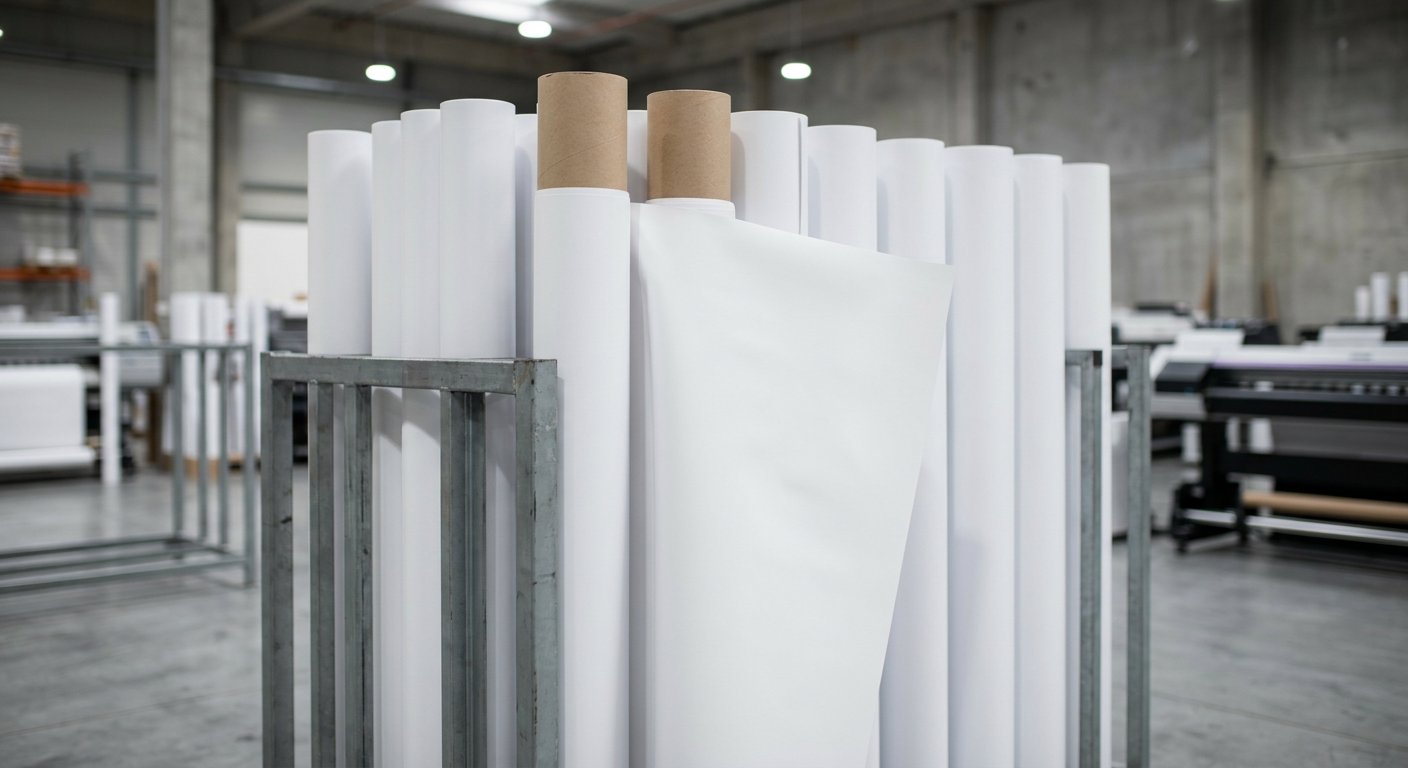
How you store flex media decides how it prints. Wrinkles, edge waves, ink adhesion failures, and mid-print head strikes frequently trace back not to the printer or the operator — but to rolls that were stored flat, damp, or in heat for weeks. This guide covers the complete storage playbook for flex media: orientation, temperature and humidity control, shelf life, handling heavy rolls, and the warning signs that a roll is already damaged before you load it.
Why Flex Media Storage Matters
Flex is PVC + polyester — stable materials, but their coated surfaces and wound tension are sensitive to environment:
- Moisture makes edges wave, causing banding and head strikes
- Heat softens PVC, causing layers to stick (blocking) and flat spots
- Pressure from stacking deforms the roll into an oval, printing with rhythmic wrinkles
- Dust settles on roll edges and transfers into the print path
- Age slowly yellows coatings and weakens ink adhesion
Rule 1: Store Rolls Upright, Always
The single most important habit: stand rolls vertically on their core ends on a rack or pallet.
- Upright storage keeps the roll perfectly round — gravity acts along the core, not across it.
- Flat-stored rolls deform within days; the resulting “egg shape” causes repeating wrinkles and tension surges mid-print.
- Never lean rolls at angles — they sag into the same deformation.
- Use a roll rack or wooden crib with dividers so rolls can’t topple; a falling 100 m roll (220+ kg) is a serious safety hazard.
Rule 2: Control Temperature & Humidity
| Condition | Ideal Range | What Happens Outside It |
|---|---|---|
| Temperature | 15–30°C | Above 35°C: PVC softens, layers block, flat spots form |
| Humidity | 40–65% RH | Above 75%: edge waving, ink adhesion loss, mould on backing |
| Sunlight | None (dark storage) | UV yellows coatings and pre-degrades the surface |
Practical tips for Indian shops:
- Keep rolls off tin-shed floors in summer — floor temperatures under GI roofs cross 50°C. Use a partitioned, shaded corner or a raised platform.
- Monsoon protocol: keep rolls wrapped in their original plastic until loading day; add a moisture absorber (silica bags) near the rack; never store against a leaking wall.
- Condition rolls before printing: bring rolls from cold/humid storage into the print room 2–4 hours early so they acclimatise — cold PVC unrolls stiff and waves.
Rule 3: Keep Original Wrapping Until Use
- The factory wrap and end caps protect against dust, moisture, and edge knocks.
- Opened rolls should be re-wrapped in polythene at day’s end — especially in dusty or humid workshops.
- Label opened rolls with grade, GSM, brand, and date opened — stops mystery-roll confusion and forces FIFO rotation.
Rule 4: First In, First Out (FIFO)
Flex media ages even in good storage:
| Storage Time | Condition Risk |
|---|---|
| 0–6 months | Negligible if stored correctly |
| 6–12 months | Slight coating drying; test adhesion on premium jobs |
| 12–18 months | Yellowing possible; use for economy jobs first |
| 18+ months | Adhesion failures likely; run test strips before big jobs |
Mark arrival dates on every roll and load oldest stock first. Buying 6+ months of inventory “to save 10%” often loses more to ageing than it saves.
Handling Heavy Rolls Safely
- Two-person minimum for 50 m rolls (110–120 kg); trolley or lift for 100 m rolls (220+ kg).
- Never drop rolls onto cores — cracked cores cause wobble and banding.
- Use core adapters/shafts rather than forking through the media itself.
- When loading onto the printer, keep the roll parallel to the platen — skewed loading prints with one-side tension waves.
Pre-Loading Roll Inspection (60 Seconds That Save Jobs)
- Look at the roll face: any visible waves, gaps, or telescoping (layers sliding sideways)? Damaged edges mean waste and possible head strikes.
- Check roundness: roll should be perfectly circular; flat spots print as repeating wrinkles.
- Feel the surface: tacky or sticky = heat damage/blocking — reject for premium work.
- Sniff test: musty smell = moisture exposure; test adhesion before the job.
- Clean the edges: wipe roll edges with a dry cloth before loading — edge dust travels into the print path.
Storing Finished Prints vs Raw Media
- Printed flex rolls should also stand upright; face-to-face contact on fresh solvent prints can offset (transfer) — interleave with paper if stacking is unavoidable.
- Folded finished banners: fine for short term; long-term folded storage creases permanently. Roll instead.
- Vinyl/PP stock: same rules, and even more heat-sensitive — vinyl blocking ruins rolls faster than flex.
Common Storage Mistakes Checklist
- Rolls stacked flat like firewood ❌
- Stock touching an outer wall that heats/leaks ❌
- Opened rolls left unwrapped through monsoon ❌
- Newest stock loaded first while old rolls age ❌
- Rolls stored next to ink/solvent drums (vapour exposure) ❌
- No labels — nobody knows what grade that mystery roll is ❌
Frequently Asked Questions (FAQs)
Q1. How should flex rolls be stored?
Upright on their cores, in original wrapping, in a cool (15–30°C), dry (40–65% RH), dark space — with oldest stock loaded first.
Q2. Can flex rolls be stored lying flat?
Avoid it. Flat storage deforms rolls within days, causing repeating wrinkles and tension problems in print. Short-term flat placement is tolerable; storage racks should be vertical.
Q3. What is the shelf life of flex media?
12–18 months in proper storage. Beyond that, coatings dry and yellow; run adhesion test strips before using old rolls on customer work.
Q4. Does humidity really affect flex printing?
Yes — high humidity waves the media edges, causes banding, and weakens ink adhesion. Monsoon is when storage discipline pays most.
Q5. How do I stop roll edges from waving?
Keep wraps on until loading, store away from damp walls, acclimatise rolls in the print room for a few hours, and use edge-cleaning wipes before printing.
Q6. Can heat-damaged flex be saved?
Blocked (sticky) layers usually can’t be separated cleanly. Use the outer undamaged wraps for test prints and economy jobs; discard the core section.
Q7. How much stock should a flex shop keep?
4–8 weeks of moving grades (usually 280 GSM standard + 340 GSM Star Flex), plus one roll each of slow movers (backlit, mesh). More inventory ages more than it saves.
Q8. Should rolls be stored near the printer?
Close enough for workflow, but not where heaters or direct sunlight reach them. A shaded rack beside the machine is ideal.
Q9. How do I label opened rolls?
Masking tape + marker: brand, GSM, grade, and date opened. Takes 30 seconds; prevents expensive “guess which roll” mistakes.
Q10. What’s the safest way to move 100 m rolls?
A roll trolley or two-person carry with core support — never rolled along the floor or dropped. Cracked cores create wobble that ruins print quality.
Good Media Deserves a Good Machine
Perfectly stored flex still needs stable tension systems and clean heaters to print at its best. UED’s flex printers are built for Indian workshop conditions — with installation, training, and pan-India support.
Final Word
Flex storage is free quality control: upright, wrapped, cool, dry, rotated. Five habits that cost nothing and prevent the banding, wrinkles, and adhesion failures that shops wrongly blame on their printers. Treat your rolls well, and every job starts with perfect media.
