



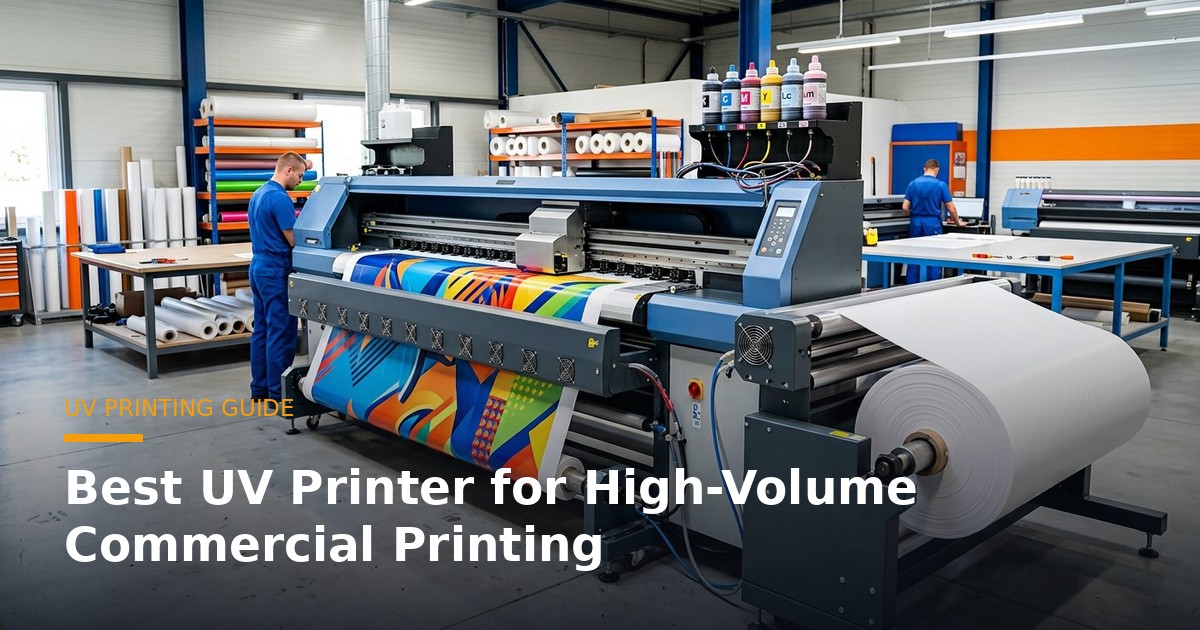
High-volume commercial UV printing is a different sport from shop-floor printing: the winners are decided by uptime, head economics, automation and cost per good square metre, not by brochure resolution. This guide explains what high-volume commercial work demands and which UV printer is best for it, so a production house or large shop invests in a machine built to run, not just to impress.
What “high-volume commercial” actually demands
High-volume means long runs, tight deadlines and thin per-unit margins recovered through throughput. It demands industrial printheads that last, a frame and media system that hold registration for hours, automated or assisted media handling, stable ink delivery including white, and a service organisation that can keep the machine running. The best high-volume machine is therefore judged on cost per good square metre at real utilisation and on mean time between interventions — not on peak speed alone.
Printheads: the heart of volume economics
At volume, head choice dominates economics. Epson i3200 arrays can serve mid-volume well, but true high-volume production favours industrial heads — Konica and Ricoh — for their longer life, higher uptime and consistency at speed. The calculation is cost per head divided by expected good output plus downtime cost: a costlier head that runs longer and stops less usually wins at volume. Always get head price, expected life and local availability in writing before committing.
Width, speed and the throughput equation
Throughput is width multiplied by speed multiplied by utilisation. A 3.2 m roll-to-roll or a large flatbed prints more per pass, but only if the media handling and drying/curing keep pace and the operator flow feeds it. The best high-volume machine pairs width and heads with a media path and workflow that sustain them; a wide machine starved by manual loading is slower than a narrower one that runs continuously. Design the workflow — loading, take-up, finishing — before choosing the width.
Uptime, service and the cost of downtime
In volume printing, downtime is the largest hidden cost: a stopped machine still costs heads, rent and labour while missing deadlines. The best high-volume machine comes with a service organisation that guarantees response time, holds spares locally and offers preventive maintenance. Build downtime into the TCO: a machine with slightly higher sticker but guaranteed support usually costs less per good square metre than a cheaper one that waits days for an engineer.
Ink systems and white at volume
High-volume ink delivery must be stable: bulk or continuous ink supply, reliable white circulation to avoid sedimentation, and consistent curing at speed. White at volume is both a margin channel and a maintenance burden, so its reliability is critical. Choose an ink system with proven bulk supply and white management, and price white-ink products to reflect the added consumable and maintenance.
Automation and workflow for volume
Volume rewards automation: auto media-height sensing, take-up and unwind tension control, batch queueing in the RIP, barcode or variable-data workflows, and integrated cutting or finishing where possible. Each automated step removes labour and error, raising good output per operator-hour. The best high-volume setup is a system — machine, RIP, handling, finishing — not a standalone printer.
Best machine classes by volume profile
- Mid-volume producer: dual/multi i3200 3.2 m roll-to-roll or 4×8+ flatbed; strong value at steady volume.
- High-volume production: industrial-head (Konica/Ricoh) wide-format line; uptime and head life rule.
- Mixed rigid+flexible volume: hybrid or paired flatbed+roll-to-roll with industrial heads.
Total cost of ownership at volume
Model TCO per good square metre: purchase amortised, heads, ink, media, waste, maintenance, labour and downtime, divided by realistic good output at high utilisation. Compare candidates on this figure, not sticker. Because volume magnifies every inefficiency, a small per-square-metre advantage compounds into large annual savings — which is why volume buyers compare TCO obsessively.
Common high-volume buying mistakes
- Buying peak speed without the workflow to sustain it.
- Under-investing in service and spares, then paying in downtime.
- Choosing value heads for a volume duty cycle they cannot survive.
- Ignoring white-ink reliability at speed.
- Not automating loading/finishing, then capping throughput with labour.
Frequently asked questions
When do industrial heads pay over i3200?
When daily volume and duty cycle make head life and uptime the binding constraint; at moderate volume, i3200 value usually wins.
Is a wide machine always better for volume?
Only with the media handling and workflow to feed it; width without sustained utilisation is wasted capital.
How important is the RIP at volume?
Critical — queueing, nesting, variable data and colour consistency at speed live in the RIP and workflow, and they decide good output per hour.
A deeper look: building the volume production cell
Treat the high-volume machine as the centre of a production cell: upstream, media staging and climate control; at the machine, automated handling and stable ink; downstream, finishing, QC and packing arranged for flow. Measure good output per operator-hour and per machine-hour, and attack the biggest bottleneck each quarter. A cell designed for flow out-produces a faster machine in a disordered room, which is why volume leaders invest in the system around the printer as much as the printer itself.
A deeper look: pricing and winning volume contracts
Volume contracts are won on reliable cost per unit and guaranteed turnaround, so price from your TCO with a margin that survives a bad month, and commit only to volumes your cell can sustain. Use utilisation data to know your true capacity before promising, and build penalties and peaks into the contract honestly. A volume account that is priced from real cost and delivered reliably compounds; one priced to win and delivered late destroys margin and reputation.
Spotlight: roll-to-roll volume lines
High-volume flexible work — banners, hoardings, vehicle vinyl, backlit film — runs on wide roll-to-roll lines where the economics are cost per good square metre at sustained speed. Industrial heads, stable tension and take-up, and bulk ink supply keep such a line earning. The finishing side — trimming, grommeting, laminating where required — must be organised for flow too, because a fast printer blocked by slow finishing is not fast. Volume roll shops win on the whole line, not the printer alone.
Spotlight: flatbed volume lines
High-volume rigid work — panels, ACP, foam board, industrial labels — runs on large flatbeds where gang-run efficiency and registration decide throughput. Industrial heads and strong vacuum hold quality across long shifts, and automated height sensing protects heads on varied sheets. The prep and packing benches must match the printer’s pace, since rigid work’s labour sits upstream and downstream. A volume flatbed is a cell: printer, prep, finishing, packing, all balanced.
Staffing, shifts and the human side of volume
Volume often means shifts, so the machine must be operable by more than one specialist: clear SOPs, documented daily maintenance and simple changeover procedures let a second or third shift run safely. Cross-train operators and rotate them through QC so quality does not depend on one hero. Because heads and lamps do not care who runs them, disciplined handover checklists are what keep a multi-shift volume machine consistent and alive.
Quality control at speed
At volume, QC must be built into the flow, not bolted on: nozzle checks at shift start, inline visual checks at defined intervals, and a reject log that flags recurring defects by cause. Track waste by reason — banding, misregistration, media fault, strike — and attack the top cause each week. Because volume magnifies small defects into large waste, a tight QC loop is one of the highest-return practices in production printing.
Energy, environment and running conditions at volume
A volume machine runs hot and long, so its environment matters: stable temperature and humidity for media and ink, clean power with conditioning for lamps and electronics, and extraction where needed. Budget energy as a real line item at volume, because a wide industrial line draws significant power continuously. A controlled environment is not a luxury in production; it is the difference between consistent output and drift that shows up as waste and reprints.
Scaling from one machine to a production fleet
When a single volume machine reaches sustained high utilisation with regular declined overflow, the case for a second is proven. Add capacity by the binding constraint — another roll line if flexible overflows, another flatbed if rigid overflows — and keep each machine dedicated to its media so operators and workflows stay simple. A fleet managed with shared TCO discipline and central spares compounds the production house’s advantage, turning one good machine into a scalable business.
The volume buyer’s checklist
- Fix duty cycle first; choose heads (i3200 vs Konica/Ricoh) by it.
- Confirm media handling sustains the width and speed you are buying.
- Get head price, life and local spares in writing.
- Verify white-ink reliability and bulk supply at speed.
- Demand a service response commitment and preventive-maintenance plan.
- Model TCO per good square metre at realistic utilisation.
- Design the finishing workflow before signing, not after.
When volume is not the right strategy
Volume is not for every business: it needs steady demand, working capital for media, and the discipline to run thin margins at high utilisation. A shop whose strength is premium, personalised or industrial work may earn more at lower volume with fatter margins. The honest question is whether your market and temperament suit a throughput business; if not, the best machine is the one that serves value, not volume, and that is a perfectly good strategy.
Buy the system, not the sticker: heads for the duty cycle, width for sustained utilisation, support for the worst day, and a workflow that lets it all run. That combination, priced by cost per good square metre, is the best UV printer for high-volume commercial printing – whatever badge is on the frame.
A note on choosing a production partner
At volume, the supplier relationship is a strategic asset: you are buying years of heads, ink, spares and engineer-hours. Choose a partner with a proven installed base in production, transparent consumable pricing and a roadmap your business can grow with. Reference calls with existing volume users are the best due diligence available, because they reveal how the machine and the support behave at month thirty, not at the demo.
Volume rewards the prepared: the shop that designs its cell, locks its support and prices from real cost turns a fast machine into a durable, compounding production business.
Make uptime the culture, waste the enemy and cost-per-good-square-metre the scoreboard, and the volume line becomes the engine it was bought to be.
The discipline, not the badge, is what makes a volume printer profitable – apply it and the machine pays for itself many times over.
The long view on volume
Volume businesses compound through reliability: every on-time contract won is a reference that wins the next, and every quarter of stable cost per good square metre widens the gap over competitors who run looser. Build the reputation for dependable volume and the machine becomes the centre of a durable production franchise.
Buy on evidence, run on discipline, and let reliability compound into the franchise.
That is the volume business: engineered, measured and reliable – the machine simply executes the system you build around it.
Choose it with the checklist, run it with the culture, and the volume line earns its keep.
Run it as a system and it will run your margins upward.
Evidence in, discipline on, and the volume machine pays.
Buy the system, run the culture, keep the score.
Do that and the volume line becomes a franchise.
And a franchise, run well, compounds.
Measure, maintain, and let uptime do the compounding.
Run it like a system and it pays like one.
Conclusion
The best UV printer for high-volume commercial printing is the industrial-head, wide-format machine whose media handling, ink system and service organisation sustain throughput at the lowest cost per good square metre — embedded in a workflow designed for flow. Choose heads by duty cycle, width by sustained utilisation, and support by response time, and model TCO obsessively. Explore our digital UV printer range or talk to us about a production-grade configuration.
