



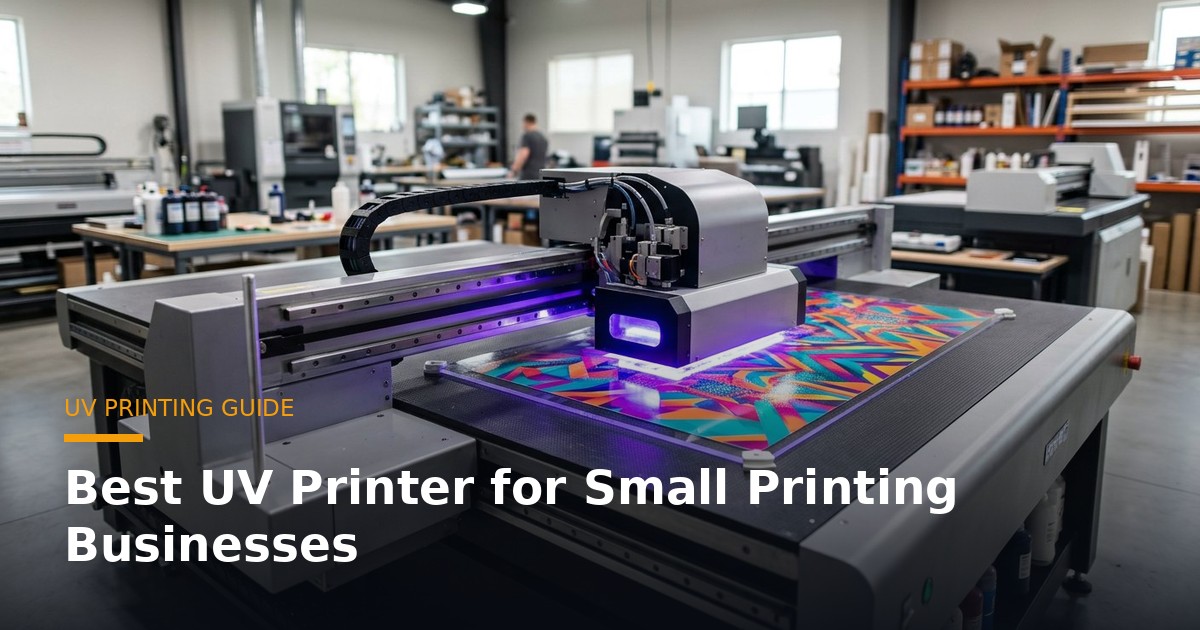
For a small printing business, the first UV printer is less about peak performance and more about versatility, low risk and the ability to say yes to the jobs that build a customer base. This guide explains what a small business should look for and which UV printer is best to start with, so the machine earns from week one and leaves room to grow.
What a small business needs from a first UV machine
A small shop needs a machine that covers its likely mix at low capital: signage boards, a few gifts, stickers or banners depending on the market. It needs reliability and simple maintenance, affordable heads and consumables, and local support, because a small business cannot absorb long downtime. Versatility matters more than peak speed: the ability to print rigid and flexible, with white ink for premium work, lets a small shop say yes to most enquiries.
The two sensible starts
Depending on the local market, a small business starts with either a compact UV flatbed (gifts, signage boards, décor) or an entry UV roll-to-roll (banners, vinyl, stickers). The flatbed suits a décor/gift/signage market with fat per-piece margins; the roll-to-roll suits an advertising market with daily volume. Where the market is mixed and space or capital allows one versatile machine, a compact hybrid can cover both at moderate performance. The right start follows the dominant local enquiry type.
Keep the entry cost and risk low
A small business should buy the machine its proven demand pays for, not the largest it can finance. Entry i3200 or single-head machines give good quality at moderate head cost and widely available spares. Add white ink if the market wants premium products, because it is the margin channel, but avoid over-optioning for demand that does not yet exist. The goal is a machine that pays for itself quickly and funds the next step.
Support and ease of maintenance matter most
For a small shop, the supplier’s support is part of the product: local engineer, training, spares and a responsive helpline keep a small business running. Choose a machine whose daily maintenance is simple and documented, and learn it well; a small shop’s owner is often the operator, so ease of maintenance directly protects revenue. A slightly simpler machine with strong support beats a complex one with none.
Versatility: white ink and the product range
White ink multiplies a small shop’s sellable range: dark and transparent acrylic, glass, coloured items and clear-vinyl stickers all depend on it. If the budget allows, include white from the start; if not, plan the upgrade path. A small machine with white opens gifts, décor and premium signage — the families that carry margin for a small business — so it is usually the best first option money can buy.
Space, skills and the one-person workflow
Small shops often run one or two people, so the workflow must be simple: easy media loading, straightforward prep, and finishing that one person can manage. Measure the true footprint including stock and finishing, and choose a machine that fits both the room and the labour. A machine that one person can run confidently earns more for a small business than a larger one that needs a crew.
Best starter classes by small-business type
- Gift and personalisation studio: desktop/A2–60×90 cm white-ink flatbed; low cost, strong margins.
- Signage and décor shop: 60×90 to 4×8 ft white+varnish flatbed.
- Advertising and banner shop: 1.6–1.9 m entry roll-to-roll, add white for stickers.
- Mixed general shop: compact hybrid covering both at moderate volume.
Growth path: from first machine to platform
Plan the first machine as step one of a platform: it proves demand and funds the second. Track declined work from day one; when rigid or flexible enquiries you cannot serve reach steady weekly value, add the complementary machine. This demand-led expansion keeps a small business growing without over-leveraging, and each machine stays earning because it was bought for proven work.
Common small-business buying mistakes
- Over-buying size or heads for demand that does not exist.
- Skipping white ink, then losing the premium market.
- Choosing on price over local support, then paying in downtime.
- Under-budgeting stock, consumables and working capital.
- Buying a second machine before the first proves the demand.
Frequently asked questions
What is a realistic first-machine budget?
A compact white-ink flatbed or entry roll-to-roll plus installation, stock and working capital is a common small-business start; model the first-year total, not just the machine.
Flatbed or roll-to-roll first for a small shop?
Follow the market: décor/gift/signage demand favours the flatbed; banner/advertising volume favours the roll-to-roll; mixed moderate demand can suit a hybrid.
Can a small machine grow with the business?
Yes as a capacity or dedicated line once a larger machine arrives; buy the first machine knowing it will remain useful, which keeps every purchase purposeful.
A deeper look: validating demand before buying
Before investing, validate cheaply: survey ten local prospects on what they buy and at what price; run a soft launch by outsourcing a few real orders to test margin and repeat interest; and check local competition. If the soft launch shows real, payable demand, buy the machine to capture that margin in-house. Validation turns the first UV purchase from a bet into a scale-up of proven demand, which is exactly the risk discipline a small business needs.
A deeper look: the small shop’s marketing flywheel
A small UV shop grows by a simple flywheel: produce a few beautiful products, photograph them, display them at the counter and online, deliver on time, and ask every happy customer for a referral and a photo. Each satisfied customer feeds the next enquiry, and the sample wall converts walk-ins. Because UV products are visual and personal, the flywheel compounds quickly; the machine supplies the range, but the flywheel — samples, photos, referrals — supplies the growth.
Spotlight: the gifting starter
A compact white-ink flatbed is the classic gifting starter: phone cases, keychains, photo blocks, awards and name plates, personalised on demand. The economics are friendly — low entry cost, strong per-piece margins, and variable data that makes each unique piece as cheap as the last. Batch with jigs, build a tidy catalogue and ride the festival and wedding calendar. Gifting teaches a small shop pricing, preparation and photography with low capital at risk, which is why it is such a good first UV business.
Spotlight: the signage starter
A 60×90 to 4×8 ft white+varnish flatbed suits a small signage and décor shop: acrylic boards, foam panels, small ACP, menu boards and décor pieces. Signage gives larger tickets than gifting and builds trade relationships with shops and offices. Master acrylic preparation and back-face printing early, keep a sample board at the counter, and add installation or partner for it. Signage is a dependable small-business UV niche with room to grow into décor.
Spotlight: the advertising starter
An entry 1.6–1.9 m roll-to-roll suits a small advertising and banner shop: same-day banners, stickers, vinyl and lightbox media. The work is frequent and fast, building cash flow and a customer base that later buys rigid signage. Add white ink for stickers and backlit as soon as the market shows demand, and keep finishing quick. The advertising starter is a volume-and-cash-flow play that funds the shop’s expansion into higher-margin rigid work.
Financing a first machine sensibly
Most small businesses finance, so keep the repayment inside the machine’s realistic contribution and hold a buffer for heads and consumables in year one. Match the term to the cash-flow shape — frequent small payments for a roll-to-roll, fewer larger for a flatbed — and never let the optimistic case be the only one modelled. A first machine should be a comfortable obligation at half utilisation, so a slow quarter never threatens the business.
The first ninety days
Run a disciplined launch: install and profile properly, build a sample wall of your chosen products, announce the capability to existing customers first, and track every enquiry by type. Deliver on time, photograph everything, and ask for referrals. Review weekly what sold and what was declined. The first ninety days are research as much as revenue: the data you collect becomes the business case for the second machine and the focus for your marketing.
Pricing for a small shop
Price gifts and décor per piece on value, signage per job including design and fitting, and banners competitively but never below full cost. Keep a simple price sheet so quoting is fast and consistent, and review margins monthly as ink and media prices move. A small shop that prices confidently and consistently earns respect and margin; one that discounts from fear trains customers to wait for a lower price.
The small-business buyer’s checklist
- Survey local demand; let the dominant enquiry choose flatbed, roll-to-roll or hybrid.
- Prefer i3200/single-head value with widely available spares.
- Include white ink if the market wants premium products.
- Check local support, training and service response.
- Budget stock, consumables and working capital, not just the machine.
- Measure the true footprint including finishing and storage.
- Plan the second machine as the first one proves demand.
The mindset: start small, think platform
The best small-business owners treat the first UV machine as the seed of a platform, not the whole business. It proves a niche, funds the next capability and teaches the discipline — preparation, pricing, photography, reliability — that scales. Start small, master a few products, and let each proven family add a rung; over a few years the small shop becomes the local specialist without ever over-betting.
Start with the niche your town already pays for, keep the machine simple and supported, price with confidence and let the flywheel turn. A small UV shop run that way grows steadily, funds its own expansion, and becomes the local name for the products it mastered first.
A note on staying small on purpose
Not every small shop should grow big; some owners prefer a compact, profitable specialist over a scaled operation, and that is a valid strategy. The UV platform suits staying small beautifully: one versatile machine, a focused catalogue and strong margins can provide an excellent living with low overhead. Whether you scale or stay small, the same discipline applies – buy on proven demand, price on value and keep the machine earning – so the choice of size is lifestyle, not risk.
Begin where the demand is, keep it simple, and let each satisfied customer fund and refer the next; that is the whole of a successful small UV business.
Choose the machine your market already pays for, run it with discipline, and the small shop quietly becomes the specialist the whole town calls first.
Small, focused and reliable beats big, scattered and hopeful every time in this trade – start there and grow on proof.
The long view on small
A small UV shop compounds through trust: every delivered promise earns a referral, every mastered product widens the catalogue, and every year deepens the local reputation that a newcomer cannot buy. Stay disciplined and the small shop becomes an institution, which is its own kind of scale.
Start small, prove the niche, and let the flywheel carry you to the specialist the town calls first.
That is the small-business path: validated, focused and compounding – the machine is only the beginning of the asset.
Choose it on proof, run it with care, and the first machine becomes the foundation of the whole business.
Run it as a platform and it will grow with you.
Proof first, then the machine – never the other way round.
Conclusion
The best UV printer for a small printing business is the versatile, low-risk machine its proven market pays for: a compact white-ink flatbed for gifts and décor, an entry roll-to-roll for advertising volume, or a compact hybrid for a mixed shop — always with simple maintenance and strong local support. Start small, validate demand, master a few products, and let proven work fund the next machine. Explore our digital UV printer range or talk to us about a right-sized starter.
