

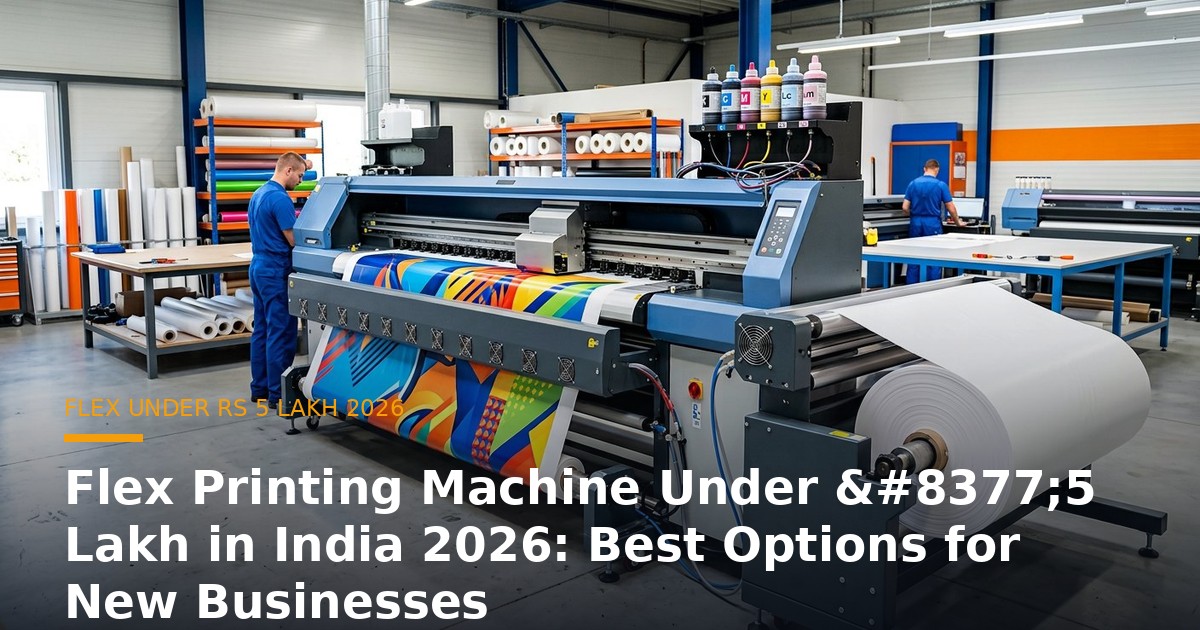
A budget of under ₹5 lakh is the sweet spot for most new flex printing businesses in India in 2026. It is enough to buy a genuinely capable, saleable-quality machine without over-leveraging yourself before you have a steady order book. This guide explains exactly what a flex printing machine under ₹5 lakh gets you in 2026, which configurations offer the best value for a start-up, and how to avoid the traps that turn a bargain purchase into an expensive mistake.
The under-₹5 lakh segment is crowded, which is good for buyers — but it also means quality varies wildly. Two machines can carry similar price tags and deliver completely different reliability, print quality and running costs. Knowing what to prioritise within this budget is what separates a machine that builds your business from one that quietly drains it.
What a Flex Printing Machine Under ₹5 Lakh Gets You in 2026
In the under-₹5 lakh bracket you can realistically expect a new 6 to 10 ft eco-solvent flex machine with one of the following printhead configurations:
| Option | Typical Spec | Indicative Price | Best For |
|---|---|---|---|
| XP600 single/dual-head (8 ft) | Entry speed, good quality | ₹1.8L – ₹3.2L | Tight budgets, local jobs |
| Epson i3200 dual-head (8–10 ft) | Sharp text, strong quality | ₹3.0L – ₹4.8L | Quality-focused start-ups |
| Konica 512i dual-head (8–10 ft) | Faster, production-ready | ₹3.5L – ₹5.0L | Start-ups expecting volume |
The key insight is that under ₹5 lakh you generally choose between higher quality at lower speed (Epson i3200) and higher speed at slightly lower resolution (Konica 512i). Both are excellent; the right choice depends on whether your customers care more about fine detail or fast turnaround.
The Three Best Options for New Businesses
1. XP600 flex machine — the lowest-cost entry
If your budget is tight and your initial volume is modest, an 8 ft XP600 machine is the cheapest way to start producing saleable flex output. It handles shop boards, banners and local advertising well, and its low ink and maintenance costs keep your break-even point achievable even at modest volumes. The trade-off is lower top speed, so it suits businesses that are building their customer base gradually rather than chasing high-volume contracts from day one. Many successful printers started on an XP600, learned the market, and upgraded to a Konica machine once demand justified the investment.
2. Epson i3200 flex machine — the quality pick
The Epson i3200 is widely regarded as the best-quality head in this price band. It produces crisp small text and smooth gradients, which matters if you are targeting retail signage, premium banners and detail-sensitive work where a customer will stand close and judge the finish. For a start-up that wants to win customers on quality rather than compete purely on price, an i3200 machine under ₹5 lakh is an excellent choice that positions you in a more profitable, less crowded segment of the market.
3. Konica 512i flex machine — the growth pick
If you expect steady commercial volume quickly — for example, you already have relationships with advertising agencies or retail chains — a dual-head Konica 512i machine at the top of the under-₹5 lakh band gives you production speed and durability that will serve you for years. It is the head most established Indian flex printers use, and starting on it means you will not outgrow the machine as fast, avoiding the cost and disruption of an early replacement.
What to Prioritise Within a ₹5 Lakh Budget
When money is limited, spend it on the things that affect output and uptime, not cosmetics. Prioritise a rigid frame and stable media handling, because banding and misfeeds waste expensive material and ruin jobs. Prioritise a reliable printhead from a proven family — XP600, i3200 or Konica 512i — with spares genuinely available in India. Prioritise a decent RIP and proper heaters and dryers, because curing affects both the quality and the outdoor durability of the print. Finally, prioritise the supplier’s service capability; a responsive technician and ready spares are worth more than a marginal hardware upgrade, because every hour your machine is down is an hour of revenue you cannot recover.
What to Avoid
Avoid unknown no-name heads with no spares pipeline, however cheap they seem; a single failed head with no replacement available can idle your business for weeks. Avoid machines that are cheap because critical components — servo drives, media take-up, heaters — have been quietly downgraded. Avoid comparing quotations that are not for identical specifications, and avoid suppliers who cannot clearly explain the configuration they are quoting or who will not put it in writing. The cheapest machine on a quotation is very rarely the cheapest to own over three years.
Setting Up: What Else Your ₹5 Lakh Should Cover
First-time buyers often spend the entire budget on the machine and then discover they have nothing left to actually run it. A realistic launch budget reserves a portion of your capital for everything around the printer. You will need an initial stock of flex media in the widths and GSM your customers ask for, a starter set of eco-solvent inks, and possibly lamination film if you offer finished, weather-protected output. You will need a RIP software licence if it is not bundled with the machine. You will need a stable power supply, and in many Indian localities a voltage stabiliser or online UPS to protect sensitive electronics and printheads from fluctuation. You will also need basic finishing tools — cutting, pasting, eyeleting and framing — plus a worktable and storage. Keeping roughly a fifth of your budget aside for these essentials prevents the stressful situation of owning a machine you cannot yet feed, ink or protect.
A Simple First-Year Economics Example
Numbers make the decision clearer. Suppose you buy a machine around ₹4 lakh and your combined running cost — ink, media, power and consumables — averages roughly ₹35 per square foot, while you sell finished flex work at an average of ₹80 per square foot in your market. That leaves around ₹45 per square foot of gross contribution. If you produce and sell even 1,500 square feet a month, that is roughly ₹67,500 of monthly gross contribution, which repays the machine in well under a year before you even count growth. The lesson is that utilisation drives everything: a modest machine kept busy outperforms an expensive machine left idle. Buy the configuration that matches the volume you can realistically sell, and upgrade when your order book — not your ambition — demands it.
Common Mistakes New Flex Buyers Make
The most common mistake is buying on price alone and ignoring service, which turns a small saving into weeks of lost revenue when the machine needs a technician. The second is buying too small and outgrowing the machine within a year, forcing a costly early upgrade; if you already have agency or retail relationships, buy a little more capacity than you need today. The third is neglecting power protection, which is a leading cause of premature electronic and printhead failure in India. The fourth is underestimating working capital and running out of cash for media and ink just as demand picks up. Avoiding these four mistakes does more for your first-year profitability than any single hardware specification.
Regional Price Variations Across India
Flex machine prices are not identical everywhere in India, and understanding why helps you negotiate. The base hardware cost is broadly similar nationwide, but the final landed price moves with freight to your city, local installation and training charges, state tax treatment, and the strength of local service coverage. Metros and major printing hubs often see sharper pricing because competition among suppliers is fiercer and logistics are cheaper, while buyers in smaller towns may pay a little more for freight and on-site support. This does not mean you should always buy from the cheapest distant supplier: a slightly higher price from a supplier who can reach you quickly when the machine stops is usually the better deal, because downtime costs far more than the difference in freight. Always compare the total landed, installed price rather than the bare ex-works number.
How to Evaluate and Negotiate a Quotation
Get at least three written quotations and compare them line by line, not just on the headline total. Check that each quote specifies the exact printhead model and count, the print width, the RIP software included, the number of ink channels, the heaters and dryers, the media take-up system, and what installation, training and warranty cover. Suppliers sometimes appear cheaper by omitting items another includes, so normalise the comparison before deciding. Negotiate on the total value — bundled inks, media, spare parts, extended warranty or training — rather than only on the machine price, and always get the final agreed configuration in writing. A supplier who explains every line clearly is telling you something important about the support you will receive after the sale.
Financing Your First Machine
You do not always need the full ₹5 lakh upfront. Many Indian suppliers, including UED, can arrange EMI and financing options that spread the cost while preserving your working capital for media, ink, rent and marketing. When you finance, compare the total interest against the revenue the machine will generate, and avoid stretching yourself so thin that a slow month becomes a crisis. A modest machine you can comfortably afford beats a bigger one that keeps you awake at night.
Why Buy From UED?
Unified Engineering Dynamics (UED) specialises in helping new printing businesses choose the right machine for their budget and market. We supply genuine XP600, Epson i3200 and Konica 512i flex machines under ₹5 lakh, with professional installation, operator training and dependable after-sales support across India. Our goal is to get your first machine earning quickly and reliably, and to be the partner you grow with as your volume increases.
UED’s Recommendation by Budget
If you can spend up to ₹3 lakh, an 8 ft XP600 machine is the sensible start: low entry cost, low running cost, and perfectly good output for local shop boards and banners while you build your customer base. If you can reach ₹4 lakh, an Epson i3200 dual-head machine gives you a visible quality step that lets you win premium retail and detail-sensitive work at better margins. If you can stretch to ₹5 lakh and you already have agency or retail demand waiting, a dual-head Konica 512i machine is the smartest long-term buy, because its speed and durability mean you will not outgrow it quickly. Whichever tier you choose, spend the balance of your budget on media, ink, power protection and finishing tools rather than maximising the machine alone — a well-supported mid-range machine beats a maxed-out one you cannot afford to feed.
Frequently Asked Questions
What is the best flex printing machine under ₹5 lakh in India in 2026?
For most new businesses, an 8–10 ft Epson i3200 dual-head machine offers the best quality, while a dual-head Konica 512i offers the best speed and durability at the top of the budget. Tight-budget start-ups can begin with an XP600 machine around ₹2–3 lakh.
Can I get a Konica 512i machine under ₹5 lakh?
Yes — a dual-head 8–10 ft Konica 512i flex machine is typically available around ₹3.5–5 lakh depending on configuration and automation.
How much working capital do I need besides the machine?
Plan for media and ink inventory, a RIP licence, power protection, finishing tools and a few months of operating buffer. A common guideline is to keep roughly 20–30 percent of your total budget aside for these essentials.
Is a used machine better than a new one under ₹5 lakh?
Not necessarily. A used machine with worn heads can cost more in replacements than a new entry machine. If you buy used, verify head health, service history and spares availability first.
Do these prices include GST and installation?
Usually not. Most prices are ex-GST and may exclude installation and training. Always request a written, configuration-specific quotation.
Want an exact, configuration-specific quote? Talk to UED’s printing specialists — share your print width, monthly volume and budget, and we’ll recommend the right machine with transparent pricing. Request a quote →
Prices on this page are indicative 2026 market ranges (ex-GST) and vary with configuration, printhead count, automation, accessories, installation and location. Always confirm a written, configuration-specific quotation before purchase.
