

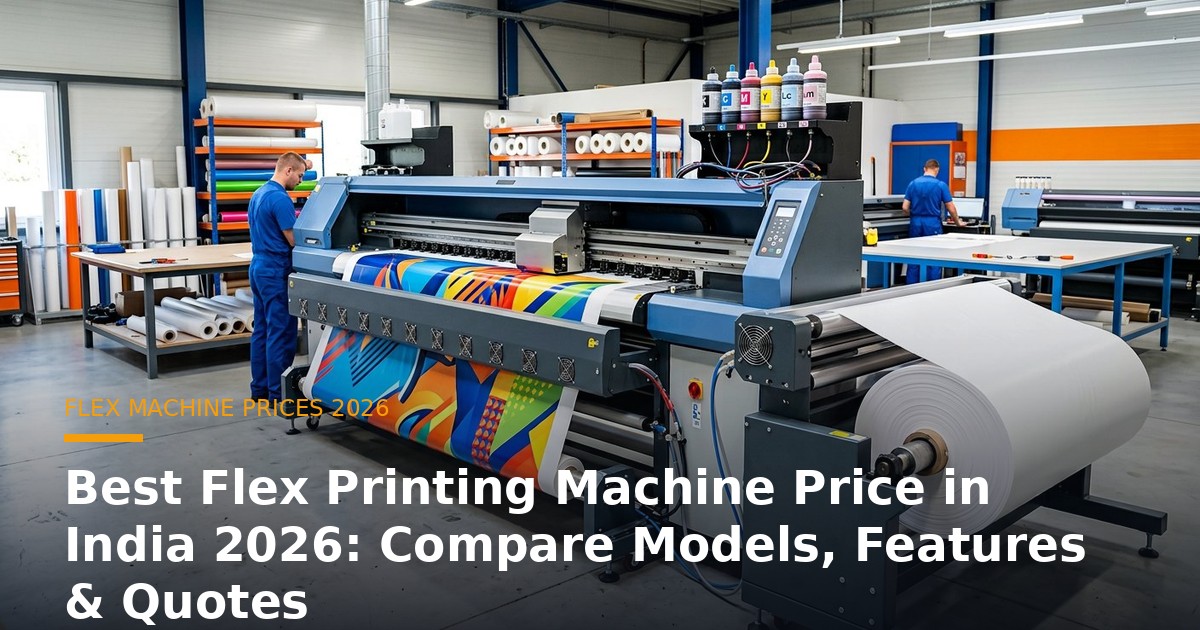
If you are researching flex printing machine price in India for 2026, the honest answer is that there is no single number. A flex printer can cost anywhere from around ₹1.8 lakh for an entry-level single-head machine to ₹16 lakh or more for a high-speed eight-head production line. What you pay depends almost entirely on three things: the printhead technology, the print width, and the level of automation and after-sales support bundled with the machine. This guide breaks down real 2026 price ranges across every popular configuration so you can budget accurately, compare quotations fairly, and avoid both overpaying for capacity you will never use and under-buying a machine that becomes a bottleneck within months.
Flex printing remains one of the most profitable segments of the Indian printing industry because demand is steady and diversified — shop boards, hoardings, backlit panels, event graphics, vehicle graphics, banners and retail signage all consume flex output every single day. That consistent demand is why so many entrepreneurs ask about flex machine prices first. Understanding the price structure is the first step toward buying a machine that actually returns your investment quickly.
Flex Printing Machine Price in India 2026 — Quick Snapshot
Here is a realistic snapshot of what flex printing machines cost in India in 2026. These are indicative, ex-GST ranges for new machines supplied and installed by a professional integrator rather than a bare-bones importer:
| Configuration | Typical Printhead | Indicative Price (2026) |
|---|---|---|
| Entry single-head flex printer (6–8 ft) | XP600 / single i1600 | ₹1.8L – ₹3.0L |
| Dual-head flex printer (8–10 ft) | Epson i3200 / Konica 512i | ₹3.0L – ₹6.0L |
| Four-head flex printer (10 ft) | Konica 512i | ₹6.0L – ₹10.0L |
| Eight-head flex printer (10 ft) | Konica 512i | ₹10.0L – ₹16.0L |
| High-speed industrial line | Konica 1024i | ₹14.0L – ₹22.0L |
Notice how the price roughly doubles every time you move up a printhead-count tier. That is because the printheads themselves — not the frame or the electronics — are the single most expensive component in the machine. A machine’s frame can last a decade, but its heads are the consumable heart that determines both cost and capability.
What Determines Flex Printing Machine Price?
1. Printhead technology (the biggest cost driver)
The printhead is the heart of the machine and the largest slice of the cost. In 2026 the Indian market runs on a handful of proven heads, each suited to a different budget and volume profile. The XP600 is the most affordable head on the market and is ideal for start-ups and low-to-mid volume shops; it keeps the machine cost low but offers a lower top speed. The Epson i3200 is the current sweet spot for quality-focused businesses, delivering excellent droplet control and razor-sharp small text at a moderate price, which makes it popular for retail signage and premium banners. The Konica KM512i is the workhorse of Indian flex printing — robust, fast and built for long, uninterrupted production runs, which is why most established flex printers standardise on it. Finally, the Konica KM1024i is the premium industrial head for very high volume and genuine 24×7 operation.
Moving from an XP600 machine to a Konica 512i machine can add ₹1–3 lakh to the purchase price, but it typically doubles or triples your output speed. That directly improves your cost-per-square-foot and shortens your payback period, which is why the Konica 512i remains the default recommendation for any business that expects steady commercial volume rather than occasional jobs.
2. Print width (6 ft vs 8 ft vs 10 ft)
Wider machines handle bigger jobs — hoardings, large backlit panels, building wraps — in a single pass without joining, but they cost more and consume more floor space. A 6 ft machine is the cheapest entry point and suits shops focused on smaller boards and banners. An 8 ft machine is the most popular all-rounder in India because it balances cost, footprint and job capability. A 10 ft machine commands a premium and is chosen by printers who regularly take on large-format hoarding work. We cover each width in detail in our dedicated 6 ft, 8 ft and 10 ft price guides.
3. Number of heads
More heads means more speed and higher throughput. A two-head machine suits a growing shop with moderate daily volume. A four-head machine suits steady commercial volume where turnaround matters. An eight-head line is for high-throughput printers running multiple shifts and fulfilling large hoarding and bulk banner orders. Each additional pair of heads adds cost but also multiplies the square footage you can produce per hour, so the right number depends entirely on your order book.
4. Automation, build quality and components
Servo drives, automatic media take-up systems, multi-zone heaters and dryers, media sensors, a rigid welded frame and a stable media-handling path all add to the cost — and all reduce downtime, banding and wastage. A cheap machine with poor media handling will waste flex and ink on misfeeds and head strikes, quietly eroding the money you saved upfront. When you compare two machines at very different prices, look closely at these components; they are usually where the difference hides.
5. RIP software, inks and after-sales support
A good RIP such as ONYX or PhotoPRINT gives you accurate colour, efficient nesting and reliable queue management, and it affects both output quality and ink consumption. Equally important — and frequently overlooked — is service. A slightly dearer machine backed by responsive local service and ready spares is almost always cheaper to own than a bargain machine that sits idle for days waiting for a technician. Downtime costs you revenue every hour, so factor support into the price comparison, not just the hardware.
Operating Cost — The Number That Really Matters
Purchase price is only part of the picture; your true economics come from the running cost per square foot. As a rough 2026 guide, eco-solvent flex ink typically lands between ₹180 and ₹400 per litre depending on quality and purchase volume, while flex media runs roughly ₹18 to ₹45 per square foot depending on GSM and brand. Power, lamination and consumables add a modest amount per job. When you add these up, a faster and more reliable machine spreads its fixed costs over far more output and wastes less material on reprints, so a higher upfront price frequently produces a lower cost per square foot and a quicker payback. Before you compare prices, calculate your expected monthly volume and work out the payback period for each configuration; that number matters far more than the sticker price.
How to Choose the Right Flex Machine for Your Budget
- Define your volume. If you print under roughly 3,000 sq ft per month, a single or dual-head XP600 or i3200 machine is enough. Above that, look seriously at Konica 512i multi-head machines.
- Define your width. Mostly shop boards and banners? An 8 ft machine is ideal. Regularly printing large hoardings? Go 10 ft.
- Buy for growth, not just today. A machine that becomes a bottleneck within a year is a false economy that forces a costly early upgrade.
- Weigh after-sales heavily. Service response time and spares availability directly protect your revenue during breakdowns.
- Get configuration-specific quotes. Never compare two quotations that are not for identical specifications, head counts and included accessories.
New vs Used, and Financing Options
Some buyers consider used machines to save money. A well-maintained used Konica 512i machine can be a sensible buy, but you must verify head health, service history and the availability of spares, because a used machine with tired heads can cost more in replacements than a new one. Many Indian suppliers, including UED, also offer EMI and financing arrangements, which can make a higher-specification machine affordable without straining working capital. If you are financing, compare the total interest cost against the additional revenue a faster machine can generate.
Why Buy Your Flex Printing Machine from UED?
Unified Engineering Dynamics (UED) supplies, installs and services flex printing machines across India. When you buy from UED you get genuine help selecting the right head-count and width for your actual volume, genuine Konica and Epson printheads, professional installation and commissioning, structured operator training, and dependable after-sales support — so your machine earns from day one instead of sitting idle. We focus on your total cost of ownership and payback, not just the sticker price, and we back every machine with responsive service, genuine spares and honest guidance so you buy once and buy right the first time.
Real-World Budgets: What Different Businesses Actually Spend
It helps to translate these ranges into real scenarios. A first-time entrepreneur starting a small flex shop in a tier-2 or tier-3 town, printing mostly shop boards and local banners, usually does well with an 8 ft XP600 or single-head i3200 machine in the ₹2–3 lakh bracket. That keeps the entry cost low while still producing saleable quality for the local market. A growing commercial printer serving retail chains, events and corporate clients typically invests in an 8–10 ft dual or four-head Konica 512i machine in the ₹4–9 lakh bracket, because the extra speed and reliability pay for themselves through faster turnaround and fewer rejected jobs. A high-volume hoarding and bulk-banner printer running multiple shifts generally needs a four-to-eight-head 10 ft Konica 512i line, or even a Konica 1024i machine, in the ₹10–20 lakh bracket, where throughput and uptime are the whole business model.
Matching the machine to the business stage is the single most important budgeting decision. Over-buying as a beginner ties up capital you will need for media, ink, rent and marketing; under-buying as an established printer caps your revenue and forces an expensive early replacement. Be honest about your current monthly volume and your realistic growth over the next eighteen months, and buy for that.
Hidden Costs New Buyers Forget
The purchase price is never the whole spend. New buyers routinely underestimate the surrounding costs, so budget for them from the start. You will need a stable power supply and, in many areas, a voltage stabiliser or UPS to protect the electronics and printheads from fluctuation. You will need lamination, media and ink inventory before the first job, plus a RIP software licence if it is not bundled. Installation, training and freight may be quoted separately. You should also keep a working-capital buffer for the first few months while you build your order book, and a maintenance reserve for periodic head cleaning, capping, filters and eventual head replacement. A buyer who budgets only for the machine price often finds themselves cash-strapped at exactly the moment they land their first big order. Planning these costs upfront turns a stressful purchase into a smooth launch.
Frequently Asked Questions
What is the flex printing machine price in India in 2026?
Most new flex printing machines in India range from about ₹1.8 lakh for an entry single-head model to ₹16 lakh for an eight-head production line. The popular 8–10 ft dual-to-four-head Konica 512i machines typically land between ₹3.5 lakh and ₹10 lakh depending on configuration and automation.
Which printhead is best for a flex printing business?
For most commercial flex printers, the Konica KM512i offers the best balance of speed, durability and cost. Start-ups on a tight budget can begin with XP600 or Epson i3200, while very high-volume operations benefit from the Konica KM1024i.
Is a cheaper flex machine worth it?
Only if your volume genuinely justifies it. Cheap machines often cost more over time through downtime, wastage and weaker service. Always compare total cost of ownership and payback, not just the purchase price.
Do quoted prices include GST and installation?
Usually not. Most quoted prices are ex-GST and may exclude installation, training and freight. Always ask for a clear, written, configuration-specific quotation so you can compare like for like.
Want an exact, configuration-specific quote? Talk to UED’s printing specialists — share your print width, monthly volume and budget, and we’ll recommend the right machine with transparent pricing. Request a quote →
Prices on this page are indicative 2026 market ranges (ex-GST) and vary with configuration, printhead count, automation, accessories, installation and location. Always confirm a written, configuration-specific quotation before purchase.
