

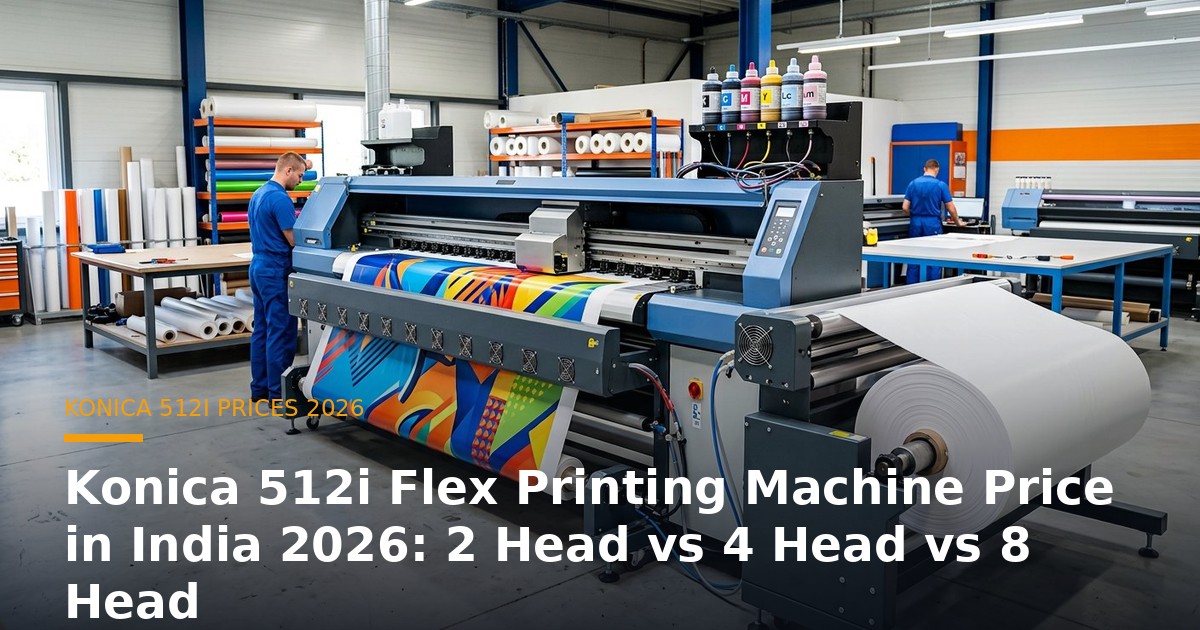
The Konica KM512i is the workhorse printhead of the Indian flex printing industry, prized for its durability, speed and consistent output on long production runs. When buyers ask about Konica 512i flex printing machine price in India for 2026, the single biggest variable is the number of printheads — a two-head, four-head and eight-head machine differ dramatically in speed, output capacity and cost. This guide compares all three head-count configurations so you can match the machine to your actual production volume and budget.
Choosing the right head count is one of the most consequential decisions a flex printer makes. Buy too few heads and you will struggle to meet deadlines and turn away volume work; buy too many and you will carry a large capital cost and higher running cost on a machine that sits partly idle. Understanding what each configuration delivers — and what it costs — is the key to buying right.
Why the Konica KM512i?
The Konica KM512i has become the default choice for serious flex printers in India because it combines industrial durability with strong speed at a sensible cost. It handles the high-volume, long-run work that hoardings, bulk banners and campaign printing demand, and it is far more robust than entry-level heads under continuous production. Spares, inks and service expertise for the 512i are widely available across India, which keeps uptime high and ownership costs predictable. For any business beyond hobby-level volume, the 512i is the head that scales with you.
Konica 512i Price by Head Count — 2026 Snapshot
| Configuration | Typical Width | Relative Speed | Indicative Price (2026) |
|---|---|---|---|
| 2-head KM512i | 8–10 ft | Base | ₹3.5L – ₹6.0L |
| 4-head KM512i | 10 ft | ~2× | ₹6.0L – ₹10.0L |
| 8-head KM512i | 10 ft | ~4× | ₹10.0L – ₹16.0L |
As the table shows, price scales roughly with head count, but so does output. The important question is not which machine is cheapest, but which one produces the square footage you can sell at the lowest cost per square foot.
Two-Head Konica 512i — The Growing Shop
A two-head KM512i machine, typically in 8–10 ft width, is the entry point into genuine Konica production. It suits a growing shop that has moved beyond occasional local jobs and now handles steady commercial work — retail signage, event graphics, regular banner orders. It offers a clear quality and durability step up from an XP600 machine without the capital outlay of a four-head line. For a printer building consistent volume, a two-head 512i around ₹3.5–6 lakh is a balanced, future-proof first Konica machine.
Four-Head Konica 512i — The Commercial Workhorse
A four-head KM512i machine, usually 10 ft, roughly doubles the output of a two-head machine and is the sweet spot for established commercial printers. It handles high daily volumes with faster turnaround, which is exactly what advertising agencies, retail chains and event companies demand. At ₹6–10 lakh, it is a serious production asset that pays for itself through throughput. If your order book regularly keeps a two-head machine busy, the four-head configuration is the logical, profitable upgrade.
Eight-Head Konica 512i — The High-Volume Line
An eight-head KM512i machine is built for high-throughput operations running long shifts and fulfilling large hoarding and bulk-banner contracts. With roughly four times the output of a two-head machine, it dramatically lowers the cost per square foot at scale and lets you win volume tenders that smaller machines cannot serve. At ₹10–16 lakh it is a major investment, justified only when you have the volume to keep it busy — but for a high-demand printer, it is a genuine competitive weapon.
How Head Count Affects Speed, Cost and ROI
More heads mean more nozzles firing in each pass, so the carriage produces more coverage per unit of time — which is why output scales roughly in proportion to head count. The capital cost also scales, but the cost per square foot often falls as volume rises, because fixed costs spread over more output and the machine spends less time per job. The practical implication is that head count should be driven by your sellable volume: a machine that runs flat-out most days is far more profitable than a bigger one that idles. Model your expected monthly square footage, then choose the smallest head count that comfortably meets your peak demand with a little headroom.
Running Costs Across Head Counts
Ink consumption rises with output, not simply with head count — an eight-head machine running at full tilt uses more ink per hour than a two-head machine, but it also produces far more saleable area in that hour. Eco-solvent ink for the 512i typically costs between ₹180 and ₹400 per litre in 2026, and media runs roughly ₹18–45 per square foot. Because the 512i is efficient and reliable, its cost per square foot is competitive, and the higher-head machines achieve the lowest unit costs at volume. Factor in periodic maintenance — head cleaning, capping, filters and eventual head replacement — when comparing configurations.
Choosing the Right Head Count for Your Volume
- Under ~5,000 sq ft/month: a two-head 512i (or a quality i3200 machine) is sufficient.
- ~5,000–15,000 sq ft/month: a four-head 512i gives the throughput and turnaround you need.
- Above ~15,000 sq ft/month or multi-shift: an eight-head 512i line delivers the lowest cost per square foot.
Always buy for the volume you can realistically sell, with modest headroom for growth — not for an aspirational order book you have not yet won.
Price Factors Beyond Head Count
Two machines with the same head count can differ in price based on print width (8 ft vs 10 ft), the level of automation (servo drives, auto media take-up, media sensors), heater and dryer configuration, the bundled RIP software, frame rigidity and the supplier’s warranty and service package. When comparing quotations, make sure the head count is identical and that the surrounding specification matches, so you are comparing like for like rather than being misled by a headline number.
Why Buy Your Konica 512i Machine from UED?
Unified Engineering Dynamics (UED) supplies, installs and services Konica KM512i flex printing machines across India in two-head, four-head and eight-head configurations. We help you choose the head count that matches your real volume, supply genuine Konica printheads and inks, and back every machine with professional installation, operator training and responsive after-sales support. Our focus is your cost per square foot and payback, so your Konica investment earns from day one and keeps earning as you grow.
Konica 512 vs 512i vs 1024i: Understanding the Family
Not all Konica heads are the same, and knowing the differences helps you buy sensibly. The original KM512 was a robust industrial head that served the flex market well for years. The KM512i is its improved successor, offering better droplet control, higher reliability and strong speed, and it is the head most Indian flex printers now standardise on. The KM1024i is a larger, higher-throughput head designed for very high volume and continuous industrial operation; machines built on it cost more but deliver the lowest cost per square foot at serious scale. For the vast majority of flex businesses, the KM512i hits the sweet spot of speed, durability and price, which is why it anchors this guide.
Real Production Numbers: What Each Configuration Outputs
Head count translates directly into daily capacity. As a practical rule of thumb in production conditions, a two-head KM512i machine comfortably produces a few thousand square feet per shift, a four-head machine roughly doubles that, and an eight-head machine roughly doubles it again. These are indicative figures — actual output depends on print resolution, the number of passes, media and operator efficiency — but they illustrate why head count is the primary lever on throughput. If your peak demand regularly exceeds what a two-head machine can produce in your working hours, the four-head configuration removes the bottleneck and the overtime; if you run multiple shifts on bulk work, the eight-head line is what keeps you competitive on large tenders.
Maintenance and Printhead Life
The Konica 512i is durable, but like all industrial heads it rewards disciplined care. Keep the heads clean and correctly capped whenever the machine is idle, run regular nozzle checks and cleans, use good-quality inks and avoid letting channels run dry, and keep the media path free of dust and debris that can cause head strikes. With proper maintenance a 512i head can deliver a long service life, but you should still budget for eventual head replacement as a normal cost of ownership. A supplier who stocks genuine heads and spares locally — as UED does — protects you from the long downtimes that occur when a head fails and no replacement is available.
Total Cost of Ownership Over Three Years
Smart buyers compare three-year total cost of ownership, not just the purchase price. Add the machine cost to estimated ink, media, power, routine maintenance, periodic parts and any head replacement over three years, then divide by the total square footage you expect to produce. Viewed this way, a higher-head machine that runs at good utilisation frequently achieves a lower cost per square foot than a smaller machine pushed beyond its comfortable capacity, because it wastes less time and material per job. Modelling this before you buy prevents both over-spending on idle capacity and under-spending on a machine that becomes a costly constraint.
Financing, Warranty and Buying a Konica 512i Machine
A Konica 512i machine is a significant capital purchase, so how you buy and finance it matters as much as which configuration you choose. Many Indian suppliers, including UED, offer EMI and financing arrangements that let you spread the cost while preserving working capital for media, ink, rent and marketing — which is often the difference between a machine that sits idle for want of materials and one that earns from the first month. When you finance, compare the total interest payable against the additional revenue a higher-head machine can generate; sometimes financing a four-head machine that keeps up with demand is far more profitable than buying a two-head machine outright and turning away volume work.
Pay close attention to warranty terms and what they cover, especially the printheads, which are the most expensive component. Understand the service commitment: response time, whether engineers are available in your region, and whether genuine spares are stocked locally rather than imported on demand. A slightly higher price from a supplier who offers a clear warranty, fast service and ready spares is almost always the better long-term buy, because every day a production machine stands still is lost revenue and, potentially, a lost customer. Get the full specification, warranty and service terms in writing before you commit, and compare quotations on total value rather than headline price alone.
Frequently Asked Questions
What is the Konica 512i flex printing machine price in India in 2026?
A two-head KM512i machine typically costs ₹3.5–6 lakh, a four-head machine ₹6–10 lakh, and an eight-head machine ₹10–16 lakh, depending on width, automation and included software.
Which head count should a new business choose?
Most growing shops start with a two-head KM512i and upgrade to four heads once volume justifies it. Only high-volume, multi-shift printers need eight heads from the outset.
Does more heads always mean better?
No. More heads increase output and capital cost. The right choice is the smallest configuration that comfortably meets your peak sellable volume with a little headroom for growth.
Is the Konica 512i better than Epson i3200?
For high-volume flex production, the Konica 512i offers greater speed and durability. For detail-focused, lower-volume quality work, the Epson i3200 can produce finer results. Many businesses choose based on volume versus quality priorities.
Do these prices include GST and installation?
Usually not. Prices are typically ex-GST and may exclude installation and training. Always request a written, configuration-specific quotation.
Want an exact, configuration-specific quote? Talk to UED’s printing specialists — share your print width, monthly volume and budget, and we’ll recommend the right machine with transparent pricing. Request a quote →
Prices on this page are indicative 2026 market ranges (ex-GST) and vary with configuration, printhead count, automation, accessories, installation and location. Always confirm a written, configuration-specific quotation before purchase.
