

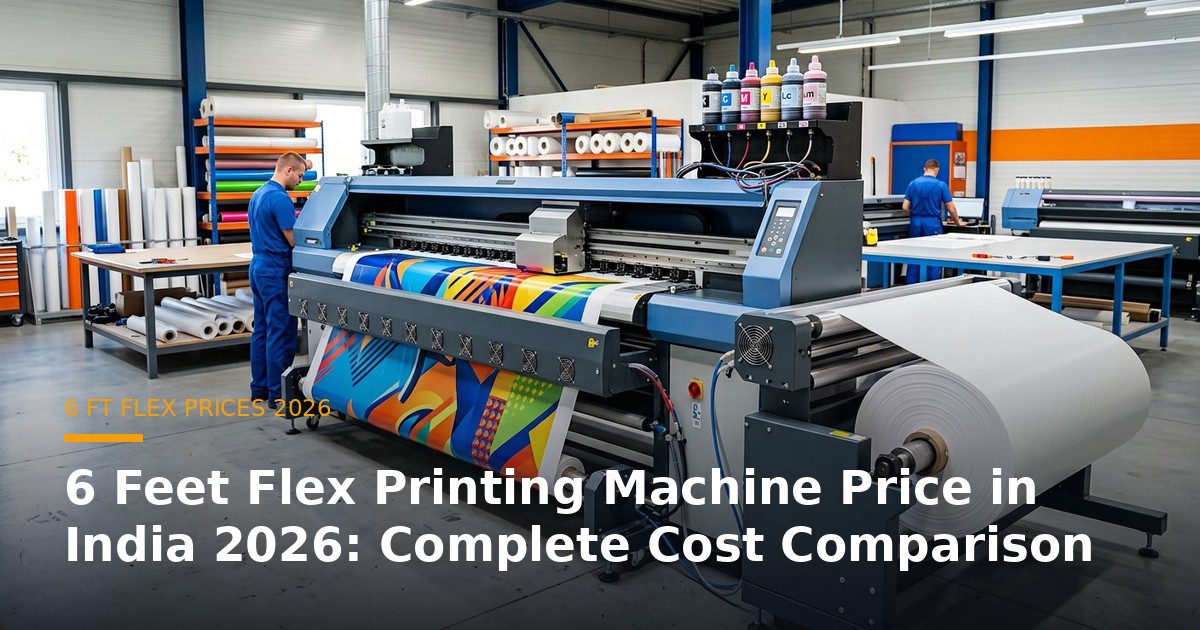
A 6 feet flex printing machine is the most popular entry point into the flex printing business in India, and for good reason: it is compact, affordable and perfectly capable for the shop boards, banners and local signage that make up the bulk of demand in small towns and neighbourhood markets. If you are researching the 6 feet flex printing machine price in India for 2026, this complete cost comparison explains what you can expect to pay across printhead options, what a 6 ft machine can and cannot do, and whether it is the right width for your business.
The 6 ft width — roughly 1.6 metres of printable media — strikes a balance between footprint and capability. It fits comfortably in a modest shop, consumes less power and media than wider machines, and keeps the purchase price low, which is exactly what a first-time buyer needs. Understanding its real costs and limits helps you decide whether 6 ft is enough or whether you should stretch to 8 ft from the start.
6 Feet Flex Printing Machine Price in India 2026 — Snapshot
| Printhead Option | Typical Spec | Indicative Price (2026) |
|---|---|---|
| XP600 single-head | Entry, good quality, lower speed | ₹1.8L – ₹2.8L |
| Epson i3200 single/dual | Sharper detail, better colour | ₹2.5L – ₹4.0L |
| Konica 512i dual-head | Faster, production-ready | ₹3.5L – ₹5.0L |
As with wider machines, the printhead is the biggest cost driver. Most 6 ft buyers choose an XP600 for the lowest entry cost or an Epson i3200 for better quality; a Konica 512i in 6 ft is less common but available for buyers who want speed in a compact footprint.
Who Should Buy a 6 Feet Machine?
A 6 ft machine is ideal for a start-up or small shop serving a local market — printing shop boards, banners, posters, small backlit panels, stickers and event graphics. It suits businesses with limited floor space, a modest initial budget, and customers whose jobs rarely exceed 6 ft in width. If most of your work is neighbourhood signage and standard banners, a 6 ft machine handles it well and keeps your costs low. It is also a sensible first machine for a printer testing the market before committing to a larger investment.
What a 6 Feet Machine Can and Cannot Do
The key limitation is width: at roughly 1.6 metres, a 6 ft machine cannot print wide hoardings or large building graphics in a single pass. For jobs wider than the media, you would need to print in panels and join them, which adds labour and can be visible on large displays. For most shop boards, banners and posters this is not an issue, but if you expect regular large-format hoarding work, an 8 ft or 10 ft machine will serve you better. Within its width, though, a 6 ft machine produces the same quality as a wider one — width affects job size, not print quality.
What Affects the Price of a 6 Feet Machine?
Beyond the printhead, the price of a 6 ft machine moves with the level of automation (servo drives, auto media take-up, media sensors), the heater and dryer configuration, the bundled RIP software, the rigidity of the frame, and the supplier’s warranty and service package. A basic 6 ft XP600 machine sits at the low end, while a well-appointed 6 ft i3200 machine with good automation and a quality RIP costs more but wastes less material and produces more consistent output. As always, compare the total installed specification, not just the headline price.
6 Feet vs 8 Feet: Which Should You Choose?
The choice between 6 ft and 8 ft comes down to your job mix and budget. A 6 ft machine is cheaper, smaller and easier to fit into a modest shop, and is plenty for local signage and banners. An 8 ft machine costs somewhat more but handles wider jobs — larger boards, wider backlit panels and bigger banners — without joining, and gives you room to grow. If your budget allows and you expect any wider work, 8 ft is the safer long-term buy; if you are strictly local and space-constrained, 6 ft is a smart, affordable start.
Return on Investment for a Small Flex Business
Because a 6 ft machine is inexpensive to buy and run, its break-even point is achievable even at modest volumes. With running costs of roughly ₹25–40 per square foot for ink, media and power, and selling prices of ₹60–120 per square foot depending on your market, a small shop producing even 1,000–1,500 square feet a month can repay a 6 ft machine well within its first year. The low entry cost also means less financial pressure while you build your customer base, which is a major advantage for a first-time entrepreneur.
Buying Tips for a 6 Feet Flex Machine
- Choose a proven printhead (XP600 or Epson i3200) with Indian spares support.
- Prioritise stable media handling and decent heaters to reduce wastage and curing problems.
- Confirm the RIP software and colour-management tools included.
- Check the supplier’s service response and spares availability in your region.
- Budget for media, ink, power protection and finishing tools alongside the machine.
- Get a written, configuration-specific quotation and compare like for like.
Why Buy Your 6 Feet Flex Machine from UED?
Unified Engineering Dynamics (UED) supplies, installs and services 6 feet flex printing machines across India, built on genuine XP600, Epson i3200 and Konica 512i printheads. We help small and first-time businesses choose the right configuration for their budget and market, provide professional installation and operator training, and back every machine with responsive after-sales support and ready spares — so your compact investment starts earning quickly and reliably.
Operating a 6 Feet Machine: Space, Power and Setup
One of the biggest advantages of a 6 ft flex machine is how little it demands from your premises. The machine itself occupies a modest footprint, and you need only enough room around it to load media rolls and collect finished output, plus space for finishing work like cutting, pasting and eyeleting. Most small shops can accommodate a 6 ft machine alongside a worktable and storage without renting a large hall, which keeps your overheads low from the start. Power requirements are similarly modest compared with wider, faster machines, though you should still provide a stable supply and, in areas with voltage fluctuation, a stabiliser or online UPS to protect the electronics and printhead. Proper setup matters: level the machine, align the media path, load a good RIP with profiles for your media, and run test prints to confirm colour and curing before taking paid jobs. A well-set-up 6 ft machine produces output indistinguishable from a larger one within its width.
Running a 6 Feet Flex Business: Finding Customers and Growing
A 6 ft machine is well matched to a local, relationship-driven business. Your natural customers are nearby shops, restaurants, clinics, schools and offices that need boards, banners, posters and signage on a regular basis. Local advertising agencies, event organisers and political or festive campaign work also generate steady seasonal demand. Because your entry and running costs are low, you can compete on service and turnaround as much as on price, which builds loyalty and repeat business. As your customer base grows and you start receiving wider jobs — large hoardings, big backlit panels — you will know it is time to add an 8 ft or 10 ft machine. Many successful printers began with a single 6 ft unit, reinvested the profits, and gradually built a multi-machine operation. Starting small on a 6 ft machine is therefore not a limitation but a sensible, low-risk first step into a scalable business.
6 Feet Flex Machine Maintenance Basics
A 6 ft machine is simple to maintain, and a little daily discipline goes a long way toward consistent output and a long printhead life. The most important habit is keeping the printhead clean and properly capped whenever the machine is not printing, because eco-solvent ink dries quickly and a clogged nozzle is the most common cause of banding and quality loss. Run a nozzle check and a short clean at the start of each day and after any pause, and never let an ink channel run completely dry, which can draw air into the system. Use good-quality inks and media, keep the media path free of dust and debris that can cause head strikes, and confirm the heaters are curing prints properly so output comes off dry and durable. Schedule periodic professional servicing, and keep spare filters, wipers and capping parts on hand. These habits cost very little but dramatically reduce downtime and reprints, protecting the value of your investment and keeping your customers happy with consistent quality.
Should You Buy a New or Used 6 Feet Machine?
Because 6 ft machines are relatively inexpensive, many first-time buyers consider a used unit to save money. A well-maintained used machine with a healthy printhead can be a sensible buy, but you must verify three things before paying: the condition and remaining life of the printhead, the machine’s service history, and the availability of genuine spares for that exact model. A used machine with a tired head can cost more in a head replacement than a new entry machine costs outright, and an obscure model with no spares pipeline can leave you idle for weeks. For most start-ups, a new 6 ft XP600 or Epson i3200 machine with a warranty and supplier support is the safer choice, because the modest price difference buys reliability, training and after-sales cover that a private used sale cannot match. If you do buy used, insist on a demonstration print and, ideally, an inspection by someone who knows the machine.
Popular Applications for a 6 Feet Flex Machine
Despite its compact size, a 6 ft flex machine covers an impressive range of sellable products that keep a small shop busy throughout the year. Shop boards and fascia signage for retail stores, restaurants, clinics and offices are a constant, recurring need in every neighbourhood. Banners and posters for promotions, festivals, political campaigns and local events generate steady seasonal volume. Small backlit panels for display boxes, menus and directory boards are high-margin, quality-sensitive work. Stickers, decals and sun-control films serve both retail and automotive customers. Hoarding sections and panel prints can be produced and joined for larger displays when needed. Wedding and event decorators regularly need backdrops, standees and welcome boards. Because these products are diverse and locally sourced, a 6 ft machine is rarely dependent on a single client or season, which gives a small business stable, predictable cash flow. Mastering finishing — clean cutting, pasting, eyeleting and framing — lets you deliver these products as finished goods at better margins than selling raw prints alone.
Frequently Asked Questions
What is the 6 feet flex printing machine price in India in 2026?
A 6 ft flex printing machine typically costs between ₹1.8 lakh and ₹5 lakh depending on the printhead: an XP600 machine around ₹1.8–2.8 lakh, an Epson i3200 machine around ₹2.5–4 lakh, and a Konica 512i machine around ₹3.5–5 lakh.
Is a 6 feet machine enough for a flex printing business?
Yes, for local signage, banners, posters and small backlit work. It cannot print wide hoardings in one pass, so if you expect regular large-format work, consider an 8 ft or 10 ft machine instead.
Which printhead is best for a 6 feet machine?
For most small businesses, the Epson i3200 offers the best quality, while the XP600 is the most affordable. Choose based on whether your customers value fine detail or low cost.
Do these prices include GST and installation?
Usually not. Prices are typically ex-GST and may exclude installation and training. Always request a written, configuration-specific quotation.
Want an exact, configuration-specific quote? Talk to UED’s printing specialists — share your print width, monthly volume and budget, and we’ll recommend the right machine with transparent pricing. Request a quote →
Prices on this page are indicative 2026 market ranges (ex-GST) and vary with configuration, printhead count, automation, accessories, installation and location. Always confirm a written, configuration-specific quotation before purchase.
