

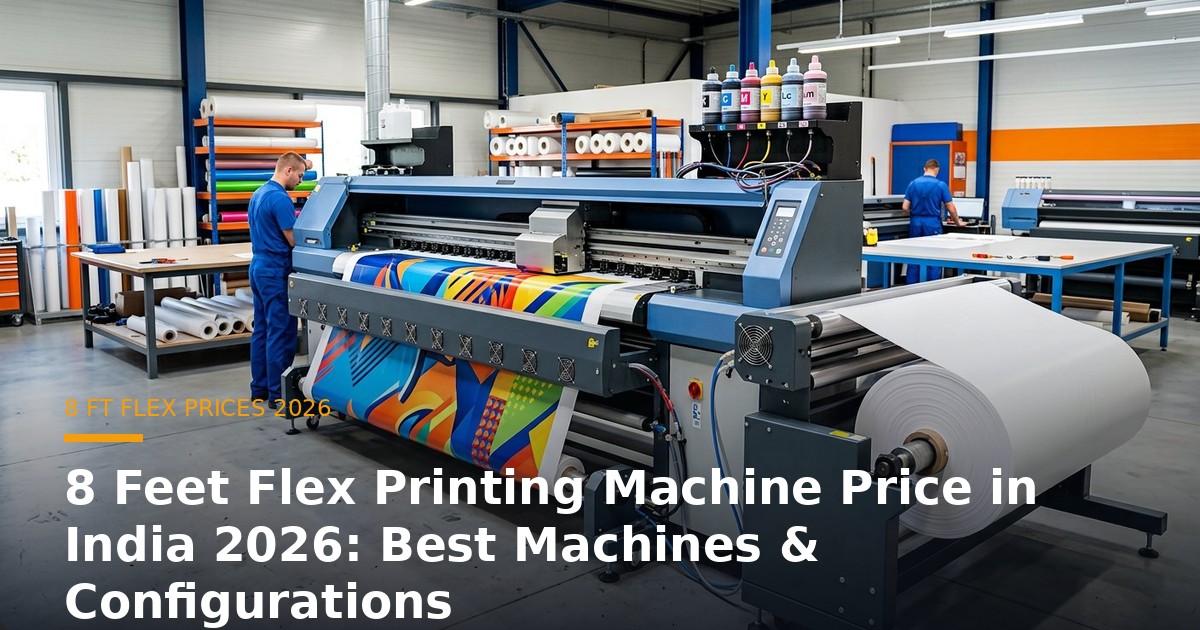
The 8 feet flex printing machine is the most popular all-rounder in the Indian flex printing market, and 2026 is no exception. Wide enough to handle large boards, backlit panels and big banners without joining, yet compact and affordable enough for a growing shop, the 8 ft width hits a sweet spot that suits the majority of commercial printers. This guide covers the 8 feet flex printing machine price in India for 2026, the best machines and configurations, and how to choose the right one for your volume and budget.
If you are unsure whether to buy 6 ft, 8 ft or 10 ft, the 8 ft machine is the default recommendation for most businesses precisely because it balances capability, footprint and cost. It handles almost everything a typical signage and advertising shop needs, without the space and capital demands of a 10 ft line.
8 Feet Flex Printing Machine Price in India 2026 — Snapshot
| Configuration | Printhead | Indicative Price (2026) |
|---|---|---|
| 8 ft single/dual-head | XP600 | ₹2.2L – ₹3.5L |
| 8 ft dual-head | Epson i3200 | ₹3.0L – ₹4.8L |
| 8 ft dual-head | Konica 512i | ₹3.5L – ₹5.5L |
The 8 ft width is available across all three popular printhead families, so you can match the head to your quality-versus-speed priorities while staying in a familiar footprint. Most growing shops choose an Epson i3200 for quality or a Konica 512i for speed.
Why 8 Feet Is the Sweet Spot
An 8 ft machine — roughly 2.5 metres of printable width — covers the vast majority of Indian signage and advertising jobs in a single pass: large shop boards, backlit display panels, event backdrops, banners and hoarding sections. It fits in a standard workshop, does not demand the power and floor space of a 10 ft line, and keeps media wastage reasonable. For a printer serving retail, agencies and events, an 8 ft machine removes most width limitations without the cost jump of going wider, which is why it remains the best-selling flex width in India.
Best Configurations for Different Businesses
A start-up focused on quality-sensitive retail work should look at an 8 ft Epson i3200 machine, which produces crisp text and smooth gradients. A shop chasing volume and fast turnaround should consider an 8 ft Konica 512i dual-head machine for its speed and durability. A budget-conscious first-time buyer can begin with an 8 ft XP600 machine and upgrade later. The right configuration depends on whether your customers prioritise fine detail, fast delivery or low cost — and on the volume you expect to handle.
8 Feet vs 6 Feet vs 10 Feet
Compared with a 6 ft machine, an 8 ft machine handles significantly wider jobs without joining and gives you room to grow, at a moderate price increase. Compared with a 10 ft machine, it is cheaper, smaller and easier to site, though it cannot print the very largest hoardings in one pass. For most businesses, 8 ft is the ideal middle ground — more capable than 6 ft without the cost and space demands of 10 ft. Only printers regularly taking on very large hoarding work truly need 10 ft.
What Affects the Price of an 8 Feet Machine?
Price is driven first by the printhead, then by automation and build quality. Servo drives, automatic media take-up, multi-zone heaters and dryers, media sensors, a rigid frame and a good RIP all add cost — and all reduce downtime, banding and wastage. Two 8 ft machines with the same head can differ in price based on these factors, so compare the full specification rather than the headline number. A well-appointed machine costs a little more but produces more consistent output and wastes less expensive material.
Return on Investment for an 8 Feet Machine
An 8 ft machine’s versatility translates directly into revenue: because it can handle a wider range of jobs, you can serve more customers and win larger orders than a 6 ft shop. With running costs around ₹25–40 per square foot and selling prices of ₹60–120 per square foot, a busy 8 ft machine can repay its cost within a year. The key is utilisation — an 8 ft machine kept busy with agency, retail and event work is one of the most reliable earners in the flex printing business.
Buying Tips for an 8 Feet Flex Machine
- Match the printhead to your priority: i3200 for quality, Konica 512i for speed, XP600 for budget.
- Prioritise stable media handling and proper heaters to protect output and reduce waste.
- Confirm the RIP software and colour-management tools included.
- Verify the supplier’s service response and genuine spares availability.
- Budget for media, ink, power protection and finishing equipment.
- Get at least three written, configuration-specific quotations.
Why Buy Your 8 Feet Flex Machine from UED?
Unified Engineering Dynamics (UED) supplies, installs and services 8 feet flex printing machines across India, built on genuine XP600, Epson i3200 and Konica 512i printheads. We help you choose the configuration that matches your volume and market, provide professional installation and operator training, and back every machine with responsive after-sales support and ready spares — so your all-rounder machine performs reliably from day one.
Setting Up an 8 Feet Flex Print Shop
An 8 ft machine is a step up in capability, and your setup should match it. You will need a little more floor space than a 6 ft unit — room to load wide media rolls, collect large finished prints and handle finishing without crowding the machine. Plan for a clean, dust-controlled print area, because dust and debris are common causes of head strikes and print defects on wide-format work. Provide stable power with protection, a good RIP with reliable profiles for your media, and finishing equipment for cutting, laminating, eyeleting and framing. Keep an initial stock of the flex, vinyl and backlit media your customers ask for most, along with eco-solvent inks, so you are never caught unable to fulfil an order. Printers who organise their workflow and finishing capability from the start scale smoothly; those who improvise tend to waste material and miss deadlines.
Winning Work with an 8 Feet Machine: Markets and Margins
The versatility of an 8 ft machine lets you serve several profitable markets from one asset. Retail businesses need shop boards, in-store graphics and promotional material on an ongoing basis. Advertising agencies need campaign banners, backlit panels and event graphics with reliable turnaround. Event and exhibition companies need backdrops, standees and signage, often at short notice. Corporate clients need office signage, branding and fleet graphics. Each of these markets values something slightly different — retail values consistency, agencies value speed and reliability, events value flexibility — and an 8 ft machine can serve all of them. Margins are healthiest on finished, value-added work such as laminated outdoor signage and installed backlit displays, so pair your machine with good finishing and, where possible, installation services. That combination turns an 8 ft machine from a commodity print engine into a dependable, high-margin business.
Keeping Your 8 Feet Machine Running: Maintenance and Uptime
An 8 ft machine is a production asset, and its profitability depends on uptime. Daily care is straightforward but essential: keep the printheads clean and capped when idle, run nozzle checks before paid jobs, use good inks and never let channels run dry, and keep the wide media path clean and aligned to prevent head strikes and misfeeds on large rolls. Because wide-format jobs use more material, a single ruined print is costly, so disciplined colour management and correct curing settings pay for themselves in reduced waste. Schedule regular professional servicing, keep genuine spares — filters, wipers, capping parts and, eventually, a spare head — available, and train your operators to perform basic checks themselves. A printer who treats maintenance as part of the job rather than an afterthought keeps an 8 ft machine earning steadily and avoids the expensive, customer-losing downtime that comes from neglect.
Future-Proofing Your 8 Feet Investment
Buying an 8 ft machine is a multi-year commitment, so it is worth thinking ahead. Choose a machine built on a mainstream printhead family — XP600, Epson i3200 or Konica 512i — so that spares, inks and service expertise remain widely available for years to come, rather than an obscure head that may become unsupported. Prioritise a supplier with a strong service network and a reputation for standing behind their machines, because the relationship matters long after the sale. Buy a little more capability than you strictly need today if your budget allows, so you do not outgrow the machine within a year; an 8 ft width already gives you room for most signage and advertising work. Finally, keep your RIP software and profiles current and your operators trained, so output quality stays competitive as customer expectations rise. A future-proofed 8 ft machine remains a dependable earner for many years, which is exactly what makes it such a popular choice among Indian flex printers.
Popular Applications for an 8 Feet Flex Machine
The 8 ft width opens up a broader and more profitable range of work than a smaller machine can handle. Large shop boards and fascia signage for showrooms, retail chains and restaurants can be printed in a single pass without joining. Backlit display panels for malls, airports, retail stores and hospitality venues are high-margin, quality-sensitive jobs that reward good colour and curing. Event and exhibition graphics — backdrops, standees, podium wraps and directional signage — are regularly needed at short notice and pay well for reliable turnaround. Advertising agencies rely on flex printers for campaign banners, hoarding panels and promotional material, providing steady repeat volume. Corporate clients need office signage, branding, wall graphics and fleet or vehicle graphics. Retail point-of-sale displays, promotional posters and seasonal campaign material round out the mix. Because an 8 ft machine can serve retail, agency, corporate and event customers from one asset, it smooths out the seasonal dips that affect printers who depend on a single niche. Pairing the machine with strong finishing and, where possible, installation services lets you deliver complete, high-value solutions rather than competing on raw print price alone.
How Much Space and Power Does an 8 Feet Machine Need?
An 8 ft flex machine needs a little more room than a compact 6 ft unit, but it is still manageable in a standard workshop. Plan for clear space at both ends to load wide media rolls and collect large finished prints, plus room for finishing work such as cutting, laminating and eyeleting without crowding the machine. A clean, dust-controlled environment protects print quality on wide-format jobs. Power requirements are moderate, but you should provide a stable supply and, in areas with voltage fluctuation, a stabiliser or online UPS to protect the electronics and printhead. With sensible layout and basic power protection, an 8 ft machine fits comfortably into most small and mid-size print shops and produces reliable, high-quality output from day one.
Frequently Asked Questions
What is the 8 feet flex printing machine price in India in 2026?
An 8 ft flex printing machine typically costs between ₹2.2 lakh and ₹5.5 lakh depending on the printhead: XP600 around ₹2.2–3.5 lakh, Epson i3200 around ₹3–4.8 lakh, and Konica 512i around ₹3.5–5.5 lakh.
Is 8 feet the best width for a flex printing business?
For most shops, yes. An 8 ft machine handles the majority of signage, backlit and banner jobs without joining, while staying affordable and compact. Only printers doing very large hoardings regularly need 10 ft.
Which printhead should I choose for an 8 feet machine?
Choose the Epson i3200 for the best quality, the Konica 512i for the best speed and durability, or the XP600 for the lowest entry cost. Match the head to your customers’ priorities.
Do these prices include GST and installation?
Usually not. Prices are typically ex-GST and may exclude installation and training. Always request a written, configuration-specific quotation.
Want an exact, configuration-specific quote? Talk to UED’s printing specialists — share your print width, monthly volume and budget, and we’ll recommend the right machine with transparent pricing. Request a quote →
Prices on this page are indicative 2026 market ranges (ex-GST) and vary with configuration, printhead count, automation, accessories, installation and location. Always confirm a written, configuration-specific quotation before purchase.
