

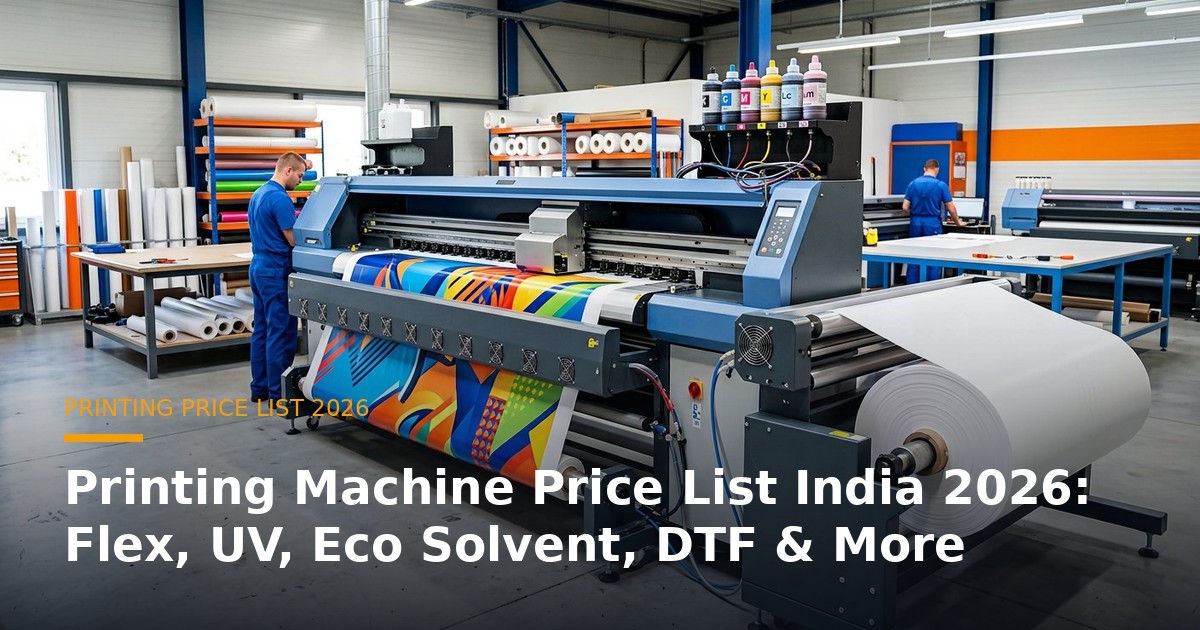
Planning to invest in a printing machine in India in 2026? Whether you want to print flex banners, signage, custom apparel, stickers or rigid displays, this complete printing machine price list for India 2026 covers every major technology — flex, UV, eco-solvent, DTF and more — with realistic price ranges so you can budget accurately and choose the right machine for your business.
The Indian printing equipment market spans a huge range, from affordable entry machines under ₹2 lakh to high-speed industrial lines above ₹20 lakh. The right choice depends entirely on what you want to print, your expected volume and your budget. This guide gives you the full picture in one place.
Printing Machine Price List India 2026 — All Technologies
| Machine Type | Best For | Indicative Price (2026) |
|---|---|---|
| Flex printing machine (eco-solvent) | Banners, hoardings, signage | ₹1.8L – ₹16L |
| Eco-solvent printer | Vinyl, stickers, wraps, backlit | ₹1.8L – ₹8L |
| UV flatbed printer | Acrylic, glass, wood, gifts | ₹4L – ₹15L |
| UV roll-to-roll printer | Durable flexible media | ₹5L – ₹15L |
| DTF printer (complete setup) | Custom apparel, textiles | ₹1.5L – ₹6L |
| Large format printer | Wide-format signage | ₹2L – ₹20L |
Prices vary with printhead, width or bed size, automation and included software. The sections below explain each technology so you can match the machine to your goals.
Flex Printing Machines
Flex (eco-solvent) machines are the backbone of Indian signage and advertising, printing banners, hoardings, shop boards and backlit panels. Entry XP600 machines start around ₹1.8 lakh, Epson i3200 and Konica 512i machines range from ₹3 lakh to ₹10 lakh, and high-speed eight-head Konica lines reach ₹16 lakh or more. Choose based on width (6, 8 or 10 ft) and head count for your volume.
Eco-Solvent Printers
Eco-solvent printers handle flexible media — vinyl, stickers, vehicle wraps, backlit film and one-way vision — with durable, outdoor-grade output. Built on XP600 or Epson i3200 heads, they range from ₹1.8 lakh to ₹8 lakh. They are ideal for signage, sticker and wrap businesses.
UV Printers
UV printers print directly onto rigid and specialty substrates — acrylic, glass, wood, metal, tiles and gifts — with instant curing. Compact UV flatbeds start around ₹4 lakh, with larger and roll-to-roll models reaching ₹15 lakh. UV adds a high-margin, differentiated product line that other machines cannot match.
DTF Printers
DTF (Direct-to-Film) printers produce vibrant transfers for custom apparel and textiles, with no screens and no minimum orders. A complete setup — printer, powder shaker, dryer and heat press — costs ₹1.5–6 lakh. DTF is perfect for the booming customisation and on-demand apparel market.
How to Choose the Right Printing Machine
Start with what you want to print: flexible signage points to flex or eco-solvent, rigid substrates and gifts point to UV, and custom apparel points to DTF. Then match the configuration to your expected volume and budget. Buy from a supplier with genuine printheads, clear specifications and responsive local service, and always get a written, configuration-specific quotation so you can compare like for like.
Why Buy from UED?
Unified Engineering Dynamics (UED) supplies, installs and services the full range of printing machines across India — flex, eco-solvent, UV and DTF. We help you choose the right technology and configuration for your products, volume and budget, provide genuine printheads and consumables, professional installation and training, and dependable after-sales support, so your investment performs from day one.
Understanding Printhead Options Across Technologies
Across flex, eco-solvent and UV machines, a few proven printheads dominate the Indian market. The XP600 is the most affordable, ideal for entry-level and budget-focused businesses. The Epson i3200 offers superior quality with sharp text and smooth gradients, suited to premium work. The Konica 512i and 1024i deliver industrial speed and durability for high-volume production. The head you choose affects machine price, output quality and running cost, so match it to your priorities: low cost (XP600), quality (i3200) or volume (Konica). A good supplier will recommend the right head for your specific products and volume rather than simply pushing the most expensive option.
Budgeting Beyond the Machine Price
The purchase price is only part of your investment. Whichever technology you choose, budget for the supporting essentials: initial media, ink and consumable stock; a RIP software licence if not bundled; stable power with protection; finishing equipment appropriate to your products; and working capital for the first few months while you build your order book. Many first-time buyers spend everything on the machine and then struggle to feed, ink and finish jobs. Planning these costs upfront — roughly 20–30 percent of your total budget beyond the machine — turns a stressful launch into a smooth, well-funded start.
Matching the Machine to Your Market
The most successful printing businesses choose equipment that matches a clear market. If you serve local shops and advertisers, a flex or eco-solvent machine for signage and banners is ideal. If you target retail brands, interior designers and corporate gifting, a UV machine for rigid, premium products fits. If you want to serve the customisation and apparel market, a DTF setup is perfect. Some businesses eventually run multiple technologies to offer a full range of services. Start with the machine that matches your strongest market, build a reputation for quality and reliability, and expand into other technologies as demand and profits allow.
Financing and Buying Your Printing Machine
Most Indian suppliers, including UED, offer EMI and financing options that let you spread the cost of a printing machine while preserving working capital for materials and marketing. When you finance, compare the total interest against the revenue the machine will generate, and avoid over-stretching. Get at least three written, configuration-specific quotations and compare them line by line — exact printhead, size, automation, software, warranty and service — rather than on headline price alone. Prioritise a supplier with genuine components, responsive local service and ready spares, because after-sales support protects your revenue long after the sale.
How Printhead Choice Affects Price Across All Technologies
Across flex, eco-solvent and UV machines, the printhead is consistently the largest single component of the cost, and understanding the options helps you budget realistically. The XP600 is the most affordable head on the market and powers most entry-level machines, keeping purchase prices low for start-ups and small shops, though it offers lower top speed. The Epson i3200 sits in the middle, delivering noticeably sharper text and smoother gradients that suit quality-focused and premium work at a moderate price premium. The Konica 512i and 1024i are industrial heads built for speed and durability in high-volume production, and machines built on them cost significantly more but achieve the lowest cost per square foot at scale. Because the head drives both price and capability, the smartest approach is to match the head to your actual needs — budget entry work points to XP600, quality-sensitive work to i3200, and high-volume production to Konica — rather than simply buying the cheapest or most expensive option available.
Planning Your Total Printing Business Budget
The machine price is only one part of your total investment, and underestimating the rest is the most common budgeting mistake new buyers make. Whichever technology you choose, you should budget for an initial stock of the media, inks and consumables your customers will ask for, so you can fulfil orders immediately rather than buying per job at higher cost. You will need a RIP software licence if it is not bundled, stable power with protection such as a stabiliser or UPS, and finishing equipment appropriate to your products — cutting, laminating, eyeleting and framing for flex, a heat press and powder shaker for DTF, or mounting tools for UV. You should also keep several months of working capital to cover rent, power and materials while you build your order book. As a practical guideline, set aside roughly 20 to 30 percent of your total budget beyond the machine itself for these essentials, so your business is properly funded from day one and never caught unable to complete a job it has already won.
Flex vs Eco-Solvent vs UV: A Quick Comparison
These three technologies serve different needs, and choosing between them comes down to what you want to print. Flex and eco-solvent machines both print on flexible media, but “flex” usually refers to the banner and signage workhorses built for volume, while eco-solvent machines emphasise versatile, durable output on vinyl, stickers, wraps and backlit film. UV machines print directly onto rigid substrates — acrylic, glass, wood, metal and board — with instant curing, opening premium product lines the others cannot match. Flex and eco-solvent are generally cheaper to buy and run for signage; UV costs more but commands higher margins on rigid and specialty products. Many growing businesses eventually run more than one technology to offer a full range of services.
How Printing Machine Prices Vary Across India
Printing machine prices are broadly similar nationwide, but the final landed cost moves with several local factors. Freight to your city, installation and training charges, state tax treatment, and the strength of local service coverage all affect what you actually pay. Metros and major printing hubs often see sharper pricing because supplier competition is fiercer and logistics cheaper, while buyers in smaller towns may pay a little more for freight and on-site support. This does not mean you should always buy from the cheapest distant supplier — a slightly higher price from a supplier who can reach you quickly when the machine stops is usually the better deal, because downtime costs far more than the difference in freight. Always compare the total installed price, not the bare ex-works number.
Negotiating the Best Price on a Printing Machine
Getting the best value on a printing machine is about more than haggling on the headline number. Get at least three written, configuration-specific quotations and compare them line by line — exact printhead, size, automation, software, warranty and service — so you are comparing like for like rather than being misled by a bare total. Negotiate on total value: bundled inks, media, spare parts, extended warranty or additional training often add more worth than a small discount on the machine itself. Ask clearly what is included and what costs extra, and get the final agreed specification in writing. A supplier who explains every line transparently and stands behind their after-sales support is telling you something important about the relationship you are entering — which matters far more than saving a few thousand rupees upfront.
Which Technology Should a First-Time Buyer Choose?
If you are buying your first printing machine, the simplest approach is to match the technology to the products your local market buys most. For broad, steady demand across shops, offices and advertisers, a flex or eco-solvent machine for signage and banners is the safest, most affordable start. For the fast-growing custom apparel market, a DTF setup offers low entry cost and high margins. For premium rigid products, gifts and decor, a UV machine commands the best prices. Start with one technology that fits your strongest market, build a reputation for quality, and add other machines as demand and profits allow, rather than trying to offer everything from day one.
Frequently Asked Questions
What is the printing machine price in India in 2026?
Printing machines range from about ₹1.5 lakh for an entry DTF or XP600 flex machine to ₹20 lakh or more for high-speed industrial flex or UV lines, depending on technology, size and configuration.
Which printing machine is best for a new business?
It depends on your products: a flex or eco-solvent machine for signage, a DTF setup for custom apparel, or a UV machine for rigid substrates and gifts. Match the technology to what you want to sell.
Which is cheaper: flex, UV or DTF?
DTF and entry flex machines are the most affordable (from around ₹1.5–1.8 lakh). UV machines cost more (from around ₹4 lakh) but serve high-margin rigid-substrate markets.
Do these prices include GST and installation?
Usually not. Prices are typically ex-GST and may exclude installation and training. Always request a written, configuration-specific quotation.
Want an exact, configuration-specific quote? Talk to UED’s printing specialists — share your requirements and budget, and we’ll recommend the right machine with transparent pricing. Request a quote →
Prices on this page are indicative 2026 market ranges (ex-GST) and vary with configuration, accessories, installation and location. Always confirm a written, configuration-specific quotation before purchase.
