

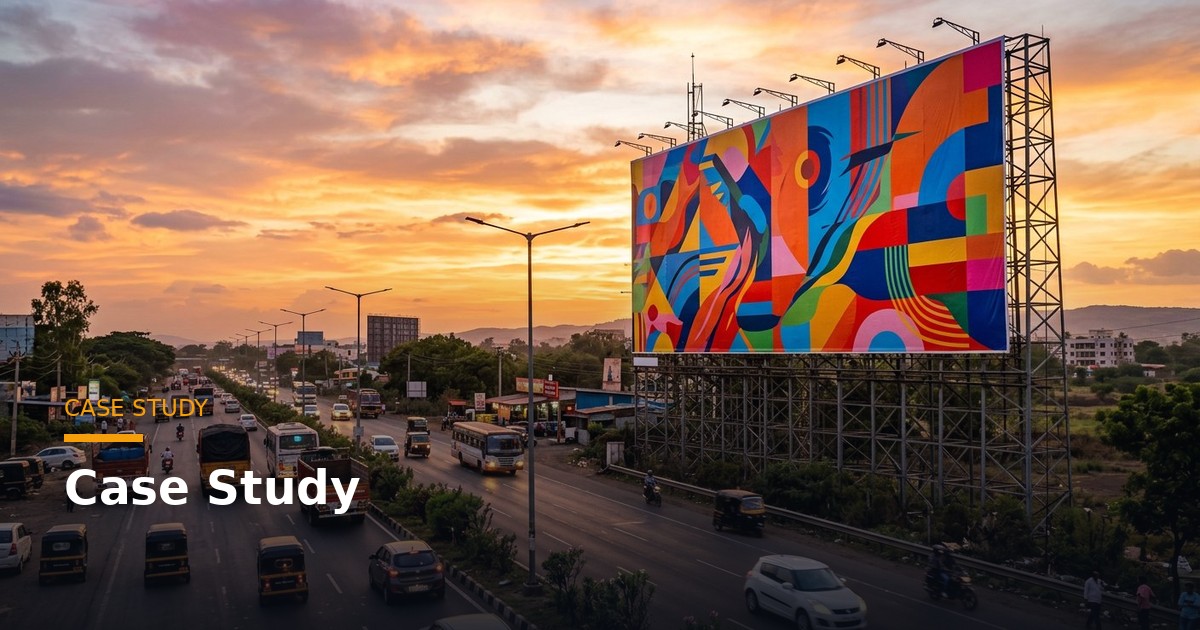
This anonymised case study follows an outdoor hoarding media company — a business that owns and rents out hoarding and billboard sites to advertisers — that had always outsourced the printing of its campaigns to third-party printers. By bringing printing in-house with a UED giant-format solvent line, the company captured the printing margin it had been paying away, controlled turnaround and quality, and added a new revenue stream. Here is how vertical integration transformed the business and what media owners can learn.
The Business and Its Opportunity
The company — an outdoor media owner with a network of hoarding and billboard sites across a region — earned revenue by renting advertising space to brands and agencies. But every campaign required the advertiser’s creative to be printed on large-format flex and installed, and the company outsourced all this printing to third-party printers. This meant paying away a significant printing margin on every campaign, being dependent on external printers’ turnaround and quality, and having no control over a critical part of its service. The company saw an opportunity: by bringing printing in-house, it could capture that margin, control quality and turnaround, and even offer printing as a service to others.
The Situation Before
Before bringing printing in-house, the company was a pure media owner, dependent on external printers for every campaign. This had several drawbacks. First, it paid third-party printers a margin on all the printing its campaigns required — a significant cost across its network. Second, it had no control over turnaround, so campaign deadlines depended on external printers’ schedules, sometimes delaying installations and frustrating advertisers. Third, quality was variable, depending on which printer was used. And fourth, the company captured only the media rental, not the printing value. The printing was a cost centre controlled by others, when it could have been an in-house profit centre and a service advantage.
Machine at a Glance
| Specification | Detail |
|---|---|
| Machine | UED Giant-Format Solvent Printer (5.3 m) |
| Printheads | 8 × Konica Minolta KM512i (industrial) |
| Print width | 5.3 m |
| Speed | High-volume production |
| Ink | Quality solvent, matched to KM512i heads |
| Best for | Hoarding, billboard and large-format campaign printing |
The giant-format solvent line with eight Konica KM512i heads was matched to the company’s needs — printing the large flex and hoarding material its campaigns required, at the volume its network demanded. The 5.3m width and industrial Konica heads delivered the high-volume, durable output that outdoor advertising needs. This capacity let the company print all its own campaign material in-house, and had spare capacity to offer printing services externally. The machine was sized to cover the company’s own needs while enabling the additional revenue of serving other businesses.
The Solution and Approach
The company vertically integrated by bringing campaign printing in-house. It installed the giant-format solvent line and set up the workflow to print, finish and prepare campaign material for its installation teams. This captured the printing margin on every campaign — value previously paid to third parties. It also gave the company control over turnaround (printing on its own schedule to meet campaign deadlines) and quality (consistent output to its own standards). With spare capacity, the company also began offering large-format printing as a service to other businesses and even other media owners, creating a new revenue stream on top of its media rental business.
Implementation and Support
Moving from outsourcing to in-house printing required building a new capability. The company invested in the machine, appropriate space and material handling for the large format, and trained a printing team (or upskilled existing staff). It established the workflow from print to installation, and standardised on quality solvent ink matched to the KM512i heads for durable outdoor output. UED’s installation, training and support were valuable for a company new to operating large-format printing equipment. Within a reasonable period, the company was printing its campaign material in-house reliably, capturing the margin and control it had previously given away to external printers.
The Results
Bringing printing in-house transformed the company’s economics and service. Indicative results:
| Aspect | Before (Outsourced) | After (In-House) |
|---|---|---|
| Printing margin | Paid to third parties | Captured in-house |
| Turnaround control | Dependent on others | Full control |
| Quality | Variable | Consistent |
| Revenue streams | Media rental only | + printing services |
| Campaign service | Coordination-heavy | Seamless |
The company captured the printing margin on every campaign — a significant boost to profitability across its network. Control over turnaround meant campaigns were printed and installed on schedule, improving service to advertisers. Consistent in-house quality enhanced its reputation. And the new printing-services revenue stream, from spare capacity, added income beyond media rental. Within its first year, in-house printing had improved the company’s margins, its service and its resilience — transforming a cost centre controlled by others into a profit centre it controlled.
The Financial Impact
The economics of vertical integration were compelling. The company had been paying third-party printers a margin on all its campaign printing; bringing it in-house captured that margin directly. Across a network of hoarding sites with continuous campaigns, this captured margin was substantial. The investment in the giant-format line paid for itself through this captured margin, plus the new printing-services revenue from spare capacity. And controlling turnaround and quality improved the company’s service, helping it retain and win advertisers. Based on the captured printing margin and new revenue, the owner estimated a strong return — vertical integration turned a recurring external cost into an internal profit.
Why It Worked
Several factors drove the success. First, the company had a guaranteed internal demand — its own continuous campaign printing — so the machine had assured utilisation from day one, de-risking the investment. Second, the giant-format Konica line was matched to its volume and format needs. Third, quality solvent ink ensured the durable output outdoor advertising requires. Fourth, the spare capacity enabled a new external printing revenue stream. And fifth, controlling turnaround and quality improved its core media service. The company succeeded because vertical integration captured margin it was already paying away, on demand it already had — one of the clearest, lowest-risk investment cases in the industry.
The Owner’s Perspective
The owner’s key insight was about capturing value they were already generating. “We were paying printers a margin on every campaign, every year, forever,” the owner explained. “Bringing it in-house just kept that money — and gave us control.” That captures the logic of vertical integration perfectly: when you have guaranteed internal demand for a service you currently outsource, bringing it in-house captures the margin and the control. For the owner, the machine was not a speculative investment but a way to stop paying away margin on demand the company already had — plus the bonus of a new external revenue stream from spare capacity.
Key Takeaways
Outdoor media owners can draw clear lessons. First, if you own hoarding or billboard sites and outsource campaign printing, you are paying away significant margin on guaranteed, recurring demand. Second, bringing printing in-house captures that margin, controls turnaround and quality, and improves your service to advertisers. Third, a giant-format Konica line matched to your volume, with quality solvent ink for durability, is the right equipment. And fourth, spare capacity creates a new external printing revenue stream. For a media owner, vertical integration into printing is one of the clearest, lowest-risk investments — capturing margin on demand you already have, while gaining control and a new income stream.
This is an anonymised, representative case study based on typical UED machine performance. Individual results vary with market, management, utilisation and local conditions.
The Logistics of In-House Campaign Printing
Bringing campaign printing in-house required building the logistics to support it, not just buying a machine. Large-format hoarding material must be printed, finished (hemming, eyeletting, joining for large sites) and prepared for the installation teams, and the company had to establish this workflow alongside its media operations. It set up the space, material handling and finishing capability the large format required, and integrated printing into its campaign timeline so material was ready when sites needed it. This integration — printing aligned with installation schedules — was key: in-house printing only delivers its turnaround advantage if it is well coordinated with the rest of the campaign process.
The company also had to manage the printing operation professionally, since it was a new capability. This meant training or hiring printing staff, establishing quality standards, maintaining the giant-format machine and its eight Konica heads, and managing ink and media supplies. For a media company new to printing, this was a learning curve, but the assured internal demand made it a worthwhile one. UED’s training and support helped the company build the capability. Within a reasonable period, the in-house printing operation was running smoothly alongside the media business, reliably producing campaign material and delivering the margin and control benefits that justified the investment.
Quality and Durability Across the Network
Controlling quality was one of the key benefits of in-house printing, and the company used it well. Previously, quality depended on whichever external printer was used, and could vary. In-house, the company set and maintained its own quality standards, ensuring consistent, high-quality campaign material across its whole network. This consistency enhanced its reputation with advertisers, who want their campaigns to look good on its sites. And controlling quality meant the company could ensure the durability that outdoor advertising demands — campaigns that stay vibrant through their display period, reflecting well on both the advertiser and the media owner.
The company ensured this durability through quality solvent ink matched to the KM512i heads and appropriate outdoor media. Outdoor hoarding material faces harsh conditions, and quality ink delivers the UV resistance and weather durability campaigns require. By controlling the printing in-house, the company could guarantee this quality and durability, rather than hoping an external printer delivered it. This control over quality and durability is a subtle but real advantage of vertical integration — it lets a media owner guarantee the standard its advertisers expect, protecting its reputation and its relationships with the brands that rent its sites.
A New Printing Services Revenue Stream
An often-overlooked benefit of the in-house printing investment was the spare capacity, which the company turned into a new revenue stream. The giant-format line had capacity beyond the company’s own campaign needs, so it began offering large-format printing as a service to other businesses — printers without large-format capability, other media owners, event companies and businesses needing large-format work. This external printing work added income on top of the media rental business, improving the machine’s utilisation and return. The company had invested in printing for its own needs, and the spare capacity became a profitable side business.
This diversification also made the business more resilient. A media owner’s revenue depends on advertising demand, which can fluctuate; adding printing services provided an additional income stream less tied to the media cycle. And it made better use of the capital invested in the machine. For a media owner, this is a valuable bonus of vertical integration: the machine that captures margin on your own campaigns can also generate external revenue from spare capacity. The company found that in-house printing was not just a cost-saving on its own work but a new profit centre in its own right — improving both its margins and its resilience.
Could This Be Your Business’s Story?
This case study reflects a compelling opportunity for outdoor media owners. If you own hoarding or billboard sites and outsource campaign printing, you are paying away significant margin on guaranteed, recurring demand — and ceding control of turnaround and quality. Bringing printing in-house captures that margin, gives you control, improves your service to advertisers, and — with spare capacity — adds a new external printing revenue stream. It is one of the clearest, lowest-risk investments in the industry, because the demand is your own.
For a media owner, vertical integration into printing is not a speculative expansion but a way to stop paying away margin on work you already generate. With a giant-format Konica line matched to your volumes and quality solvent ink for durability, you turn a cost centre controlled by others into a profit centre you control. If you own outdoor media and outsource the printing, this is an opportunity worth evaluating — the captured margin alone often justifies the machine, before the added control and new revenue stream.
Ready to Bring Your Campaign Printing In-House?
If you own outdoor media sites, in-house printing captures margin and control. Unified Engineering Dynamics manufactures giant-format solvent printers — up to 6.8m with KM1024i heads — with quality inks and support.
Discuss in-house printing for your media business with UED → Tell us your campaign volumes, and we will recommend the right machine.
