



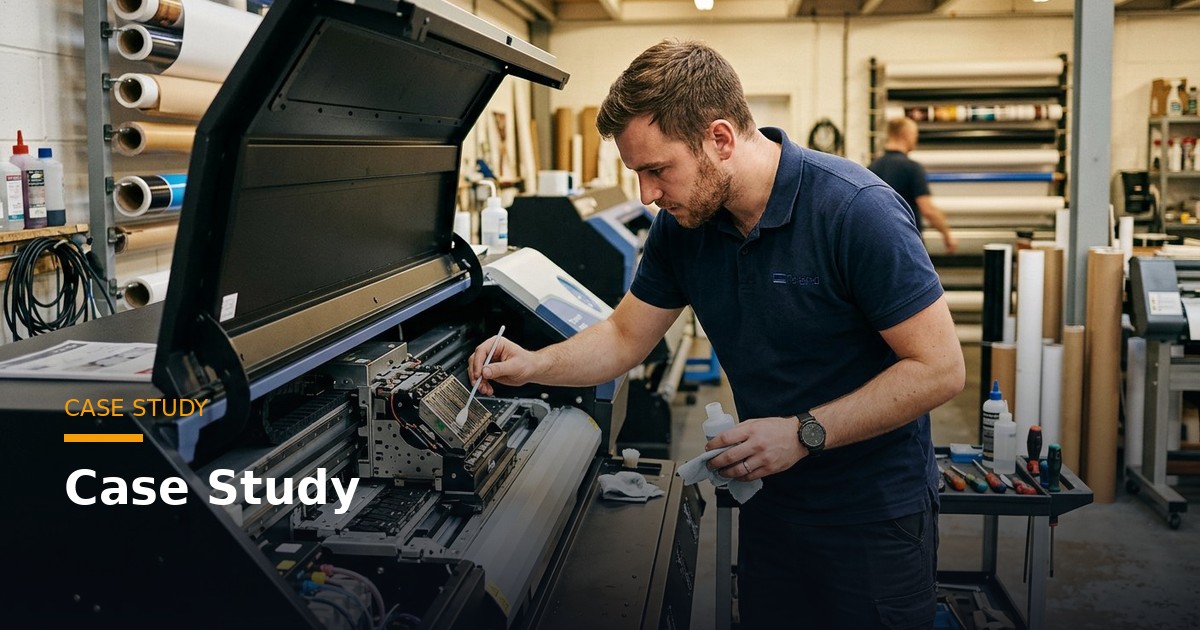
This anonymised case study follows a print business that produced good-quality graphics but was limited by offering them unfinished. By adding lamination and finishing to its UED eco-solvent printing, the business transformed its output into durable, premium, ready-to-use products — commanding higher prices, winning quality-conscious clients and improving margins. Here is how adding finishing transformed the business and what printers can learn about the value of finishing.
The Business and Its Challenge
The business — a print shop producing vinyl graphics, signage, displays and banners on an eco-solvent printer — made good prints but delivered many of them unfinished, or relied on customers to handle finishing elsewhere. This limited it in two ways. First, unfinished prints are less durable and less premium — un-laminated graphics fade, scratch and wear faster, and lack the professional finish clients expect. Second, the business captured only the printing value, not the added value of finishing. It saw that clients wanted durable, finished, ready-to-install products, and that offering finishing properly could elevate its output, its prices and its margins.
The Situation Before
Before adding finishing, the business’s output was limited by being largely unfinished. Prints that were not laminated were less durable — vulnerable to UV fading, scratching, moisture and wear — which limited their applications and the business’s ability to serve quality-conscious clients and demanding environments. And unfinished output commanded lower prices, since it was a commodity print rather than a finished product. The business either delivered prints unfinished (limiting quality and price) or sent work out for finishing (losing margin and control). It was competing as a print supplier when it could have been a finished-products supplier, capturing more value and serving clients better.
The Solution and Approach
The business added lamination and finishing capability alongside its UED eco-solvent printing, transforming its output into finished products. Lamination protected prints — adding UV resistance, scratch and moisture protection, and extending their life dramatically — while giving a professional gloss or matte finish. Finishing (cutting, trimming, mounting, eyeletting and more) turned prints into ready-to-use products. This shifted the business from selling prints to selling durable, finished, professional products. The added durability and finish let it serve quality-conscious clients, demanding applications (outdoor, high-traffic, vehicle graphics) and command premium pricing for finished products rather than commodity prints.
The Value of Lamination
Lamination, in particular, transformed the durability and quality of the business’s output. A laminated print is dramatically more durable than an unlaminated one — the laminate protects the ink from UV fading, scratching, moisture, chemicals and abrasion, extending the graphic’s life significantly. This made the business’s graphics suitable for demanding applications: outdoor signage that faces the elements, vehicle graphics that endure washing and road wear, floor graphics that face foot traffic, and high-quality displays. Lamination also enhanced appearance, adding a professional gloss or matte finish. For quality-conscious clients and demanding applications, lamination was the difference between an adequate print and a durable, professional product — and it justified premium pricing.
Implementation and Support
Adding finishing required new equipment and skills. The business invested in lamination and finishing equipment and trained its team on lamination (matching laminate to application, avoiding bubbles and imperfections) and finishing techniques. It developed workflows integrating printing with lamination and finishing, so jobs flowed efficiently from print to finished product. UED’s support on the printing side, and the business’s investment in quality finishing, ensured the finished products met high standards. Within a few months, the business was delivering durable, professionally finished products, serving quality-conscious clients and demanding applications it had previously been limited in.
The Results
Adding lamination and finishing transformed the business’s output and market. Indicative results:
| Aspect | Before (Prints) | After (Finished Products) |
|---|---|---|
| Durability | Limited | Long-lasting, protected |
| Appearance | Basic | Professional finish |
| Applications | Limited | Outdoor, vehicle, floor, more |
| Price point | Commodity print | Premium finished product |
| Value captured | Printing only | Printing + finishing |
The business could now deliver durable, premium, ready-to-use products, serving quality-conscious clients and demanding applications. Lamination extended product life and enhanced appearance, justifying premium pricing. Finishing captured the added value previously lost or sent out. And the durable, professional output won clients who valued quality and won the business a reputation for premium finished products. Within its first year, adding finishing had elevated the business from a print supplier to a finished-products supplier, with higher prices, better clients and improved margins.
The Financial Impact
The economics of adding finishing were compelling. Finished, laminated products command significantly higher prices than unfinished prints — clients pay for durability, quality and ready-to-use products. The business captured the finishing value it had previously forgone or sent out. And the durability of laminated products reduced returns and complaints, building client satisfaction and repeat business. The investment in lamination and finishing equipment paid for itself through the higher prices finished products commanded and the value captured. Based on the premium pricing and added value, the owner estimated a solid return — finishing turned commodity prints into premium products with much better margins.
Why It Worked
Several factors drove the success. First, the business recognised that finishing transforms prints into premium, durable products that command higher prices. Second, lamination dramatically improved durability, opening demanding applications and quality-conscious clients. Third, bringing finishing in-house captured the value previously lost or outsourced. Fourth, integrating finishing with its quality eco-solvent printing delivered a complete, professional product. And fifth, the durable, premium output built a reputation for quality. The business succeeded by moving up the value chain — from selling prints to selling finished, durable, premium products — capturing more value and serving clients better.
The Owner’s Perspective
The owner’s key insight was about moving up the value chain. “A print is a commodity; a finished, laminated product is what clients actually want and will pay for,” the owner explained. “Adding finishing let us sell the product, not just the print.” That shift was transformative. In a competitive printing market, competing on commodity prints means competing on price, while delivering finished, durable, premium products means competing on value. For the owner, adding lamination and finishing was not just extra equipment — it was moving the business from the low-margin print commodity to the higher-margin finished-product market, where quality and durability command premium prices.
Key Takeaways
Print businesses can draw clear lessons. First, finishing — especially lamination — transforms commodity prints into durable, premium, ready-to-use products that command higher prices. Second, lamination dramatically improves durability, opening demanding applications (outdoor, vehicle, floor) and quality-conscious clients. Third, bringing finishing in-house captures value previously lost or outsourced. And fourth, moving up the value chain — from selling prints to selling finished products — improves margins and positioning. For a print business competing on commodity prints, adding lamination and finishing is a powerful way to elevate the offering, win better clients and capture more value from every job.
This is an anonymised, representative case study based on typical UED machine performance. Individual results vary with market, management, utilisation and local conditions.
Choosing the Right Laminate
A key part of the business’s success was understanding that lamination is not one-size-fits-all — different applications need different laminates, and choosing correctly matters. For outdoor graphics, a UV-protective laminate is essential to prevent fading from sun exposure. For vehicle graphics, a conformable, durable cast laminate that withstands washing, abrasion and the flexing of body panels is needed. For floor graphics, a tough, slip-rated laminate handles foot traffic. For premium displays, a high-clarity gloss or an elegant matte laminate enhances appearance. The business learned to match the laminate to each application, ensuring the finished product was both durable and appropriate for its use.
This expertise in laminate selection is part of delivering professional finished products. Using the wrong laminate — a non-UV laminate outdoors, or a non-conformable one on a vehicle — leads to premature failure, damaging the business’s reputation and the client’s investment. By understanding laminates and matching them to applications, the business delivered finished products that performed as they should, building trust with clients. This knowledge, combined with quality lamination application (free of bubbles and imperfections), is what turns a printed graphic into a durable, professional, fit-for-purpose product. Finishing well requires both the right materials and the skill to apply them correctly.
Finishing for Different Applications
Beyond lamination, the business’s finishing capabilities — cutting, trimming, mounting, eyeletting, applying and more — let it deliver products ready for their specific applications. A banner needs hemming and eyelets for hanging; a rigid sign needs mounting to board; a vehicle graphic needs precise cutting and application; a display needs finishing to a professional standard. By offering comprehensive finishing, the business delivered not just prints but complete, ready-to-use products suited to each application. This completeness is what clients value — they want a finished product, not a print they must finish themselves or send elsewhere.
Offering comprehensive finishing also captured more value and served clients better. Each finishing step adds value that the business captured rather than sending out, and it gave clients the convenience of a one-stop supplier for finished products. The business that delivers a complete, ready-to-install product is far more valuable to a client than one that delivers a print requiring further work elsewhere. By investing in finishing capability across applications, the business moved from being a print supplier to a finished-products supplier — capturing more value per job, serving clients more completely, and building the reputation for complete, professional products that wins quality-conscious clients.
The Premium Positioning
Adding lamination and finishing repositioned the business as a premium supplier, which was as valuable as the direct margin gain. A business that delivers durable, professionally finished products competes on quality and value, not price — a far stronger position than competing on commodity prints. The business’s finished products — laminated, durable, professionally finished — stood apart from competitors offering basic prints, allowing premium pricing and attracting quality-conscious clients who value durability and finish. This premium positioning improved not just margins but the whole character of the business and the clients it attracted.
This positioning also builds a more resilient, higher-value business. Premium suppliers who deliver quality finished products attract clients who value quality over lowest price, who are more loyal and who provide better-margin work. By moving upmarket through finishing, the business escaped the price competition of commodity printing and built a reputation for premium, durable products. The investment in lamination and finishing was therefore not just about adding value to individual jobs — it was about repositioning the entire business as a premium supplier of finished products, competing on quality and durability rather than price, and building a stronger, more profitable operation.
Could This Be Your Business’s Story?
This case study reflects a powerful opportunity for print businesses competing on commodity prints. Adding lamination and finishing transforms your output from basic prints into durable, premium, ready-to-use products that command higher prices and win quality-conscious clients. Lamination dramatically improves durability — opening demanding applications like outdoor, vehicle and floor graphics — while finishing captures value previously lost or outsourced and gives clients complete, professional products.
For a print business, adding finishing is a move up the value chain — from competing on the price of commodity prints to competing on the value of premium finished products. It improves margins, attracts better clients and repositions the whole business as a premium supplier. If you are delivering prints unfinished, or sending finishing out, bringing lamination and finishing in-house is a proven way to elevate your offering, capture more value from every job, and build a stronger, more profitable business around quality finished products.
In a market where anyone can print, the businesses that thrive are those that deliver more — durable, finished, premium products that clients value and pay for. Adding lamination and finishing is how a print business makes that leap.
Ready to Deliver Premium Finished Products?
Finishing turns prints into durable, premium products that command higher prices. Unified Engineering Dynamics supplies quality eco-solvent printers and inks, and advises on finishing workflows.
Discuss quality printing and finishing with UED → Tell us your products, and we will help you deliver premium finished output.
