



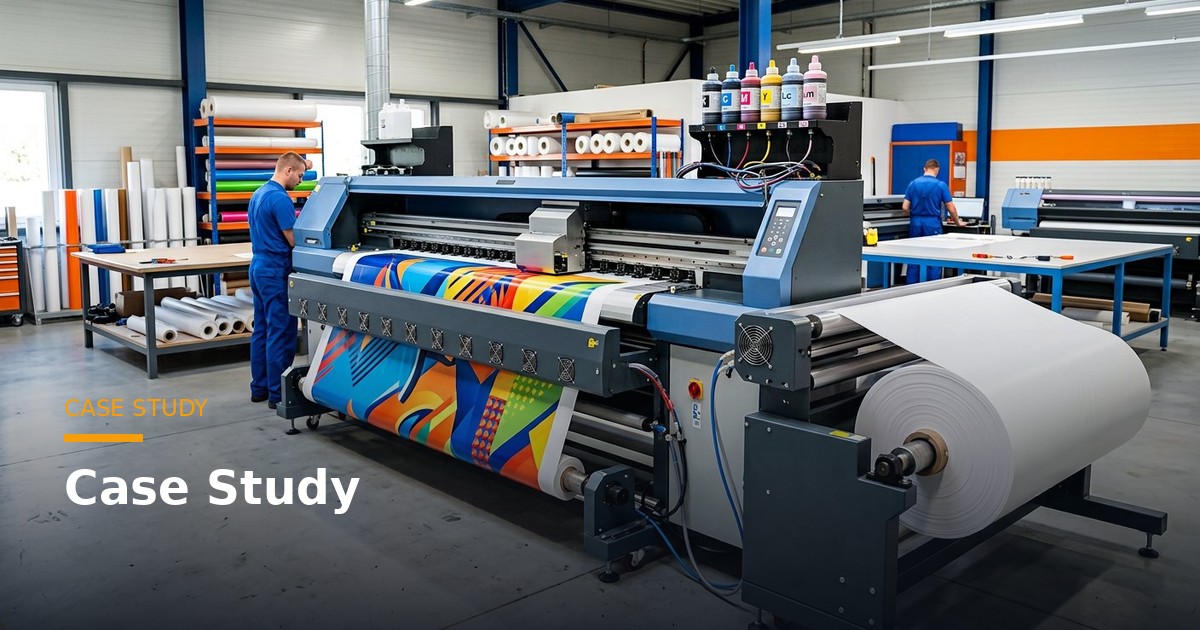
This anonymised case study follows a busy print shop whose single production machine had become both a bottleneck and a single point of failure — every job queued behind it, and any breakdown halted the whole business. By adding a second machine, the shop ended the bottleneck, gained crucial uptime redundancy and grew its capacity. Here is how the second machine transformed the business and what growing print shops can learn.
The Business and Its Challenge
The shop — a successful, busy print business serving a strong client base — had grown to the point where its single production machine was the constraint on everything. Every job queued behind the one machine, so turnaround times stretched as demand grew. More critically, the single machine was a single point of failure: whenever it was down for maintenance or a breakdown, the entire business stopped — no production, missed deadlines, frustrated clients. The shop had more demand than its single machine could handle, and no backup when it went down. The owner recognised that the single machine was now both a capacity bottleneck and a serious operational risk.
The Situation Before
Before adding a second machine, the shop’s single machine constrained its growth and exposed it to risk. As demand grew, jobs queued behind the one machine, stretching turnaround and limiting how much work the shop could take. Clients with urgent jobs had to wait, and some work went to competitors with more capacity. And the single point of failure was a constant worry: any breakdown or maintenance stopped all production, causing missed deadlines and lost revenue, with no backup to keep the business running. The shop had built a strong client base and had growing demand, but its single machine capped its growth and left it vulnerable to any downtime. The owner calculated that the bottleneck and downtime risk were costing more than a second machine would.
The Solution and Approach
The shop invested in a second machine, matching its existing equipment, to end the bottleneck and gain redundancy. The second machine immediately doubled production capacity, so jobs no longer queued behind a single machine and turnaround improved — the shop could take on more work and serve clients faster. Just as importantly, it provided redundancy: if one machine was down for maintenance or a breakdown, the other kept production running, eliminating the single point of failure that had risked the whole business. The two machines also gave flexibility — running different jobs simultaneously, or handling urgent work on one while the other continued. The second machine transformed both the shop’s capacity and its resilience.
Machine at a Glance
| Specification | Detail |
|---|---|
| Approach | Second machine (matching existing) |
| Benefit 1 | Doubled production capacity |
| Benefit 2 | Uptime redundancy (no single point of failure) |
| Benefit 3 | Flexibility (parallel / urgent jobs) |
| Result | Faster turnaround, more capacity, resilience |
Adding a second matching machine was a straightforward, low-risk way to solve both problems at once. Because it matched the existing equipment, the shop’s team already knew how to run it — no new training or workflow disruption — and it used the same inks, media and spare parts. This made the second machine an efficient capacity and redundancy addition, integrating seamlessly into the existing operation. The matching equipment meant the shop gained capacity and resilience without the complexity of learning a different machine, making it one of the simplest, most effective growth investments a busy print shop can make.
Implementation and Support
Adding the second machine was smooth, precisely because it matched the existing one. The shop’s team already had the skills, so there was no training curve, and the machine slotted into the existing workflow, using the same inks, media, RIP software and maintenance routines. UED’s installation and support got it running quickly. The shop integrated the two machines into its production planning — balancing jobs across both, running parallel work, and using one as backup when the other needed maintenance. Within a very short period, the second machine was productive, and the shop was benefiting from doubled capacity and the security of redundancy.
The Results
The second machine transformed the shop’s capacity and resilience. Indicative results:
| Aspect | Before (One Machine) | After (Two Machines) |
|---|---|---|
| Capacity | Bottleneck | Doubled |
| Turnaround | Stretched | Faster |
| Downtime impact | Full stop | Production continues |
| Work taken | Limited | More, including urgent |
| Risk | Single point of failure | Redundancy |
The doubled capacity let the shop take on more work and serve clients faster, ending the bottleneck that had capped its growth. Just as importantly, the redundancy eliminated the single point of failure — when one machine needed maintenance or broke down, the other kept production running, so the shop no longer faced full stoppages and missed deadlines. The flexibility to run parallel and urgent jobs improved service. And the ability to take more work grew revenue. Within its first months, the second machine had transformed the shop from capacity-constrained and vulnerable to growing and resilient.
The Financial Impact
The economics of the second machine were compelling on two fronts. First, the doubled capacity let the shop capture more revenue — taking on work it had been turning away or delaying, and serving clients faster. Second, the redundancy protected revenue: previously, any downtime on the single machine meant zero production and lost income; with a backup, production continued through maintenance and breakdowns, protecting revenue that would otherwise be lost. The second machine also reduced the risk and stress of the single point of failure. Based on the additional capacity revenue and the protected revenue during downtime, the owner estimated a strong return. The second machine was not just growth — it was insurance against the downtime risk that a single-machine business constantly faces.
Why It Worked
Several factors drove the success. First, the shop recognised that its single machine was both a growth bottleneck and an operational risk, and that a second machine solved both. Second, matching the existing equipment made the addition low-risk and seamless — no new training, same consumables and workflow. Third, the doubled capacity captured more revenue and improved turnaround. Fourth, the redundancy protected against the downtime that halts a single-machine business. And fifth, the flexibility of two machines improved service. The shop succeeded by addressing both the capacity constraint and the single-point-of-failure risk with one simple, efficient investment — a second matching machine that grew the business and made it resilient.
The Owner’s Perspective
The owner’s key insight was about risk as much as capacity. “The second machine doubled our output, yes,” the owner explained. “But just as important — we stopped being one breakdown away from a full stop.” That captures the dual value of redundancy. A single-machine business is constantly vulnerable: any downtime halts everything, risking deadlines, clients and revenue. A second machine provides the capacity to grow and the resilience to keep running through problems. For the owner, the second machine was both a growth investment and essential insurance — it let the shop grow confidently, knowing that a breakdown or maintenance no longer meant the whole business grinding to a halt.
Key Takeaways
Growing print shops can draw clear lessons. First, a single production machine becomes both a growth bottleneck and a single point of failure as demand grows. Second, adding a second matching machine solves both — doubling capacity and providing uptime redundancy, seamlessly and with low risk (no new training, same consumables). Third, the doubled capacity captures more revenue and improves turnaround. And fourth, the redundancy protects revenue during maintenance and breakdowns, eliminating the full stoppages that a single-machine business faces. For a busy print shop, adding a second machine is one of the simplest, most effective investments — it grows capacity and provides the resilience that lets a business operate without the constant risk of a single point of failure.
This is an anonymised, representative case study based on typical machine performance. Individual results vary with market, management, utilisation and local conditions.
Planning Production Across Two Machines
With two machines, the shop developed smart production planning to use both effectively. It balanced jobs across the two machines to maximise throughput and minimise turnaround — running parallel jobs, or queueing work efficiently so neither machine sat idle while the other was overloaded. It also used the flexibility strategically: running urgent or priority jobs on one machine while the other continued regular work, and grouping similar jobs for efficiency. This production planning across two machines is what turned the added capacity into real throughput and faster turnaround, rather than just having a second machine sitting underused. Effective scheduling was key to realising the capacity benefit.
The matching equipment made this planning simpler, since both machines ran the same way — same inks, media, RIP software and processes — so jobs could move between them seamlessly and operators could work on either. This interoperability meant the shop could flexibly allocate work to whichever machine was available, optimising utilisation. For a shop adding a second matching machine, this seamless interoperability is a significant advantage: it makes production planning across two machines straightforward, since they are functionally interchangeable. The shop could treat its two machines as a flexible, combined production capacity, allocating work optimally to maximise throughput and minimise turnaround.
The Value of Redundancy
The redundancy benefit of the second machine proved as valuable as the capacity, and the shop came to appreciate it deeply. Previously, with one machine, any maintenance or breakdown meant a full production stop — missed deadlines, lost revenue and stressed clients. With two machines, when one was down, the other kept production running, so the shop never faced a complete halt. This redundancy transformed the shop’s reliability: it could承诺 deadlines with confidence, knowing a breakdown on one machine would not stop delivery. The peace of mind and reliability that redundancy provided was worth a great deal, both operationally and in client trust.
This redundancy also reduced the stress and risk that a single-machine business constantly faces. A single machine is a constant vulnerability — every printer knows the anxiety of a critical machine being the only one. With a backup, the shop could perform maintenance proactively (rather than putting it off for fear of downtime), handle breakdowns without crisis, and operate with confidence. This resilience made the business more robust and its service more reliable. For the shop, the second machine’s redundancy was not just a backup — it was the foundation of reliable, confident operation, eliminating the single point of failure that had been a constant risk and limitation. Redundancy, it turned out, was worth as much as the extra capacity.
Growth and Resilience Together
The second machine delivered growth and resilience together, and this combination was its greatest value. The doubled capacity drove growth — the shop could take more work, serve clients faster and increase revenue. The redundancy delivered resilience — the shop could operate reliably through maintenance and breakdowns, protecting that revenue and its client relationships. Together, they transformed the business from capacity-constrained and vulnerable to growing and robust. This is the ideal combination for a growing business: the capacity to expand and the resilience to operate reliably, each reinforcing the other.
For a growing print shop, this combination is compelling. Growth without resilience is risky — expanding on a single machine means a breakdown can halt the growing business at the worst time. Resilience without growth is stagnant. The second machine delivered both: the capacity to grow and the backup to grow safely. By adding a second matching machine, the shop gained the best of both — it could pursue growth confidently, knowing it had the redundancy to operate reliably through any problem. For a busy print shop looking to grow, adding a second machine is one of the smartest investments: it delivers the capacity to expand and the resilience to do so reliably and confidently.
Ready to End Your Bottleneck and Gain Redundancy?
A second machine doubles capacity and eliminates your single point of failure. Unified Engineering Dynamics manufactures a full range of printers, with quality inks and support.
Discuss adding capacity with UED → Tell us your production needs, and we will recommend the right machine.
