
Quick Answer: In 2026, the Epson i3200 decisively beats the DX5 for new eco solvent printer purchases: 3,200 nozzles vs 1,440 (≈2.2× the jetting capacity per pass), newer PrecisionCore architecture, better availability of genuine stock, and realistic head life of 18–36 months under normal maintenance. The DX5 — legendary as it was — is a discontinued head surviving on leftover OEM stock priced at scarcity premiums (₹38,000–55,000) and increasingly on clones of uncertain quality. Buy DX5-based machines only in exceptional used-deal circumstances; for every new machine purchase, the i3200 is the correct, future-proof choice. This guide gives you the full technical and financial comparison.
If you’re shopping for an eco solvent machine in India right now, the single most consequential component decision — bigger than the chassis brand, bigger than the dealer’s discount — is which Epson print head sits inside. Nearly every machine in the ₹1.5–12 lakh eco solvent market is built around one of two heads: the aging legend DX5 or the modern standard i3200.
Dealers muddy this choice deliberately. DX5 stock machines need selling; the sales pitch writes itself (“same resolution! proven technology! cheaper!”). And there was a time, around 2016–2020, when that pitch was sound economics. In 2026, it isn’t — and the reason is a supply-chain story as much as an engineering one. This guide lays out the real comparison: architecture, speed, droplet science, price, lifespan, genuine-vs-clone risk, and total cost of ownership — ending with a clear recommendation for every buyer situation.
The Two Heads, Briefly Introduced
Epson DX5 (F1440/F186000 family) — The Legend
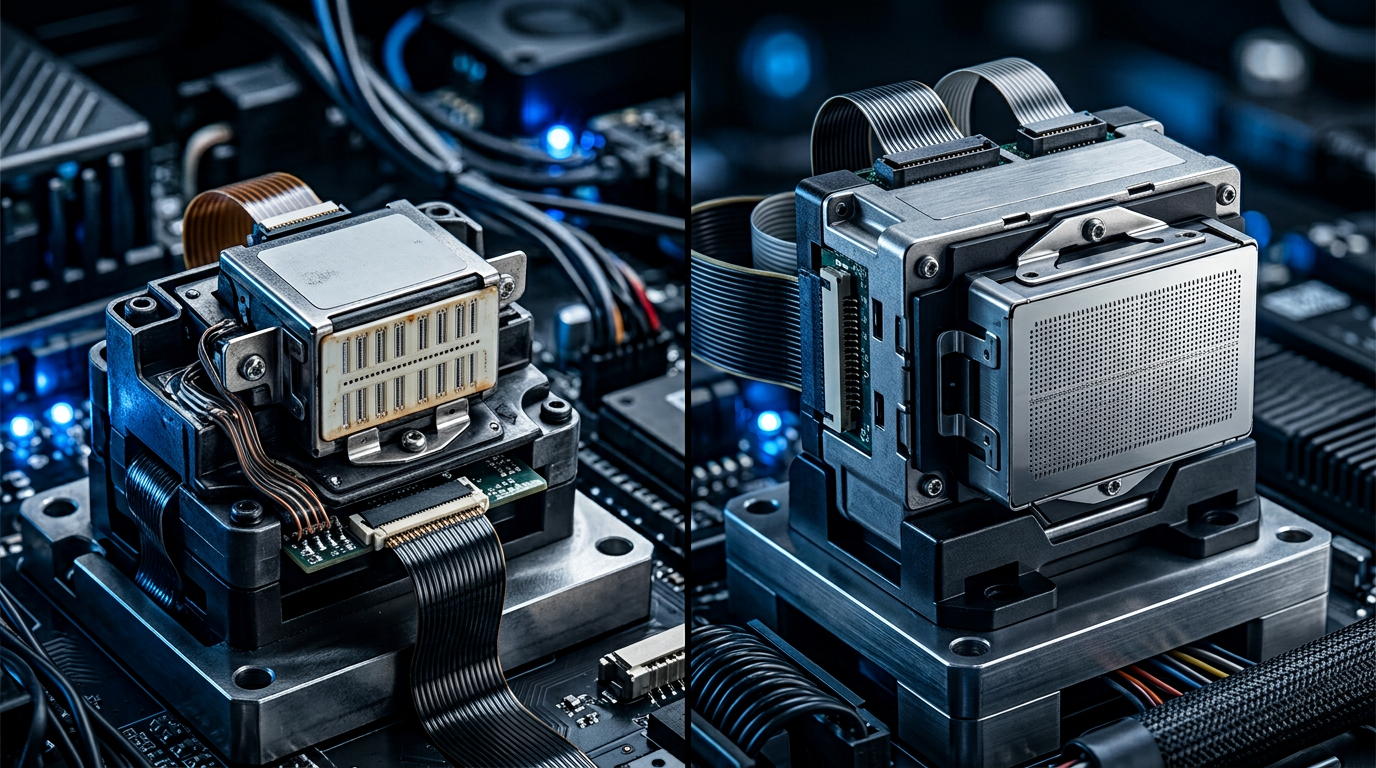
Released in the late 2000s, the DX5 became the most successful solvent/eco-solvent head of all time. With 1,440 nozzles (8 channels × 180), Micro-Piezo firing, and 3.5 pl minimum droplets, it powered the global explosion of affordable photo-quality printing: Mutoh, Mimaki, and Roland built flagship machines on it, and virtually every Chinese eco-solvent chassis from 2012–2022 was DX5-based. The Indian vinyl revolution ran on DX5 heads.
The catch: Epson wound down OEM production years ago. What remains in the market is old stock, “new-old-stock” of uncertain storage history, and a swelling clone industry.
Epson i3200 (PrecisionCore) — The Incumbent
The i3200 arrived as Epson’s answer to industrial single-pass demands: 3,200 nozzles across a 4.7-inch-wide print swath, PrecisionCore thin-film piezo actuators firing at higher frequencies, and variants for aqueous (-A1), eco-solvent (-E1), and UV (-U1) chemistries. Where the DX5 was a great 2010s head, the i3200 is engineered like modern production equipment: more nozzles per rupee, finer drop control, better ink-channel protection.
Technical Specifications: Side by Side
| Parameter | Epson DX5 | Epson i3200-A1/E1 |
|---|---|---|
| Nozzle count | 1,440 (8×180) | 3,200 (4×800 staggered PrecisionCore chips) |
| Print swath width | ~25.4 mm (1 inch) | ~47 mm (≈4.7× per-pass coverage) |
| Minimum droplet | 3.5 pl (variable) | 3.5 pl (variable, finer interpolation) |
| Max firing frequency | ~14.4 kHz class | ~21.6+ kHz class |
| Colors per head | 4 channels paired traditionally CMYK×2 heads or CMYK+LcLm | 4 channels; typical builds run CMYK on one head or 2× for CMYK+speed |
| Max native resolution | 1440 dpi | 1200 dpi nominal, 2400 dpi class addressing on builds |
| Ink chemistry variants | Solvent/eco/aqueous/uv (legacy variants) | A1 (aqueous), E1 (eco solvent), U1 (UV) |
| Internal filtration/air handling | Adequate for its era | Improved — better air evacuation, reduced starvation banding |
| Production status (2026) | Discontinued | Current production |
The number that drives everything else is nozzles and swath: 3,200 nozzles across nearly double the swath means the i3200 lays down roughly 2.2–2.5× the ink volume per carriage pass at equal quality settings. This is physics, not marketing — and it’s why otherwise identical machines print so differently with the two heads.
Print Speed in the Real World (Measured, Not Brochure)
Same machine chassis, same file, same media, production-quality pass modes, operator-measured field numbers:
| Pass Mode | Single DX5 (1.6m) | Single i3200 (1.6m) | Verdict |
|---|---|---|---|
| Draft / fast billboard | 9–12 sq m/hr | 18–22 sq m/hr | ~2× i3200 |
| Production (sellable retail) | 6–9 sq m/hr | 12–18 sq m/hr | ~2× i3200 |
| Photo quality | 3–5 sq m/hr | 5–8 sq m/hr | ~1.6× i3200 |
Translate that into your working day: a 100-sq-ft laminated shop-board batch that takes ~2 hours of print time on a DX5 clears in ~1 hour on an i3200. On a busy festival-week day, that difference is the difference between “yes, tomorrow morning” and “sorry, day after.”
Print Quality: The Honest Truth
Here’s where we give the old legend its due. Because droplet minimums are equal (3.5 pl) and resolution numbers are comparable, well-profiled DX5 output and well-profiled i3200 output at the same pass count are genuinely hard to separate at normal viewing distances:
- Fine gradients/skin tones: both excellent; i3200 slightly smoother thanks to newer screening electronics and finer drop modulation
- Small text: equal-ceiling quality; i3200 slightly more consistent over long runs due to better ink-feed stability
- Banding resistance: the i3200’s wider swath hides individual nozzle variation better; DX5 banding shows earlier as heads age
- Colour gamut: function of ink and profiling more than the head — equal potential on both
Neutral verdict: quality is a narrow i3200 edge; speed is a wide i3200 win; quality-at-speed is decided entirely for the i3200. Since business is exactly quality-at-speed, the practical verdict widens.
Price & Availability: Where 2026 Changes Everything
| Factor | DX5 | i3200 |
|---|---|---|
| Genuine head price (2026) | ₹38,000–55,000 (old stock) | ₹45,000–80,000 |
| Genuine availability | Scarce, shrinking yearly | Readily stocked by all major importers |
| Clone/refurb supply | Flood of “compatible” DX5 at ₹18–28k with luck-of-draw lifespan | Clone i3200s exist but far fewer; market still OEM-dominant |
| Machine price built on it | ₹0.9–2.2 lakh (new-old-stock/used) | ₹1.65–4.5 lakh (new) |
| Future parts pipeline | Closed; dead-end platform | Open; Epson’s current-generation industrial head |
The arithmetic that settles arguments: a DX5 machine that saves ₹60,000 today but needs a ₹50,000 scarcity-priced head in ten months, and another increasingly-hard-to-find head within three years, has not saved ₹60,000 — it has deferred and multiplied the cost while stranding you on a dead platform. The i3200’s head market, by contrast, is in its high-production prime: prices trend stable-to-down, every service shelf stocks it, and your 2028 machine build will still jet through the same part.
Lifespan & Maintenance Behaviour
| Parameter | DX5 | i3200 |
|---|---|---|
| Typical life (maintained, commercial use) | 12–24 months | 18–36 months |
| Idle tolerance | Moderate — sensitive membranes | Slightly better — improved capping response |
| White-ink/pigment handling (DTF variants) | Struggles; clog-prone | Stronger; pigment-tolerant with circulation |
| Sensitivity to ink quality | High | High — cheap ink kills any head; i3200 marginally more forgiving |
| Air-in-line banding incidents | Recurrent complaint | Reduced by design |
| Typical failure mode | Gradual nozzle loss into channel fade | Sudden dropout events rarer; wear is more graceful |
Both heads die quickly when abused; daily nozzle checks, nightly wet-capping, quality ink, and dust control decide lifespan more than the model number. But assuming equal discipline, the i3200 lasts roughly 1.5× longer in the field reports we see across India.
Total Cost of Ownership: The 5-Year Verdict Table
| 5-Year Line Item | DX5 Machine Path | i3200 Machine Path |
|---|---|---|
| Machine purchase | ₹1.4L (typical 2026 DX5 deal) | ₹2.3L (single i3200) |
| Head replacements (5 yrs) | ₹2.0L (≈4 × 50k, scarcity-priced) | ₹1.5L (2 × 75k) |
| Downtime cost of parts hunting | High — days per head event | Low — same-week delivery is normal |
| End-of-period platform value | Near-zero (dead platform) | Healthy 40–55% resale |
| 5-year machine+head total | ≈ ₹3.4L + downtime risk | ≈ ₹3.8L + uptime + resale |
The savings narrows to ~₹40k over five years — and then evaporates entirely when you price the DX5 path’s recurring weeklong downtimes against the i3200’s throughput advantage applied over 60 months of Fridays. There is no honest spreadsheet where the DX5 route wins a 2026 new-purchase decision.
When the DX5 Still Makes Sense (The Exceptions)
Honesty demands the exceptions list:
- An exceptional used deal with tested heads: a well-kept DX5 machine at genuinely distressed pricing (think ₹60–90k total) with a live-proven nozzle pattern can be a rational bridge for a bootstrap starter — walked into with eyes open on platform risk.
- Existing DX5 shop: stay disciplined, not nostalgic. If your current machine runs wonderfully, don’t rush to swap. Run it with disciplined maintenance, bank the i3200 fund monthly, and execute the changeover on your schedule rather than on a failure’s schedule.
- Spare-parts miners: operators with local clone-head sourcing mastered and the mechanical skills to burn through them cheaply can still run DX5 economics — but that is a craft strategy, not a purchase recommendation.
For everyone else buying new in 2026, the answer is firm: i3200 or don’t buy.
The Clone-Head地雷 Minefield (Buyer’s Survival Guide)
Both head families have counterfeit problems, but asymmetric risk: cloned *old-generation* heads vastly outnumber clones of the current one, because demand now flows to genuine i3200 stock. When buying heads:
- Accept only sealed OEM packing with Epson hologram/labels intact — inspect under good light, not through a shop catalog.
- Verify nozzle-plate cleanliness (pristine, no wipe-arcs) under magnification.
- Photograph and register serials on installation day.
- Expect market-sane pricing — a “genuine i3200” at ₹35k is a refurbished摊位 stall product in a convincing box.
- Buy through suppliers who stake their name on installation-week survival claims, not courier-only anonymous sellers.
Printhead Anatomy: Why Nozzle Count Decides Everything
A piezo print head is deceptively simple in concept — thousands of microscopic firing chambers, each with a piezo element that flexes when voltaged, ejecting a measured droplet through a nozzle. The two levers engineering uses are nozzle count per head and firing frequency. Together they set the maximum fluid throughput per carriage pass, which is what “speed” actually is.
The DX5 was balanced for its era: 8 channels × 180 nozzles with ~25 mm swath. The i3200 rearchitected the package: four PrecisionCore chips staggered into a ~47 mm wide array carrying 3,200 nozzles — more nozzles and wider coverage in a body of similar volume, at substantially higher firing rates. Across an 8-hour day, this arithmetic difference compounds into roughly double the square metres while sustaining the same drop sizes and print fidelity.
Why shops should care about the engineering rather than the spec sheet: heads are consumable capital goods selling at ₹45,000–80,000 — the one that delivers double the throughput per replacement cycle mathematically halves your head-cost-per-printed-meter, which is where the i3200’s purchase price keeps paying you back forever.
Head Failure Forensics (Learn the Dead Head’s Story)
When heads fail, the failure pattern carries diagnostic information that changes what you do next:
- Gradual outer-nozzle loss → channel fade: classic age/wear curve, more acute under dry climates and dust. Normal end-of-life after 18–36 service-months. Action: replacement budget drawn on schedule.
- Sudden total-channel death: often electrical — head-board faults, cable degradation, voltage events. Action: diagnose boards before head swap, or the new head inherits the cause.
- Solid-fill striping that cleaning never repairs: partial permanent nozzle loss — usually a strike or thermal event rather than age. Action: post-mortem your strike protections, not just the head.
- Repeated short-interval deaths: the classic signature of ink chemistry attack — counterfeit cleaning fluid, contaminated ink, or mis-matched evaporation grades. Action: audit consumables before installing head number three.
Discipline in reading failures converts them from recurring expense into single-tuition lessons.
The Supply Chain Story: How DX5 Died in Slow Motion
Understanding why a legendary head became a bad buy inoculates you against nostalgia pricing everywhere in machinery:
Epson’s micro-piezo lineup consolidation moved industrial printing to PrecisionCore platforms. Once OEM production wound down, the global DX5 install base — still huge, still printing daily — drew its spares from a finite pool of warehoused stock. Scarcity economics did the rest: prices rose, storage-age risk quietly climbed (heads stored 5+ years carry their own failure odds regardless of sealing), and clone/factory-seconds filled demand at every gradation of dishonesty from “licensed-ish” to outright fraudulent.
The same end-of-life arc eventually meets every dominant consumable platform — the evergreen buyer’s lesson is to evaluate parts-pipeline horizon as seriously as specs. A machine whose consumable is in production-prime owns its own service future; one whose consumable is in twilight owns somebody else’s clearance schedule.
Warranty Reality: What “Head Warranty” Usually Means
Head warranty language at purchase deserves forensic reading, because most policies exclude the failure modes that actually happen:
- Typically covered: dead-on-arrival, no-fire-out-of-box, immediate electrical failure events.
- Typically excluded: clogging of any kind (filed as “maintenance”), strike damage (“operator”), ink-contamination deaths (“consumable traceability”), wear-fade beyond threshold tests.
- The exception that matters: head-support dealers who diagnose root cause with you — documented in writing — on early failures. Price such dealers into purchase comparisons; their head-survival economics routinely outweigh the machine-price delta.
Anatomy of a Piezo Printhead: Why Heads Die (and How Yours Doesn’t Have To)
Both the i3200 and DX5 are piezoelectric heads: 3,200 (i3200) or 1,440 (DX5) microscopic chambers, each with a ceramic wall that flexes when charged, squeezing a droplet through a nozzle. Understanding the failure modes tells you exactly which habits extend head life:
| Failure Mode | What Actually Happens | Cause | Prevention |
|---|---|---|---|
| Nozzle clogging (recoverable) | Dried ink film blocks nozzles; test print shows gaps | Idle time, dust, hot dry air, skipped cleanings | Daily nozzle checks, proper capping, weekly wet-capping if idle |
| Permanent blockage | Pigment sediment hardens inside channels; no flush recovers it | Cheap unfiltered ink, mixing ink brands, long shutdowns without flushing | One ink brand, filtered gradients, proper long-storage procedure |
| Piezo element burn-out | Dead nozzle lines that no cleaning restores | Dry firing (printing empty), electrical spikes, age | Never let ink run dry; UPS/stabilizer; accept age (3–5 yr horizon) |
| Face plate damage | Scratches deflect droplets → banding at any setting | Media crashes (buckled vinyl hitting head), rough manual wiping | Correct head height, taped media edges, swab-only cleaning |
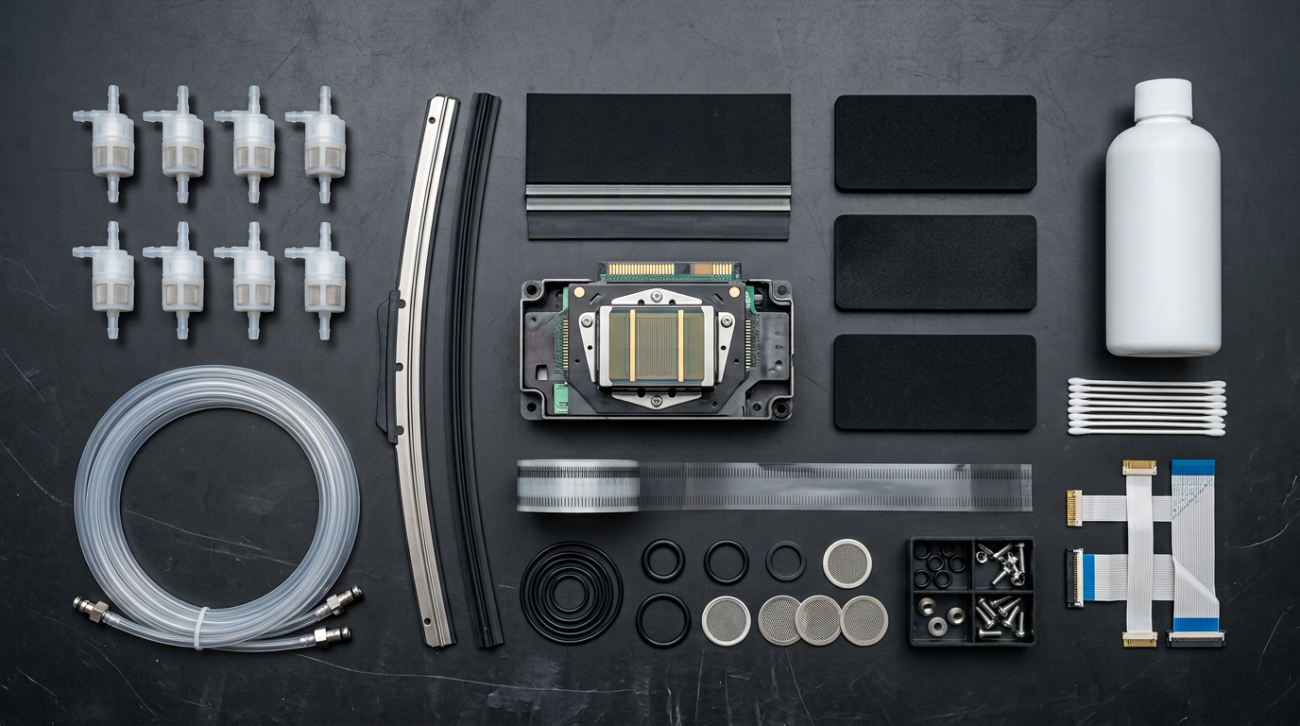
| Air ingestion / ink starvation | Random missing nozzles mid-print, recovers after clean | Leaky dampers, perished capping seals, low tank levels | Replace dampers/cappings on schedule, not on failure |
The economics are stark: an i3200 head at ₹45,000–75,000 that lasts 24 months costs ₹60–100/day. The same head killed in 6 months by bad ink and skipped maintenance costs ₹250–400/day — plus the banded reprints and the job you delivered late. Head care is not housekeeping; it is the single biggest line item in your cost structure.
The Head-Life Logbook: What Disciplined Operators Track Daily
Print shops with consistently long head life all do one boring thing: they log. This 2-minute daily ritual catches problems while they’re still ₹200 problems instead of ₹60,000 problems:
| Log Entry | Frequency | What Good Looks Like | Red Flag |
|---|---|---|---|
| Nozzle test print (photographed) | Daily, before first job | All channels firing, crisp lines | >5 missing nozzles or drifting pattern after 2 cleans |
| Ink levels + batch number of opened bottles | Daily | Same brand, in-date batches | Any third-party or expired ink entering the system |
| Cleaning cycles run (auto + manual) | Daily | 1–2 normal cleans/day | >4 cleans/day = system problem, stop cleaning and diagnose |
| Room temp & humidity | Daily (cheap hygrometer) | 20–30°C, 40–65% RH | >35°C or monsoon spikes without AC/dehumidify plan |
| Wiper / capping station condition | Weekly | Clean rubber, no ink crust | Crusted wiper smearing instead of wiping |
| Metres printed per head | Weekly total | Steady utilization | Sudden quality drop at predictable metreage = wear pattern |
When you buy a used machine, ask for this log. A seller who kept one is a seller whose machine you want. A seller who says “log kya hota hai” just told you the machine’s maintenance history — there isn’t one.
The 3-Year Cost-per-Print Model: i3200 vs DX5 With Real Numbers
Marketing compares printhead prices; owners should compare lifetime cost per square metre. Worked example for a shop printing 500 sq m/month over 3 years (18,000 sq m total):
| Cost Line | i3200 Path | DX5 Path |
|---|---|---|
| Head replacements (life: 24 mo vs 12–15 mo typical) | 1 replacement = ₹45,000–75,000 | 2–3 replacements = ₹60,000–1,05,000 |
| Ink @ ~180 ml/sq m avg, i3200 finer drops use ~10% less | ~3,240 L × ₹1,100 avg = ~₹35.6L… (see ink guide for per-litre math) | ~3,560 L at similar grade |
| Reprint waste from banding/strikes (~2% vs ~6%) | ~360 sq m media+ink waste | ~1,080 sq m waste — 3× the hidden cost |
| Downtime days (head swaps, chronic clogs) | ~3–5 days over 3 years | ~12–20 days — each worth ₹8,000–15,000 lost billing |
| Resale value of machine at year 3 | i3200 machines hold 45–55% | DX5 machines hold 20–30% and falling |
Add it up honestly and the “expensive” i3200 path runs ₹1.5–3 lakh cheaper over three years at typical volumes — before counting the jobs a DX5 shop simply loses to faster competitors. The head price difference (₹15–25k) is a rounding error in that math.
The Honest Counterpoint: When a DX5 Still Makes Sense
This comparison has a clear winner — but intellectual honesty demands the exceptions, because they exist:
- Ultra-low-budget entry (<₹1 lakh total): a used DX5 machine at ₹50–80k lets a skilled operator start earning while saving for the i3200. It’s a paid apprenticeship, not a business foundation. Buy it knowing the head is a consumable and the machine is disposable.
- Heads already in stock: if you inherit or already own sealed DX5 heads (they still appear in the supply chain), a DX5 body runs them fine while stock lasts.
- Very low duty cycle: for 30–80 sq m/month of occasional in-house work where downtime doesn’t lose customers, a cheap DX5 build can be rational — the i3200’s advantages compound with volume, and without volume they don’t compound.
- Specific legacy workflows: a handful of older RIP profiles and media ICCs are tuned around DX5 droplet behaviour. If your entire calibrated workflow is DX5-based and profitable, switching heads means re-profiling everything.
But be honest about which list you’re reading: for anyone buying a new machine in 2026 with commercial intent, these exceptions don’t apply. The i3200’s supply depth (every serious assembler builds on it), technician familiarity, finer droplets at higher speed, and resale value make it the default choice. The DX5 era produced great machines — and it’s over.
Myth-Busting: 6 Printhead Claims That Refuse to Die
| The Myth | The Reality |
|---|---|
| “i3200 heads clog less, so maintenance doesn’t matter” | i3200’s finer channels clog differently, not never. Skipped maintenance kills them exactly as dead — just at higher head replacement cost |
| “A refurbished DX5 head is as good as new” | “Refurbished” heads are used heads ultrasonically cleaned. They can run well — or die in a month. Price them as consumables with unknown remaining life, never as new equivalents |
| “More cleaning cycles = cleaner head” | Every cleaning cycle stresses the system and consumes ink into the waste pad. Two cycles with no improvement means the problem isn’t a clog — diagnose, don’t keep flushing |
| “DX5 gives better colour because it’s an older, proven head” | Colour comes from ink + profile + media, not the head’s birth year. i3200’s smaller droplets actually render smoother gradients at production speeds |
| “Non-original ink instantly voids/kills i3200 heads” | Cheap unfiltered ink kills them slowly; premium third-party ink usually doesn’t. Warranty terms vary — read yours. But the physical head doesn’t know the bottle’s brand; it knows particle quality |
| “Printheads die suddenly without warning” | Almost never. Nozzle-test photos over 2–4 weeks show the creeping deflection and dropout pattern. Sudden deaths usually mean someone wasn’t looking |
Buying a New Head: 8 Questions Before You Pay
A head purchase (₹25,000–1,00,000) deserves the same diligence as the machine itself:
- Sealed or “unlocked”? Genuine i3200 heads for the aftermarket must match your board’s encryption expectations — confirm your machine firmware accepts the specific head version being sold.
- Source and invoice? GST bill, seller’s GSTIN, and a return window in writing. Head counterfeits and re-labelling exist.
- Manufacture date on the box? Prefer stock under 12 months old — heads age on shelves too.
- Warranty terms, exactly? Typical honest terms: DOA (dead-on-arrival) replacement within 7–30 days, void if non-approved ink/burn damage. Anyone promising 6–12 month unconditional head warranty is pricing the lie into the quote.
- Installation support included? A mis-seated cable or static discharge during DIY install can kill the new head instantly — a seller-provided engineer visit is worth paying for.
- Dampers/captop bundled? New head + old clogged dampers = new head inheriting the old head’s disease. Change the blood with the heart.
- Price checked against 2–3 suppliers? The spread on identical i3200 heads in India routinely runs ₹8,000–20,000 between sellers.
- Payment protection? Traceable payment against invoice — heads are the single most disputed purchase category in this industry; your paper trail is your only leverage.
Ask all eight and counterfeiters filter themselves out — honest suppliers answer these in their sleep, because they field them daily from the experienced shop owners who form their real customer base.
Frequently Asked Questions (FAQs)
Q1. Is the Epson i3200 better than the DX5 for eco solvent printing?
Yes in 2026, across speed (~2×), availability, platform future, and realistic lifespan; print quality at matched pass counts is a narrow i3200 edge. The DX5’s only remaining case is exceptional used-machine pricing with proven heads.
Q2. Why is the DX5 more expensive than before if it’s older?
Discontinuation economics: DJX5 heads are no longer manufactured by Epson; remaining genuine stock commands scarcity pricing, and even that stock is shrinking every quarter. Older ≠ cheaper for discontinued components — it means rarer.
Q3. Can I upgrade my DX5 machine to an i3200 head?
Generally no — head boards, firmware, carriage electronics, and ink systems are engineered per head family. Some “conversion kits” surface in the market periodically; they cost enough that a fresh i3200 machine with warranty is almost always the smarter spend.
Q4. What about the XP600 — where does it fit?
The XP600 is the budget rung: 1,440 nozzles, cheaper (₹15–22k), shorter life (8–14 months under commercial load). It beats the DX5 on availability and platform currency but loses to the i3200 on speed and economics. Choose it for strict-budget, gentle-volume use only.
Q5. How many prints does one i3200 head produce before replacement?
Under disciplined solvent/eco-solvent maintenance, operators commonly report 1.5–3 years of daily commercial production; in square metres, think in the 40,000–70,000 sq m band per head depending on coverage and care.
Q6. Is a two-head i3200 machine double the speed of one-head?
Close — 1.8–1.9× in production modes due to staggered overlap efficiency (25–30 vs 12–18 sq m/hr). It also adds graceful degradation: you keep printing at reduced speed during any single-head issue.
Q7. i3200-A1 vs E1 vs U1 — which variant do I need?
Match the variant letter to your ink chemistry: A1 for aqueous (water-based indoor photo work), E1 for eco solvent (vinyl/outdoor work — the Indian mainstream), U1 for UV machines. Swapping chemistry on one head family is not possible; choose E1 for the eco-solvent business.
Q8. Are clone i3200 heads safe to buy in 2026?
Cloned i3200 supply exists but remains a minority of the market; quality ranges from passable to head-carriage-frying. With genuine stock plentiful, the small saving carries asymmetric risk. Buy genuine, sealed, serial-registered.
Q9. How do I maximize whichever head’s life?
Daily nozzle check, nightly wet-cap, quality ink only, dust-controlled room, weekly capping/wiper maintenance, and no forced-syringe heroics. The maintenance schedule in our maintenance guide applies almost verbatim to eco solvent heads.
Q10. If DX5 is dead, why do dealers still push DX5 machines?
Inventory that must clear, nostalgia inertia, and headline-price positioning (“same resolution, ₹60k cheaper!”). The pitch targets buyers comparing brochures instead of five-year spreadsheets — which is precisely the analysis this article arms you with.
Final Verdict
The Epson DX5 earned its legend — an entire industry generation was built on its back, and thousands of surviving machines still earn daily. But legend status doesn’t stock spare parts. The 2026 decision is not a referendum on DX5’s history; it is arithmetic on your next five years: the i3200 offers roughly double the jetting capacity, 1.5× the realistic life, a live parts pipeline, and a healthy resale market against a head-price premium that a single busy month recovers.
New machine? i3200. Existing DX5 machine printing fine? Maintain it beautifully and bank the upgrade fund. Used DX5 deal at distress pricing? Acceptable bridge with tested heads and eyes-open platform risk. Everything else is brochure noise.
Shopping i3200 machines or heads? Our eco solvent printer range is built exclusively around genuine, sealed Epson i3200 heads — with spare parts support and pan-India engineer coverage. Ask us for current head prices and machine availability in your state.