



Updated: November
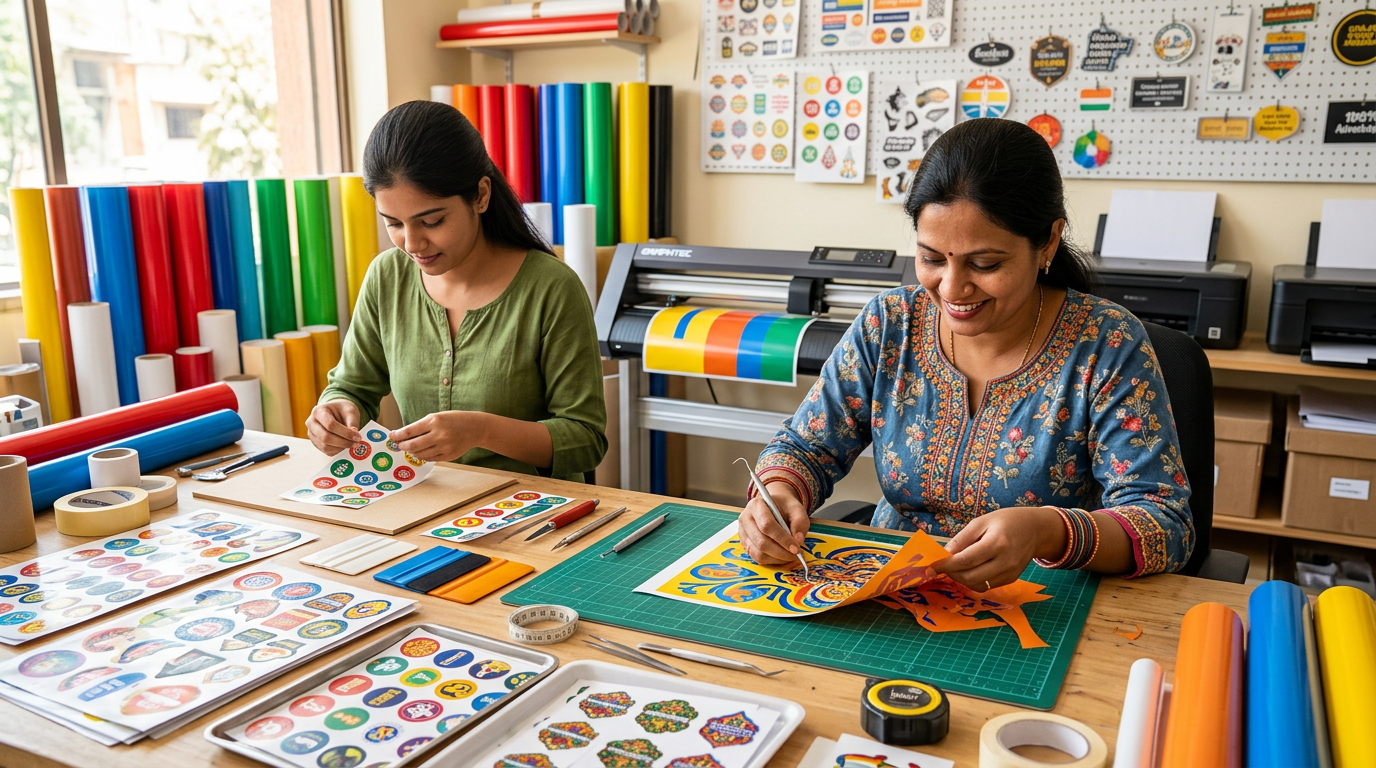
Direct answer: three printing setups genuinely work from a home room in India – sublimation gifting (Rs 26,000-1,00,000), sticker printing (Rs 24,000-60,000), and a small DTF or laser setup if you have ventilation (est.). Each fits a 100-150 sqft room with standard single-phase power. What does not work at home: flex printing (space, fumes, noise), large UV flatbeds (power and footprint), and CNC routing (dust, noise, ventilation).
What Fits, What Does Not (est.)
| Setup | Room space | Power | Home-friendly? |
|---|---|---|---|
| Sublimation gifting | 80-150 sqft | single phase | yes – low odour, quiet |
| Sticker printing | 80-150 sqft | single phase | yes |
| Small DTF line | 150-250 sqft | single phase | possible with ventilation |
| Laser engraving | 150-250 sqft | single phase plus extraction | possible with external venting |
| UV flatbed | 250 sqft plus | often three phase | difficult |
| Flex printer | 300-500 sqft | three phase typically | no |
| CNC router | 300 sqft plus | three phase often | no – dust and noise |
Home Setup Requirements (est.)
| Requirement | Target | Cost if missing |
|---|---|---|
| Dedicated power point and stabiliser | separate circuit | Rs 5,000-20,000 |
| Sturdy table at correct height | machine weight plus working space | Rs 5,000-15,000 |
| Ventilation or window extraction | for fumes and heat | Rs 3,000-25,000 |
| Dust control | closed storage, cover sheets | Rs 2,000-8,000 |
| Storage for blanks and media | flat, dry, off the floor | Rs 4,000-15,000 |
| Lighting | bright, colour-neutral | Rs 2,000-6,000 |
Working From Home: the Real Advantages (est.)
- Zero rent – the single biggest fixed-cost saving, worth Rs 6,000-18,000 monthly.
- Lower break-even – Rs 15,000-25,000 monthly covers a home operation.
- Flexible hours – orders can be scheduled around family and other work.
- Faster recovery – investment often repaid in two to five months.
And the Real Constraints (est.)
| Constraint | Workaround |
|---|---|
| No walk-in customers | active outreach, WhatsApp, Instagram, referrals |
| Space limits stock depth | buy monthly, use vertical storage |
| Family disturbance | fixed working hours and a door that closes |
| Power reliability | UPS for the printer, not for production |
| Credibility with corporate clients | professional invoicing, GST, a meeting point or client visit |
When to Move Out (est.)
| Signal | Meaning |
|---|---|
| Billing consistently above Rs 40,000-60,000 monthly | rent is affordable and walk-ins become viable |
| Refusing orders for space | capacity ceiling reached |
| Need for staff | home is no longer a workable workplace |
| Corporate clients requiring visits | a shopfront becomes a sales asset |
A Practical First 60 Days (est.)
| Week | Action |
|---|---|
| 1-2 | choose the product, order samples, set up one working corner |
| 3-4 | produce 40-60 sample pieces and photograph them properly |
| 5-6 | visit 30 local businesses, send 100 WhatsApp messages |
| 7-8 | deliver first paid orders, record every specification |
The home-based printing guide guide and the sublimation price guide machine guide cover the two most common home starts in detail.
Our Verdict
Home setups win on cost structure, not on convenience: zero rent means a break-even of Rs 15,000-25,000 monthly instead of Rs 60,000. Build the sales engine before the machine, keep stock monthly, and move to premises only when billing and walk-in demand justify rent.
FAQs – Home-Based Printing Business Guide
What printing business can I run from home? (est.)
Sublimation gifting, sticker printing, a small DTF line with ventilation, and laser engraving with external extraction (est.). Flex printing, large UV flatbeds and CNC routers need space, power and ventilation that homes rarely provide.
How much space do I need? (est.)
80-150 sqft for sublimation or sticker work, 150-250 sqft for a small DTF or laser setup, and 250 sqft plus for UV flatbeds (est.). The footprint of the machine is usually smaller than the storage needed for blanks and media.
Is a home printing business legal and GST-compliant?
Yes – register as a proprietorship or Udyam, obtain GST if you supply corporates or cross the threshold, and use a business bank account (est.). Home address is acceptable for registration; corporate clients care about documentation, not premises.
What are the main disadvantages of working from home?
No walk-in traffic, limited stock depth, family disturbance and lower perceived credibility with large clients (est.). All four are manageable with active outreach, monthly purchasing, fixed hours and professional invoicing.
When should I move to a shop? (est.)
When billing consistently exceeds Rs 40,000-60,000 monthly, when you are refusing orders for space, or when you need staff and client visits (est.). Moving too early is the more common mistake – rent is a fixed cost a young business cannot absorb.
How much can a home printing business earn? (est.)
Rs 10,000-35,000 net monthly at steady operation, and more if you add a second product line or take on corporate gifting seasons (est.). Because rent is zero, net margins at home are typically higher than a small shop doing the same billing.
Business idea series: Business Under Rs 50,000, Business Under Rs 1 Lakh, Business Under Rs 5 Lakh, For Women Entrepreneurs, For Women Entrepreneurs, Part-Time Side Income, Franchise vs Own Machine, Village and Rural Business.
Start here: digital printing startup guide, businesses under Rs 2 lakh, digital machine price guide, growth report.
Tell us your city and budget on the contact page – we reply with a configuration that fits, not the biggest one available.
