

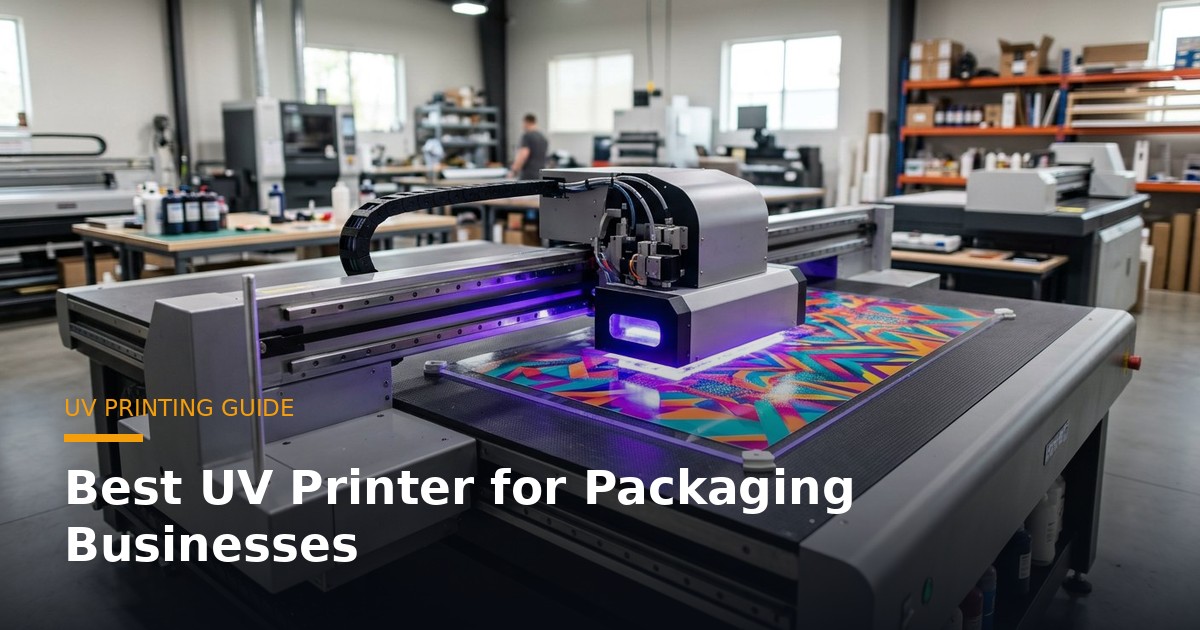
Packaging is packaging’s premium digital niche: short-run boxes, rigid set-up boxes, display units, labels and prototypes that offset and flexo cannot serve economically. But packaging is also exacting — die-cut registration, food-contact rules and shelf-ready finish all matter. This guide explains what a packaging business needs and which UV printer is best for it, so you invest in a machine that wins brand work rather than merely printing board.
What packaging printing demands
Packaging spans rigid board (greyboard, set-up boxes, folding cartons in short runs), corrugated display and POS units, and flexible label/film work. It demands precise registration to die-cut lines, white and varnish effects for shelf appeal, food-contact awareness, and the ability to run fifty or five hundred units profitably. The best packaging machine is therefore chosen by which part of packaging you serve: rigid/prototype (flatbed) versus labels/film (roll-to-roll), or both (hybrid).
Rigid packaging and prototypes: the flatbed’s domain
For short-run premium boxes, rigid set-up boxes, display units and prototypes, a UV flatbed printer is the tool. It prints direct on board, applies white and varnish effects in-line, and handles assembled faces for very short runs. Because brands need physical prototypes before committing to long runs, the flatbed’s prototyping capability is a strategic entry: it puts you at the start of the packaging decision chain and often grows into ongoing short-run production.
Labels and flexible packaging: the roll-to-roll’s domain
Labels and flexible packaging are roll work: a UV roll-to-roll printer with white ink prints clear, metallic and coloured label stocks and films without plates, enabling short-run and seasonal variants. White ink on clear and metallic labels is a premium capability brands pay for. If your packaging focus is labels and flexible, the roll-to-roll is the core machine; rigid work then becomes the flatbed add-on.
The hybrid option for a mixed packaging shop
Where a business serves both rigid displays and labels but can fund one machine, a UV hybrid printer covers both on a single frame. It trades some specialised performance for versatility and footprint, and suits a general packaging supplier. If one side clearly dominates, buy the dedicated machine for it and add the other when proven.
White, varnish and premium effects
Packaging sells on shelf appeal, so white ink on clear/metallic substrates and varnish in gloss, matte, textured and soft-touch finishes are the money features. These used to need separate processes; UV applies them in-line in short runs. A premium limited-edition box with textured varnish, produced in a run of two hundred, is exactly the job UV makes profitable and offset cannot. Choose a machine whose white and varnish are reliable, because they are the packaging margin.
Die-cut registration and the print-to-cut workflow
Packaging quality is won or lost at registration between print and die-cut. Use registration marks, verify alignment on a proof before the run, and keep the cutter calibrated to the printer. For displays, design for the board’s grain and fold characteristics so the finished unit stands correctly. A disciplined print-to-die-cut workflow, with a checked proof at every stage, is what lets you ship boxes and displays that fit, fold and present as intended.
Food-contact and regulatory awareness
Standard UV inks are generally not certified for direct food contact. For food packaging, use certified food-safe inks and coatings, or print on the outside of a liner or secondary package, and be explicit with clients about what is and is not food-safe. Getting this right protects the brand and your reputation, and it marks you as a professional packaging partner rather than a print shop experimenting.
Best machine classes by packaging business type
- Label and flexible specialist: roll-to-roll with white and varnish; clear/metallic labels.
- Rigid and prototype studio: flatbed sized to boards and displays, with white+varnish and a cutter.
- Mixed packaging supplier: hybrid, or flatbed plus roll-to-roll as volume grows.
Building brand relationships
Packaging is relationship-driven: brands choose a partner they trust for consistency, confidentiality and reliability, then stay for years. Win trust through accurate prototypes, honest food-contact guidance, consistent colour across runs and discretion with unreleased designs. Hold brand standards — colours, varnish specs, templates — so every run matches, and you become the sticky packaging partner rather than a one-off vendor.
Common mistakes choosing a packaging printer
- Claiming food-contact safety without certified inks and coatings.
- Skipping die-cut registration checks, then shipping misaligned boxes.
- Using rigid ink on flexible film, then getting cracks.
- Quoting short runs against offset marginal cost instead of its fixed cost.
- Ignoring substrate testing on coated or metallic boards.
Frequently asked questions
Can UV replace offset for packaging?
Not for million-unit runs. UV wins short-run, personalised, premium and prototype work where offset’s plates and minimums make no sense.
Is a flatbed or roll-to-roll better for packaging?
Rigid boxes and displays need a flatbed; labels and flexible need a roll-to-roll. Choose by which packaging you serve, or a hybrid for both.
Do I need a cutter?
Yes for displays and box blanks — a flatbed cutter or plotter completes the print-to-die-cut chain and captures the fabrication margin.
A deeper look: prototyping as the gateway
The highest-leverage packaging service is the physical prototype: brands need accurate, full-colour mockups to test design and shelf presence before production tooling. UV produces these in hours, letting designers iterate cheaply and present real objects to buyers. Charge prototyping as a design service, photograph the results, and use each prototype as the gateway to the eventual short-run or limited-edition production. By inserting yourself at the start of the packaging cycle, you convert one-off mockups into recurring brand work.
A deeper look: pricing packaging on value
Price packaging against the high fixed costs of traditional processes, not its marginal cost: a brand needing two hundred boxes finds UV dramatically cheaper than offset even at a healthy per-unit price. Charge for prototyping as a service, price limited editions per unit with setup amortised, and price displays on size and fabrication. Because you remove the customer’s plate costs and minimums, the premium is justified; value pricing, not area pricing, is how packaging becomes a high-margin line.
Spotlight: short-run premium boxes
Short-run premium boxes — limited editions, festival packs, corporate gift boxes, D2C launches — are where UV packaging earns most. Brands need a few hundred units with premium finish and no plate cost, exactly UV’s sweet spot. Print on greyboard or rigid stock with white and textured varnish, then fold and finish. Because the run is small and the finish premium, pricing is per-unit value, and the margin is strong. Master a couple of standard box structures and you can quote fast and produce confidently.
Spotlight: display and point-of-sale units
Point-of-sale and retail display units are large-format, one-off, full-colour jobs on corrugated and foam board — a strong UV application. Brands need them for launches and seasonal pushes in quantities too small for traditional display printing. Offer design, print and die-cut as a package and you become the retail-activation supplier. Because displays are tied to campaigns, they recur with each promotion and command good margins; a flatbed plus cutter handles them end to end.
Spotlight: labels and the short-run label economy
Labels are packaging’s highest-frequency item and a natural roll-to-roll application: short-run product labels, seasonal variants, batch labels and limited editions on clear and metallic stocks. UV prints full colour with white in-line and no plates, so a craft brand can run a few hundred labels as easily as a few thousand. Labels are often the entry point that grows into full packaging work, and they recur constantly as products and seasons change.
Spotlight: prototypes, mockups and photography
Brands need realistic packaging mockups for e-commerce imagery, buyer presentations and design tests long before production. UV-printed prototypes photographed professionally serve this need and add margin. A physical, accurately printed box shot in studio light sells a product online better than a 3D render. By providing the mockup and its imagery, you insert yourself early in the brand’s process and become the natural choice for the eventual short-run production.
Sustainability and material selection
Brands increasingly specify sustainable packaging, so material choice is part of the specification. UV works across recyclable and recycled boards and films, and short-run right-sizing reduces overproduction waste. Where a brand wants an eco-claim, print on appropriate stock and be accurate about the ink and coating system, avoiding vague green claims. Offering sustainable short-run options aligns you with the market’s direction and differentiates you from long-run-only suppliers.
Scaling a packaging business
Grow packaging by depth before breadth: deepen a few brand relationships with prototypes, labels, displays and short-run boxes before chasing many one-off jobs. Keep accurate cost records, hold brand standards so reorders match, and reinvest in the capabilities — cutter, food-safe inks, varnish effects — that unlock higher-value work. Packaging compounds slowly but stickily; the supplier who becomes a trusted packaging partner enjoys recurring work that is hard to displace.
The packaging buyer’s checklist
- Decide rigid vs label vs both first, then flatbed, roll-to-roll or hybrid.
- Confirm white and varnish reliability – they are the packaging margin.
- Verify die-cut registration workflow and a calibrated cutter.
- Ask for food-safe ink options and documentation if serving food brands.
- Check media handling across board and film, and local service support.
- Compare contribution per job, not sticker price.
Packaging as a compounding relationship business
Packaging rewards patience: each prototype, label run and display deepens a brand relationship that recurs with every SKU and season. The supplier who is accurate, discreet and dependable becomes part of the brand’s product journey, and that position is far stickier than any single job. Start small with prototypes and labels, deliver impeccably, and let the relationships – not a big machine – carry the growth.
The right packaging machine is the one that matches the packaging you serve, priced on the value it removes – plates, minimums and lead time – and run with the registration and honesty that brands reward with loyalty. Buy on that evidence and packaging becomes one of the stickiest, highest-value lines a UV shop can build.
Working with brands: the spec sheet habit
For every packaging client, keep a one-page spec: media, ink and coating system, colour standards, varnish finish, die-line and food-contact notes. Update it as the brand evolves and attach it to every reorder so the hundredth run matches the first. This habit turns goodwill into a documented standard, reduces errors and makes you indispensable, because the spec lives with you, not in the brand’s head.
Bring the spec sheet, the prototype and the honesty to every brand conversation, and the packaging business you build will be measured in years of reorders, not one-off jobs.
Do that and the packaging line stops being an experiment and becomes a franchise – the kind of recurring, trusted work every print business wishes it had.
Begin with one brand, one prototype and one honest spec; deliver it flawlessly and the rest of the packaging programme tends to follow, reorder by reorder.
That steady compounding – prototype to label to display to short-run box – is the packaging business model in one sentence, and it is why the patient supplier wins.
Patience plus precision is the whole packaging game.
Choose the machine that serves the packaging you already win, run it with registration and honesty, and let the reorders build the franchise.
Model before you buy, spec before you print, and the packaging line earns.
Do it with care and the brands stay for years.
Start with the brands you have, and grow the rest on proof.
And proof, repeated, becomes the franchise.
Buy on evidence and the brands stay.
Run it well and the reorders follow.
Conclusion
The best UV printer for a packaging business matches the packaging you serve: a flatbed for rigid boxes, displays and prototypes; a roll-to-roll for labels and flexible; a hybrid where one machine must cover both. Prioritise white and varnish, die-cut registration and food-contact honesty, and enter through prototyping to build sticky brand relationships. Explore our digital UV printer range or contact us to configure a packaging-ready setup.
