

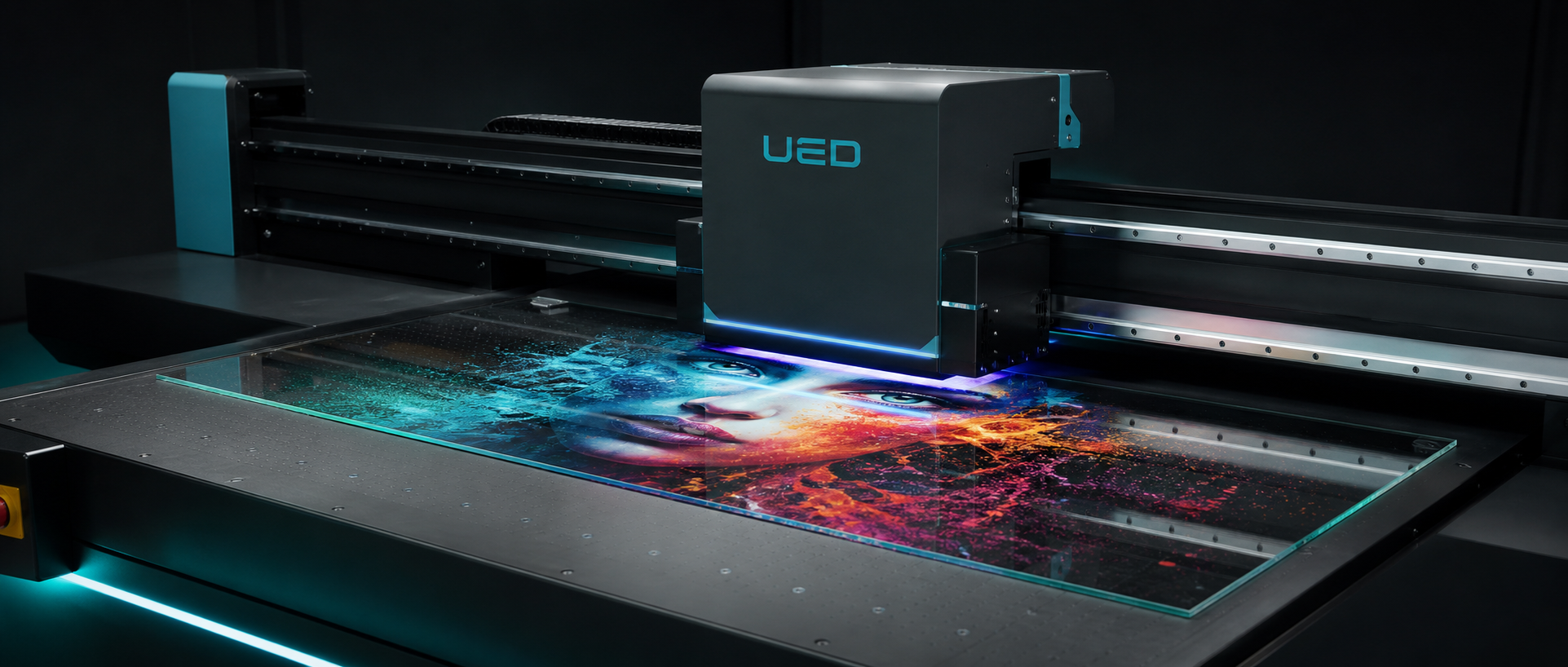
Few substrates transform a print shop’s margins like glass. It is everywhere — homes, offices, retail fronts, hospitality — and in its plain form it is invisible value. Print it directly with a UV flatbed and it becomes splashbacks, privacy screens, partition graphics, glass doors, balustrade panels and backlit feature walls, each commanding prices that vinyl-on-glass never did. But glass is also the substrate where adhesion mistakes are most visible and most expensive. This guide covers the science, the preparation, the machine and the market.
Why glass is both easy and treacherous for UV ink
Glass is perfectly smooth, hard and non-porous. UV ink cures on top of it rather than soaking in, which is fine — but a smooth, high-energy-yet-inert surface gives the cured ink film very little mechanical key. Ink can pass a dry tape test and still fail under humidity, thermal cycling or abrasion at the edges. The classic failure is a beautiful print that delaminates months later in a kitchen splashback where steam and cleaning chemicals work at the interface. The professional answer is preparation: clean thoroughly, and use a glass primer or adhesion promoter as standard for any job that must last. Treated correctly, UV print on glass is durable for years.
The preparation routine that makes glass permanent
- Clean with isopropyl alcohol or a dedicated glass prep solvent to remove grease, fingerprints and silicone residue.
- Ensure the surface is fully dry; water spots under the print become adhesion voids.
- Apply a compatible glass adhesion promoter (often a wipe-on primer) and let it flash as the supplier directs.
- Handle edges with gloves after priming so skin oils do not re-contaminate the face.
- Print within the promoter’s open window and cure fully.
This routine is the difference between a print that survives a steamy kitchen for a decade and one that peels in a season. Make it non-negotiable for splashbacks and any interior architectural work.
White ink, opacity and the backlit opportunity
Clear glass needs a white under-base for solid colour, exactly like acrylic. The more valuable technique is layered printing for privacy and backlit work: a sandwich of white and colour lets a partition read as a designed screen from both sides, while a backlit panel (white-colour-white) glows in a lightbox. Frosted or acid-etched glass adds a premium translucent base that a printed design can sit on beautifully. UV’s ability to lay white, colour and varnish in one pass makes glass decoration a genuinely high-value service rather than a commodity.
Applications and where the money is
Kitchen splashbacks are the flagship: a full-height printed glass panel behind a hob, often with a stone, abstract or photographic design, is a high-ticket item with strong perceived value. Beyond that: office partitions and manifestation graphics, retail frontage and window branding, glass balustrades and pool fencing décor, lift-lobe and door panels, shower screens, and backlit signage. Because glass is heavy and fragile, local production with installation is a natural moat — customers pay for the measured, printed, toughened-and-fitted solution, not just a sheet.
Toughened glass: print after, never assume before
Safety glass for splashbacks and balustrades must be toughened (tempered) before printing, because toughening after printing would destroy the ink. Order toughened, polished-edge panels to measure, then print. Critically, never print on the face that will contact adhesives or stand in constant water without specifying the right side; most splashbacks are printed on the back face and viewed through the glass, which also protects the ink behind the panel — a configuration you should actively recommend because it hugely improves durability.
Machine and ink considerations
Glass panels are rigid and often large, so a UV flatbed printer with a big, flat, vacuum bed and good Z-height is essential. A white ink channel is required for the work that pays. Because glass jobs are high-value and reprints are costly, choose a machine with dependable white circulation and a reliable media-height sensor to avoid head strikes on heavy panels. Flexible inks are less critical on glass (it does not bend), but a slightly flexible, high-adhesion ink set combined with primer gives the best crack resistance at drilled holes and edges.
Cost, pricing and ROI
Ink and primer costs on glass are modest relative to the selling price; the margin lives in design, measurement, toughening coordination and installation. Price splashbacks and architectural glass as installed solutions with a clear per-square-foot rate plus edging, toughening and fitting. Because the substrate reads as luxury, customers accept premium pricing, and a single kitchen or office fit-out can equal a week of small signage jobs. The shops that win this work combine a reliable print process with confident measuring and glazier partnerships.
Common mistakes that cost real money
- Skipping primer because a dry tape test passed — humidity failure shows later.
- Printing on the wrong face for a splashback, exposing ink to steam and scrubbing.
- Printing before toughening and scralling expensive safety glass.
- Leaving fingerprints or silicone on the surface, creating visible adhesion voids.
- Under-curing white ink, so colour laid on top never reaches full opacity.
Frequently asked questions
How durable is UV print on glass in a kitchen?
Printed on the back face of toughened glass, with primer, it is highly durable — protected from direct abrasion and steam by the glass itself. This is the recommended configuration for splashbacks.
Can you print on frosted or textured glass?
Yes, though textured surfaces vary the head gap; frosted (acid-etched) glass prints well and gives a premium translucent base. Allow for slightly softer detail on heavily textured glass.
Do mirrors print?
Yes — printing on the back of mirror creates striking effects, and printing a design around a mirror’s edge is popular for wardrobe doors. Use the same primer routine.
A complete splashback workflow, measure to install
A professional splashback job follows a strict chain. Measure on site with a laser, noting socket cut-outs, hob position and edge returns; order toughened glass with polished edges and any cut-outs pre-drilled, because nothing can be modified after toughening. On arrival, clean and prime the back face, print the design mirrored if it must read correctly through the glass, and lay white-colour-white for opacity where the wall behind is dark or uneven. Cure fully, inspect, then coordinate installation with the glazier or fit in-house using the correct neutral-cure silicone so adhesives never attack the print. Document the recipe and glass specification on the job bag so a replacement panel years later matches exactly.
Privacy, manifestation and decorative film replacement
Offices and retail spaces constantly need privacy and manifestation graphics on glass. Traditionally this meant frosted vinyl or etch film, applied by hand with its bubbles, seams and weeding. UV printing replaces much of that: you can print a frosted-effect pattern, a branded manifestation band, or a full-colour decorative screen directly and permanently, and you can print both sides of a partition for a double-sided design. For existing installed glass, printing is not possible on site, so the workflow is to print panels in the shop and fit them, or to offer printed replacement panels. The permanence and design freedom are the selling points over film.
UV print on glass versus the alternatives
Vinyl on glass is cheap but shows edges, seams and lift over time, and full-colour photographic vinyl is labour-heavy. Ceramic frit or fired glass is extremely durable but requires huge minimums and kiln lead times, locking out short runs and one-offs. UV digital printing sits between: permanent with primer, any design, one-off friendly, and fast. It loses only to fired glass in extreme abrasion and chemical resistance, which is exactly why the back-face splashback configuration — print protected behind the glass — is the industry’s answer, giving near-fired durability with digital flexibility.
Cleaning and care guidance to give customers
Hand the customer a one-line care card: wipe with a soft cloth and mild, non-abrasive cleaner; avoid scouring pads and strong solvents on the printed face. For back-face splashbacks this barely matters because the glass shields the ink, which is another reason to recommend that configuration. For exposed printed glass (partitions, doors), the care card sets expectations and prevents the rare complaint from becoming a dispute. Small touches like this are what make architectural glass a repeat, referral-driven line.
Building the architectural-glass offer
The shops that profit from glass package it as a service: design support, measuring, toughening coordination, printing and fitting. Partner with a local glazier or toughening supplier if you do not toughen in-house, and keep a physical sample wall — splashback designs, frosted effects, backlit samples — because architects and homeowners specify from what they can see and touch. Once you are specified into a kitchen studio or an office fit-out contractor, the work recurs project after project. It is a slower sale than counter signage but a far stickier one, and the margins reflect it.
Troubleshooting beyond adhesion
Band-free large panels demand a flat bed and consistent head gap; heavy glass can deflect a weak bed, so verify bed rigidity on big sheets. White ink starvation on large white areas shows as grey patches; slow the pass or add a white pass for architectural work. Edge chipping during handling is a glass problem, not a print problem — use padded racks and two-person lifts, and price breakage risk into large jobs. Keeping a short written SOP for each of these turns glass from a nerve-wracking premium job into a routine one.
Choosing glass type and thickness per application
Not all glass suits every job, and specifying correctly is part of the service. Kitchen splashbacks are typically 6 mm toughened low-iron glass; low-iron removes the green cast that dulls whites and light colours, which matters enormously for photographic or pale designs. Partitions and doors often use 8–10 mm toughened, sometimes laminated for safety where impact is possible. Balustrades and pool fencing demand laminated or toughened-to-standard panels and should only be quoted with the right safety specification. Backlit panels favour thinner, optically clear acrylic or glass with an even edge-lit or rear-lit system. Keeping a simple internal chart of application, thickness, toughening and edge finish prevents costly mis-orders and builds client confidence.
The economics of architectural glass work
A useful way to think about glass is that the print is a small fraction of the job value while being the differentiator. The glass, toughening, edging, measuring and installation together dwarf the ink cost, so the shop that controls the whole chain captures the whole margin. Even if you outsource toughening and fitting, owning the design and print lets you quote the package and keep the customer relationship. Track each job’s components so your per-square-foot rate honestly reflects substrate and labour; under-pricing glass because the ink seems cheap is the classic error. Done well, architectural glass becomes a flagship offer that lifts your whole brand upmarket.
Seasonal and retail angles for glass décor
Beyond architectural work, printed glass feeds a lively retail and seasonal trade: personalised photo panels and frames, glass chopping-board-style gift items, decorative trivets, festive and wedding table pieces, and branded glass awards for corporate events. These small items use offcuts and standard profiles, so they convert waste glass and idle machine time into margin, and they introduce walk-in and online customers to your larger architectural capability. A counter display of glass samples — a splashback corner, a backlit tile, a printed award — does more selling than any brochure, because glass must be seen catching light to be believed. Rotate the display seasonally and let each piece carry a small price card and your contact details.
Glass remains one of the few substrates where a print shop can move from selling square feet to selling transformed spaces. A kitchen, an office front or a retail window is a visible, high-value canvas, and a well-executed printed-glass installation is advertising for your business every day it stands. Start with one or two flagship jobs photographed beautifully, add those images to your sample wall and website, and let the material’s own presence do the selling. The discipline of primer, back-face printing and careful handling becomes second nature quickly, and with it comes one of the most durable and profitable product lines in modern digital printing.
Conclusion
Glass rewards discipline: prime, print on the protected face of toughened panels, use white ink confidently, and sell the installed solution. Do that and glass becomes one of the most profitable architectural lines a UV shop can offer. Review our digital UV printer range for glass-ready machines, or talk to our team about primers, white ink and bed size for architectural work.
