



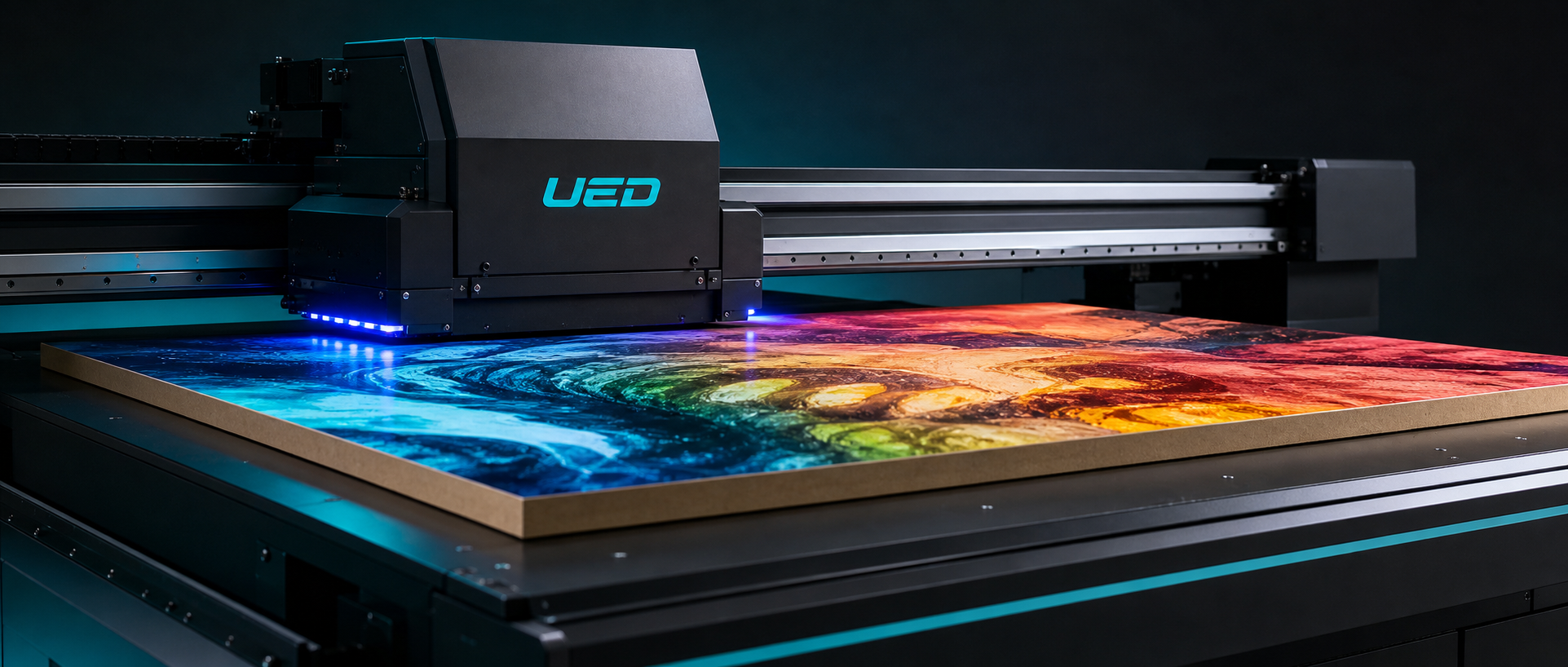
MDF (medium-density fibreboard) is the workhorse of furniture, retail fixtures and interior décor, and UV printing has turned it from a plain painted substrate into a full-colour, photo-realistic surface. Printed MDF now stands in for expensive veneers, marble, stone and parquet across wardrobes, kitchen shutters, wall panelling and shopfitting. This guide covers how UV ink adheres to MDF, the preparation that makes it durable, the right machine class, and the business opportunities it opens.
Why UV printing suits MDF
MDF is smooth, dimensionally stable and cheap, but in its raw form it is visually dull. Traditional decoration meant lamination, veneering or spray painting — all slow, all with minimum-order or VOC drawbacks. UV digital printing deposits and cures ink in seconds, needs no drying racks, and reproduces any artwork, wood grain or stone texture at photographic quality on a per-piece basis. Because curing is instant, a printed MDF panel can move straight to edging, cutting or installation.
The one property of MDF that dictates everything: it is porous
Unlike acrylic or glass, MDF is porous and absorbent. Raw MDF will soak up ink like paper, which dulls colour, raises consumption and can give a fuzzy edge. The professional approach is therefore to seal or prime the surface before printing. A light coat of MDF primer, a melamine-facing, or a purpose-made UV-compatible coating gives the ink a consistent surface to sit on, producing vivid colour and sharp detail at normal ink coverage.
Many furniture-grade boards arrive pre-finished — melamine-faced MDF (MFMDF) or pre-primed panels. These print beautifully, but melamine is a low-energy surface, so adhesion testing matters. A quick cross-hatch test after curing tells you whether your ink set bonds to the facing or whether you need an adhesion promoter. Most modern flexible UV inks bond to primed and melamine MDF well enough for interior furniture use.
Surface preparation workflow
- Use moisture-checked, interior-grade MDF; swollen or damp board will not hold a flat print.
- Sand the face lightly (P240) if raw, then remove all dust with a tack cloth or vacuum table.
- Seal raw MDF with a compatible primer and let it cure fully before printing.
- For melamine-faced board, wipe with isopropyl alcohol to remove release agents and handling grease.
- Keep panels acclimatised in the print room to avoid condensation on cold boards.
Choosing the machine for MDF panels
MDF panels for furniture and panelling are rigid and often large — wardrobe doors and wall panels run to 8×4 ft and beyond. That points to a large-format UV flatbed printer with a sturdy bed, good vacuum hold-down and enough Z-clearance for 18–25 mm board. Shops that print MDF alongside flexible signage media often choose a UV hybrid printer so one machine covers boards and rolls. The critical specs for MDF are bed size, bed flatness under load, and vacuum zoning so a heavy panel sits perfectly still.
Design and finish options that sell
The money in printed MDF is in imitation and personalisation: realistic wood grain and book-matched veneers, marble and stone for kitchens, herringbone parquet for walls, branded retail fixtures, children’s-room murals, and textured finishes using varnish to add a tactile grain over the printed image. Because UV varnish can be layered, you can print a wood grain and then build a subtle embossed texture on top — a finish that customers accept as genuinely premium. This “print + texture” combination is a strong differentiator versus plain lamination.
Durability and where printed MDF can and cannot go
Properly primed and printed, MDF panels are durable for interior furniture, wall panelling and retail fixtures: they resist handling, light cleaning and years of indoor UV-free use. They are not suited to permanent wet areas or exterior exposure — MDF itself swells with moisture regardless of the print. For kitchens and bathrooms, use moisture-resistant (MR) MDF and a protective varnish, and advise customers accordingly. Setting accurate expectations is part of selling the job well.
Cost structure and pricing
Ink cost per square metre on sealed MDF is comparable to other rigid substrates; the economics win on labour and minimums. A veneer-look wardrobe door that would cost real wood veneer plus a skilled finisher becomes a print job with minutes of handling. Shops typically price printed MDF by the panel or square foot with a premium for texture/varnish finishes and for book-matched or custom design work. The ability to produce a single replacement panel that exactly matches an earlier run is a quiet but powerful selling point for furniture makers.
Common mistakes to avoid
- Printing on raw, unsealed MDF and accepting dull, thirsty colour.
- Skipping the alcohol wipe on melamine-faced board, leaving release-agent contamination.
- Printing damp or swollen board that will later warp and crack the ink film.
- Over-looking head strikes on bowed panels — use vacuum zones and, if needed, edge weights.
- Quoting exterior or wet-area jobs without an MR-board and varnish specification.
Frequently asked questions
Can UV printing replace laminate on MDF?
For many interior applications, yes — printed MDF with a protective varnish matches laminate’s look with far more design freedom. For heavy-abuse horizontal surfaces, laminate still wins on wear resistance.
Do I print before or after cutting?
Usually print the full sheet then cut, which keeps registration simple and lets you nest parts. Edge sealing after cutting protects the core.
Is white ink needed on MDF?
Not on light or primed faces. White ink helps when printing on dark-tinted or black MDF, or when you want extra pop on coloured cores.
A full production workflow, board to fitted panel
Start with acclimatised, moisture-checked board. If the MDF is raw, sand the face, remove dust completely, and apply a compatible primer or sealer, allowing full cure. If it is melamine-faced, wipe with isopropyl alcohol. Load the panel on a vacuum bed, set head height from the board surface, and print with your chosen profile. Because curing is instant, the panel can go straight to the next step: cutting to size, edge-banding, drilling for hardware, or routing decorative profiles. Print-first-then-cut keeps registration simple and lets you nest multiple parts on one sheet. Finish edges with matching edge band or a painted edge so the core never shows.
Texture and varnish: the finish that sells the illusion
A flat printed wood grain photographs well but feels like print. The professional upgrade is layered varnish: printing a matte or textured varnish aligned to the grain so the surface has physical relief you can feel. On a printer with a varnish channel this can be built in a few passes. The combination of realistic grain and tactile texture is what convinces a customer the panel is a genuine veneer, and it is the difference between a commodity print and a premium surface. The same technique produces leather-look, stone-look and fabric-look panels for interiors and retail.
Printed MDF versus laminate and veneer
Laminate offers huge pattern ranges but fixed designs, minimum sheet orders and visible repetition across a project; real veneer is beautiful but expensive, slow and fragile to work. UV-printed MDF offers any design, one-off panels, exact book-matching, and replacement panels years later that match the original run. It loses only on extreme horizontal abrasion, where a high-pressure laminate still outwears print. Positioning printed MDF as bespoke surface decoration — wardrobes, wall panelling, feature doors, retail fixtures — rather than a worktop material is the honest and profitable framing.
Edging, finishing and fabrication after print
Because the ink film sits on the face, fabrication is straightforward: cut with a sharp blade to avoid chipping the print edge, then band or paint the edge. Drilling is fine; use a backing board to avoid breakout on the printed face. For panels that will be handled often, a sacrificial protective varnish adds scuff resistance. Discuss with your machine supplier the best handling practice for your bed size, and see our UV flatbed range for boards and panels.
Sectors buying printed MDF
Modular and custom furniture makers use it for doors and carcass faces; interior designers for wall panelling and murals; retail for branded fixtures; hospitality for feature walls and menus; and a growing consumer market for personalised wardrobes and kids’ rooms. Furniture makers especially value the ability to order exactly the panels a job needs, with no minimum, which is why printed MDF has become a supply line rather than a novelty.
Maintenance and quality control for furniture work
Furniture clients expect consistency across a whole job and across reorders. That demands controlled profiles, logged recipes per board type, and regular nozzle checks so a missing nozzle never ships in a wardrobe door. Keep a physical sample library of every board type and finish you sell, re-tested quarterly, so adhesion and colour stay proven. This discipline is what turns printed MDF into a dependable trade product rather than an experiment.
Artwork, colour and file preparation for surfaces
Surface printing is less forgiving than paper: a wood grain that tiles visibly, or a stone texture at too low a resolution, is obvious at arm’s length. Source or create textures at adequate resolution for 1:1 output, and check repeats at full size before committing a board. Colour management matters because customers compare the panel to a real material or a sample; keep a calibrated monitor, print proof strips on the actual board, and save the winning recipe per board type. For book-matched veneer looks, mirror the grain in the file so consecutive doors flow like real veneer — a detail that reads as craftsmanship and justifies a premium.
Worked examples of profitable MDF jobs
Consider a boutique café needing a feature wall: twelve panels of book-matched walnut grain with a matte textured finish. Real veneer would cost far more and take weeks; laminate cannot book-match; printed MDF delivers in days at a strong margin. Or a wardrobe manufacturer offering any décor from a catalogue with no minimum: printed doors let them compete with the big brands on choice while producing to order. Or a single homeowner replacing one damaged panel from a five-year-old fitted wardrobe, matched exactly from a saved recipe. Each example sells a different virtue — speed, choice, or matchability — and together they show why printed MDF supports both trade and retail revenue.
Scaling from samples to a production line
Most shops start by printing sample boards for furniture makers and designers; the sample pack is the marketing asset that opens accounts. Once orders repeat, the workflow tightens: standardised board types, saved recipes, a cutting and edging partner or in-house saw, and a delivery rhythm that suits the furniture trade. The natural scale-up is a larger-bed flatbed so full 8×4 sheets print un-tiled, and a second shift on the RIP and design side rather than another printer. Growth in printed MDF is usually limited by design and finishing capacity before it is limited by the printer, so invest in the whole chain. If you are planning that scale-up, our team can help you size beds and throughput to your order book.
Health, safety and the workshop environment
UV printing on MDF is a low-VOC process, but MDF dust from cutting and sanding is a separate hazard that must be extracted at source; keep board machining away from the printer so abrasive dust never settles on the bed or into the ink system. Use appropriate extraction and PPE for machining, and follow your ink supplier’s guidance for handling and skin contact. A clean, organised workshop also protects the product: printed panels should be stored upright, interleaved and dust-free so a perfect print is not scratched before delivery.
Choosing a machine for MDF-first production
If MDF panels will dominate your order book, buy the bed before the bells: a large, flat, well-zoned vacuum table that holds an 8×4 sheet dead still is worth more than any extra ink channel you will rarely use. Prioritise a white and varnish option for texture work, a reliable media-height sensor for varying board thickness, and service support that understands furniture-industry uptime, because a wardrobe job waits for no one. A UV flatbed printer sized to your largest panel, with room to grow a bay for cutting and edging, is the right foundation; add roll capability later only if your customer mix genuinely demands it.
Conclusion
UV printing turns commodity MDF into a design surface: veneers, stone, murals and textures on demand, with no minimum order and no drying time. The formula is simple — seal or prime, control dust, verify adhesion on facings, and use a flatbed with a bed big enough for furniture panels. Explore our UV flatbed printers sized for board work, or contact us to talk through your target applications and throughput.
