
Quick Answer: Starting a flex printing business in India requires an investment of ₹7 lakh to ₹12 lakh (including machine, setup, and working capital), a 250–400 sq ft workspace, and 1–2 operators. A well-run unit processing 1,000–1,500 sq ft of banners daily can earn a net profit of ₹50,000 to ₹1.8 lakh per month, with machine investment typically recovered within 6–18 months. Below is the complete step-by-step plan — from choosing your machine to landing your first 50 customers.
Every street in India runs on flex. Election banners, wedding hoardings, shop boards, coaching institute advertisements, real-estate launch signage, religious events, political campaigns, retail sales banners — all of it is printed on flex printing machines. The Indian signage and large-format printing industry is worth thousands of crores and keeps growing because physical advertising in India is still unbeatable in cost per eyeball.
That demand makes flex printing one of the most accessible machinery-based small businesses in the country. You don’t need an engineering degree, you don’t need a fancy showroom, and you don’t need a massive team. What you do need is the right machine, the right location, disciplined pricing, and a pipeline of local customers.
This guide is the exact business plan we would follow if we were starting from zero in 2026.
Is the Flex Printing Business Still Profitable in 2026?
The honest answer: yes, if you run it like a business and not like a machine-parking shed.
Three structural trends keep demand strong:
- Hyperlocal advertising is exploding: India’s Tier-2 and Tier-3 cities are seeing a retail and coaching-institute boom. Every new shop opening orders 3–5 banners plus a main board. Every real-estate project orders site branding. Every election — and India has some level of election almost every year — pumps crores of rupees of banner work into local markets.
- Event & wedding culture keeps growing: Stage backdrops, welcome banners, and photo walls are now standard at even small-town functions.
- Digital cannot replace location signage: A coaching institute in Lucknow or a jeweller in Patna needs a physical banner in front of the shop, not an Instagram ad.
The businesses that fail in this industry are almost always the ones that bought a machine without customers, or who tried to win purely by being the cheapest. The businesses that succeed pair the machine with finishing services (pasting, framing, installation, vinyl cutting) and lock in repeat institutional clients.
Step 1: Understand Your Local Market Before Spending a Rupee
Spend 2–3 weeks on market research. It costs nothing and decides everything.
Map the Demand
List every potential bulk customer within 5 km: coaching institutes, schools, hospitals, jewellers, mobile shops, automobile dealers, real-estate developers, event decorators, caterers, political party offices, religious committees, gyms, hospitals and diagnostic centres. Estimate how often each orders banners — coaching institutes and event companies order weekly; politicians order in bursts.
Map the Competition
Count existing flex printing shops, their machine type (look at print quality — grainy output means old solvent machines), their rates per sq ft, and their delivery time. A market where shops deliver in 2–3 days is begging for a “same-day delivery” competitor even at slightly higher rates.
Find Your Gap
The most profitable gaps we see in Indian markets: same-day emergency printing (events industry), premium eco-solvent quality (for jewellers and showrooms), installation service (nobody wants to paste a 40-ft hoarding themselves), and design + print packages (most shops make customers bring their own artwork — bundling a designer wins customers who don’t have one).
Step 2: Investment Breakdown — Three Business Setup Levels
Setup A: Starter Unit (₹5–7 lakh) — Eco-Solvent Based
Best for: photo studios, designers, and small-town entrepreneurs starting lean with indoor-quality work (shop boards, vinyl stickers, photo prints, small banners).
| Item | Cost (₹) |
|---|---|
| 1.6m Eco-Solvent Machine (single Epson i3200 head) | 1,80,000 – 2,20,000 |
| Laminator (64-inch, hot & cold) | 45,000 – 65,000 |
| Computer + RIP Software | 40,000 – 60,000 |
| UPS + Stabilizer | 20,000 – 30,000 |
| Vinyl Cutting Plotter (2 ft) | 15,000 – 25,000 |
| Startup Inventory (media rolls, ink, vinyl) | 35,000 – 55,000 |
| Room setup, deposit, furniture, boards | 80,000 – 1,50,000 |
| Working capital (2 months) | 60,000 – 1,00,000 |
| Total | ₹4,75,000 – ₹7,05,000 |
Setup B: Standard Flex Unit (₹7–12 lakh) — Solvent Based
Best for: the classic banner/hoarding business — highest demand, fastest payback.
| Item | Cost (₹) |
|---|---|
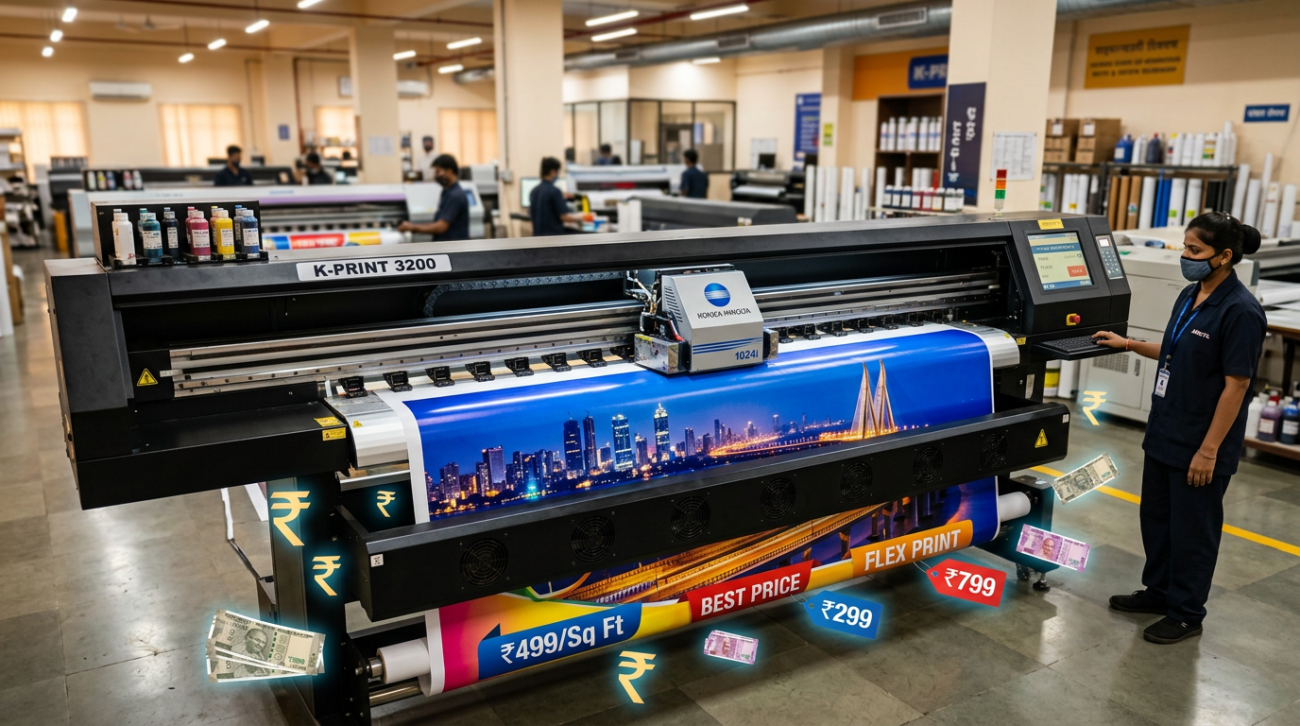
| 3.2m Solvent Machine (4× KM 512i heads) | 4,00,000 – 6,50,000 |
| Computer + RIP software | 35,000 – 60,000 |
| Online UPS (5 kVA) + Stabilizer | 35,000 – 60,000 |
| Exhaust, electrical work, AC | 50,000 – 85,000 |
| Eyelet punching, cutters, tools | 10,000 – 25,000 |
| Startup inventory (flex, ink, cleaning supplies) | 40,000 – 70,000 |
| Room deposit + setup | 80,000 – 1,50,000 |
| Working capital (2 months) | 80,000 – 1,50,000 |
| Total | ₹7,30,000 – ₹12,50,000 |
Setup C: Full-Service Print House (₹15–25 lakh)
Best for: established players or well-funded startups targeting agencies and premium clients — adds eco-solvent, lamination, plotter cutting, and possibly UV later.
| Item | Cost (₹) |
|---|---|
| 3.2m Solvent Machine (8× heads) | 6,50,000 – 9,00,000 |
| 1.8m Eco-Solvent Machine (dual i3200) | 2,75,000 – 4,25,000 |
| Hot/cold laminator + plotter cutter | 80,000 – 1,30,000 |
| Infrastructure, power, computers (2) | 1,50,000 – 2,50,000 |
| Inventory (all media types) | 1,00,000 – 1,75,000 |
| Setup + working capital | 2,50,000 – 4,00,000 |
| Total | ₹15,05,000 – ₹22,80,000 |
Step 3: Choosing Your Machine (The Decision That Makes or Breaks You)
Your machine decides your market. Here’s the quick decision matrix:
| Your Primary Customers | Machine to Buy | Budget |
|---|---|---|
| Banners, hoardings, events, political work | 3.2m Solvent, 4× KM 512i heads | ₹4 – 6.5 lakh |
| High-volume wholesale/city hub production | 3.2m Solvent, 8× heads | ₹6.5 – 9 lakh |
| Shop boards, indoor branding, photo quality | 1.6/1.8m Eco-Solvent, Epson i3200 | ₹1.8 – 4.25 lakh |
| Premium: wraps, wallpaper, backlit displays | 3.2m UV Roll-to-Roll, Ricoh heads | ₹14 – 28 lakh |
Three machine-buying rules that will save you lakhs:
- Buy heads you can service locally. Konica Minolta 512i and Epson i3200 heads are stocked by most Indian dealers; exotic heads mean weeks of downtime waiting for imports.
- Buy from a dealer with a service engineer within 150 km. The machine is married to the dealer. A ₹30,000 cheaper machine from a non-local dealer is the most expensive mistake in this business.
- Demand training. Two days of proper operator training on head cleaning, media handling, and RIP settings is worth more than any discount.
Step 4: Location, Space & Infrastructure Requirements
| Requirement | Specification |
|---|---|
| Floor Space | 250–400 sq ft minimum (a 3.2m machine alone needs ~14×10 ft plus working area) |
| Location Type | Ground floor preferred; near market/traffic adds free visibility — your own wall becomes your showroom |
| Power | 5 kVA commercial connection; machine ~2 kW + heaters ~2.5 kW |
| Ventilation | Mandatory exhaust for solvent machines; eco-solvent needs only basic airflow |
| Temperature/Dust | AC strongly recommended — heat and dust are the #1 print head killers |
| Loading Access | Media rolls are 50–80 kg; easy ground-floor loading matters daily |
A visible shop on a busy road may cost ₹10,000 more rent per month than a back-lane godown, but it works as a 24×7 advertisement. In this business, walk-in customers finding you is half the marketing battle.
Step 5: Licenses & Registrations (Simple But Mandatory)
Flex printing is a low-compliance business. You need:
- Udyam (MSME) Registration: Free, online, 30 minutes. Unlocks MSME loan schemes, subsidies, and easier current account opening.
- GST Registration: Mandatory once turnover crosses ₹40 lakh (goods/services threshold varies by state) — but register from day one anyway because B2B customers (your best customers) want GST invoices for input credit.
- Trade License / Shops & Establishment: From your municipal corporation. Usually ₹500–₹2,000 annually.
- Current Account in Business Name: Essential for B2B payments and building loan eligibility.
- Pollution Board: Flex printing with solvent inks in small units typically falls under low-pollution (green/white category in most states) and does not need a consent certificate at small scale — but confirm your state’s current category list, especially if your unit is large or in a residential zone.
Step 6: Raw Materials — What You’ll Stock and What It Costs
| Material | Common Specs | WhatsApp/Dealer Price (2026) |
|---|---|---|
| Frontlit Flex (standard) | 280–340 GSM, 3.2m roll (~50m) | ₹3.5 – ₹6 / sq ft |
| Star Flex / Premium Frontlit | 340–510 GSM | ₹6 – ₹9 / sq ft |
| Backlit Flex | For glow-sign boards | ₹9 – ₹14 / sq ft |
| Blackout Flex | Double-sided printing/banners | ₹8 – ₹12 / sq ft |
| Self-Adhesive Vinyl | White/grey-back, 100 gsm liner | ₹6 – ₹11 / sq ft |
| One-Way Vision Film | Glass branding | ₹12 – ₹18 / sq ft |
| Canvas / Art Fabric | Photo & interior work | ₹10 – ₹20 / sq ft |
| Solvent Ink (Original-grade) | 5L bottle | ₹1.2 – ₹2 / sq ft usage |
| Eco-Solvent Ink | 1L bottle | ₹2.5 – ₹4.5 / sq ft usage |
| Cleaning solution, syringes, dampers, capping tops | Consumables kit | ₹3,000 – ₹6,000 / month |
Inventory rule: Never let ink drop below 5 litres per colour and never run fewer than 2 flex rolls in stock. A stopped machine during an urgent event order is how you permanently lose customers to the shop down the road.
Step 7: Pricing — The Rate Card That Keeps You Profitable
Indian flex printing is priced per square foot. Rates vary by city tier, quality, and urgency:
| Product/Service | Tier-1 City Rate | Tier-2/3 City Rate | Your Production Cost |
|---|---|---|---|
| Normal Frontlit Flex (solvent) | ₹14 – ₹20/sq ft | ₹10 – ₹14/sq ft | ₹6 – ₹9/sq ft |
| Star Flex / Premium | ₹20 – ₹30/sq ft | ₹14 – ₹20/sq ft | ₹9 – ₹13/sq ft |
| Backlit Flex | ₹30 – ₹50/sq ft | ₹22 – ₹35/sq ft | ₹13 – ₹18/sq ft |
| Eco-Solvent Vinyl Print | ₹30 – ₹60/sq ft | ₹25 – ₹45/sq ft | ₹10 – ₹16/sq ft |
| One-Way Vision (glass) | ₹60 – ₹90/sq ft | ₹45 – ₹70/sq ft | ₹18 – ₹25/sq ft |
| Canvas Photo Print | ₹80 – ₹150/sq ft | ₹60 – ₹100/sq ft | ₹20 – ₹35/sq ft |
| Pasting/Installation | ₹8 – ₹15/sq ft | ₹5 – ₹10/sq ft | ₹3 – ₹5/sq ft |
| Eyelet Punching + Rope | ₹2 – ₹4/sq ft | ₹1 – ₹3/sq ft | Negligible |
| Same-Day/Emergency Orders | +25–50% surcharge — customers in a hurry happily pay it | — | |
Pricing strategy that works:
- Never be the cheapest in town — cheapest attracts customers who leave for ₹1 less and demand the most.
- Publish a clear rate card; hidden pricing loses trust and invites painful negotiation on every order.
- Offer slab discounts: standard rate under 100 sq ft, −10% above 500 sq ft, −15% above 1,000 sq ft — volume customers feel rewarded without you losing margin.
- Charge separately for designing (₹300–₹1,500 per artwork). Free design is how printing shops quietly go broke.
Step 8: Team & Daily Operations
A starter unit runs on 2–3 people:
| Role | Work | Monthly Salary (Tier-2/3) |
|---|---|---|
| Machine Operator | Printing, media loading, daily head maintenance | ₹12,000 – ₹18,000 |
| Designer (can be you) | Artwork on CorelDRAW/Photoshop, client coordination | ₹15,000 – ₹22,000 |
| Helper/Finisher | Cutting, eyeleting, packing, delivery coordination | ₹9,000 – ₹13,000 |
The daily discipline checklist that protects your investment:
- Morning: nozzle check print → clean if any missing nozzles → check ink levels → wipe capping station
- During work: never leave media loaded under tension overnight; cover the machine when idle
- Evening: wet-cap the heads with cleaning solution, note day’s output in a register
- Weekly: deep clean capping station and wiper blade; check encoder strip
- Monthly: clean rails and lubricate; tighten belts; backup RIP settings
Ten minutes of daily care is the difference between print heads lasting 2.5 years and 6 months. Treat head maintenance like brushing your teeth — non-negotiable.
Step 9: Profit Calculation — Real Numbers
Working model for a standard ₹9 lakh Setup-B unit in a Tier-2 city:
| Item | Slow Month | Average Month | Good Month |
|---|---|---|---|
| Output (sq ft) | 15,000 | 30,000 | 50,000 |
| Average Rate (₹/sq ft) | 13 | 14 | 15 |
| Revenue (₹) | 1,95,000 | 4,20,000 | 7,50,000 |
| Material + Ink (₹) | 1,20,000 | 2,25,000 | 3,60,000 |
| Salaries (₹) | 40,000 | 40,000 | 45,000 |
| Rent + Power + Misc (₹) | 30,000 | 35,000 | 40,000 |
| Net Profit (₹) | 5,000 | 1,20,000 | 3,05,000 |
Three revenue multipliers most owners discover late:
- Election seasons (every 1–2 years somewhere): A single Vidhan Sabha or municipal election can generate ₹2–5 lakh of banner work in 3–4 weeks. Political work pays advance cash — cultivate party office contacts early.
- Finishing margins: Pasting, framing, and installation add ₹8–15/sq ft at almost no material cost. A “print + install” package doubles your margin on the same banner.
- Repeat institutional clients: 5 coaching institutes + 3 event companies ordering monthly can cover your entire fixed cost. Everything retail walk-ins bring on top is profit.
Step 10: Marketing — Your First 100 Customers
Offline Marketing (80% of early revenue)
- Your own shopfront is your best banner: Cover your walls, shutter, and if possible a sample hoarding above the shop with your best print work and phone number. Every passer-by is a potential customer.
- Anchor client rounds: Personally visit every coaching institute, gym, hospital, jeweller, and developer within 3 km in your first month with a one-page rate card and printed samples. Coaching institutes change banners every admission season — 4 times a year.
- Event company partnerships: Decorators and tent houses need urgent, reliable printing weekly. Offer them a trade rate (10–15% off retail) in exchange for guaranteed monthly volume.
- Dealer/shopkeeper referral network: Frame sellers, hardware shops, and signboard painters meet banner customers daily. A ₹50–₹100 per order referral commission builds a sales army for almost nothing.
Digital Marketing (compounds over time)
- Google Business Profile: Non-negotiable and free. “Flex printing near me” is searched daily in every city. Collect reviews from your first 20 customers — reviews win the map pack.
- WhatsApp Business: Catalogue with rate card + order-taking on WhatsApp. 90% of Indian print orders close on WhatsApp. Status updates with daily best work act as free ads.
- Instagram/Facebook page: Post before/after installations, time-lapse printing videos (they perform surprisingly well), and festival offer creatives.
- Local SEO website: A simple site targeting “flex printing in [your city]” and “banner printing [city]” ranks with ease in Tier-2/3 cities and brings steady enquiries for years.
The 90-Day Launch Roadmap
| Phase | Actions |
|---|---|
| Days 1–15 | Market survey, machine dealer visits, live demos, financing application, shop hunting |
| Days 16–30 | Registrations (Udyam, GST, trade license), shop lease, electrical + exhaust work, machine order |
| Days 31–45 | Machine installation, operator training, trial prints, rate card design, Google Business Profile setup |
| Days 46–60 | Anchor client visits (50+ shops/institutes), event company tie-ups, sample work on shopfront, soft launch |
| Days 61–75 | Full launch with opening offer, referral program activation, WhatsApp catalogue live |
| Days 76–90 | Review pricing vs actual costs, fix operational bottlenecks, start collecting reviews, plan first festival-season campaign |
7 Mistakes That Kill New Flex Printing Businesses
1. Buying the machine before finding the shop and customers. Machine-first owners spend month one paying rent on an idle machine instead of building orders.
2. Competing only on price. The ₹2/sq ft war has no winner. Win on speed, quality, finishing, and reliability instead.
3. Skipping head maintenance. One dead print head (₹30,000+) erases a month of profit. Maintenance is profit protection.
4. Ignoring B2B customers. Walk-in retail is seasonal and price-sensitive. Institutional clients are the annuity that pays your fixed costs.
5. No design capability. Customers increasingly expect “you handle everything.” A designer (even freelance) converts enquiries into orders at 2× the rate.
6. Under-stocking media and ink. Every “come back tomorrow” sends a customer permanently to a competitor.
7. Underestimating seasonality. Wedding season, festival season, admission season, and election season create peaks; monsoon creates dips. Keep 2 months of fixed costs as buffer and push hard during peaks.
The Indian Flex Printing Demand Calendar (Plan Your Year)
Flex printing demand in India is not flat — it moves with festivals, weddings, admissions, and elections. Smart owners stock up before peaks and maintain machines during troughs:
| Months | Demand Level | What’s Driving Orders |
|---|---|---|
| January – February | High | Republic Day campaigns, board-exam coaching admissions, spring weddings, budget-season retail offers |
| March – April | Very High | Financial year-end retail sales, new academic session banners, Navratri/Ramadan-Eid events, IPL fever in retail |
| May – June | Very High | Peak wedding season, coaching admission season part two, summer camp promotions, school re-opening prep |
| July – August | Medium (monsoon dip) | Independence Day events, monsoon sale retail, admission extensions, political groundwork in election years |
| September – October | Very High | Ganesh Chaturthi, Durga Puja pandals (bonanza for printers in East/Central India), Diwali retail blitz |
| November – December | High | Winter wedding season, year-end corporate events, Christmas/New Year retail, election bursts when scheduled |
Plan your machine’s preventive maintenance for July and use peak months to recover investment aggressively. A unit charging rush premiums during October–December can earn 30–40% of its annual profit in that single quarter.
Machine Room Layout & Power Setup (The Boring Stuff That Saves Lakhs)
Most machine failures in India trace back to environment, not manufacturing. Set up the room correctly once:
- Power line: Dedicated 5 kVA commercial connection with proper earthing (earth-to-neutral voltage below 5V). Poor earthing silently corrupts machine electronics and print signals.
- UPS + stabilizer: An online (double-conversion) UPS in the 3–5 kVA range protects against India’s voltage fluctuation and gives you 5–10 minutes to properly park heads during power cuts. Servo stabilizers add a second layer in low-voltage areas.
- Air conditioning: Print heads perform best at 20–28°C. In north Indian summers touching 45°C, an AC is not a luxury — it directly extends head life and stabilises ink viscosity.
- Dust control: Concrete floors must be sealed/painted or tiled; loose dust settles on encoder strips and nozzles. A shoe-off rule inside the print room genuinely adds months to head life.
- Exhaust ducting: For solvent machines, install a properly ducted exhaust pulling air away from the operator side. This is a health issue and a print-quality issue (air currents disturb heater drying).
- Lighting: Bright, even lighting over the print bed lets operators catch banding and nozzle issues mid-print instead of after 50 metres are wasted.
- Workflow layout: Media storage near the machine’s loading side, finishing table on the exit side, design PC within shouting distance of the operator. Every metre of unnecessary movement multiplied by 200 prints a day is real time lost.
Scaling Up: From One Machine to a Local Print House
The successful flex printing journey usually follows this ladder:
- Year 1: Single machine, owner-led sales, 25,000–35,000 sq ft/month. Focus: survive, build repeat clients, master maintenance.
- Year 1.5–2: Machine hits capacity on peak days. Add a second complementary machine — eco-solvent if you started solvent, or vice-versa — to capture the quality segment you currently refuse.
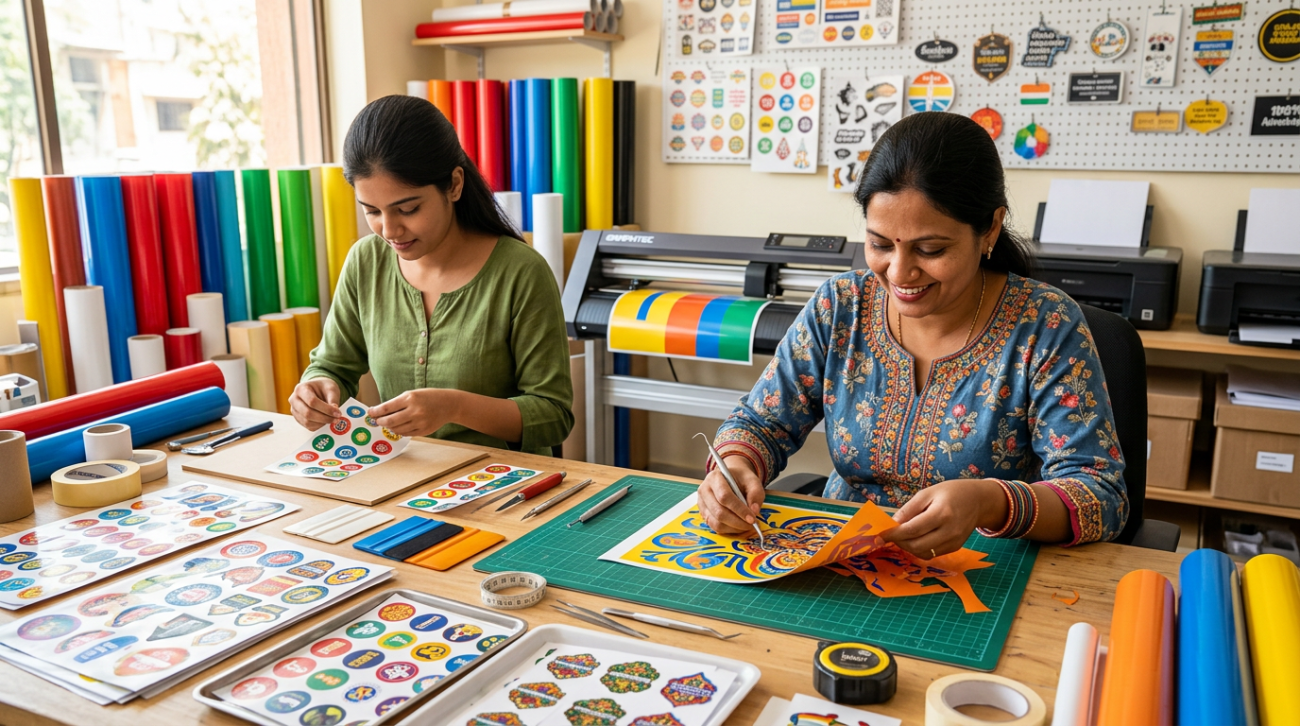
- Year 2–3: Add finishing arsenal: lamination, plotter cutting, eyelet automation, possibly a small CNC router for acrylic/ACP letters. You now sell “signage,” not “printing” — at 2× the ticket size.
- Year 3+: Consider UV printing, DTF garments, or fabric printing to serve premium niches. Multiple machines + institutional contracts turn the shop into a B2B production partner — the most stable and valuable form of this business.
The compounding insight: existing customers almost always need more than banners. The same jeweller ordering festival banners also needs acrylic letters, glass film, wallpaper, and event backdrops. Every capability you add multiplies the revenue of relationships you already own.
GST, Billing & Payment Discipline (Protect Your Margins)
Small printing shops bleed profit through sloppy billing more than through any machine problem. Set these rules from day one:
- Quote with GST clarity: Printing services attract 18% GST. Either quote “₹14/sq ft + GST” or built-in inclusive pricing — never mix the two formats across customers, or your margin quietly varies order to order.
- Advance for custom work: Take 50% advance on any order above ₹5,000 and 100% from brand-new customers on urgent jobs. The moment you print a customer’s banner, its resale value to anyone else is zero.
- Written job tickets: Every order gets a printed or WhatsApp job ticket: size, media, quantity, finishing, delivery date, rate, advance paid. Disputes in this business are almost always memory disputes.
- B2B credit discipline: Agencies and event companies will request 15–30 day credit. Limit credit to one outstanding order until a client proves reliability, and put the limit in writing. More print shops die from receivables than from competition.
- Use GST invoices as a growth tool: Clean GST billing makes corporate and government orders possible — and government tender work (municipalities, PSUs, election departments) is some of the most lucrative bulk printing in India. You cannot touch it on informal billing.
Frequently Asked Questions (FAQs)
Q1. How much does it cost to start a flex printing business in India?
A lean eco-solvent setup starts around ₹5–7 lakh; a standard 3.2m solvent-based banner printing unit needs ₹7–12 lakh including machine, infrastructure, inventory, and working capital. A full-service print house with multiple machines runs ₹15–25 lakh.
Q2. Is the flex printing business profitable in small cities?
Yes — often more than in metros, because competition is lower and word-of-mouth travels faster. A Tier-3 town with 3–4 coaching institutes, active real-estate development, and regular events can comfortably support a machine at 40–60% gross margins.
Q3. How much can I earn per month from flex printing?
Realistic net profit ranges from ₹30,000 in slow months to ₹1.5–3 lakh in strong months for a single-machine unit, depending on volume, rate realisation, and finishing services. Election and festive seasons can multiply normal revenue.
Q4. Do I need a designer, or should I learn design myself?
Learning basic CorelDRAW yourself is highly recommended in the first year — it saves salary, speeds up urgent edits, and lets you control quality. Hire a dedicated designer once monthly artwork volume exceeds what you can handle alongside operations.
Q5. Which licenses are needed for a flex printing shop?
Typically: Udyam (MSME) registration, GST registration, trade license from your municipality, and a business current account. Small printing units generally fall under low-pollution categories, but verify your state pollution board’s latest classification.
Q6. Can I get a loan for a flex printing machine?
Yes. Options include MUDRA loans (up to ₹10–20 lakh, collateral-free), PMEGP with 15–35% subsidy for new units, NBFC equipment finance, and dealer instalment schemes. Udyam registration strengthens every application.
Q7. What is the break-even point for this business?
Most standard units break even operationally within the first 2–3 months (revenue covering monthly costs) and recover the full machine investment in 6–18 months, depending on how aggressively anchor clients are built up front.
Q8. What else can I sell from the same machine?
Vinyl stickers, wall graphics, vehicle wraps (needs eco-solvent/UV), canvas photos, one-way vision glass branding, backlit glow-sign prints, and laminated posters — all use the same core setup and dramatically increase revenue per customer.
Q9. Should I buy a new or second-hand machine to start?
New is strongly recommended for first-time buyers. Used machines carry hidden wear on heads, pumps, and rails; a failed print head in month one (₹30,000–₹45,000) destroys the savings. If budget forces used, buy only with a live nozzle test and from a dealer offering at least 30-day support.
Q10. How do I get my first customers quickly?
Final Verdict: Should You Start a Flex Printing Business in 2026?
If you have ₹7–12 lakh to invest, a decent location in a growing town or city, and the willingness to personally build client relationships for the first 6–12 months, flex printing remains one of India’s most reliable machinery-based small businesses. The demand driver — physical local advertising — is not going away, and digital printing keeps replacing older technologies rather than shrinking.
The formula is simple: right machine + maintained heads + anchor B2B clients + finishing services + never the cheapest price. Get these five things right and the business pays you back month after month, year after year.
Ready to choose your machine? Explore our range of flex & solvent printing machines, eco-solvent printers, and original printing inks — with pan-India installation, operator training, and after-sales support. Talk to our machine experts and get a customised setup plan + ROI estimate for your city, free.