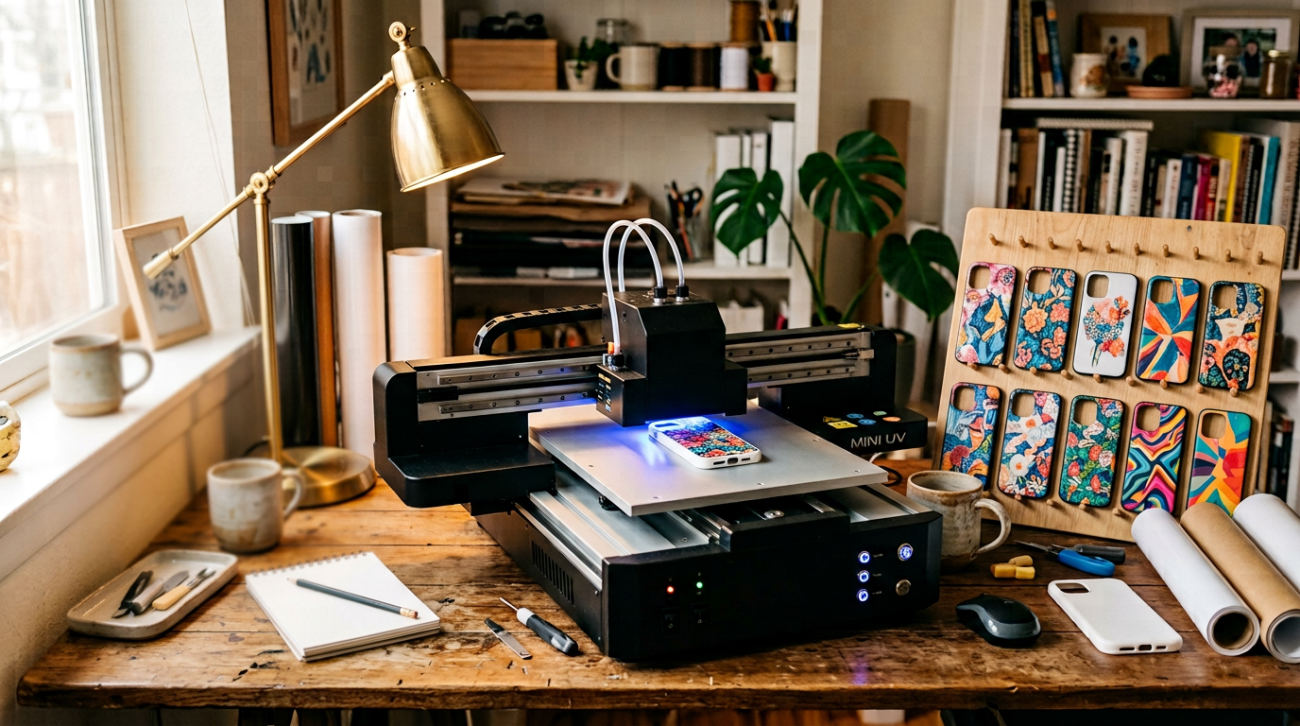


Somewhere between 2023 and today, a new word quietly took over Indian printing WhatsApp groups: “crystal stickers.” Bottles at gyms wearing perfect brand logos. Helmets with designs that look painted on. Plain steel kettles turned corporate gifts in ninety seconds. All of it traces to one technology: UV DTF — and the machines that make it have become the most requested printers in the ₹2–6 lakh bracket.
If you’re researching a UV DTF printer — what it actually is, how it differs from both UV flatbed and regular DTF, what the machines cost in India, and whether the business case holds — this guide covers the complete picture with real numbers: the technology, machine types and prices, consumable costs, product economics, and the buyer checklist.
What Is UV DTF Printing? (Crystal Stickers Explained)
UV DTF stands for UV Direct-to-Film. Instead of printing on an object, the machine prints your design — colour, white, and varnish in one pass — onto a special adhesive-backed Film A. A laminator then marries the print to Film B (a clear carrier). The result is a flexible, self-adhesive “transfer sticker” with a glossy, slightly raised, crystal-like finish — hence the market name.
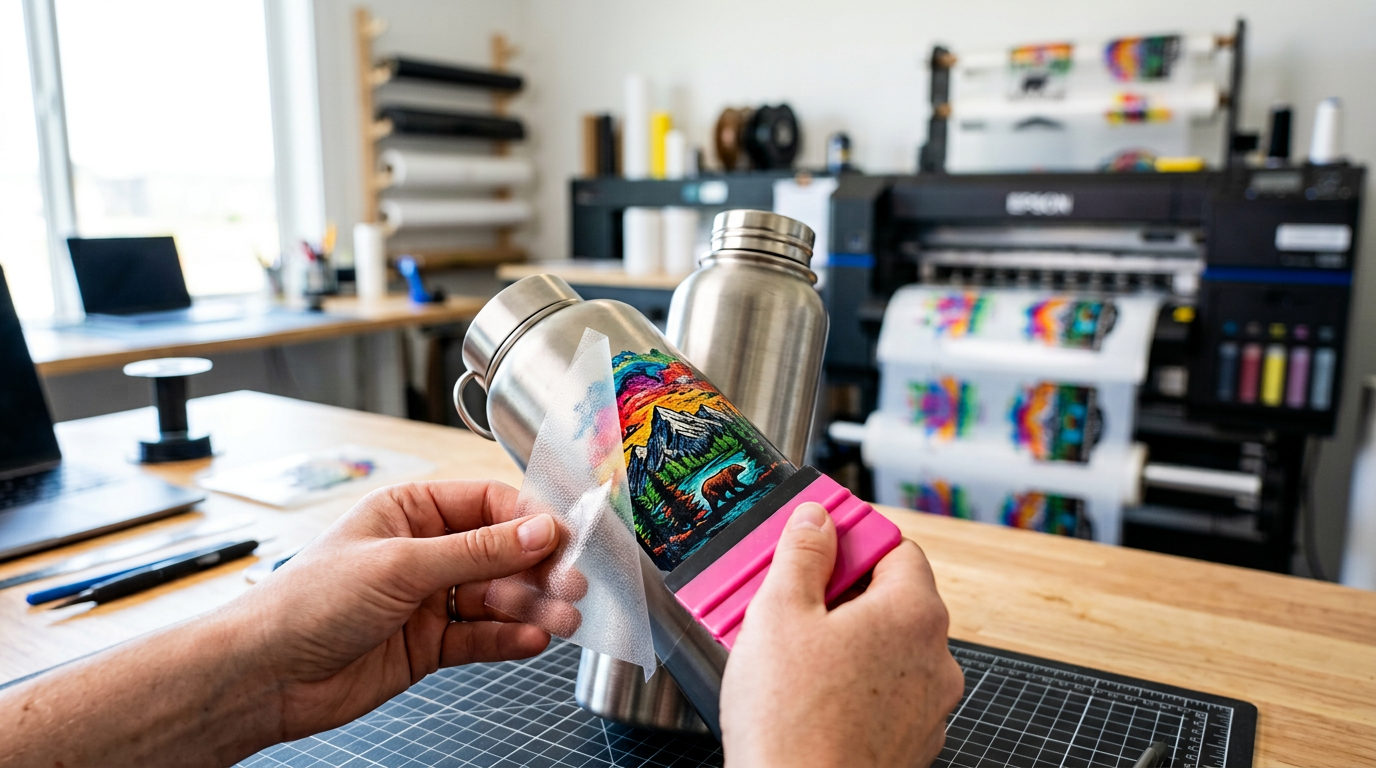
Application needs NO machine: cut the sticker, peel, position on the product, press firmly, peel the carrier. The design transfers to almost any hard surface — flat OR curved — in under two minutes: bottles, helmets, glass, gadgets, appliances, machinery panels. That’s the breakthrough: UV print quality on surfaces no flatbed can physically reach.
UV DTF vs UV Flatbed vs DTF vs Sublimation (The Comparison Everyone Needs)
| Factor | UV DTF | UV Flatbed (Direct) | Classic DTF (Fabric) | Sublimation |
|---|---|---|---|---|
| Prints on | Transfers applied to hard goods (any shape) | Rigid objects directly | Fabric (T-shirts, bags) | Poly-coated items / polyester fabric |
| Curved surfaces (bottles, helmets) | ✅ Its superpower | ❌ (rotary jigs only for cylinders) | ❌ | ⚠️ limited (mugs via sublimation coating) |
| Direct-on-product feel | ⚠️ Premium sticker finish | ✅ True direct print | n/a | ✅ infused |
| Special blanks required | ❌ any hard surface | ❌ any rigid object | ❌ any fabric | ✅ poly-coated ONLY |
| Machine entry price (India) | ₹1.5 – 6.5 lakh | ₹80k – 12 lakh | ₹1 – 4 lakh | ₹25k – 1.5 lakh |
| Cost per finished phone case / bottle | ₹8 – 20 transfer + blank | ₹2 – 5 ink + blank | ₹15 – 40 per garment print | ₹10 – 30 + coated blank |
| Retail price of finished item | ₹150 – 800 | ₹250 – 700 | ₹350 – 700 (tees) | ₹150 – 500 |
| Durability on hard goods | High (waterproof, scratch-resistant) | Highest | n/a | High on coated only |
| Skill barrier | Lowest (peel & press) | Medium (jigs, Z-height, prep) | Medium (powder, pressing) | Low-medium |
Key insight: UV DTF and UV flatbed are complements, not competitors. Flatbeds produce the premium direct-print feel on flat objects; DTF conquers curves. Serious personalization shops eventually run both — but UV DTF is the cheaper first entry and the broader “anything” answer.
How the Machine Works (End to End)
- Print: Design RIP’d with automatic white+varnish layers; printed mirror-side onto Film A as a continuous roll — dozens of designs per run, through Epson XP600/i3200-class heads with LED curing inline.
- Laminate: printed Film A passes through a laminator with Film B; pressure and mild heat bond the carrier (2–5 min per metre).
- Cut: scissors/plotter; gang-sheets mean one run yields 20–60 sellable stickers.
- Apply: clean the surface (isopropyl wipe), peel the backing, position, press firmly from centre out, peel the carrier film. Done. Waterproof, UV-stable, dishwasher-tolerant (hand-wash recommended) on smooth surfaces.
UV DTF Printer Price in India 2026
| Machine Class | Print Width | Heads | Price (₹) | Output Reality |
|---|---|---|---|---|
| Desktop A3 UV DTF | ~30 cm roll | 1–2× XP600/TX800-class | 1,50,000 – 2,80,000 | Startup tier: ~15–25 sq ft film/hour; 100–250 stickers/day |
| 30–40 cm prosumer (inlaminator) | 30 – 40 cm | 2–3× i3200-U | 3,00,000 – 4,50,000 | Best value: dedicated white/varnish channels; 300–600 stickers/day |
| 60 cm production | 60 cm | 3–4× i3200-U | 4,50,000 – 6,50,000 | Wholesale/supply tier: gang-sheet production for resellers |
Non-negotiables at any class: integrated laminator (single-pass print+laminate machines save a full handling step — worth every rupee), auto white-ink circulation, LED curing, and a RIP that automates white/varnish layer generation. Machines without inline lamination exist cheaper — the manual laminating wed hour eaten daily erases the saving.
Consumables & True Cost per Sticker
| Consumable | Price (2026) | Yield Notes |
|---|---|---|
| UV ink CMYK (litre) | ₹2,400 – 4,200 | Sparse per sticker; a litre covers months of small designs |
| White ink (litre) | ₹2,800 – 4,800 | Highest consumption channel — always keep backup |
| Varnish (litre) | ₹2,400 – 4,200 | The “crystal” gloss layer — thin but mandatory |
| Film A + Film B (rolls, 30–60cm × 100m) | ₹6 – 20 per A4-equivalent area combined | THE recurrent cost; quality film = transfer reliability |
All-in cost per sticker: a 4×6 cm logo runs ₹3–8; a 10×15 cm panel ₹10–20. Selling: ₹120–300 retail per applied transfer, ₹15–45 per sticker in wholesale gang-sheet rates. The film supplier relationship is a strategic asset — inconsistent film quality is the #1 silent business-killer in UV DTF.
What You Can Sell (The Product Map)
| Product Lane | Examples | Price/Piece | Buyer |
|---|---|---|---|
| Bottle & tumbler branding | Gym bottles, corporate sippers, cafe glassware | ₹250 – 800 finished | Corporates, gyms, cafes |
| Helmet & auto accessories | Rider helmets, bike tanks, toolboxes | ₹300 – 1,200 | Riders, workshops, clubs |
| Gadget branding | Laptops, speakers, power banks, airpods | ₹150 – 500 | Students, corporate gifting |
| Appliance/maker panels | Mixer grinders, machinery plates, electrical panels | ₹80 – 400 | Manufacturers (B2B gold) |
| Home & event decor | Glass jars, mirrors, candle holders, wedding favors | ₹150 – 900 | Decorators, homemakers |
| Sticker supply (wholesale) | Gang sheets to gift shops/instapreneurs | ₹15 – 45/sticker | Resellers — the volume game |
Who Should Buy a UV DTF Printer (and Who Shouldn’t)
Buy one if: your product vision is curved/hard goods (bottles, helmets, gadgets); you want the gentlest technical learning curve in UV; you’re adding a machine to an existing gifting/printing business; or you plan to supply stickers wholesale to a reseller network.
Don’t buy one if: your dream products are flat, premium-feel signage and awards (buy a flatbed — direct print beats sticker feel there); or your demand is fabrics (that’s classic DTF/DTG territory). And never buy without in-person demo of YOUR design transferring onto a metal bottle — transfer integrity is where weak machines/films expose themselves.
Gang-Sheet Economics: The Hidden Revenue Engine
UV DTF’s quiet superpower is the gang sheet — packing dozens of unrelated designs into one continuous print run. A metre of 30 cm film fits ₹1,500–3,000 worth of assorted transfer orders at a consumable cost of ₹150–350. The business meaning:
| Mode | Who Orders | Rate Structure | Why It’s Profitable |
|---|---|---|---|
| Custom applied work | End customers (bottle/branding jobs) | ₹250 – 800 finished per item | Full retail margin on blanks + transfer |
| Gang-sheet wholesale | Gift shops, insta-sellers, hobbyists | ₹15 – 45/sticker or ₹800 – 1,500 per running metre | You print once; they apply; zero blank risk/cost sits on your books |
| Design-own sticker lines | Your own catalogue (bike, devotional, pop-culture-safe originals) | ₹50 – 150/sticker retail | Own-IP stickers = brand + margin + marketplace inventory |
The smartest UV DTF shops run all three lanes: custom work for margin, gang wholesale for machine utilization, and own catalogue lines for brand-building. Idle hours become wholesale metres; wholesale metres never idle the machine again.
Film Quality Forensics: Your Supplier Vetting Protocol
Film quality is the silent business-killer in UV DTF — transfers that lift at edges, cloudy carriers, adhesive that gives up in a Delhi summer. Vet suppliers with the five-test protocol BEFORE bulk commitment:
- The round-the-bottle test: apply a sample transfer fully around a curved bottle; edges that hold after 48 hours = film passes.
- The stretch-and-return test: gentle stretch over curvature; film that wrinkles or silvers at tension fails.
- The water test: 24 hours water-submerged on glass; lifting edges = reject the batch.
- The clarity test: hold carrier film to light — cloudiness/grain in the carrier telegraphs into cheap-looking finished products.
- The batch-consistency test: order the same SKU twice, two weeks apart. Variance between batches is the disqualifier — one great sample roll means nothing.
Two trusted film suppliers minimum, always. When (not if) your primary has a stock-out in Diwali week, your business survives on the second relationship.
Application SOP by Surface (The Professional Difference)
| Surface | Prep | Application Notes | Care Instructions to Give Customer |
|---|---|---|---|
| Steel/metal bottles | Isopropyl wipe, 60s dry | Centre-out pressing, firm thumb pressure on edges | Hand-wash recommended; no abrasives |
| Glass/ceramic | Isopropyl; ensure room-temp surface | Slow carrier peel at low angle | Gentle wash; no dishwasher premium promise unless tested |
| Helmets (ABS/polycarb) | Isopropyl; check for silicone coatings | Apply at 20–30°C; heat-gun kiss on stubborn curves | No solvent cleaners |
| Plastics (PP gadgets) | Adhesion test first — some PP resists everything | Flame/corona pretreatment for stubborn cases | Standard gentle care |
| Powder-coated surfaces | Usually excellent adhesion | Standard SOP | Fully outdoor-capable |
Print this table. Laminate it near your application table. Half of “UV DTF doesn’t last” reviews trace to skipped prep — the surface was dusty, oily, or cold. Process beats excuses.
The 6 UV DTF Mistakes
- Buying a no-laminator machine to save ₹40,000: the manual-lamination hour daily erases the saving within two months of real volume.
- Single film supplier dependency: stockout risk carried into every festival season.
- Selling transfers untested on customer-chosen surfaces: the “it came off my bottle” refund spiral. Test kit first, promise second.
- Undercharging wholesale: ₹8/sticker pricing with ₹20 cost structure happens quietly — know your per-metre consumable math cold.
- Ignoring the white-ink rules because “it’s DTF”: same pigment, same settling physics, same clogged Saturday.
- Staying order-taker: shops that never build original catalogue designs stay forever interchangeable with the next machine owner — and interchangeability is where pricing power goes to die.
UV DTF + Flatbed: The Two-Machine Synergy
The endgame configuration: flatbed handles flat premium direct-print (plaques, signage, glass), UV DTF handles curves and wholesale transfers — while BOTH feed the same corporate/gifting accounts with complete-solution capability nobody else in town matches. Combined investment ₹8–13 lakh; combined product map covers ~95% of personalization demand. If you can own only one first: choose the one matching your strongest existing demand, and let its economics birth the second within 12–18 months. The businesses that started “either-or” and ended “both” out-earn the ones still debating in forums.
Machine Anatomy: The Specs That Matter on a UV DTF Quote
| Component | Good | Red Flag |
|---|---|---|
| Printhead config | 2–3× i3200-U with colour/white/varnish separation | Single XP600 asked to carry all channels at “production speed” |
| Laminator integration | Inline, single-pass print→laminate with tension control | “Laminator sold separately” + table-space workaround pitch |
| White circulation | Auto circulation + tank stirring | Static white system (settlement-city by design) |
| Film handling | Guided path, anti-static bar, edge sensors | Bare rollers; film wander blamed on rolls |
| RIP capability | Automatic white/varnish layer generation + gang-sheet nesting | Manual layer design demanded on every file |
| Takeup & idle systems | Auto take-up, scheduled nozzle wetting during pauses | Manual everything; drying heads between runs |
The First Week: Setup Map for a New UV DTF Machine
- Day 1–2: installation with engineer, ink charge, three substrate-transfer tests officially witnessed (bottle, helmet shell, glass). Sign acceptance only after all three pass — the acceptance signature is your warranty’s starting gun.
- Day 3–4: film-batch characterization: your received film rolls tested across humidity conditions of YOUR room; dial cure settings and file the profiles.
- Day 5: gang-sheet templates built (30-cm and 60-cm masters) + file intake SOP written.
- Day 6–7: 20 assorted sample transfers produced, applied to your product range, photographed — your shop just opened its sample bank.
What Does a GOOD Transfer Look Like? (The Quality Glossary)
| Quality Dimension | Pass Looks Like | Fail Looks Like |
|---|---|---|
| Clarity | Glass-clear carrier areas; colours vivid post-transfer | Cloudy film, milky gloss layer |
| Adhesion | Edges bonded invisible; 48-hr bottle test holds | Edge lift within days; silvering at stretches |
| Texture | Slight premium “dome” feel you can charge for | Thick plasticky patch screaming “sticker” |
| Peel release | Carrier releases in one smooth slow pull | Design tears/patches stay on carrier |
| Wash survival | Hand-wash cycles survived for months | First wash lifts corners |
Photograph every failed transfer with batch numbers — failure documentation converts free replacement rolls out of suppliers remarkably fast, and tunes your own SOPs month over month.
B2B Verticals for a UV DTF Operation
| Vertical | What They Order | Volume Signature |
|---|---|---|
| Gyms & fitness studios | Bottle branding, equipment labels, membership merch | 50–300 pcs/event; quarterly |
| Cafes & restaurants | Glassware logos, jar labels, window decals | 30–200 pcs; menu-change cycles |
| Manufacturers | Machine plates, panel labels, serial appliqués | Recurring industrial gold; sticky accounts |
| Corporate gifting distributors | Bottle/bundle branding for kits | 500–5,000 pcs per Diwali/quarter cycle |
| Riding clubs & auto workshops | Helmet art, tank/toolbox decals | Community-driven bursts |
| Gift/reseller shops | Blank gang-sheet supply | Weekly metres — pure utilization filling |
Financial Model: A 40 cm Production Setup at Month 6
| Line | ₹/Month | Notes |
|---|---|---|
| Revenue (custom + wholesale mix) | 1,50,000 – 2,60,000 | Custom 60%, wholesale metres 40% |
| Films + inks (consumables) | 35,000 – 60,000 | ~22–26% of revenue at honest discipline |
| Blanks for custom work | 18,000 – 32,000 | Bottles/helmets you stock yourself |
| Rent + power + internet | 12,000 – 20,000 | Small footprint is UV DTF’s structural gift |
| Labour (1 operator-packer) | 13,000 – 18,000 | Owner sells; operator produces |
| EMI (if financed) | 10,000 – 16,000 | On the ₹3.5–5 L machine class |
| Owner profit band | ₹55,000 – 1,10,000 | Matches flatbed economics at lower entry |
Scaling: From Machine to Micro-Factory
The growth path most UV DTF successes follow: machine #1 runs mixed custom+wholesale → wholesale metres begin dominating utilization → machine #2 (identical, shared supplies/spares) turns wholesale into the core with custom as margin → original-design sticker catalogues become your BRAND (licensed art, regional aesthetics, devotional-safe originals) feeding reseller networks → at 3 machines, you stop being a print shop and become a sticker manufacturer with a client list. The whole arc needs one discipline protected from day one: BATCH files, SOPs and film QC logs — the paperwork unglamorous shops skip is the paperwork that scales.
The Layer Logic: How White + Colour + Varnish Stack in UV DTF
Understanding the sandwich is the difference between transfers that survive and transfers that peel:
- Varnish layer first (on the film — becomes the OUTER surface after transfer; provides the “crystal” dome and surface protection)
- Colour layer second (the visible art, printed in mirror orientation)
- White layer last (becomes the opacity backing + the bonding bridge to adhesive)
Because everything mirrors after transfer, design file orientation discipline is absolute — your RIP template must mirror automatically. A week spent building correct per-product templates (with choke margins for the white layer, typically 0.2–0.4 px contracted) repays itself forever. The classic beginner artifacts — colour halos around sticker edges, white peeking from art borders — are template-choke mistakes, not machine problems.
Extended Surface Compatibility Encyclopedia
| Surface | Adhesion | Prep/SOP | Durability Note |
|---|---|---|---|
| Stainless steel bottles | ✅ Excellent | Isopropyl wipe, room-temp surface | Hand-wash; months-years |
| Powder-coated metal | ✅ Excellent | Standard SOP | Outdoor-capable |
| Glass | ✅ Very good | Isopropyl; slow peel | Avoid dishwasher heat cycles |
| Ceramic (glazed) | ✅ Good | Ensure glaze is cured/clean | Hand-wash recommendation |
| ABS/PU helmets | ✅ Very good | Check silicone dressings; warm curve application | UV-stable; rider-proof |
| Smooth plastics (laptops, gadgets) | ✅ Good | Isopropyl first, always | Standard wear zones soften edges over years |
| PP/PE (some bottle plastics) | ⚠️ Problematic | Adhesion promoter or reject politely | Better to decline than warranty-fail |
| Painted wood | ✅ Good | Sanded/cured paint only | Fully interior-durable |
| Raw wood | ⚠️ Variable | Sealer coat recommended | Porous fibres weaken bonds |
| Leather (genuine/PU) | ⚠️ Variable | Small test patch mandatory | Flex-points show wear first |
| Textured/rough surfaces | ❌ Avoid | — | Promise only smooth-surface work |
| Silicone items | ❌ Avoid | — | Nothing bonds silicone honestly |
The Reseller Program Blueprint
The wholesale engine, built deliberately:
- The partner kit: 20-sample demo sheet, application instruction cards, surface-care cards, partner price sheet PDF. Investment: one print run; returns: every partner becomes a trained salesperson.
- Slab pricing: per-metre or per-sticker rates at 5/10/25-metre tiers with monthly-consistency bonus pricing (the partner who orders weekly gets the rate the monthly partner doesn’t — loyalty priced in).
- Terms: advance/prepaid for first 3 orders; then weekly-settlement accounts for proven partners. The day resellers get casual credit is the day your cash flow starts limping.
- Quality-guarantee line: “batch-defect replacement, no argument” — the guarantee costs almost nothing at quality-batch discipline, and it’s why partners stay when a new shop undercuts you by ₹2/sticker.
- The catalogue refresh: monthly new-design drop for partners — freshness keeps their shelf alive and your share-of-wallet growing.
Transfer-Specific Troubleshooting Table
| Problem | Usual Cause | Fix |
|---|---|---|
| Edges lift after days on surface | Poor film batch / surface prep / cold application | Batch QC protocol; isopropyl SOP; 20–30°C application temperature |
| Design tears during carrier peel | Undercure or film ink-bonding mismatch | Cure check (thumb test); film-ink system matched from same supplier family |
| Cloudy/milky finished look | Cheap carrier film; varnish undercured | Clarity-test films before bulk; cure calibration |
| White peeking at art edges | Un-choked white template | 0.2–0.4 px choke in layer setup |
| Colour halos outside sticker area | Over-bleed design files | Trim discipline in gang nesting |
| Bubbles visible under transfer | Application speed/pressure errors | Centre-out slow press SOP; needle-pop training for operators |
Automation Path for Growing UV DTF Shops
As metre-volumes grow, production friction migrates to software and handling: RIP auto-nesting (gang-sheet auto-fit) saves 10–20% film immediately; batch-queue organization by partner/order replaces art-folder chaos; application stations set with marked pressure-positions make packers productive in days, not weeks; and barcode/order-labelling on packing prevents the wholesale-mixup that loses your best partner. None of this needs machines — it needs the operational maturity to build systems before the volume forces you to build them at 2 AM.
The Name Confusion Resolved: DTF vs UV DTF (Never Mix These Orders)
| Factor | Classic DTF (Powder) | UV DTF (Crystal Stickers) |
|---|---|---|
| Final surface | Fabric (T-shirts, caps, bags) | Hard smooth surfaces (bottles, helmets, gadgets) |
| Machine core parts | Inkjet + powder shaker + heat press | UV inkjet + laminator |
| Hand-feel | Soft garment print | Glossy raised sticker-film |
| Cannot do | Hard goods | Fabric |
| Entry setup (India) | ₹1.5 – 5 lakh | ₹1.5 – 6.5 lakh |
The branding-collision damage arrives when shops take a garment order on a UV DTF machine or promise bottle work for powder-DTF — both fail publicly. Train your order-takers on this table from day one; the market containing BOTH names is exactly the market where professional clarity converts.
Transfer Logistics: Packing Custom Work for the Last Mile
Applied-product shipping holds its own risks (bottles in transit = impact surfaces). The professional kit: double-wall cartons for bottles/mugs; individual bubble sleeves + void-fill discipline (no rattle = no impact); fragile-labelled orientation stickers; photograph EVERY premium packed order pre-seal; courier-selection toward handling quality over raw rate. Damage claims processed professionally (instant reship, then pursue courier silently) protect review profiles — public arguments about courier fault still read as your fault to the next customer watching.
Complementary Equipment That Multiplies the UV DTF Machine
| Add-On | ₹ | Unlocks |
|---|---|---|
| Precision cutting plotter | ₹35,000 – 90,000 | Contour-cut sticker retail packs; clean die-cut wholesale |
| Application toolkit upgrade (squeegees, heat gun, jigs) | ₹4,000 – 12,000 | Application speed/quality = your reputation on assemblies |
| Quality laminator (if machine lacked inline) | ₹25,000 – 70,000 | Workflow sanity; the rescue lane for offline lamination |
| Sectioned stock of blank bottles/tumblers | ₹20,000 – 60,000 | Full-product fulfilment (your transfer + your blank = your margin twice) |
Wholesale Pricing Slabs That Actually Work
| Volume | Per-Metre Rate (30 cm class) | Notes |
|---|---|---|
| 1 – 4 m sample tier | ₹1,100 – 1,500 / m | Discovery pricing; converts trial into accounts |
| 5 – 15 m | ₹850 – 1,100 / m | Steady-partner territory |
| 15 – 40 m monthly | ₹700 – 900 / m | Anchor resellers; prioritize their slots |
| 40 m+ contract | ₹550 – 750 / m | Production-line discipline territory; monthly-commitment basis |
Slab integrity matters more than slab numbers: discount exceptions train partners that prices are fiction — the published slab defended politely is what builds wholesale trust longer-term.
The Wedding-Season UV DTF Playbook
November–February weddings concentrate personalized-favor demand in unbelievable local bursts: couple-monogram bottles, family-crest jars, mehndi-favor candles, car decals for the procession. Capture playbook: decorator partnerships signed by September (they own the client relationship, you own production); a dedicated wedding-catalogue of 12–16 proven favour designs printed as physical samples; 72-hour turnaround slots priced at seasonal premium; and bride-side referrals harvested with the “tag us in the photos” ask. Wedding work is trend-visible — monogram reels travel exactly in the moments when other brides are booking decorators. One season executed properly fills the next season’s inquiry calendar automatically.
The Long-View: Where UV DTF Goes From Here
Realistic trajectory for planning: machine prices continue sliding as assembly matures (desktop classes approaching ₹1 lakh territory within 2–3 years); crystal-sticker customer awareness keeps compounding (it’s still new for 95% of Indian buyers); film ecosystems broaden (specialty films — holographic, textured, colour-therapy — extend design languages); and margin compression eventually arrives at the wholesale-metre level exactly as it did in every transfer technology before. The durable defense is the same as in every segment of this industry: build brand, channels, and B2B contracts while the technology edge is still running — technology spreads, but relationships stay signed.
The Application Skill Ladder (Operator Training Map)
| Level | Skills | Typical Time to Reach |
|---|---|---|
| Level 1 — Flat application | Prep, position, centre-out press, slow peel on flat goods | Day 1 – 3 |
| Level 2 — Curves & edges | Bottles, helmets, tension control, heat-kiss technique | Week 2 – 4 |
| Level 3 — Tricky surfaces | Adhesion problem-solving, promoter use, reject-judgment (“this PP bottle will not hold”) | Month 2 – 3 |
| Level 4 — Production coaching | Documented SOPs taught to others; QC standards held on YOUR behalf | Month 4+ |
The lessons that stick: skill in UV DTF lives in the application fingers, not the machine. While competitors brag about printers, quietly trained hands are the actual local moat — budget training weeks accordingly, and let Level-4 documenters be celebrated (they’re force multipliers during your peak weeks).
Common First Orders That Validate the Investment Immediately
The early wins that reliably carry new UV DTF shops to proof:
- Gym bottle batches (30–100 pc, trainer-branded) — one relationship, forecastable volume, beauty of a reference portfolio piece in every member’s hand daily.
- Tuition-class/coaching startup kits — bottles + helmet artists for the tuition-kids’ bikes + sticker packs: one founder buys the whole menu at once.
- Cafe glassware + menu-table decals — aesthetic-led owners accept premium rates instantly when samples show potential.
- Local manufacturer label runs — machine panels, sequence stickers, product badging — invisible, undramatic, and endlessly recurring.
- Festive couple-helmet sets — wedding-weekend special, premium-priced, inherently photogenic (driver-reel material supplied included with the order).
Each order type exists in every city; each is winnable with the sample-bank walkthrough. Two of the five activated = machine EMI covered from month one.
Frequently Asked Questions (FAQs)
What is a UV DTF printer used for?
Making “crystal sticker” transfers applied by hand to hard surfaces — bottles, helmets, gadgets, appliances, glass — especially curved items that UV flatbeds cannot print.
What is the UV DTF printer price in India?
Desktop A3 class ₹1.5–2.8 lakh; 30–40 cm production machines with inline laminator ₹3–4.5 lakh; 60 cm wholesale machines ₹4.5–6.5 lakh.
Is UV DTF printing durable?
Yes — waterproof, UV-stable, and scratch-resistant on smooth, cleaned hard surfaces; hand-wash care recommended for drinkware. Surface prep (isopropyl wipe) decides adhesion quality.
Is UV DTF better than a UV flatbed?
Different jobs: UV DTF for curved/awkward items and transferable stickers; flatbed for premium direct-print feel on flat objects. Ambitious personalization businesses run both.
Can UV DTF stickers go on clothes?
No — UV DTF bonds to hard, smooth surfaces. Fabric needs classic DTF (powder-based) printers. The naming similarity confuses everyone; the machines share nothing.
Is the UV DTF business profitable?
Very — ₹3–20 sticker costs selling at ₹15–45 wholesale or ₹150–800 applied-finished. Volume comes from B2B (corporates, gyms, cafes, manufacturers) plus reseller networks.
Final Verdict
UV DTF is 2026’s sharpest small-format opportunity: lowest skill barrier in UV, curve-conquering product range, and sticker economics that compound through resellers and B2B repeat orders. Buy the inline-laminator 30–40 cm class if volume justifies, else the A3 desktop to prove your lanes — but lock quality film suppliers first, because in UV DTF your consumables ARE your product.
Exploring crystal-sticker machines for your market? Check our UV printing range — including UV DTF setups with films, inks, and full training. Share your product plan and we’ll map machine, class, and honest costs for it.