

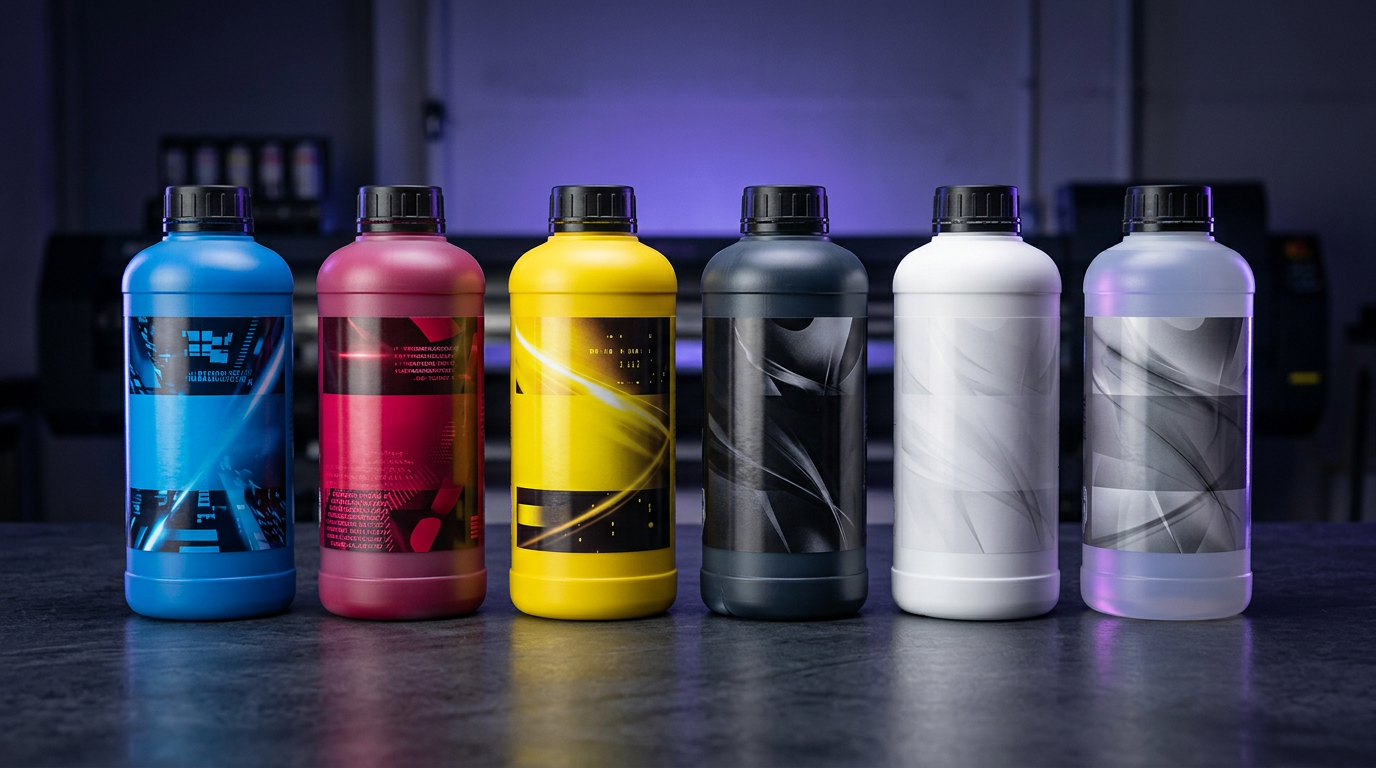
Ask a struggling UV shop what’s wrong and they’ll blame the machine. Ask their service engineer privately and you’ll hear the truth: the ink. Wrong type for the substrate, grey-market bottles with mystery chemistry, white bottles stored beside a sunny window, varnish bought from a seller who “also has flex ink.” In UV printing, ink choice isn’t a consumable decision — it’s a quality system.
This guide makes you dangerous in ink conversations: what UV ink actually is, the types (rigid vs flexible vs LED-tuned), honest 2026 per-litre prices in India, per-product cost math, the adhesion/primer reality nobody advertises, storage rules that protect your heads, and the field checks that catch fake ink before it catches you.
What’s Inside UV Ink (Why It’s Different from Every Other Ink)
Water-based inks dry; solvent inks evaporate. UV ink does neither — it waits for light. Four families of chemistry live in every bottle:
| Component | Share | Job | Corner-Cutting Risk |
|---|---|---|---|
| Monomers & oligomers | 60–80% | The liquid backbone that light turns into solid polymer film | Cheap monomers = brittle prints, skin-irritant handling, weak adhesion |
| Photoinitiators | 3–10% | The trigger chemistry that reacts to UV wavelengths (395nm LED standard) | Wrong initiator package = ink that never fully cures — sticky prints, smell, rub-off |
| Pigment | 5–15% | The colour (titanium dioxide in white — heavy, fast-settling) | Coarse milling = nozzle clogs; faded greys pretending to be white opacity |
| Additives | 1–5% | Flow, defoaming, adhesion, flexibility agents | This invisible 3% decides whether print survives a key in a pocket |
That chemistry explains the three UV ink commandments: it costs 2–3× solvent ink per litre, it must match your lamp’s wavelength, and white ink behaves like a separate species needing its own discipline.
UV Ink Price in India 2026: The Real Numbers
| Ink Type | Economy Chinese Brands (₹/litre) | Quality Chinese/Korean (₹/litre) | Premium (Nazdar-style imports) (₹/litre) |
|---|---|---|---|
| CMYK colours | 1,400 – 2,200 | 2,400 – 4,200 (recommended band) | 6,000 – 10,000 |
| White (W) | 1,800 – 2,600 | 2,800 – 4,800 | 7,000 – 11,000 |
| Varnish (V) | 1,500 – 2,400 | 2,600 – 4,400 | 6,000 – 9,000 |
| Cleaning flush solution | 600 – 900 | 900 – 1,500 | 2,000 – 3,500 |
| Adhesion promoter/primer (glass, metal) | 800 – 1,400/500ml | 1,200 – 2,000/500ml | 2,500 – 4,000 |
The recommended band is deliberately mid-market: full import-grade inks don’t return their premium on Indian price-point products, while sub-₹2,000 mystery ink routinely costs a printhead (₹55,000+) in clogs, undercure, and reprints. Buy the ₹2,400–4,500 band from a supplier who names the brand and stakes their service visits on it.
Rigid vs Flexible vs LED-Tuned: Match Ink to Ink’s Job
- Rigid/hard UV inks: cured film is hard and scratch-tough — for acrylic, glass, metal, wood, signage. Brittle under flexing; never for leatherette rolls or anything bent after printing.
- Flexible UV inks: elongation additives let cured film stretch with media — roll-to-roll work, vehicle films, faux leather, banners. Slightly softer scratch resistance; wrong choice for awards/boards.
- Mid-flex/hybrid inks: the compromise most flatbed shops actually run — tough enough for plaques, tolerant enough for occasional soft media. If your supplier offers one “universal” ink at the right brand tier, it’s usually this.
- Lamp matching: LED ink ≠ mercury ink. Photoinitiator packages are tuned to specific wavelength windows (LED ~395nm standard). Mixed lamp/ink pairing = undercured prints that smudge for days and never harden in the ink’s core. Always ask: “this ink is certified for LED 395nm, yes?”
Per-Product Ink Economics (Why Ink Is Your Smallest Problem)
| Product | Ink Used | Ink Cost | Ink as % of Sale Price |
|---|---|---|---|
| Phone case (white+colour) | 0.4 – 0.7 ml | ₹2 – 5 | <2% of ₹300–600 |
| A5 award plaque (colour+varnish) | 1 – 2 ml | ₹5 – 12 | ~3% of ₹400–900 |
| A3 acrylic panel | 4 – 7 ml | ₹18 – 40 | ~4% of ₹700–1,800 |
| 8×4 ft sunboard | 40 – 70 ml | ₹150 – 350 | ~6% of ₹2,500–6,000 |
| UV DTF sticker (10×15 cm) | 0.5 – 0.9 ml | ₹3 – 7 | ~4% of ₹150–300 |
Ink is 3–6% of revenue in a healthy UV business. The expensive failures buyers cause chasing the LAST ₹500/litre of ink price — clogs, undercure, reprints — erase a year of “savings” in one bad month. Optimize consumption discipline (cleaning cycles, purge waste) before optimizing bottle price.
The Adhesion Truth Table (Primer Reality)
UV ink bonds mechanically and chemically — but not equally on every surface. The honest adhesion map:
| Substrate | Direct-Print Adhesion | Fix/Primer |
|---|---|---|
| Acrylic (cast/extruded) | ✅ Excellent | None needed — wipe clean |
| Sunboard/PVC foam | ✅ Excellent | None |
| Wood/MDF (raw) | ✅ Very good | Light sanding for gloss-premium feel |
| Coated metals (powder-coated, anodized) | ✅ Good–excellent | Scuff test first; primer rarely needed |
| Bare glossy metal, stainless | ⚠️ Variable | Metal primer/adhesion promoter recommended |
| Glass/mirrors | ⚠️ Needs help | Glass primer mandatory for dishwasher/premium durability |
| Ceramic/glazed tile | ⚠️ Needs help | Primer on glaze; test bake cycles if demanded |
| PP/PE plastics (some bottles) | ❌ Poor without treatment | Corona/flame treat or specialty PP primer — many cheap bottles fail here |
| PU-coated/leatherette | ⚠️ Variable | Flexible ink + scuff + test before committing a job |
The professional habit: every new substrate supplier batch gets a crosshatch tape test (score the cured print lightly, press tape, rip — clean lines stay = go). Ten seconds that prevent recall disasters.
Storage & Handling: UV Ink’s Special Rules
- Light is the enemy: bottles in dark cabinets, never sunlit shelves. Partial UV exposure starts silent polymerization → gel particles → clogged nozzles months later.
- Temperature 15–28°C: heat accelerates initiator decay; cold thickens ink (warm bottles naturally to room temp before filling — never with heaters).
- White = special custody: gentle daily inversion (never vigorous shake — bubbles photocure as defects), FIFO rotation strictly, oldest stock first.
- Opened bottles: 3–6 months; sealed: 12–18 months. Marker every bottle with open-date.
- Skin discipline: uncured UV monomers irritate skin; nitrile gloves for refills and cleanups. Cured prints are inert and safe.
- Flush = same family as ink: mixing flush chemistry brands randomly invites gel reactions in lines. One ink family, one flush family.
Spotting Fake & Relabelled Ink
- Price red flag: genuine mid-band white at ₹1,600/litre isn’t a deal — white pigment can’t cost that.
- The settling test: sealed sample bottle, invert gently after 48hrs standing. Premium ink re-suspends smoothly; bad ink leaves stubborn sludge ribbons.
- The cure test: print, cure at rated settings, thumb-rub after 1 minute. Full-cure ink is slick-hard immediately; tacky/greasy feel = wrong lamp match or dead initiators.
- Paper trail: brand batch codes + GST invoice naming the ink brand — and only suppliers whose service team actually handles that brand daily.
- New-supplier protocol: always one set trial order first; head-health test documented before/after two weeks; only then bulk.
White Ink Deep-Dive: The Channel That Runs Your Business
In UV printing, white isn’t a colour — it’s infrastructure. It prints the base layer on every dark/transparent substrate, builds the embossed texture for premium effects, and carries the titanium-dioxide pigment that settles like wet cement when ignored. Mastering white decides whether your machine serves premium products or only pastel-on-white jobs:
- Circulation vs stirring: circulation pumps move white through the line loop continuously; stirring motors agitate the tank. Machines need both ideally; a machine with neither is a white-channel funeral at ₹4–5 lakh discounts that aren’t discounts.
- Density settings in the RIP: 100% white for black/clear acrylic; 60–80% white as “soft base” for light substrates saves ink without visible loss. Learn the choke and density controls — they’re where premium output lives.
- Weekend protocol: wet-cap, circulation confirmed ON even during idle days, printer powered in standby rather than cold-off (most machines circulate only when powered). Monday-morning white failures are weekend-protocol failures.
- Consumption planning: white typically runs 1.5–2× the volume of any colour channel in signage/awards work. Your stock reorder rhythm is driven BY white — never let the white bottle hit zero; air ingested in the white line is a two-day problem.
Varnish: The Margin Layer Nobody Prices Properly
The varnish channel is where average shops leave money invisible. Spot-gloss varnish turns a ₹600 plaque into a ₹1,200 plaque in the customer’s eyes — selective gloss highlights, texture/emboss effects, matte-gloss contrast designs. Practical guidance: charge for varnish/emboss as a named upgrade (“3D texture finish +₹X”), because customers pay for effects they can see described. Keep varnish head-care equal to white (it gums when idle); and teach your designer that varnish layers are MASKS — a separate design discipline worth one focused week of practice that pays forever.
The 12-Month Ink Cost Simulation (Quality vs Economy vs Premium)
| Line (12 months, 6090 shop, moderate volume) | Economy Ink (₹1,800 avg/L) | Quality Mid-Band (₹3,200 avg/L) | Import-Premium (₹7,500 avg/L) |
|---|---|---|---|
| Ink spend (~30 L/yr all channels) | ₹54,000 | ₹96,000 | ₹2,25,000 |
| Extra cleaning/purge waste | +15–25% | +5–8% | +3–5% |
| Expected head-health events | 0.5–1 (₹25k–85k exposure) | ~0 (warranty-safe) | ~0 |
| Reprints from undercure/colour drift | ₹8,000 – 20,000 worth | ₹2,000 – 5,000 | ₹1,500 – 3,000 |
| Print-quality ceiling | Colour drift + clog risk caps premium pricing | Full premium pricing unlocked | Same as mid-band for Indian products |
| Realistic annual exposure | ₹90,000 – 1,80,000 (high variance) | ₹1,00,000 – 1,08,000 ✅ | ₹2,30,000 (overspending) |
The math repeats the theme: mid-band quality ink is the economic optimum — premium imports overspend on Indian price points, economy ink transfers your savings to the head-replacement column with interest.
Safety, Handling & Workspace Rules
- Nitrile gloves for every fill/clean operation — uncured monomers absorb through skin; make gloves as automatic as footwear.
- Ventilation at the machine point — LED-UV output is mild but real during long runs; exhaust plus cross-flow beats cologne-of-the-factory ambience.
- No food at the worktable; hand-washing SOP after machine contact.
- Waste-ink bottle discipline — sealed, labeled, dark-stored; never open buckets. Disposal per local norms, never drains.
- MSDS folder: your ink supplier’s safety sheets filed and findable — inspectors and insurance both ask eventually.
- Eye protection for lamp maintenance — never look into an active UV lamp zone; treat LEDs with the respect their wavelength deserves.
Supplier Negotiation: Ink Contracts That Compound
- Annual commitment pricing: a quiet “I’ll take 3–4 L/month all year” often unlocks 8–12% — plus priority allocation during shortage seasons.
- Bundle the ecosystem: negotiate ink + flush + film + dampers together; accessory margins make these bundles flexible gold for suppliers.
- Batch freshness clause: written max-6-months-from-manufacture terms on delivered ink. Old stock at new prices is the industry’s quietest tax.
- The trial protocol before any switch: single-set order; head-health documented before/after 2 weeks; only then commit volume. New-ink experiments during peak season are how Diwali becomes a horror story.
The Ink Selection Decision Tree (60 Seconds to the Right Bottle)
- What head does your machine run? → narrows to head-compatible viscosity families (your assembler’s approved list governs — start there, always).
- What lamp cures on your machine? → LED 395nm-certified ink ONLY for LED machines; mercury-tuned ink never fully hardens under LED.
- What do 80% of your jobs print on? → rigid substrates = rigid ink family; rolls/flexibles = flexible ink; genuinely mixed = mid-flex “universal” from the quality band.
- What price band serves your products’ margins? → ₹2,400–4,500/L quality band for 90% of Indian products; premium imports only when client specs literally demand certifications.
- Who stakes service on this ink’s behaviour in YOUR head? → the supplier’s accountability is part of the product. No accountability, no purchase.
Machine-to-Ink Compatibility Map (Common Indian Setups)
| Your Machine | Ink Family to Run | Never Run |
|---|---|---|
| Desktop A3/A4 (XP600-class heads) | Head-rated LED UV ink, mid-flex; fine-pigment grades | Industrial Ricoh-grade thick-viscosity inks; ANY mystery unbranded litre |
| 6090 dual i3200-U flatbed | i3200-rated LED UV (approved list), mid-flex or rigid per product mix | “Universal for all heads” bargain grades |
| Ricoh Gen5/Gen6 industrials | Ricoh-rated LED or dual-cure grades (rigid for signage work) | Desktop-grade economy inks (head wear accelerates invisibly) |
| UV DTF machines (any) | DTF-specific flexible UV ink matched to your film system | Flatbed rigid inks (transfer film cracking guaranteed) |
| Roll-to-roll UV | Flexible LED UV family | Rigid sign inks on anything that bends after print |
Viscosity and Temperature: The Working Band
UV ink’s two numbers that explain most winter mornings: viscosity rises steeply below ~20°C (cold ink starves nozzles — hence the warm-up ritual), and over 32°C thins toward misting/satellite defects. Practical handling: shop room 22–30°C always (an AC sized to the room is a consumable, cost-wise); bottles reaching the machine at machine-room temperature (no godown-cold refills); January mornings = 15-minute heaters-on warm-up before nozzle test. Machine ink-path heaters exist on better builds — they’re not decoration, they’re the viscosity stabilization system during winter duty.
The Print-Shop Ink Audit (Find Your Hidden 8–12%)
- Track 4 weeks of reality: litres opened per channel vs square feet billed per channel. Numbers stun most owners — the white channel inefficiency ALONE runs shops 10–20% over-budget quietly.
- Quantify cleaning-cycle waste: every purge logs millilitres; the months with spike-correlated breakdowns (“we were too busy for nozzle checks”) prove the maintenance math better than any lecture.
- Profile-driven ink limits: correctly linearized profiles routinely save 8–15% ink at identical output quality. The RIP calibration afternoon pays for itself monthly.
- Waste-pad evidence: the pad is your accountant — unusually rapid saturation = over-cleaning culture somewhere.
- Grey-channel inventory review: old half-bottles beyond use-by become the clogs of next quarter; date-check and reclaim shelf space quarterly.
The Midnight “Ink Just Ran Out” SOP
- Never dry-fire: most machines stop channels on low-ink warnings for a reason — override culture is head-funeral culture.
- The bridge bottle SOP: every shop holds one sealed “emergency” CMYK+W set — opened ONLY in emergencies, replaced next-day like a fire extinguisher.
- Supplier emergency line: local suppliers run informal urgent-bottle logistics for proven customers (see: “pay fast, visibly” reputation from this guide) — build that credit long before the 11 PM call.
- Job triage: colour-only jobs reroute around an empty white channel overnight; white-dependent jobs honestly re-promised for 24-hours-later beats silent dry-channel damage worth a head.
Disposal & Compliance Done Right
UV waste streams are modest but specific: waste-purge fluid, empty bottles, expired stock, wipe swabs. Correct pattern: sealed metal waste container, labelled, dark storage; municipal hazardous/chemical disposal norms followed (your ink supplier often takes consolidated empties/expired stock back on delivery runs — ask, most quietly do); zero drain disposal, zero open buckets in the workspace. The smallest discipline here prevents the largest regulator conversation later — and keeps your workshop insurable at honest premiums.
The Four Market Bands in Character (Buying Personalities Mapped)
| Band | ₹/Litre (CMYK) | Behaviour Reality | Right User |
|---|---|---|---|
| Mystery unbranded | 900 – 1,600 | No batch identity, cure-lottery, head-risk every litre | Nobody we can recommend it to |
| Economy branded | 1,800 – 2,400 | Usable on patient hobby-duty; drift and slow-cure quirks appear at production pace | Experimentation phase only |
| Quality mid-band | 2,400 – 4,500 | Predictable cure, colour stability, batch consistency, support channel exists | Every commercial shop |
| Import premium | 6,000 – 10,000+ | Certification-grade consistency (GREENGUARD-class documentation) | Export/brand-specified work where ink certificates are demanded |
Gloss, Matte & Varnish: The Finish Science
The finish tier strategy on flatbed machines starts behaving like product strategy, not print strategy:
- Matte look: raw cured CMYK, no varnish — sophisticated muted aesthetics, photographs without glare reflections, perfect for photo-art and textile-look products.
- Full-gloss flood varnish: depth-popped colours + protection surface — signage and branding products get the industrial finished look.
- Spot gloss (selective varnish): design elements shine against matte field — the premium design language customers pay tier-jump prices for.
- Emboss/stacked varnish: dimensional texture — braille signage, premium logos, the “run-your-fingers-over-it” wow effect.
- Primer layers: invisible adhesion insurance on glass/metal — amateurs skip it, professionals bundle it silently into premium-tier pricing.
Training note: each finish family deserves a dedicated premium-tier LINE in your rate card — finishes are the margin architecture of a UV business.
White Circulation Systems Compared
| System Type | Found On | Real-World Behaviour |
|---|---|---|
| Full peristaltic circulation + tank stirring | Better quality 6090+ builds | White stable for weeks; industry baseline done right |
| Stirring only (no line circulation) | Mid builds | Better than nothing; heavy whites still risk static line sediment |
| Manual-shake “systems” | Budget machines / older stock | The operator becomes the circulation pump; Monday failures inevitable |
| Damper-filter-stage circulation | Ricoh-class industrials | Industrial-grade recirculation designed for round-clock duty |
Ask specifically at purchase: “show me the circulation pump running, and where the return line goes.” A salesman’s vague gestures at this question tell you everything about year one’s white-channel experience.
Multi-Supplier Strategy: When Diversifying Helps (and Hurts)
Single approved supplier gives accountability, batch consistency and priority allocation — the default correct answer. Diversify ONLY when: volumes outgrow one supplier’s guaranteed allocation (festival-season rationing becomes your constraint); or a second line of certified-compatible ink runs a separate machine (never mix within one machine without full flush). What never works: parallel cheap suppliers swapped by monthly price — your machine reads chemistry, not invoices, and it votes with its nozzles.
The Bulk-Buy Calendar
| Window | Why It Works |
|---|---|
| Quarter-ends (Jun/Sep/Dec/Mar) | Supplier target pressure = scheme windows; 5–12% concessions + bundled flushes appear |
| Pre-Diwali build (Aug–Sep) | Your peak-production stock secured BEFORE seasonal allocation squeezes |
| January | Post-peak supplier willingness + your GST-planning timelines align nicely |
FIFO discipline governs everything bought in windows: 12–18 month sealed life punishes hoarding beyond 2 quarters; rotation tags on shelves make the discipline mechanical instead of hopeful.
Cost per Square Foot: Precise Math for Your Rate Card
Stop estimating ink cost; formula-ize it. Standard consumption at production quality on rigid media runs 6–10 ml per sq ft for full-coverage CMYK work, with white base layers adding 3–6 ml where used. At ₹3,200/litre average across channels:
| Job Type | Ink per Sq Ft | Ink Cost per Sq Ft | Typical Sell per Sq Ft |
|---|---|---|---|
| CMYK only, light coverage | 4 – 6 ml | ₹13 – 20 | ₹60 – 120 |
| CMYK full coverage | 6 – 10 ml | ₹20 – 32 | ₹90 – 180 |
| White base + colour | 10 – 15 ml | ₹32 – 48 | ₹120 – 250 |
| Colour + flood varnish | 12 – 18 ml | ₹38 – 58 | ₹150 – 300 |
| Embossed multi-pass art | 18 – 30 ml | ₹58 – 96 | ₹250 – 500 |
The takeaway that pricing-pages should wear: even the heaviest embossed premium work costs under ₹100/sq ft in ink while commanding ₹250–500. Ink fear should never drive your job pricing decisions; time and finishing are your real cost centres.
Ink and Your Head Warranty: The Relationship to Manage Deliberately
Here’s the triangle nobody explains at purchase: head warranty validity typically binds to an approved-ink list; the assembler sells ink; your FOMO on cheaper bottles stands exactly between them. The professional handling: at purchase, get the approved-ink list written WITH prices locked for 12 months. If the assembler’s ink is priced reasonably (within ~15% of equivalent open-market quality brands), staying in-program is almost always correct — the warranty + support + accountability bundle outweighs the delta. Where assembler ink runs absurdly priced, negotiate the second approved brand onto the list in writing at purchase time — mid-conversation leverage never returns after signature.
The Free-Ink Dilemma: What Comes in the Box
Machines ship “with free ink” of wildly varying honesty. Three scenarios and their correct handling:
- Genuine quality starter set (assembler-proven brand, fresh batch codes): use it, benchmark it, reorder it. Congratulations, you have a baseline.
- Unbranded “starter” bottles: run break-in prints only on expendable substrates while the approved set is procured; never let mystery-chemistry near white channels on an untested machine.
- Promised-ink-that-never-arrives: the classic discount-machine defect. Written PO line items before payment, always — verbal ink promises evaporate at delivery.
Owner Q&A Lightning Round
My machine sat with ink loaded for 3 weeks. Safe?
If capped properly and circulated (white), usually yes — run wet-cap, 1–2 cleans, nozzle test, evaluate. Beyond 2–3 weeks idle, budget a flush of the white channel before premium jobs.
Two ink brands, same machine, alternating?
Never alternate within one machine without full flush between brands. Additive incompatibilities gel silently in dampers and show up as channel death weeks later.
Can I dilute thick ink with flush?
No — flush is a cleaning solvent, not a thinner; dilution breaks the polymerization chemistry. Viscosity problems are temperature problems; warm the room, not the bottle.
Opened bottle, 8 months old, looks fine?
Past opened-life norms (3–6 months). Strain-test visually, test-print on expendable substrate, watch channels for 48 hours — then decide with evidence. When in doubt, demote it to cleaning-cycle-adjacent uses and replace the front-line stock.
Best bulk-buy quantity for a 6090 shop?
Peak-season buffer: 1.5 months of consumption, not more — sealed life (~12–18 months) forgives caution less than storage realities forgive optimism.
The Ink Conversation That Happens at Purchase Day (Script)
Use this exact five-line script at machine delivery — it converts good intentions into protections:
- “My machine’s approved ink list on the invoice, please — brand names and grades.”
- “Today’s ink batch codes photographed against my machine serial — for the record.”
- “The reorder hotline and usual dispatch time for my city?” (45-minute delivery cities vs 4-day courier cities are different planning universes.)
- “If a batch shows problems in my first-month tests, what’s the swap process?”
- “Annual quantity-based rate-lock: does the price on the invoice hold for my first year?”
Five sentences, five minutes, permanent protection. The buyers who skip this conversation meet it again later — at worse moments.
The Quiet Skill: Reading Your Waste Pad
Every UV machine’s waste-ink pad/bottle keeps a diary of your discipline. Monthly reads: sudden fill-rate spikes mean a culture of panic-cleaning is forming somewhere on your team; unusually DRY rates after busy weeks often reveal skipped maintenance runs rather than health; white-heavy sediment build-up flags the circulation system’s real work-rate. The pad never lies, never forgets, and tells on everyone kindly — read it before the problems it records become the problems your customers receive.
The Ink Buyer’s Quick Card (Print This for Your Store Room)
| Rule | Why |
|---|---|
| One approved brand per machine — period | Chemistry mixing gels invisibly, expensively |
| Buy the ₹2,400–4,500/L quality band | Economy ruins heads; imports overkill Indian jobs |
| White stock: never below 1 sealed backup | White-first stockouts stall premium lanes hardest |
| Dark cabinet, 15–28°C, FIFO tags on every bottle | Partial UV + heat silently polymerize shelf stock |
| Sealed life 12–18 months; opened life 3–6 | Date markers at opening, without exceptions |
| Roll bottles gently; never shake | Bubbles print as dropouts |
| Nitrile gloves for every fill | Uncured monomers are skin-absorbable chemistry |
| Tape-test every new substrate batch | Adhesion reality arrives before customer reality |
| New supplier = 1-set trial, never immediate bulk | Cheap experiments, never expensive ones |
| Emergency bridge set sealed & sacred | Midnight stockouts lose clients, not just hours |
Ten lines covering 90% of ink-related business damage — taped to the ink cabinet door, they cost one print and return a machine-room worth of prevention.
One Line Almost Every Ink Problem Obeys
When diagnosing anything ink-related, start by assuming the bottle is innocent and the handling is guilty — because statistically it is. Temperature sins, storage sins, mixing sins and idle sins cause the overwhelming majority of “bad ink” experiences; genuinely defective batches from quality suppliers are rare and visibly batch-specific (two bottles behaving identically wrong is process; one bottle alone is possibly batch). The rule’s gift: it keeps your attention on the variables you control, which is where every ink problem in this industry actually gets solved.
Frequently Asked Questions (FAQs)
What is the price of UV printing ink in India?
Quality CMYK: ₹2,400–4,200/litre; white ₹2,800–4,800; varnish ₹2,600–4,400; flush ₹900–1,500; primers ₹1,200–2,000 per 500ml. Ultra-cheap (<₹2,000) ink is a printhead risk, not a saving.
How long does 1 litre of UV ink last?
Surprisingly long: a phone case uses under 1ml — one litre prints 1,500–2,500 cases. Most small shops consume 2–4 litres/month all channels combined at moderate volumes.
Can I use any UV ink in my printer?
No — match three things: your head model (viscosity spec), your lamp (LED 395nm vs mercury), and your job (rigid vs flexible). Random ink swaps are the #1 cause of dead head channels.
Why is white UV ink more expensive?
Dense titanium-dioxide pigment load — it’s the opacity engine for dark/clear substrates. It also settles fast, demanding circulation systems and tighter quality control in the bottle.
Is UV ink safe?
Cured UV ink is inert and food-adjacent-safe externally (never print direct food-contact zones). Uncured ink needs nitrile-glove handling — monomers irritate skin before curing.
Final Verdict
Treat UV ink like the chemistry system it is: mid-band quality brands, lamp-matched, FIFO-stored in the dark, one family per machine, adhesion-tested per substrate. Do that, and ink quietly costs you 3–6% of revenue forever. Chase the ₹1,600 litre, and it will bill you a printhead instead.
Need genuine, head-approved UV inks for your machine? Our printing inks range covers machine-matched CMYK, white, varnish and flush — and a quick message with your machine model gets you the exact approved ink family recommendation.
