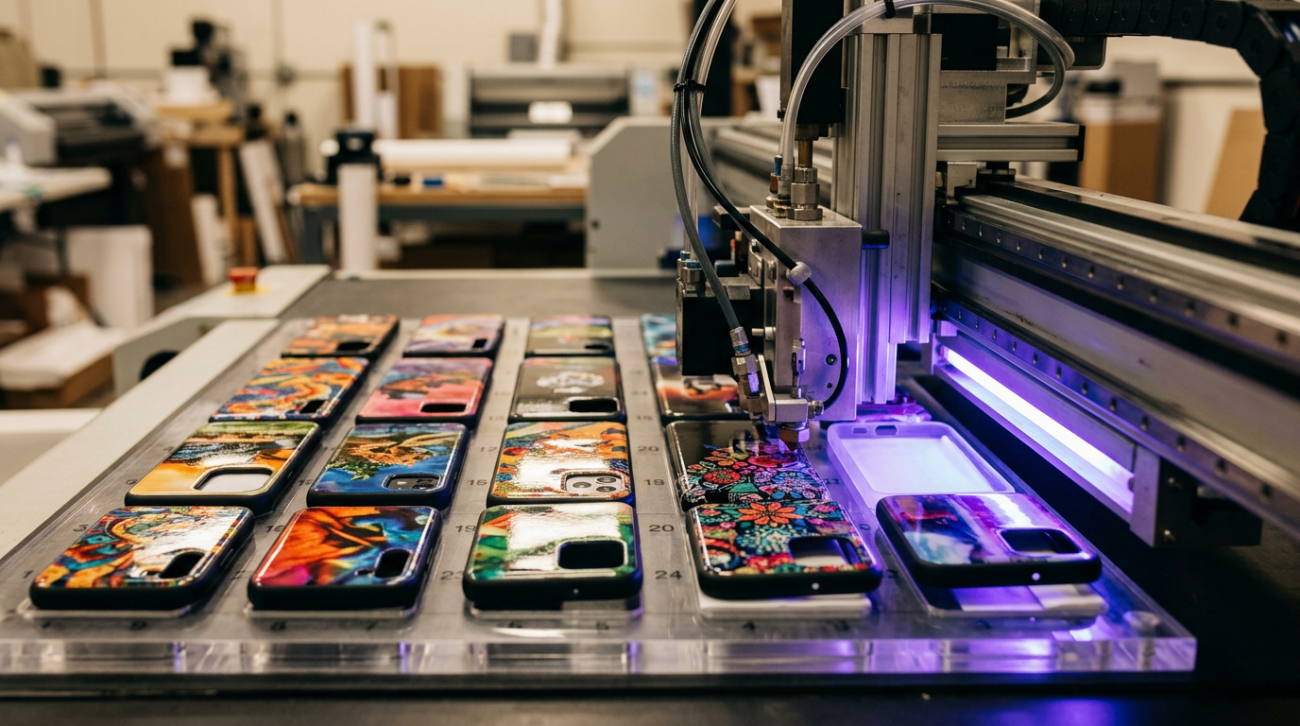

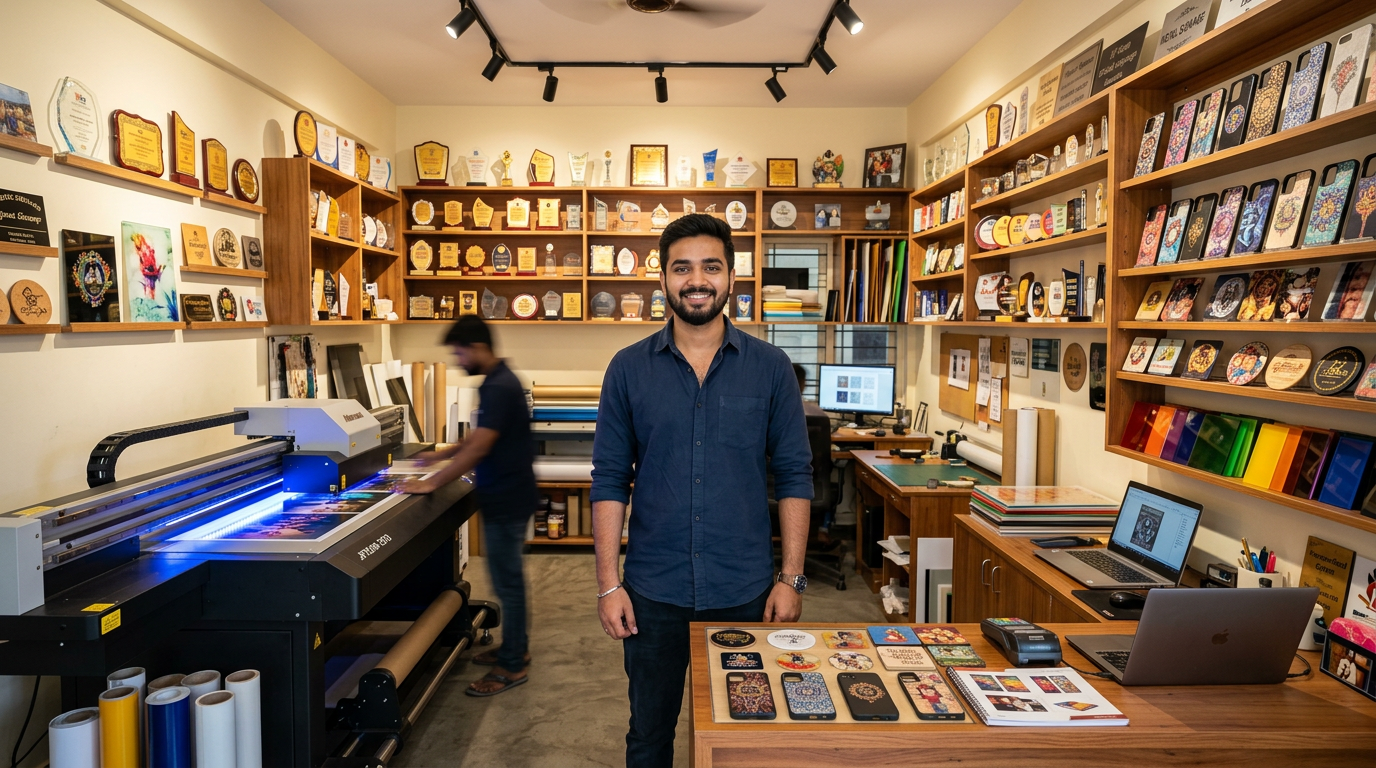
Every city in India has the same quiet gap: customers who want a phone case printed today, a shop that needs its acrylic nameboard by Friday, a school that wants 40 trophies next month, an interior designer hunting someone who prints on glass and wood. The shops serving these used to say “not possible here.” UV printing turned every one of those sentences into a product.
A UV printing business is the most product-diverse opportunity in Indian digital printing today — one machine legitimately serving gifting, signage, awards, decor, and promotional products, at gross margins (60–80%) that flex/banner printing can’t dream of. It’s also a business you can start at ₹2 lakh on a desktop or ₹8–10 lakh properly. This guide is the honest full plan: exact investment breakup, legal setup, product menu with real rates, where customers actually come from, the P&L shape, and the 90-day launch sequence.
Why UV, and Why Now (The Market Case)
- The personalization economy is compounding — customized gifting, boutique signage, and decor panels grow 20–30% annually in Indian urban markets, and every trend report agrees on the direction.
- Supply is thin outside metros. Most tier-2/3 cities have vinyl/flex shops and photo studios — but very few direct-object UV printers. Local monopoly pricing remains available to early movers.
- Machine economics matured. The 6090-class flatbed (₹5–7.5 lakh) with reliable Epson i3200-U heads turned what needed ₹20 lakh in 2020 into a small-business purchase.
- UV DTF expanded the map again — bottles, helmets, gadgets, every curved thing became a printable product for ₹1.5–6.5 lakh more.
Investment Tiers: Three Honest Ways In
| Tier | Total Investment | Machine Core | Right For |
|---|---|---|---|
| Bootstrap | ₹2 – 3 lakh | Desktop A3/A4 UV flatbed (Epson class) | Home gifting startup; Instagram-led; proving demand |
| Standard (recommended) | ₹7 – 11 lakh | 6090 flatbed, dual i3200-U, CMYK+W+V | First serious shop; full product menu; best payback math |
| Full-spectrum | ₹12 – 16 lakh | 6090 flatbed + UV DTF machine + laminator | Ambitious launch covering flat + curved + merch all at once |
The Standard Setup: Line-Item Budget (₹7–11 Lakh Tier)
| Head | ₹ (Range) | Notes |
|---|---|---|
| UV flatbed 6090 (dual i3200-U) | 5,00,000 – 7,50,000 | GST-billed, licensed RIP, installation + training included — in writing |
| Ink starter stock (CMYK+W+V ×2 sets) | 35,000 – 55,000 | Two sets: running + backup; white sells out first, always |
| Compressor + UPS/stabilizer (3–5 kVA) | 35,000 – 65,000 | Clean power is head insurance; don’t shave here |
| RIP workstation PC | 40,000 – 55,000 | 16–32 GB RAM, SSD — layer-heavy UV files demand it |
| Substrate starter stock | 25,000 – 40,000 | Acrylic/sunboard sheets, phone cases, plaques, glass, tiles, wood blanks |
| Jigs, work tables, racks, tools | 15,000 – 30,000 | Jigs are the productivity system — budget real money |
| Rent deposit + interiors/exhaust/lighting | 30,000 – 80,000 | City-dependent; 150–250 sq ft is plenty |
| Legal + launch marketing | 10,000 – 20,000 | GST/Udyam free; signage, samples, launch offers |
| Working capital buffer (3 months) | 60,000 – 1,20,000 | The line that decides survival; never zero |
Legal Setup in a Week (The Boring Lines That Unlock B2B)
- Proprietorship + current account — fastest structure; upgrade later as you scale.
- Udyam (MSME) registration — free, 30 minutes online, unlocks machinery loans, subsidies, and corporate vendor registrations.
- GST registration — mandatory beyond thresholds in theory; in practice from day one, because corporate gifting and award clients demand GST invoices for input credit.
- Trade licence (municipal) — simple for a small workshop; keeps inspectors friendly.
- Copyright discipline: customer artwork goes on your order form as “customer warrants rights.” Branded characters and logos offered by walk-ins get politely refused — one legal notice costs a year of profit.
The Product Menu & Rate Card (2026 Market Rates)
| Product | Your Cost (₹) | Sells At (₹) | Margin | Demand Pattern |
|---|---|---|---|---|
| Custom phone case | 80 – 130 | 250 – 600 | 60–75% | Steady daily; festive spikes |
| Acrylic trophy/award (medium) | 180 – 450 | 700 – 2,200 | 65–78% | Schools/corporates; seasonal bursts |
| Acrylic nameplate (door/desk) | 120 – 350 | 600 – 1,800 | 65–80% | Steady; new homes/offices |
| Sunboard shop sign (per sq ft) | 25 – 45 | 90 – 180 | 60–72% | Retail openings; referral-heavy |
| Glass/wood photo panel (12×18″) | 150 – 300 | 800 – 2,500 | 65–80% | Festivals, weddings, gifting peaks |
| Corporate gift kits (per set) | 350 – 900 | 1,200 – 3,500 | 60–72% | Diwali/onboarding cycles; bulk B2B |
| UV DTF bottle/helmet branding | 40 – 120 | 250 – 800 | 65–80% | Gyms, brands, auto shops |
| Ceramic tile printing (per tile) | 60 – 140 | 300 – 900 | 65–78% | Interiors, temples, kitchens |
| Pens/USB/diary branding (per pc) | 15 – 60 | 80 – 300 | 60–75% | Corporate bulk orders |
Where Customers Come From (Channels That Actually Work)
| Channel | Cost | Time to Traction | Play |
|---|---|---|---|
| Google Business Profile + “near me” searches | Free | 2–8 weeks | Photos of every job; reviews harvested weekly |
| Instagram reels (print process porn) | Free | 2–10 weeks | 40-sec phone-case reveals go viral locally; link WhatsApp |
| WhatsApp catalogue + status | Free | Week 1 | Every Indian printing business’s real storefront |
| IndiaMART listing | Free / ₹35k paid | Month 1–2 | B2B bulk gifting & trophy inquiries; filter price-shoppers fast |
| Local B2B walkabouts | Petrol | 2–6 weeks | Schools, event companies, corporates, interior designers — carry physical samples |
| Gift-shop/photo-studio partnerships | Margin share | Month 1–3 | They retail, you produce — white-label volume |
| Justdial/Sulekha/local directories | ₹10–25k/yr | Month 1+ | Still works for trophies/nameplates in tier-2/3 |
The P&L Shape: What Healthy Looks Like (Standard Tier, Month 8+)
| Line | Monthly ₹ | % Revenue |
|---|---|---|
| Revenue | 1,60,000 – 2,60,000 | 100% |
| Substrates + ink + film (COGS) | 45,000 – 75,000 | 26–30% |
| Rent + power + internet | 15,000 – 25,000 | 8–11% |
| Staff (1 helper/operator) | 14,000 – 20,000 | 8–10% |
| Machine EMI (if financed) | 15,000 – 22,000 | 8–11% |
| Marketing + misc + maintenance | 6,000 – 12,000 | ~4% |
| Owner profit | 55,000 – 1,10,000 | 34–42% |
The levers in order: product focus (cash-cow SKUs), B2B recurring accounts, jig-batch productivity, and substrate procurement. New owners obsess over the first; profitable owners run all four.
The 90-Day Launch Sequence
| Phase | Actions | Exit Criteria |
|---|---|---|
| Days 1–15: Foundation | Machine commissioning; test prints on EVERY sample substrate; make the sample book; 6 jig templates built | Perfect print on 10 substrates; sample book photographed |
| Days 16–30: Shadow launch | WhatsApp catalogue live; GMB verified; 10 gifted jobs to local businesses tagged publicly | First 15 paid orders; 3 reels posted |
| Month 2: Menu & B2B | Price 12–15 flagship SKUs; visit 20 B2B prospects with samples; IndiaMART live | ₹70k+ billing; 2 repeat accounts |
| Month 3: The Cash Cow | Identify your #1 profitable SKU; double marketing on it; festive/corporate calendar mapped | ₹1.2L+ billing; one anchor B2B account |
Scaling: The Natural Arc
Year 1: 6090 flatbed + master the object menu. Year 2: add UV DTF (curves) and/or a laminator; hire operator #2; deepen B2B contracts. Year 3: either a second 6090 (proven products, more throughput) or a 9060/2513 industrial step-up against signed volumes. Diversification follows PROVEN demand — never speculation. The businesses that die here die from machine-first ambitions; the ones that thrive keep technology trailing revenue.
The B2B Verticals: Where the Recurring Money Lives
Walk-ins build daily cash flow; institutional accounts build the business. Each vertical buys UV work differently — target accordingly:
| Vertical | What They Buy | Cycle | How to Win Them |
|---|---|---|---|
| Schools & colleges | Trophies, certificates plaques, event signage | Annual-day/result seasons; predictable every year | Sample trophy visits in June–July; price-list-on-file status |
| Corporates (HR/admin) | Gift kits, joining kits, awards, office nameplates | Quarterly + Diwali spike | GST invoice professionalism + kit catalogue PDF + one free sample kit |
| Interior designers | Glass art, wood panels, decor murals, signage for projects | Project-based; monthly steady once in panel | Showroom samples + designer-margin structure they can upsell on |
| Event/wedding companies | Plaques, monogram panels, favors, signage | Weekend-warrior bursts Oct–Feb | Guaranteed 48-hr slots during season; rush premium accepted happily |
| Real estate & auto dealers | Site boards, sunboard signage, showroom plates, key-drop gifts | Launch-linked; monthly steady in active markets | Portfolio photos + multi-site delivery reliability |
| Gift shops/photo studios | White-label printing (they sell, you produce) | Weekly repeat | Trade pricing + 24-hr turnaround + zero brand conflict (plain packing) |
Target state: 4–6 anchor B2B accounts covering 50%+ of billing. Then every walk-in and Instagram order is upside, not survival.
The Indian UV Seasonal Demand Calendar
| Months | Demand Peaks | Prepare |
|---|---|---|
| Jan – Feb | School annual days, wedding aftermath gifting, corporate award functions | Trophy/award blank stock + school rate cards ready by Dec |
| Mar – Apr | FY-end corporate gifting, exam-season results prep, new-office opening season | Corporate kit catalogue refresh; accountant/clinic nameplate marketing |
| May – Jun | Admissions signage, coaching-institute boards, summer wedding decor in the South | Sunboard stock deep; institutional contacts warmed |
| Jul – Sep | Interior project season builds; Ganpati/Navratri decor products | Designer outreach; festival SKU samples shot early |
| Oct – Nov | Diwali corporate gifting (the year’s Everest) + wedding season opens | Kit stock by early Sep; confirm bulk print slots; nothing stops for maintenance now |
| Dec | Weddings + Christmas/NY retail gifting | Phone-case and photo-panel capacity guarded jealously |
Marketing Stack for a UV Business (In Order of ROI)
- The sample book: 20 perfect pieces across substrates — it closes B2B meetings better than any brochure and photographs endlessly.
- Google Business Profile: “uv printing near me,” “acrylic name plate [city],” “trophy shop [city]” — review velocity decides local rank. Ask every customer; make it a script, not a hope.
- Instagram reels of the PROCESS: UV printing is top-1% satisfying content; a phone case printing timelapse with 20k local views is ₹15,000 of equivalent local ads, free.
- WhatsApp Business catalog + broadcast lists: where Indian B2B reordering actually lives.
- IndiaMART + JustDial: for trophy/nameplate/industrial-plate queries in tier-2/3 — still genuinely productive for B2B lanes.
- The neighbor-effect signage: every board/plaque you ship should quietly carry your mark where customers consent — your portfolio installed across the city IS advertising.
Hiring, Training & Documentation
Your first hire: a finishing/packing helper or a junior designer (₹12–18k), not an operator — owner operates until 6+ productive hours/day prove the need. When hiring operators (₹18–30k depending on city/skill), prioritize process-following temperament over “experience” — experienced operators carry other shops’ bad habits as frequently as their skills. Either way: document everything — SOP videos of white-ink care, jig lists, RIP settings screenshots, substrate prep one-pagers. Knowledge that lives in one employee’s head is a vulnerability wearing a salary; knowledge in your SOP folder is an asset.
7 First-Year Mistakes That Kill UV Shops
| Mistake | Damage Pattern | Fix |
|---|---|---|
| 1. Announcing “we print everything” | Quoting chaos, zero local fame, price-only competition | 3–5 hero products with public rate cards |
| 2. Buying machine at 100% of budget | No ink/jig/samples money; machine starves its own proof phase | The ×1.35 rule — sacred |
| 3. White-ink discipline skipped | ₹55,000–1,60,000 head lesson inside 6 months | Circulation + daily nozzle test, religiously |
| 4. Free unlimited design revisions | Designer hours eaten by ₹300 orders | “2 revisions included” written on every quote |
| 5. Ignoring B2B because “Instagram is working” | Algorithm-dependent revenue = fragile revenue | 2 B2B visits/week as habit, not campaign |
| 6. Seasonal stock-outs (Diwali week!) | The year’s fattest month handed to competitors | Seasonal calendar drives purchase planning |
| 7. Zero maintenance calendar | Peak-season machine-down horror stories | September full service, before the Everest months |
None of these require capital to fix — only decisions. Which is good news: the difference between the UV shops that fade and the ones that compound is in this table, not in the machine room.
Working Capital: The Unglamorous Survival Skill
Most new UV shops die with full order books because cash timing killed them: substrates paid upfront, B2B clients paying at 45–90 days, festival stock bought in faith. The discipline set:
- The 50% advance rule for custom B2B: non-negotiable on orders above ₹5,000. Corporate procurement respects advance terms FAR more than new sellers assume — asking is professional, not rude.
- 30-day receivables sweep: weekly, calendarized. Invoiced-and-forgotten is the default state of Indian B2B payments; polite weekly follow-ups are the entire difference.
- Stock turns math: blanks/substrates should turn 4–6× yearly. Dead stock beyond 90 days gets converted into promotional samples at cost — cash sitting in a shape-generating artifact.
- Festival capital ring-fencing: Diwali stock purchases happen from a fund built July–September; don’t let festival buying cannibalize the rent account.
- Credit discipline about YOU: maintain 60+ days of clean supplier payments — ink/film suppliers extend emergency credit to customers with reputations, and your emergency will come.
The Equipment Roadmap Beyond the Printer
| Stage | Addition | ₹ | Trigger to Buy |
|---|---|---|---|
| Day 1 | Quality laminator (cold/hot 25″) | ₹25,000 – 60,000 | With the printer — finishing is half the product |
| Month 3–6 | Plotter cutter with optical eye | ₹35,000 – 85,000 | Sticker/decal volume justifying contour cuts |
| Month 6–12 | Heat press (for mixed gifting) | ₹15,000 – 40,000 | Apparel requests recurring weekly |
| Month 8–15 | UV DTF machine (or partner) | ₹1.5 – 6.5 lakh | Curve-surface inquiries ≥ weekly |
| Year 2 | Desktop CNC/laser friend (partner first, buy later) | partner → ₹2–5 lakh | Acrylic cutting volume proving the partnership economics |
| Year 2–3 | Second UV machine (capacity or category) | ₹5 – 9 lakh | Machine utilization 6+ productive hrs/day, sustained |
Note the pattern: every addition follows recurring customer requests, not possibilities glimpsed at expos. The roadmap is written by ORDER FLOW; your job is only to listen to it accurately.
The Three Failure Arcs vs The Success Arc
Failure Arc 1 — “The Exposition hall purchase”: Machine bought on show-floor excitement; arrives to a buyer with zero product lane, zero customers, zero plan. Machine depreciates while owner “does research.” Death by the 8th EMI.
Failure Arc 2 — “The Everything Shop”: Say yes to every product request; 40 mediocre SKUs; quality never deepens; every order is a one-off design marathon; B2B never built because nothing is famously repeatable. Death by a thousand custom quotes.
Failure Arc 3 — “The Fragile Artist”: Beautiful products, presentable Instagram — no GST structure, no B2B quotes, payment terms avoided as awkward. One Diwali B2B order at 90-day credit with no advance breaks the cash spine permanently.
The Success Arc — boringly consistent: one machine + 3–5 hero products + 2 weekly B2B visits + daily documentation + monthly reinvestment. It looks unsexy in month 2 and unbeatable in month 20. There isn’t a fourth failure pattern anywhere near as common as discipline’s absence — and every successful UV owner you interview describes the same boring arc with different accents.
Pricing Page Templates (Steal These)
Retail counter template: product name | 2–3 size/finish tiers | “starting at” price | finish upgrades listed as named add-ons. The counter list’s job is anchoring and speed, not precision.
B2B quote template: letterhead + itemized lines (design/setup as visible line items) + quantity slabs + payment terms bold (50% advance, balance on dispatch) + delivery commitment + validity date. Professional formatting itself wins B2B — half your competition quotes on WhatsApp voice notes.
Wholesale/trade template: per-unit pricing at 50/100/250/500 with artwork-specs note and turnaround SLA. Trade partners buy reliability documentation more than price.
The Referral Compounding System
UV gift products carry a built-in referral engine: the recipient sees the product. Systematize it: every product carries your mark (subtle: base sticker/etched plate “Crafted by X — 98XXX”); every corporate kit includes your catalogue card; every delivery ends with the two-line review+referral ask; every referrer gets a visible thank-you (small freebie — never discounts, which cheapen; gifts, which warm). Compounded over 24 months, this system routinely accounts for 40–60% of a healthy UV shop’s new business at near-zero cost.
Year 2–3 Vision Map
| Milestone | Trigger Sign | Move |
|---|---|---|
| First employee | Owner working 10+ hr days, finishing backlog growing | Helper/packer first, operator later |
| Second machine | Utilization 6+ productive hrs daily + refused orders logged | Same-family second unit (spares + skills shared) |
| Second location/branch | B2B asks in neighbouring city + proven playbook | Clone ONLY after SOP folder is real |
| Brand line of standardized products | Repeat designs selling consistently | Marketplace listings with own packaging/brand |
| Industrial upgrade | Signed volumes exceeding 2-machine capacity | Ricoh 9060/2513 class evaluation |
Brand & Identity: The Invisible Asset Built From Day One
Printing shops traditionally skip branding entirely — ironic for businesses selling visual identity. The small UV brands pulling premium prices all built the same basics: a NAME that communicates craft (not initials-and-enterprises forgettability), one consistent visual identity across WhatsApp/GMB/Instagram/letterhead (your own machine prints all physical brand material — free), a permanent sample display that looks curated rather than cluttered, and a tagline promising the specific thing you actually guarantee (“48-hour nameplate delivery, written promise” beats “quality printing” infinitely). Brand-building costs almost nothing for a printer-owner; it just requires deciding that presentation IS strategy.
Customer Service SOPs: The Professional Layer
- Approval-before-production: photo-proof on every custom job, approved in writing (WhatsApp “OK” counts). Dispute rate collapses 90% with this one SOP.
- The revision policy, printed: “2 design revisions included; further revisions ₹X” — stated cheerfully at quote stage, never invented at conflict stage.
- Delivery promises in writing: even a WhatsApp “delivery Tuesday 6 PM committed” converts casual vendors into professionals in customer perception — and forces your own scheduling honesty.
- Damage/defect replacement: no-argument reprint policy within 48 hours for any production fault. The rare reprint costs ₹50–300; the reputation it guards is unpriced.
- Payment clarity: advance % stated on first contact; UPI + account details professional; invoices follow every delivery same-day.
The Weekly Numbers Dashboard (15 Minutes Every Saturday)
| Metric | Healthy Signal | Act On… |
|---|---|---|
| Orders completed | Steady/rising trend | Two-week decline = marketing week needed |
| Average ticket size | Rising with bundles/upsells | Stagnant = revisit finish-upgrade naming |
| Repeat-customer share | 25%+ by month 6 | Below = follow-up system broken, not market |
| B2B billing share | Building toward 40–50% | Pure walk-in dependence = fragility |
| Ink+substrate % of revenue | 26–32% band | Above = waste/pricing; below = check stock-outs |
| Machine productive hours/day | 4+ hrs by month 6 | Capacity decision feeds from this number |
| Review count velocity | 2–4/week new | The referral flywheel’s only gauge |
| Maintenance ritual adherence | 100% (non-negotiable) | Any slip week = next month’s emergency budget |
Three More Failure Autopsies (Learn From the Skeletons)
The Cheap-Ink Spiral: saves ₹40,000/year on economy ink; loses a head at month 7 (₹55,000–1,60,000), colour consistency complaints drive B2B away at month 9, reprint waste eats the rest. Verdict of the autopsy: the ink bill and the machine bill are ONE bill.
The Freelancer Trap: owner stays designer+operator+salesman forever; every holiday stops the business; B2B growth refused because “kaun sambhalega.” Autopsy verdict: refusing to build humans is refusing to build the business.
The Expo Machine Collection: second machine bought because the first succeeded — into an adjacent fantasy (DTF for the “t-shirt demand I see everywhere”), never piloted, machine idles at 10% utilization while the core starves its marketing budget. Autopsy verdict: adjacent expansions need adjacent evidence, not adjacent imagination.
The 12-Month Map After Launch
| Quarter | Theme | Signals You’re On Track |
|---|---|---|
| Q1 | Product-market fit; samples; channels switch on | 15+ repeat inquiry sources identified; hero SKUs emerging |
| Q2 | B2B foundation; systems documentation | 2–3 recurring accounts; order-book visibility 2+ weeks |
| Q3 | Peak-season execution (festival/wedding windows) | Fullest capacity used well; zero twin-peak disasters; records for next year’s planning |
| Q4 | Consolidation + year-two plan | P&L clarity, honest product pruning, second-machine decision with data |
The 30-Second Pitch (Word-for-Word Foundation)
Every partner, B2B prospect, and networking introduction needs your business compressed to one breath: “Hum UV printing karte hain — acrylic, glass, lakdi, metal — sab par direct full-colour print. Trophies, nameplates, phone cases, gift kits — [city] mein sabse fast delivery ke saath. Aapko kabhi personalized gifting ya signage chahiye ho — ek sample dekh lijiye, phir decide karna.” Object-product-speed-proof, in that order. Customize the bracket to your hero lanes; practice it until automatic — the pitch opens more doors than any advertising budget in local Indian markets.
Strategic Partnerships That Multiply (The Leverage Layer)
- CNC router shops: they cut shapes, you print them — the complete signage product neither could offer alone. Revenue-share clarity from job one.
- Photo studios: prints become panels: their sessions generate your LED-frame orders endlessly.
- Flex printing shops (yes, competitors-in-theory): they decline UV work constantly; white-label production through them feeds machines with zero marketing cost. Pricing-behind-their-brand discipline is what keeps the channel alive.
- Interior designers/architects: per-project panel/glass/designer pieces with their margin structured in from the start — their commissions ARE your pricing power.
- Event/wedding companies: recurring seasonal toolkit (plaques, monograms, favors, signage) with season-slot guarantees traded for their preferred-vendor status.
The One-Page Business Plan (Fill in and Print)
- My three launch products: ______ / ______ / ______
- Target customer for each (who exactly pays): ______
- Monthly sales target by month 6 (orders AND ₹): ______
- Machine + full setup budget (×1.35 rule applied): ₹______
- My city’s #1 unmet UV gap (recon evidence): ______
- The two B2B verticals I’ll visit weekly: ______
- Review-engine target: ___ reviews by day 90
- Reinvestment rule (what % returns into capability): ______%
- The failure line (if billing stays under ₹__ by month 6, I will ___ instead of hoping): ______
One page, pinned above the desk, reviewed at every weekly numbers session. Businesses with written one-pagers pivot deliberately; businesses with vibes pivot panickedly.
The Objection-Handling Bench (Common UV Price Pushbacks)
- “Itna mehnga? Flex toh ₹30/sq ft hai.” — “Bilkul sahi — aur flex se trophy nahi banta. Yeh product hai, sirf print nahi. Material + craft + durability ka combination hai.” Sell the product category, never defend the sq-ft comparison.
- “Online cheaper milega.” — “Bilkul ho sakta hai. Humara difference: aap design approve karte ho, samaan dekh ke lete ho, aur defect pe same-week replacement humari zimmedari.” Local proof-handling + accountability — play the cards marketplaces don’t hold.
- “50% kam mein kar do.” — “Uska ek honest raasta hai — finish/options clearly batata hoon kya drop hoga.” Down-sell transparently instead of discounting silently; watch how often they stay on the full tier when the alternatives are made real.
The Identity Question That Decides Everything Downstream
One question to sit with before any machine booking: are you building a production house or a brand? Production houses win contract manufacturing (white-label throughput, invisible discipline, B2B rates, volume partners). Brands win end-customer affection (visible premium pricing, design ownership, community and content). Both compound beautifully; they compound DIFFERENTLY. Production houses reinvest in machines and operator benches; brands reinvest in design, packaging and audience. Choose the direction while capital is still small — because customers form their idea of who you are surprisingly early, and repositioning later costs more than the first positioning ever would have. Either answer can fill a ledger. The undecided middle fills neither.
Frequently Asked Questions (FAQs)
How much investment is needed for a UV printing business in India?
Bootstrap: ₹2–3 lakh (desktop A3). Standard recommended: ₹7–11 lakh (6090 flatbed, full setup, working capital). Full-spectrum: ₹12–16 lakh (flatbed + UV DTF + finishing).
Is the UV printing business profitable?
Yes — 60–80% gross margins on value-added products with mature shops netting ₹55,000–1,10,000/month on the standard tier. Local undersupply in tier-2/3 cities makes early movers’ pricing power real.
Which machine do I need to start a UV printing business?
A 6090 UV flatbed with dual Epson i3200-U heads, CMYK+White+Varnish, LED curing, vacuum bed — from a supplier with local service. Add UV DTF later for bottles/curves.
Do I need a shop, or can I run this from home?
From home at bootstrap tier (desktop A3 needs just a clean room). Standard tier works from home too if a 150–250 sq ft room with proper power exists — many successful UV shops are home-run for their first two years.
How do I get my first customers?
WhatsApp catalogue + gifted sample jobs to visible local businesses + Google Business Profile, in that order, in week one. B2B visits (schools, event companies, corporates) start week three.
What licenses do I need?
MSME/Udyam (free, online), GST registration, municipal trade licence, and a current account. No pollution-control board hassles for desktop/LED-UV classes — but keep ink MSDS sheets filed.
Final Verdict
UV printing rewards the focused and punishes the scattered. Start at the investment tier you can fund with working capital intact, choose 2–3 product lanes instead of twenty, serve B2B accounts like annuities, and the printed rupees follow within two quarters. The ₹7–11 lakh standard setup around a dual-head 6090 remains India’s highest-probability small printing business of 2026.
Want the launch bundle, not just the machine? See our UV printer range with business-ready packages — machine, ink, jigs, training, and support. Tell us your city and budget; we’ll send back an honest machine + setup plan for YOUR market, not a generic quotation.