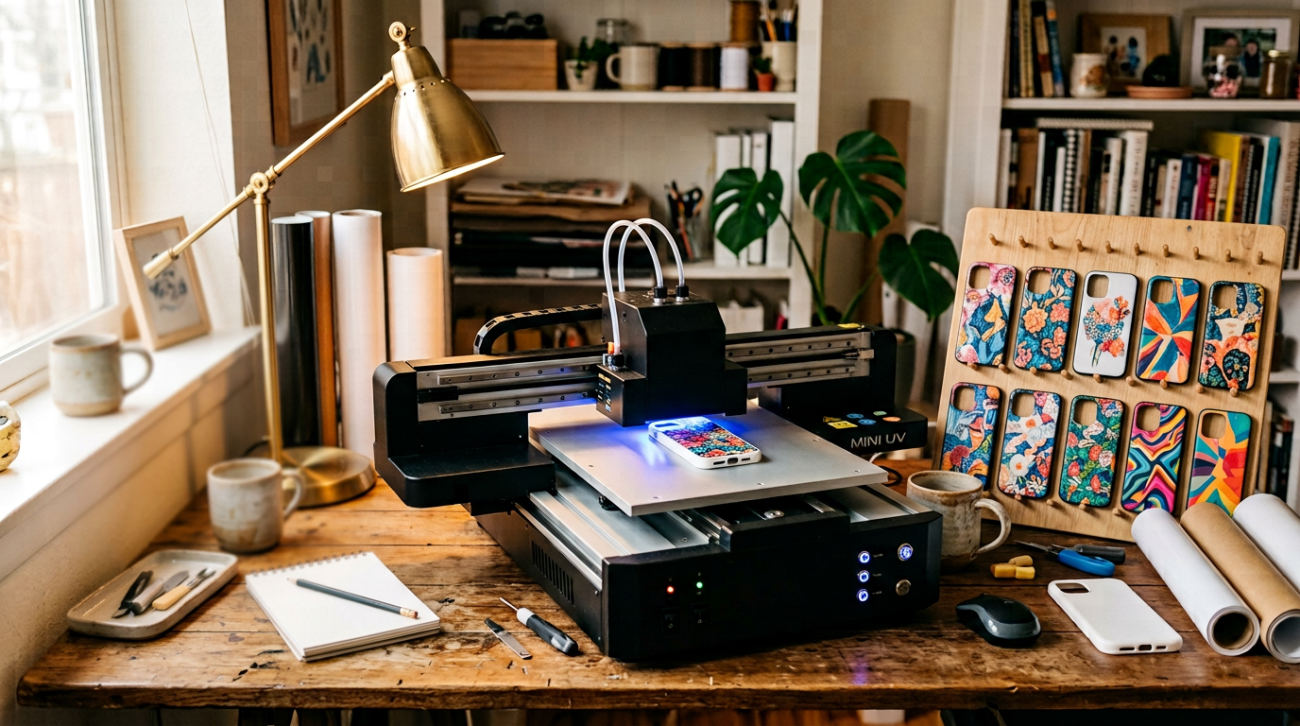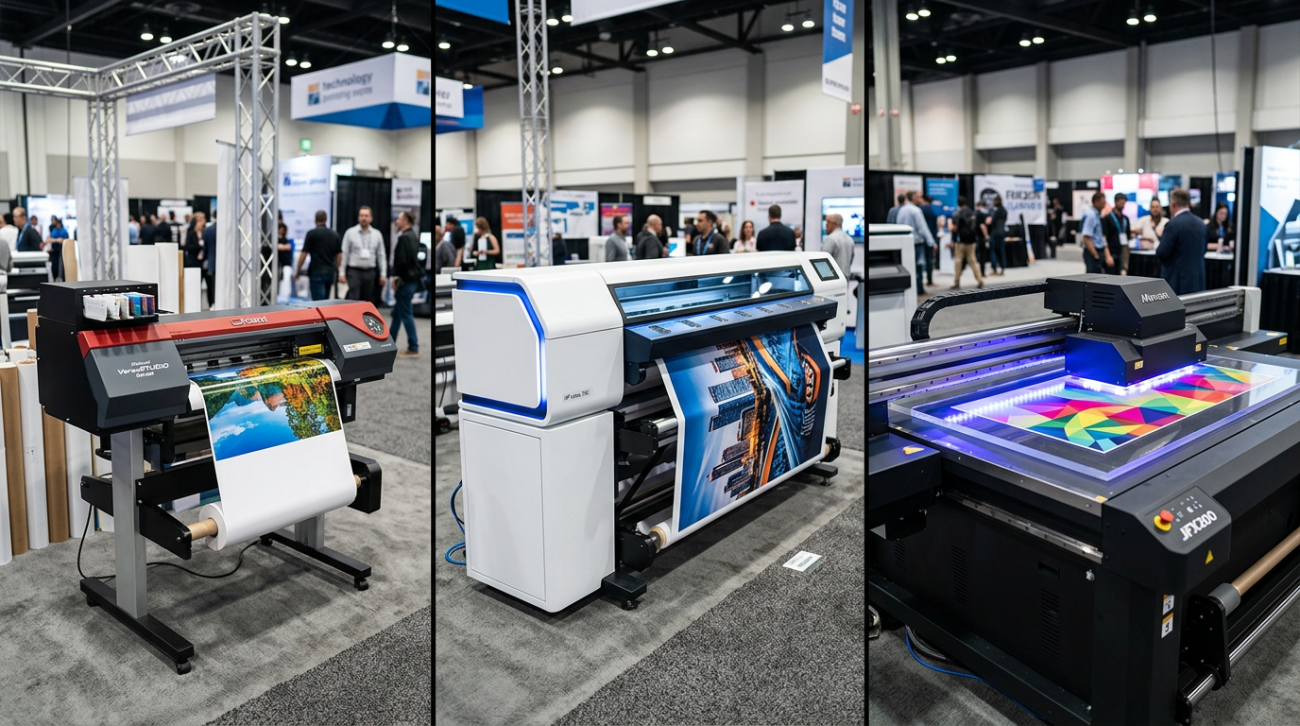


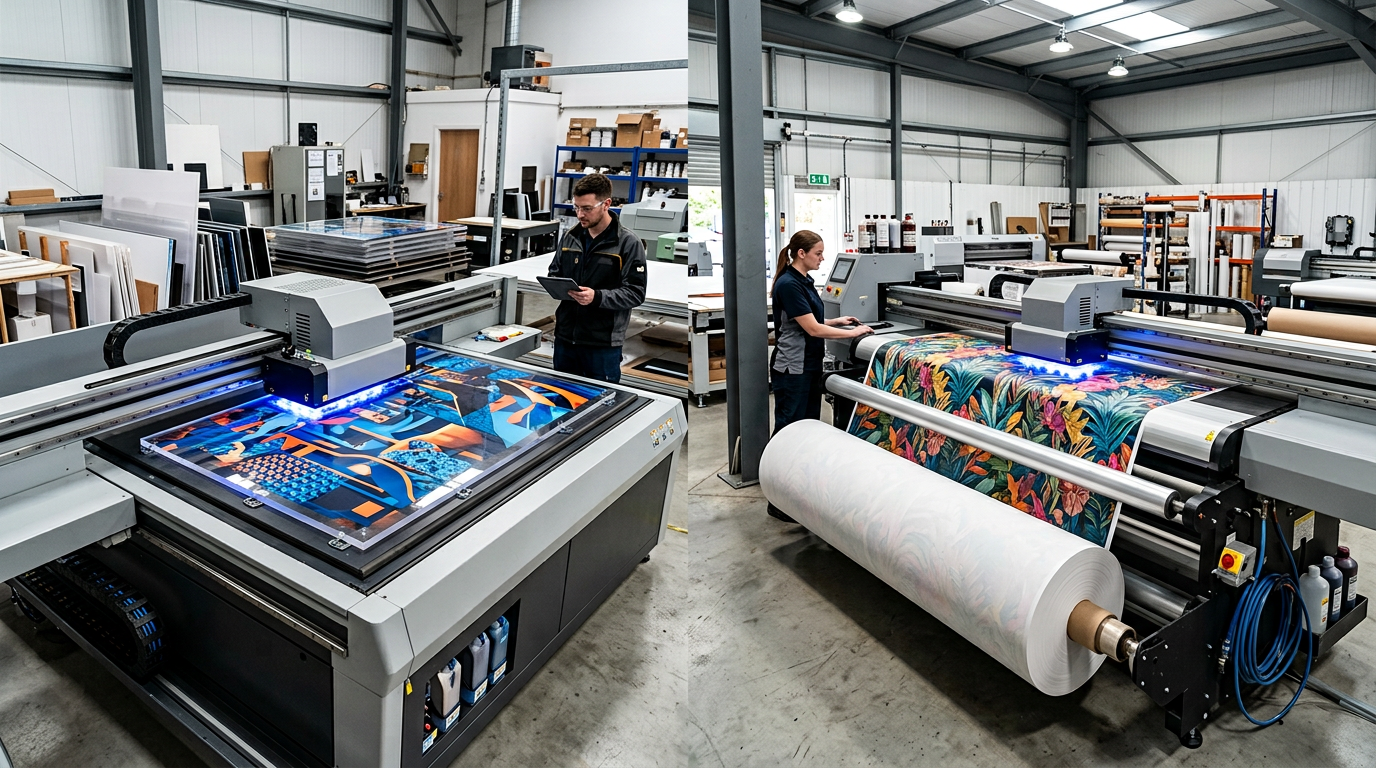
Walk into any UV machine showroom and you’ll face the same three silhouettes: the flatbed with its rigid table waiting for objects, the roll-to-roll with media spooled like a flex machine, and the hybrid wearing a belt that promises to be both. Same UV ink, same LED lamps, same heads — completely different businesses. Choosing the wrong family is the most expensive mistake in UV printing, because you can’t retrofit your way out of it.
This comparison settles it: how each family physically works, the honest product/limits map, true 2026 India pricing, speed-and-space math, the business models each one fits — and the decision flow that removes dealer persuasion from the equation entirely.
How Each Family Actually Works
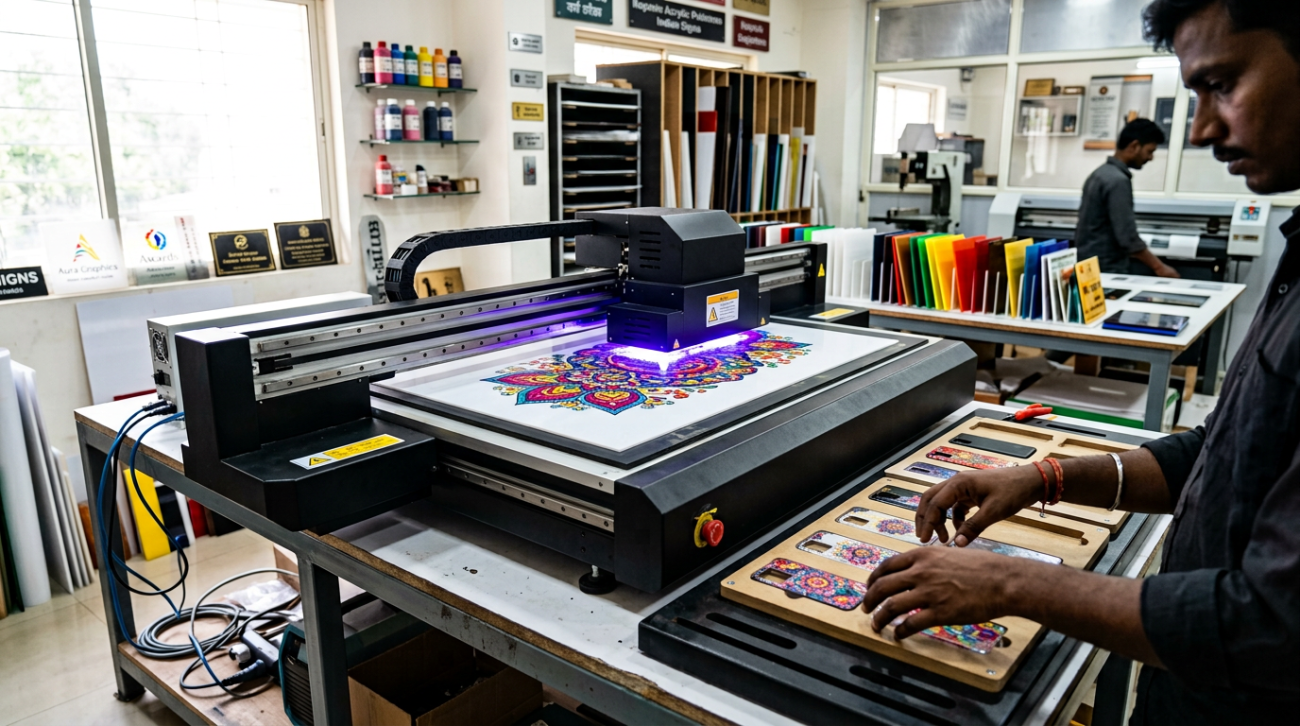
UV Flatbed: The substrate lies stationary on a vacuum-held bed while the gantry (or the bed itself, on some designs) moves in X and Y beneath the heads. The machine prints OBJECTS: plaques, sheets, cases, panels, boxes — anything flat-ish that fits within bed area and Z-height (typically 10–15 cm).
UV Roll-to-Roll: Flexible media feeds continuously from a roll under the heads, exactly like an eco solvent machine — but UV ink and LED curing mean uncoated and specialty roll media work: wallpapers, films, canvas, leatherette, backlit films, and heat-sensitive materials that latex can’t touch. It prints MEDIA, not objects.
UV Hybrid: A conveyor-belt bed carries either rigid sheets (placed on the belt, held by vacuum) or roll media (fed through the belt path). One machine, two personalities — with engineering compromises on both sides that the brochures skip and this guide won’t.
The Master Comparison Table
| Factor | UV Flatbed | UV Roll-to-Roll | UV Hybrid |
|---|---|---|---|
| What it prints | Rigid objects & sheets | Roll media only | Rigid sheets (pre-cut) + roll media |
| Signature products | Acrylic awards, sunboard signs, phone cases, glass art, wood panels, boxes | Wallpapers, window films, backlit flex, canvas rolls, vehicle films, uncoated banner media | Sheet signage + wallpapers/films combined |
| Max print area (typical business class) | 60×90 cm to 250×130 cm | 1.6 m / 1.8 m / 3.2 m width × unlimited length | 1.8–2.5 m belt width; sheets feed cut-to-size |
| Z-height objects | ✅ 10–15 cm (boxes, bottles with rotary jig) | ❌ flat media only | ❌ belt can’t carry tall/heavy 3D items safely |
| Long-format printing (banners, murals) | ❌ bed length caps everything | ✅ unlimited | ✅ rolls yes; sheets limited by belt handling |
| Heavy/thick sheets (10mm acrylic, MDF) | ✅ bed holds weight | ❌ | ⚠️ belt load limits; thin sheets only |
| Entry price (India 2026) | ₹4.5 – 12 lakh (6090–9060 class) | ₹6.5 – 16 lakh (1.6–1.8m) | ₹12 – 28 lakh |
| Operator skill demand | Medium (jigs, Z-height, layers) | Lower (media handling similar to eco solvent) | Higher (two workflows to master) |
| Footprint & utilities | Smallest; 12×14 ft room | Longer; needs media roll handling space | Largest; belt length + roll space |
| Downtime blast radius | One product family stops | One product family stops | ⚠️ BOTH families stop when the single machine is down |
When the Flatbed Wins (and It’s Most of the Time for Small Shops)
Flatbed UV owns the value-added object economy: trophies, nameplates, plaques, panels, cases, decor — where customers pay for the item, not the square foot. Gross margins of 60–80% are normal because the substrate costs ₹30–300 and the printed product sells at ₹300–3,000. Flatbeds also win on learning curve forgiveness: bad prints cost a ₹40 plaque, not a ₹900 roll section, and the machine teaches you substrate science one object at a time. For any first UV machine serving local, mixed, high-margin demand — flatbed is the default correct answer.
When Roll-to-Roll Wins
Roll UV lives on media breadth economics: it prints the same jobs as eco solvent (flex, films, decals, wallpapers) but on uncoated/specialty stock at premium rates. The winning use-cases are specific and big:
- Wallpaper & wall murals — the Indian decor boom’s core product; UV prints textured, uncoated wallpaper base that eco solvent can’t.
- Window/frosted films & transparent media — white-ink capability opens glass-film printing that dominates corporate interiors.
- Backlit films & premium signage media — richer blacks, no coated-media sourcing anxiety.
- Heat-sensitive specialty rolls — LED curing is cool; thin films and shrink-sensitive media stay dimensionally stable.
If your order book reads “we need 800 sq m of wallpaper” not “we need 200 plaques,” roll-to-roll is your machine. The margin per square metre is thinner than flatbed objects, but volume and B2B repeatability compensate.
The Hybrid Case — and Its Honest Costs
Hybrids tempt hard: “one machine, rigid + roll, half the space of two machines!” The engineering reality: belts prefer LIGHT, FLAT, PRE-CUT sheets; heavy 8×4 rigid media strains belt vacuum and registration; roll-media feed geometry is a compromise versus a true roll machine’s tension system. You gain versatility; you quietly lose the extremes of both worlds.
Buy hybrid when: your model is genuinely dual (signage panels + wallpapers in proven volumes), space forbids two machines, and you accept the belt’s substrate limits. Skip hybrid when: 80% of revenue is one side — buy the specialist on that side, add the other later. And never forget the redundancy question: one hybrid down = your whole shop down; a flatbed + small roll machine degrade gracefully.
Head-to-Head Economics: Same Rupee, Three Machines
| Metric (Typical Setup) | 6090 Flatbed | 1.8m Roll-to-Roll | 1.8m Hybrid |
|---|---|---|---|
| All-in setup cost | ₹6.5 – 9 lakh | ₹9 – 14 lakh | ₹15 – 24 lakh |
| Flagship revenue stream | Acrylic/awards/signage objects | Wallpapers, films, banners | Both, shared machine hours |
| Realistic mature monthly billing | ₹1.5 – 4 lakh | ₹2.5 – 6 lakh | ₹3 – 7 lakh |
| Gross margin structure | 60–80% (object value-added) | 35–55% (media volume) | Blended 45–60% |
| Capital payback (disciplined shop) | 8 – 14 months | 10 – 18 months | 14 – 24 months |
| Complexity tax | Low | Low–medium | Medium–high (two workflows, one machine queue) |
The flatbed’s faster payback and the roll machine’s bigger top line explain the market’s shape: small entrepreneurs start flatbed; media-volume players start roll; hybrids serve the proven-mixed minority.
The Decision Flow (Six Questions, One Answer)
- Do your target products stand up as objects (plaques, cases, panels, boxes)? → Flatbed. Stop here.
- Do they unroll (wallpaper, films, banners, decals)? → Roll-to-roll. Stop here.
- Genuinely both, in money — not imagination — with ONE machine space? → Hybrid.
- Both, with space and budget for two? → Two specialists. Better redundancy, better at each craft.
- Curved products (bottles/helmets) a third or more of planned revenue? → Add UV DTF to whichever family you chose; no flatbed or roll handles curves well.
- Not sure yet? → Flatbed 6090. It’s the option that keeps the most doors open per rupee while you discover your market.
Where UV DTF Fits in the Family Map
Since this comparison lives in 2026, no flatbed-vs-roll discussion completes without the fourth sibling: UV DTF machines print transfers, not media and not objects. They’re roll-fed like roll-to-roll machines (and confused with them constantly), but their output goes ONTO objects like a flatbed’s — by hand, as crystal stickers. Quick orientation:
| Question | Flatbed | Roll-to-Roll | UV DTF |
|---|---|---|---|
| Phones cover? | ✅ direct, premium | ❌ | ✅ as transfer |
| Wallpaper? | ❌ | ✅✅ native | ❌ |
| Bottle (curved)? | ⚠️ rotary jig only | ❌ | ✅✅ native |
| Sunboard sign? | ✅✅ native | ❌ | ⚠️ small pieces only |
Many 2026 startups now begin UV DTF-first (₹1.5–2.8 lakh entry) and add the flatbed in year two — the reverse-sequence answer that didn’t exist before 2023. Choose your FAMILY on the product list; choose the ORDER on entry economics.
Workflow & Staffing: The Daily Reality Difference
| Daily Detail | Flatbed Shop | Roll Shop | Hybrid Shop |
|---|---|---|---|
| Core skill | Jig making, Z-measurement, layer logic | Media handling, take-up tension, large-format RIP tiling | Both, plus queue-juggling priorities |
| Typical job rhythm | Dozens of small jobs/day | Few long runs/day | Mixed — scheduling discipline needed |
| Waste profile | ₹20–300 per error (one plaque) | ₹300–2,000 per error (metres of media) | Both risk types present |
| Staffing at maturity | 1 operator + 1 finishing helper | 1 operator (self-sufficient) | 2 operators when busy |
| Customer-facing pace | Walk-ins, approvals, personalization | B2B order-book rhythm | Both customer types, both rhythms |
The quiet point: flatbed businesses are people businesses (every object unique, approvals constant); roll businesses are process businesses (long unattended runs, tight repeatability). Match the family to the way YOU like working — owners who pick against their temperament print profit thinner than the spec sheet promised.
Site Preparation: What Each Family Demands of Your Room
- Flatbed (6090): 12×14 ft. Power: 16A + 3–5 kVA stabilizer. Air: compressor for vacuum. Heaviest single demand: door width and floor load (350–600 kg machines).
- Roll-to-roll (1.8m): 18×12 ft minimum with clear roll-handling paths. Media storage racks (vertical). Take-up/output side needs clean drop zone. Power as above + chiller considerations on Ricoh builds.
- Hybrid (1.8–2.5m belt): the most demanding: belt loading clearances front AND rear, roll paths, sheet staging tables on both sides. Budget 20×14 ft and hoist/team-lift plans for heavy sheets.
Two-Year Scenario Stories
Story A — Kanpur flatbed-first: Started 6090 (₹6.8L all-in) on awards + nameplates. Month 8 added UV DTF for corporate bottle orders. Month 20: 2 anchor schools + 3 corporate accounts, ₹2.1L/month average billing, flatbed utilization ~65%. Roll machine? “Wallpaper inquiries come twice yearly — still not worth it.” Family matched to demand: correct, compounding.
Story B — Surat roll-first: Decor market already asking for custom wallpaper; started 1.8m roll UV (₹11L all-in). Month 4: two interior designers channeling steady murals. Month 14: added small flatbed STRICTLY for the glass/wood accent pieces designers began requesting. His roll machine still bills 4× the flatbed. Sequence matched HIS market: correct.
Story C — the cautionary tale: First-time buyer chose a ₹19L hybrid for “future flexibility.” Year 1 reality: 85% of jobs were small objects that a 6090 handles better — while 4-hour roll queue waits cost him a wallpaper dealer relationship. The hybrid wasn’t wrong for the market; it was wrong for HIS market evidence. Configuration follows orders, not anxiety.
The Combo Roadmap for Growing Shops
- Stage 1 (₹5–9L): 6090 flatbed OR UV DTF, matched to your product lane.
- Stage 2 (add ₹2–7L): the complementing curve/flat sibling, when cross-selling evidence exists.
- Stage 3 (₹9–16L): roll-to-roll ONLY when wallpaper/film demand recurs monthly — bought with dream, justified by order book.
- Stage 4: industrial consolidation (9060/2513 or 3.2m roll) against signed volumes.
Run this roadmap and you never own an idle family; each machine’s order flow funds the next. That sequencing — boring, evidenced, patient — is the whole competitive advantage in a segment where the loud failures bought configurations and the quiet successes bought demand.
The Media Library: What Each Family Can Feed On
Machine family decides media freedom more than any spec. The practical inventory:
| Media | Flatbed | Roll-to-Roll | Hybrid |
|---|---|---|---|
| Acrylic sheets (2–12 mm) | ✅ native | ❌ | ⚠️ thin sheets only (belt limits) |
| Sunboard / PVC foam | ✅ up to 10 mm | ❌ | ✅ 3–5 mm comfortable |
| MDF / plywood / wood | ✅ native | ❌ | ⚠️ weight limits apply |
| Glass / mirror panes | ✅ native | ❌ | ⚠️ thin + light only |
| Metal sheets / ACP | ✅ native | ❌ | ⚠️ thin gauges |
| Wallpaper rolls | ❌ | ✅ native | ✅ native |
| Backlit films / window films | ⚠️ sheet pieces only | ✅ native | ✅ native |
| Self-adhesive vinyl rolls | ❌ | ✅ native | ✅ native |
| Canvas / fabric rolls | ❌ | ✅ native | ✅ native |
| Leatherette / PU rolls | ❌ | ✅ (flexible ink) | ✅ (flexible ink) |
| 3D objects (boxes, plaques, cases) | ✅ with Z-height | ❌ | ⚠️ flat-bottomed light items only |
Read this table with your product list in hand: every ❌ in your critical column is a business you can’t serve, and every ⚠️ is a compromise you’ll explain to customers forever.
Throughput Math at the Same Money (₹7 Lakh Deployment)
| Measure | 6090 Flatbed (dual i3200) | 1.6m Roll UV (dual i3200) |
|---|---|---|
| Typical flagship job | 24 phone cases on jig / 1 A2 plaque | 50 m wallpaper run / film batch |
| Output measure | ~70–110 cases/hr on jigs; 8–14 A2 panels/hr | ~100–200 sq ft/hr production quality |
| Revenue per machine-hour (typical rates) | ₹1,200 – 2,500 (objects) | ₹900 – 1,800 (media at ₹45–90/sq ft sell) |
| Labour touch per hour of print | High — load/unload objects constantly | Low — long unattended runs |
| Waste cost per error | ₹20 – 300 (one object) | ₹300 – 1,500 (media metres) |
| Utilization ceiling (single machine, realistic) | ₹1.5 – 4 L/month billing | ₹2.5 – 6 L/month billing |
The flatbed’s higher labour-touch isn’t a weakness — it’s WHY object printing pays more per hour. Choose the higher-touch model when your advantage is service breadth; choose the low-touch media model when your advantage is B2B volume contracts.
Cross-Compatibility Myths (Frequently Asked in Showrooms)
“Can’t the flatbed print roll media sometimes?” Hand-feeding banner media across a flatbed has been attempted since 2015 by every hopeful shop. Results: banding city from unsupported media movement, curled edges striking heads, and registration that wanders. Technically possible as a party trick; commercially unusable. “Can’t the roll machine print thin boards?” Some 1–2 mm sheets squeak through roll paths on some models — with feed-geometry anxiety for every mm. Sheet-work beyond paper-thin belongs to flatbeds/hybrids; machines told otherwise repay the lesson ₹60,000 at a time. Design families exist because the physics does.
Learning Curves: Weeks to Competence
| Skill | Flatbed | Roll-to-Roll | Hybrid |
|---|---|---|---|
| Basic operation (load, print, unload) | 3 – 5 days | 2 – 4 days | 1 – 2 weeks (two systems) |
| Production confidence (RIP layers, quality modes) | 3 – 4 weeks | 2 – 3 weeks | 4 – 6 weeks |
| Mastery (jigs, white-layer art, troubleshooting) | 2 – 4 months | 1 – 2 months | 3 – 5 months |
| Institutional knowledge difficulty | Mostly tactile (jigs/prep) | Mostly systematic (media/RIP) | Both stacks |
Teams with eco solvent/large-format background find roll UV nearly frictionless. Teams from gift/craft backgrounds find flatbeds natural. Hybrids demand experience in whichever side is foreign to the crew.
The Site-Prep Side-by-Side
| Requirement | 6090 Flatbed | 1.8m Roll UV | 1.8m Hybrid |
|---|---|---|---|
| Room minimum | 12 × 14 ft | 18 × 12 ft | 20 × 14 ft |
| Machine weight / floor | 350 – 600 kg / normal RCC fine | 250 – 450 kg | 600 – 900 kg / check floor + access |
| Air compressor | Required (vacuum bed) | Usually no | Required |
| Special electricals | 16A + 3–5 kVA stabilizer | Same + chiller circuit on Ricoh builds | Same, bigger top end |
| Media/object storage | Vertical substrate racks | Roll racks + humidity care | Both systems, plus belt-path clearance |
| Install day crew | 2–3 people | 2–3 people | 4 people + door/route survey mandatory |
Resale & Upgrade Paths by Family
Flatbed 6090s enjoy the deepest second-hand demand (every new UV entrant wants one) — expect 45–55% recovery at two years with maintenance logs. Roll UV machines sell to a smaller professional pool; recovery 40–50% but slower sale cycles. Hybrids: the thinnest used market — buyers of used hybrids are rare precisely because new buyers of hybrids would’ve often been better served by two specialists; plan longer holding periods. The family’s downstream liquidity deserves a seat in your purchase decision today.
Ink & Consumable Cost Profiles by Family
| Line | Flatbed Shop | Roll UV Shop |
|---|---|---|
| Ink consumption profile | Bursty; white-heavy (base layers on dark/clear objects) | Steady; colour-heavy across long runs; flexible-family ink pricing |
| Monthly ink (typical) | 3 – 6 L all channels | 8 – 20 L per machine-shift |
| Substrate media stock value | ₹25,000 – 60,000 (mixed blanks panels) | ₹60,000 – 1.5 lakh (roll media is capital) |
| Waste economics | ₹20 – 300 per object error | ₹300 – 1,500+ per metre-run error |
| Consumables cadence | Dampers/caps quarterly-ish at moderate duty | Faster cadence at industrial duty cycles |
Hiring by Family: Who You Can Actually Find
The operator labour market differs by family in ways business plans rarely note: roll-machine operators exist in every print city (eco solvent/flex crossovers adapt in a fortnight — RIP fluency and media handling transfer directly). Flatbed UV operators are genuinely scarce — the jig/Z-height/layering craft must mostly be trained in-house, hired on aptitude (detail-loving, process-respecting juniors) rather than on résumés. Hybrid operators are unicorns — plan to build them over months from your own bench. This alone has quietly decided several family choices for owner-operator founders: the family whose staffing you can actually source deserves real weight in the decision.
Financing & Insurance: Family Differences That Affect Cash
- Financing: the 6090 flatbed is the industry sweetheart of machinery finance — standard ticket size, deep assembler-finance tie-ups, smooth approvals for GST-registered proprietors. Roll machines finance similarly. Hybrids at ₹15–28L attract closer lender scrutiny (projected cash flows asked more seriously). Prepare the same pack for all: Udyam, GST, 6-month bank statements, and a one-page business plan that mentions products not adjectives.
- Insurance: machinery insurance (fire/theft/accidental damage) runs ~0.5–1% of machine value annually and is criminally under-bought in this segment — a 6090 at ₹5,000/year premium is arithmetic self-defense. Insure at replacement value including installation accessories, not invoice-less sticker price.
- Transit: insist on machine-transit insurance on every delivery (new or relocation) — “transport mein ho gaya” is uncovered without it.
The Final Verdict Matrix: Product List → Family
| If Your Target List Reads Like… | Buy |
|---|---|
| Awards, nameplates, plaques, phone cases, decor objects | Flatbed 6090 |
| Wallpapers, murals, window films, decals, banners | Roll-to-roll 1.6–1.8m |
| Bottles, helmets, gadgets, curved branding | UV DTF first (then flatbed) |
| Half panel-signage + half wallpaper, proven orders both sides | Hybrid — or two specialists (our default advice) |
| Full 8×4 industrial panels, furniture sheets at volume | Large flatbed 2513 / 9060 |
| Everything imagined, nothing proven | 6090 flatbed — the discovery machine |
Showroom Test Protocol by Family (Your Demo-Day Script)
Testing a flatbed: white-on-black acrylic coverage; embossed multi-layer texture pass; a warped sunboard under vacuum; Z-height measured on YOUR thick object; jog-noise listening; edge-of-bed print placement accuracy.
Testing a roll machine: YOUR wallpaper/film roll loaded (not their demo roll); tension behaviour across a 5-metre run; take-up alignment; edge guides; pinch-roller evenness; LED shadow on dense blacks (banding check at production speed).
Testing a hybrid: BOTH scripts — plus belt-tracking with a heavy sheet placed slightly off-centre, and the belt-to-roll changeover process timed (if swapping modes takes an engineer and an hour, your two-worlds plan quietly dies in operation).
Buyer Regrets: The Survey Nobody Conducted but Everyone Recognizes
- Flatbed buyers’ #1 regret: under-buying Z-height clearance (5 cm machines locking out boxes/bottles forever).
- Roll buyers’ #1 regret: under-buying machine width for the wallpaper segment (1.6m when projects demanded 1.8m sizing conventions).
- Hybrid buyers’ #1 regret: not measuring real share of rigid-vs-roll demand before paying the hybrid premium — most discover they ran 80/20 all along.
- Universal regret: saving ₹30,000 on stabilizer/power infra, paying ₹60,000+ for the consequence.
- The anti-regret (every satisfied buyer): buying the supplier, not just the machine — the service relationship determines whether year one was education or litigation.
Used-Market Price Signals by Family (2026 Reality)
| Family (2–3 yr old, maintained) | Typical Resale Band | Liquidity |
|---|---|---|
| Desktop A3 UV | ₹45,000 – 1,10,000 | Fast (constant entry demand) |
| 6090 flatbed (i3200 dual) | ₹2.6 – 4.5 lakh | Fastest of the serious machines |
| 1.6–1.8m roll UV | ₹3.5 – 7 lakh | Moderate (professional buyers only) |
| Hybrid belt machines | ₹6 – 13 lakh | Slowest (thin buyer pool) |
| Industrial 2513 flatbed (Ricoh) | ₹7 – 16 lakh | Slow-but-serious buyers |
Liquidity insight: flatbeds sell fast because new entrants perpetually hunt them; roll/hybrid sales take patient marketing to professional buyers — factor the exit-friction difference into family selection if upgrade cycles fit your plans.
Power & Utilities: The Monthly Reality by Family
| Utility | 6090 Flatbed | 1.8m Roll UV | Hybrid |
|---|---|---|---|
| Printing consumption | 1 – 2.5 kW while working | 1.5 – 3 kW | 2 – 3.5 kW |
| Monthly bill contribution (normal duty) | ₹2,500 – 5,500 | ₹3,500 – 8,000 | ₹4,500 – 9,500 |
| Climate control pressure | Room AC strongly recommended | Strongly recommended | Near-mandatory |
| Compressed air | Vacuum bed needs | Usually none | Vacuum belt needs |
Training Sources for Each Family
- Assembler installation-training (2–4 days bundled): your foundation — treat those days as recorded course material (video permission sought politely — most permit).
- RIP vendor content: Maintop/Onyx distributor tutorials and documentation close half the skill gap nobody attributes to software.
- Owner WhatsApp/Telegram communities: model-specific peer groups compress years of edge-case knowledge into searchable threads. Join three; lurk before asking; the 11 PM rescue answer lives there.
- Material-brand workshops: media/film manufacturers periodically run application clinics through distributor networks — free skill-multiplier days.
- Your own documented SOP evolution: the most valuable training material in your shop by year two will be written by your machine, through your camera, during month one’s mistakes.
The One-Room Dual-Machine Question
“Can my 150 sq ft studio run a 6090 flatbed AND a UV DTF?” — the most-asked space question this year. Verdicts: YES if zones get respected — flatbed against the long wall with 3-side bed access, UV DTF along the opposite wall with film loading clearance, shared packing/QC counter, shared climate and power planning (one 5 kVA stabilizer adequately serving both is fine through proper distribution); NO if the room needs the same floor space for machine access + finished-good staging simultaneously — cramped duals destroy more output than solo-welcoming rooms. The room’s job is flow; the machines must serve the flow, not occupy it.
Decision Review: What to Re-Read Before Signing
Final discipline for this comparison: re-check your top-10 products against the Master Comparison Table’s product rows. Mark each product’s compatible family. If any single family covers under 70% of your realistic, customer-proven (not imagined) product revenue — pause the purchase and re-interview your demand. The right family decision is where both your enthusiasm AND your data point the same direction; everywhere else, wait a week and ask the market again.
A Closing Note on Technology Cycles
Machine families reset roughly every 3–4 years in this industry; business models built on them renew annually. Whatever configuration you buy today, its real asset value decays — while the customer contracts, product lanes, and local reputation you build with it appreciate. The correct posture: buy the family your FIRST two years of evidence demands, extract its fullest productivity through discipline, and let TRADE-IN conversations start from markets proving new needs — never from showroom novelty books. The family choice was never about machine perfection. It was about which mistakes you could most afford to make while learning your market. Choose accordingly, then run the machine until your customers invent its replacement’s demand for you.
The 60-Second Recap (Screenshot This)
The entire comparison resolves into four unbreakable rules: (1) Products decide families — objects to flatbeds, media to roll machines, curves to UV DTF; families never substitute. (2) Hybrids earn their premium only against proven both-sides order books; imagined demand buys specialists better. (3) Entry-economics sequencing beats one-machine fantasy: UV DTF-first + flatbed-second beats hybrid-first for most 2026 starters. (4) The 6090 flatbed remains the discovery machine — the configuration that keeps maximum doors open per rupee while your market reveals which specialization deserves devotion.
Match the family to your proven product list; sequence purchases by evidence; and let the market — never the brochure — write your machine room’s story.
Frequently Asked Questions (FAQs)
Is a UV hybrid printer worth it for a small business?
Usually not as a first machine: the ₹15–24 lakh hybrid budget buys a strong 6090 flatbed AND a 1.6m roll machine separately with better capability and redundancy. Hybrids earn their premium when proven dual demand meets single-machine space constraints.
Can a UV flatbed print banners or wallpaper?
No — flatbeds print objects within bed dimensions. Wallpaper, banners, and roll films need roll-to-roll feed. This single fact resolves most flatbed-versus-roll questions.
Can roll-to-roll UV replace my eco solvent machine?
For wallpapers, films, specialty and uncoated media — yes, often at premium rates. For commodity flex at razor-thin local rates, eco solvent stays cheaper per square metre. Most shops run both, each on its margin lane.
Which UV configuration has the fastest ROI?
The 6090 flatbed — smallest capital, fattest unit margins. Roll machines scale bigger but pay back slower; hybrids biggest but slowest unless underwater with mixed orders from month one.
Do hybrids handle thick acrylic sheets?
Poorly. Belt systems suit thin, light, pre-cut sheets; 8–10 mm acrylic and MDF belong on true flatbeds. If thick rigid work matters, eliminate hybrid shortlists immediately.
Final Verdict
The shape of your products chooses the machine: objects → flatbed; rolls → roll-to-roll; proven both in one room → hybrid; proven both with space → two specialists. Everything else — belts, beds, brochures — is detail. In 2026 India, the default first UV machine for a local value-added business remains the 6090 flatbed, the volume-play remains the 1.8m roll machine, and the hybrid remains the specialist’s tool — bought on evidence, never on brochure confidence.
Confused between configurations for your product list? Check our UV printer range — flatbeds, roll systems and hybrids with transparent specs — and share your top five products with us; we’ll map the configuration to your demand before any money moves.