
India sells over 150 million smartphones a year, and almost every one of them wears a case worth ₹150–600 bought at least twice in the phone’s life. Now add the personalization twist — names, photos, anime, brand collabs, couple designs — and you understand why custom phone case printing has become the single most proven gateway business in UV printing. Low capital, instant product understanding, zero customer education needed, and margins that embarrass most small businesses.
But between “buy a machine, print cases, get rich” reels and reality sits a specific set of decisions: which machine tier, where to source blank cases, which phone models to stock, how to price, and which sales channel actually converts in India. This guide is the complete playbook — investment math, sourcing hacks, production workflow, pricing psychology, and the scaling path from bedroom to brand.
Why Phone Cases Are the Perfect UV Starter Product
- Universality: everyone instantly understands the product — no explaining, no educating, no samples begged.
- Unit math that works at any scale: case blank ₹40–90 + ink ₹2–5 → sells ₹250–600. 60–75% gross margin, forever.
- Emotional purchases: customers buy feelings (their photo, their fandom), not plastics — so price resistance stays low and repeat gifting keeps flowing.
- Content-born demand: the printing process itself is irresistible reel content; your production IS your marketing.
- Tiny learning curve: first sellable case on day two of machine ownership, not month two.
Investment Options: Three Entry Setups
| Setup | Machine | Total Investment | Daily Capacity | Best For |
|---|---|---|---|---|
| Bedroom (Bootstrap) | Desktop A3/A4 UV flatbed | ₹1.0 – 2.3 lakh | 60 – 150 cases | Students, homemakers, side-hustlers; Instagram+local |
| Studio (Recommended) | 6090 flatbed, dual i3200-U + jigs | ₹6 – 9 lakh | 250 – 500 cases (+ full product menu) | Dedicated small business; retail spot, kiosk, or B2B supply |
| Kiosk Hybrid | Desktop UV DTF + heat tools (or small flatbed) | ₹1.8 – 3.5 lakh | 80 – 200 transfers | Mall kiosks, gadget markets — footprint-first selling |
The Machine Decision in Detail
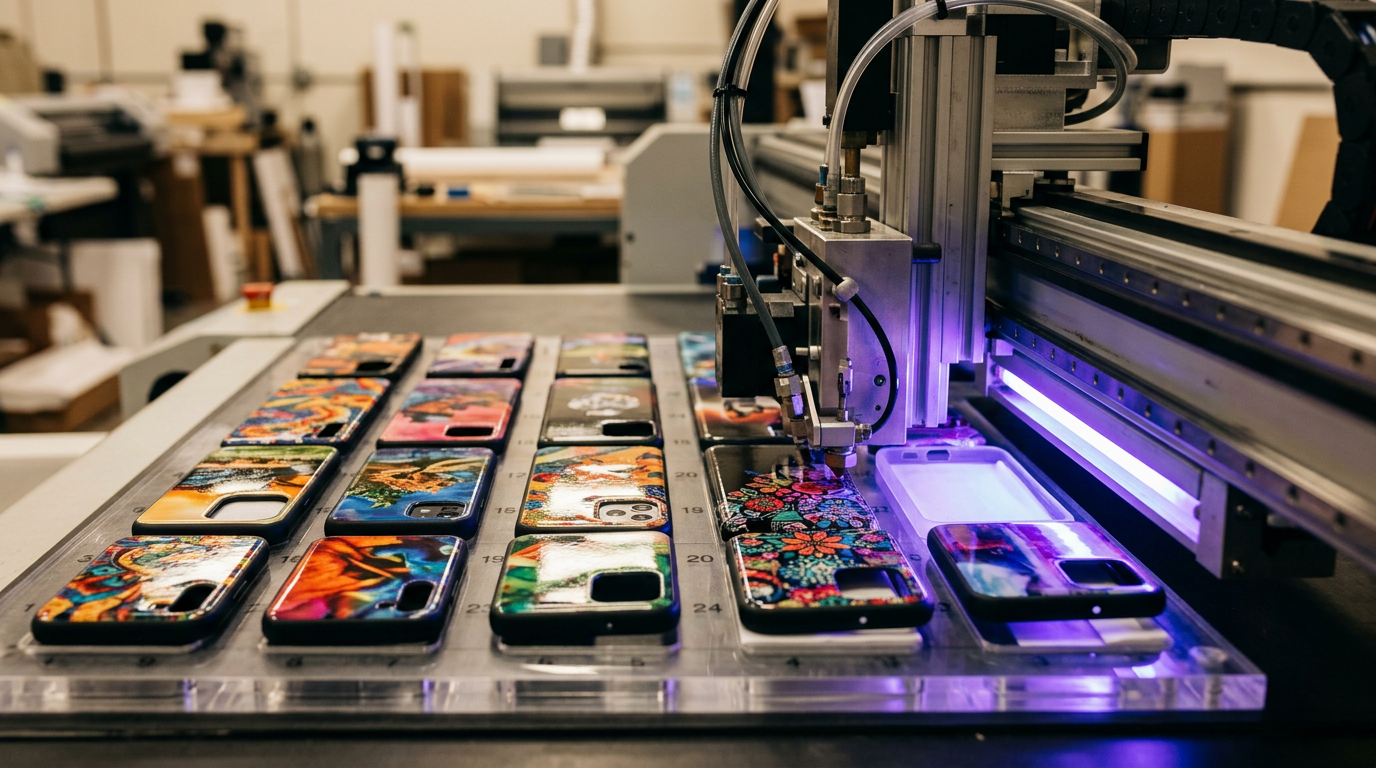
Desktop A3/A4 UV (₹80,000–2,20,000): one case at a time or 2–4 on a mini-jig; Epson XP600-class head; CMYK+White+Varnish mandatory (white is what makes designs pop on dark/coloured cases and enables prints on transparent cases). Prints direct-on-case = the premium matte/textured finish customers pay more for.
6090 flatbed (₹4.5–7.5 lakh): the same business with a productivity multiplier — 12–24 cases per pass on acrylic jigs, plus the entire plaque/trophy/signage menu sitting beside the phone-case goldmine. Buy this when you can see 100+ cases/day of demand or already run parallel product lines.
UV DTF route (₹1.5–6.5 lakh): print “crystal sticker” transfers hand-applied to cases — slightly less premium than direct print, but insanely flexible (also covers bottles, laptops, helmets with the same machine). Some of the busiest instagram case shops quietly run UV DTF because one roll-fed machine never stops.
Verdict: bedroom startup → desktop direct-print UV. Eyes on a brand with multi-product ambitions → start saving for the 6090 from day one. Volume-transfer hustle → UV DTF.
Blank Case Sourcing: Where Margins Are Actually Made
Blank case quality decides reviews; sourcing price decides margins. The ecosystem:
| Source | Price/Pc (Typical) | Notes |
|---|---|---|
| Delhi (Karol Bagh/Gaffar), Mumbai (Crawford/Lamington), Chennai (Ritchie St) markets | ₹35 – 70 | Cheapest per-piece; physical quality check before buying bulk; model coverage varies weekly |
| Alibaba/China imports (bulk) | ₹25 – 60 landed | Best rates at 500+ pcs/model; shipping time + MOQ discipline needed |
| Indian wholesale platforms (IndiaMART, TradeIndia) | ₹45 – 90 | Best convenience-per-rupee for startups; sublimation/UV-ready blanks specifically listed |
| Local case distributors | ₹55 – 100 | Fastest restock, smaller margin — used for urgent model gaps |
Model-coverage strategy matters more than price: stock deep on the 15–20 best-selling models (current iPhones, Samsung S/A/M series, Vivo/Oppo/Realme/Redmi top sellers) and run a 24–48 hr “order-on-demand” promise for the long tail. Chasing 60 models in inventory strangles cash; chasing 3 starves sales.
Pricing That Sells (Indian Market Rates 2026)
| Product Tier | Sells At | Your Cost | Notes |
|---|---|---|---|
| Name/text design case (template) | ₹250 – 350 | ₹50 – 100 | Volume workhorse; kiosk-friendly 10-minute promise |
| Photo-printed case | ₹300 – 450 | ₹50 – 100 | Gifting king; birthdays/anniversaries/Valentine’s |
| Premium textured/embossed (raised varnish) | ₹450 – 700 | ₹60 – 120 | UV’s unfair advantage — sublimation can’t do this |
| Couple/theme sets (2 cases) | ₹550 – 900 | ₹100 – 200 | Bundles lift order value painlessly |
| Corporate bulk (logo cases, 50+) | ₹150 – 300/pc | ₹45 – 90 | B2B volume lane; thinner margin, fat orders |
Pricing lines that convert: display “starting ₹299” prominently; bundle shipping/pickup; and charge ₹100 extra for 30-minute express — third surprisingly often pays.
Production Workflow: From WhatsApp Photo to Finished Case in 20 Minutes
- Order intake: WhatsApp catalog + a simple form (model, design/photo, name, quantity). Payment-first policy for custom work — always.
- Design: template library for text designs (2 min); photo jobs cleaned in a preset action (5 min). Preview image back to customer for approval — this one habit kills 90% of disputes.
- Print: white layer + colour (+ varnish/emboss for premium) — 2–6 min/case depending on machine and jig.
- QC: edge-to-edge coverage, alignment, wipe test. Pack in your branded sleeve — packaging is where a ₹300 case starts looking like ₹600.
- Handover + review ask: every delivery ends with a review request and a “next order: 10% off” card. Repeat and referral are the business’s real engine.
Where the Sales Actually Happen
| Channel | Share of Typical Startup Revenue | Playbook |
|---|---|---|
| Instagram + WhatsApp | 40–60% | Daily process reels, model-wise design grids, story polls; WhatsApp closes |
| Walk-in / college & market area visibility | 15–30% | A display wall of 50 stunning cases outsells any poster |
| Corporate/event bulk | 15–30% | HR gifting, college fests, brand merchandise — recurring and fat |
| Marketplaces (Flipkart/Amazon/Meesho) | 5–15% | Later stage: generic designs at volume; margins squeezed but machine never idles |
The 5 Mistakes That Kill Case Businesses
- Blank-case inventory fantasy: 40 models in stock, cash locked, half never sell. Stock the 15–20 proven sellers; pre-order the rest.
- Skipping the design-approval step: one “yeh nahi chahiye tha” per week becomes refund culture; previews take 40 seconds.
- White-ink neglect: on UV machines printing cases daily, white channel care IS machine life — circulation, daily nozzle check, no exceptions.
- Underpricing premium finishes: embossed/gloss customers are paying for texture — if you price it like a flat print, you’ve donated your differentiation.
- Staying a “case printer” forever: cases are the door, not the house — the same machine’s plaque/award/gift menu is where years 2–3 profit compounds.
Scaling Arc: Bedroom → Brand
Months 1–6: desktop machine, Instagram-led, 15–40 orders/day target, nail the model coverage. Months 6–12: add jigs, corporate bulk, possibly second desktop unit (cheap redundancy beats one big machine at this stage); design upload flow automated. Year 2: move to 6090 + UV DTF — cases become one lane of a personalized-products brand; retail collabs and white-label production for other Instagram shops (yes — printing for competing pages is excellent revenue). Year 3: your brand, your designs, your licensed artwork — the printing business that started “just phone cases.”
The Model-Coverage Strategy: Stocking Cases Without Drowning
The maths of phone models is brutal: ~40 actively-selling models at any time, each needing 3–4 colour blanks each in TPU AND hard PC variants — a “full coverage” fantasy locks ₹80,000+ in blank inventory. The working solution is a three-tier coverage map:
| Tier | Models | Stock Depth | Fulfilment Promise |
|---|---|---|---|
| Hero 15 (current iPhone 13–16 series, Samsung S/A top sellers, Vivo/Redmi/Realme flagships) | ~15 models × black+clear | 10–20 pcs each | Same/Next-day — advertise it loudly |
| Active 15 | next 15 sellers | 3–5 pcs each | Next-day; order-on-demand fallback |
| Long tail | everything else | Zero stock | 48–72 hr promise with confirmed availability script |
Refresh the Hero list monthly from your own order data — model popularity shifts faster than instincts do. And never let supplier MOQs push you into Tier-3 depth; cash stuck in unsold Motorola blanks has killed more case startups than bad printing ever did.
Design Files: Sources, Licensing & the Copyright Line
- Template asset libraries: build 200+ text/name templates (fonts licensed for commercial use — Google Fonts mostly qualifies; pirated font packs from Telegram groups don’t).
- Stock art with commercial licenses: Freepik/Vecteezy subscriptions are the professional answer; check the print-on-goods clauses specifically.
- Customer photos: the safest lane — customer owns the photo; your order form carries the “customer warrants rights” line.
- The danger zone: anime/movie/cricket-team/superhero art. Demand is enormous; so is the infringement liability. One studio notice or marketplace delisting can vaporize a young brand. Originals and licensed art only — it forces a better business anyway.
- In-house signature designs: 20–30 original pattern collections of your own are the real brand asset that competitors can’t file-clone.
Photography & Listing: Making ₹300 Look Like ₹800
Case photography determines online conversion more than print quality does. The starter setup is ₹3,000, not ₹30,000: one white + one textured backdrop board, one ring light + one desk lamp, your phone’s camera, and two consistent props (sunglasses, coffee mug, plant). Rules that lift conversion: same angle library for every design (grid consistency builds store trust); hand-in-frame shots communicate texture/emboss better than any spec line; short 5-second embossed-light-play videos outsell static images 3:1 on premium variants.
The Corporate Bulk Playbook
Every HR department and event manager is a 50–500-case order waiting to be quoted. The approach that works:
- Make the B2B one-pager PDF: your capacity (cases/day), past client logos mock-up samples, GST billing capability, per-piece slabs at 50/100/250/500, and the all-important line “delivery commitment: X days confirmed in writing.”
- Offer the free pilot: 10 cases with THEIR branding, delivered free before the decision meeting. Closing rate on pilot-first approaches is multiples of quote-first ones.
- Price bulk honestly: ₹150–300/pc at volume with clear payment terms (50% advance for custom corporate runs — always).
- Recurring hooks: onboarding kits (every new joiner gets a branded case + bottle), event memorabilia, festival gifting. Build the repeat structure INTO the first proposal.
Packing & Shipping That Generate Positive Reviews
The unboxing moment is your marketing team’s only on-ground employee. Budget packaging upgrades that pay for themselves: your logo sleeve (₹3–8), care card (“hand wash gently; matte for texture care”), thank-you/discount card, bubble-as-structure not bubble-as-afterthought. For shipped orders: courier aggregators beat retail counter rates by 30–40%; insure above ₹499 single-item values; and photograph every premium parcel before sealing — the 2 disputes/year this saves pay for the habit forever.
Quality Tiers in Blank Cases (Why ₹40 Cases and ₹70 Cases Both Exist)
| Blank Tier | Cost | Print Behaviour | Customer Feel |
|---|---|---|---|
| Economy hard PC | ₹35 – 55 | Adequate UV adhesion; occasional coating inconsistency | “Fine” — volume/marketplace work |
| Mid TPU soft | ₹45 – 75 | Excellent print pop; flexible; needs correct Z-height | “Premium feel” — the retail favourite |
| Designer blanks (matte/armour) | ₹60 – 110 | Best texture canvas for emboss work | “Boutique” — premium-tier pricing justified |
House rule followed by every profitable case shop: economy blanks never carry premium designs; designer blanks never leave at economy prices. Blank-tier and price-tier discipline keep both margin floors intact simultaneously.
Design Trends That Actually Sell in 2026 (India Edition)
Case design demand follows culture closely — and refreshes quarterly. The perennial sellers observed across Indian custom-case platforms and storefronts:
| Design Family | Demand Pattern | Notes |
|---|---|---|
| Photo-personalized (portraits, couple shots, baby photos) | Constant #1 seller — forever | Your enhancement quality decides reviews; learn basic photo cleanup |
| Name/initial monogram designs | Constant #2; strong female skew | Template library depth = conversion speed |
| Spiritual/devotional (deities, symbols, calligraphy) | Massive and stable; festive peaks | Original/licensed art only — this category looks generic-safe but art theft here draws the loudest backlash |
| Bikes/cars/fitness/gaming niche art | Strong male 18–35 lane | Original illustrations stand out in a sea of stolen vectors |
| Couple/anniversary sets | Valentine’s + wedding season spikes | Bundle pricing doubles ticket size naturally |
| Corporate logo + team merch | B2B steady flow | Brand-guideline respect wins repeat corporate accounts |
| Minimalist aesthetics (pastels, line art, quotes) | Urban trend-driven cycles | Refresh monthly from Instagram trends — first-shop advantage is real |
The Upsell Ladder: From ₹299 Visitor to ₹1,500 Customer
Design your product line as an escalation staircase, and most delighted customers climb it themselves:
- Entry (₹250–350): template name case / simple design. Zero-friction first purchase.
- Step 2 (₹350–500): their photo, enhanced + gloss or matte premium blank.
- Step 3 (₹500–800): embossed-texture premium case with designer blank.
- Step 4 (₹800–1,500): couple sets / gift-boxed case + pop grip + care kit.
- Step 5 (₹1,500+): gift hampers (case + bottle + diary + pen), anniversary bundles, corporate unit orders.
The ladder works because each step requires zero convincing — you’re offering finishes, not products. Shops that display the ladder visually (physical sample wall, tiered photo grid) report 30–50% higher average tickets than shops quoting flat single-tier pricing.
Marketplace Economics: When (and When Not) to List
| Reality | What It Means for You |
|---|---|
| Marketplace fees stack to 25–40% (commission + shipping + ads to be visible) | Your ₹350 direct-channel case must list ₹500+ to match margin — designed marketplace SKUs, not your premium custom work |
| Search ads are the real cost of visibility | Budget ₹3,000–8,000/month initial ads or stay invisible; treat as tuition |
| Custom-order abuse exists (approvals ignored, refunds demanded) | Marketplace = standardized designs only, no true customization; custom work stays on WhatsApp/own site where payments precede production |
| Returns policy favours buyers absolutely | Quality consistency in blanks + QC ritual before dispatch = survival math |
| Volume can be enormous once ranked | A ranked listing feeds machine idle-hours beautifully; the machine should never chase the marketplace, the marketplace should chase idle hours |
Sequence advice: prove direct channels (months 1–6), build own-catalogue design bank (months 4–8), THEN list 20–30 standardized designs on marketplaces as a volume lane. Marketplaces first = margin-free chaos with no brand equity built.
The Content Calendar: A Working Week for a Case Brand
| Day | Content | Effort |
|---|---|---|
| Monday | Process reel: satisfying print pass of a Friday order (with customer consent) | 20 min (batch-shot Sunday) |
| Tuesday | Customer photo/post reshare + review screenshot story | 10 min |
| Wednesday | New design drop carousel (3–5 designs, tap-to-WhatsApp CTA) | 30 min |
| Thursday | Behind-scenes: jig loading, emboss effect tilt video, “how white ink works” education | 20 min |
| Friday | Poll/engagement story (“Which design: A or B?”) + weekend order push | 15 min |
| Sunday | Batch content production day: shoot 5–8 clips for the week, schedule everything | 2 hrs |
Hiring When Orders Outgrow Hands
First hire is a finishing/packing/dispatch person (₹10–14k) — the moment owner-hours spent packing exceed owner-hours spent selling. Second hire is the design/operator hybrid (₹15–22k): photo cleanup, template applies, machine babysitting. Founders retain: customer chat, B2B relationships, design approval, pricing. Document every workflow into a laminated SOP folder as you hand it over — staff churn in this wage band is 6–14 months; the SOPs are what make churn survivable. And expect the poaching day: your well-trained operator is every new competitor’s target — retention through growth-share beats replacement through classifieds, every single time.
Advanced Techniques That Separate ₹300 Cases from ₹900 Cases
- 3D emboss layering: repeated varnish layers build tactile dimension — logos you can FEEL. The premium differentiation sublimation and DTF structurally cannot copy. Two extra passes = ₹200 price-tier jump.
- Gloss-matte contrast designs: matte base art + spot-gloss accents creates the “how did they do that” moment that sells premium tiers on sight.
- Texture-first blanks: leather-finish, fabric-finish, wooden-veneer case blanks take UV print beautifully and instantly read “designer” (blank cost +₹30–60; retail +₹200–400).
- Photo-retouch premium: 10-minute enhancement (crop/correct/sharpen presets) included in premium photo cases — perceived transformation justifies the +₹150 tier on its own.
- Glow/backlit art on clear cases: white-layer design strategy on transparent blanks makes art float — the content-machine finish Instagram multiplies for free.
The Festival Surge SOP (Operations for 3× Weeks)
- Stockup math (T-30 days): blanks on last-year’s run-rate × 1.5 for Hero models; ink double-set verified; film/finishing consumables confirmed.
- Order window discipline (T-14): “guaranteed-by-Diwali” cut-off dates published — capacity protected from promise-overload; premium rush-lane (+30%) opens for late demand.
- Template pre-build (T-7): the season’s top-20 designs templated with variable fields so personalization = edit-name-and-print, not design-from-zero.
- Jig+shift choreography: two-jig rotation (one prints while one loads) + documented shift handovers; seasonal part-time packer hired one month BEFORE the surge, trained one week BEFORE it starts.
- Comms automation: WhatsApp quick-replies for status queries; status photos auto-sent at print/dispatch stages — the festival-week silence about their order is what reviews punish.
Communication Templates That Do the Selling
Order confirmation: “Order confirmed ✅ [Model: __ | Design: __ | Qty: __]. Preview within 2 hours; production starts after your approval. Total ₹__ received; balance on delivery. Expected [day].” (Expectation-set completely in one message.)
Approval request: “Design ready 🎨 [image]. Reply ‘OK’ to print. Any change is free at this stage — later it’s a reprint at cost.” (The gentle contract.)
Dispatch/delivery: “Packed 📦 [photo]. [Tracking/handover time]. Care: printed case, hand-wash gently. Loved it? A quick review helps our small business so much ⭐ [link] — and your next order carries 10% off with code DIWALI10.”
Policy Design: The Returns/Reprint Charter
Custom-products businesses die slowly without written policies — or fast with arrogant ones. The middle-ground charter used by professional shops:
- Production-fault errors (ours): instant free reprint, no questions, 48-hr window. Rare (thanks to approval SOP) and completely worth it.
- Customer-side changes after approval: polite production-cost sharing — “reprint at 50%” is the line most buyers accept gratefully because the approval step made the deal clear.
- Model wrong-order (customer’s error): discount-code consolation, never free-the-blank losses absorbed silently.
- The sacred rule: dispute WhatsApps answered within working-hours-fast always — silence inflames; speed resolves.
From Operator to Brand: The Two-Year Evolution
Month 1–8 you’re a printer: machine hours convert to orders. Around month 9–14 the transformation question arrives: keep being the cheapest custom printer in the district, or become the brand the district recommends? The brand path adds: original design collections (your IP, defensible), signature premium-finish standards, a visible retail-quality identity everywhere, and wholesale acceptance of other shops’ printing to YOUR standard. Operators compete on price-by-comparison; brands own categories in customers’ heads (“kidhar se karaya?” → one name). The equipment doesn’t change. The habit of small accumulated distinctions does — and after month 14, so does the pricing power.
The QC Checklist: Every Case Before It Leaves
- Design alignment within 1 mm on all four case edges (camera/button cutouts centered — the amateur tell is a 1.5mm drift nobody approves of afterward)
- Full-coverage verification: no unprinted sliver along curved case edges
- Emboss/varnish layer registration against the base art (halo check)
- Wipe test: dry-cloth firm swipe across fresh print — zero transfer, zero smudge
- Snug-fit test on physical device (button feel, port clearances, wireless-charging-through-case verified)
- Surface touch: no dust specks cured into the finish (the QC constant of dusty rooms)
- Photo-for-records snapped with order number visible
- Packaging ritual: sleeve + care card + thanks card, every single time, no exceptions for walk-ins
Local Partnerships That Multiply a Case Business
- Mobile retailers/repair shops: white-label production for their counters — they hold the footfall, you hold the machine. 50–150 weekly pieces becomes structural volume.
- Photographers: their shoots, your cases/frames — the photography-studio pipeline custom-gifts itself (a pre-bundled “shoot + case/frame package” both businesses promote).
- College communities: club merchandise, festival merch batches, society logos — one active student ambassador outperforms sustained paid promotion at that demographic.
- Gift shops & florists: add-on custom printing to their retail — your counter display in their store at shared margin.
- Event planners: birthday/sangeet/anniversary personalization menus; their events need constant unique giftables.
The Festival Bundle Table (Ready-Made Offers)
| Season | Bundle | Price Architecture |
|---|---|---|
| Valentine’s | Couple case pair + mini frame | ₹799 (vs ₹950 separate) — photo-upload CTA from Feb 1 |
| Rakhi | Sibling-photo case + personalized chocolate-box lid | ₹599–899; sisters buy sentiment, buy early window |
| Diwali | Family-photo clear-case + LED frame combo | ₹1,199 hero gift; corporate variant with logo at 50+ volume |
| Wedding season | Couple cases + monogrammed favour cases for family | ₹1,500–4,000 family sets; decorator-linked channel |
| Birthdays (always-on) | Case + mug/bottle (partner UV DTF lane) | ₹699 standing “birthday emergency” express SKU |
Year-Two Menu Expansion (From Case Shop to Personalization House)
The natural, evidence-based expansion sequence: cases taught you personalization demand patterns → month 9–12 add keychains/magnets (tiny tickets, jigs-ready, perfect add-ons) → then photo panels/LED frames (same photos, bigger canvases, 3× ticket sizes) → then corporate gift kits (your case-proven quality extended into bulk gifting) → then either UV DTF (curves) or awards (institutional) based on which asks you’ve been repeating politely and logging faithfully. Every stage’s demand was MEASURED on the counter of the previous stage — that’s the entire meaning of growing from the phone-case doorway into the personalization house.
The 6-Month Numbers: What a Healthy Case Business Tracks
| Metric | Month 3 Target | Month 6 Target |
|---|---|---|
| Orders/week | 25 – 40 | 60 – 100 |
| Average order value | ₹280 – 380 | ₹350 – 500 (bundles working) |
| Repeat/referral share | 10% | 25%+ |
| Design-approval turnaround | <2 hours | <45 minutes (templates) |
| Blank-stockouts on Hero models | ≤ 2 events/month | ~zero (safety stock rhythm) |
| Review count (Google + marketplace) | 20+ | 60+ |
Under-performing against these targets at month 6 rarely means “the market is bad” — it means one of the systems earlier in this guide (model coverage, approval SOP, review engine, festival calendar) hasn’t been turned on yet. The numbers don’t criticize; they point.
The Community Flywheel (Referrals Multiplied Deliberately)
Case businesses grow on visible use — every phone case is carried into classrooms, offices and metro rides daily. Systematize the effect: each delivery includes two “friend cards” (₹50-off coupons to share — the recipient converts, the sharer earns loyalty points); monthly “customer feature” posts celebrating submitted photos (participation prizes = small freebies, never discounts); and a quarterly community design contest (“design our next collection”) where YOUR customers create sellable art you license properly. Six months of these loops and your marketing cost per acquired customer approaches the free stickers and goodwill you’ve always had. This is the game everyone says they play; the calendar discipline here is the playing itself.
One Line for the Wall Above Your Machine
“Hum phone case nahi, kisi ka favourite phone bechte hain.” — sell the sentiment, manufacture the case, and the machine pays for itself.
The Reality Check Nobody Gives You at the Machine Demo
Machine demos print flawless cases from studio-perfect files on climate-controlled benches. Your business prints customer WhatsApp forwards at 9 PM in July. The gap between those two scenes is closed entirely by process: template libraries that absorb bad source files gracefully, enhancement presets delivering “wow” from average customer photos, approval SOPs that convert chaos into evidence, and delivery promises padded with honesty. Expect it, build for it, and the demo-day magic becomes your ordinary Tuesday — which is when this business begins printing exactly what the brochures promised.
Frequently Asked Questions (FAQs)
Is phone case printing profitable in India?
Among the most profitable micro-businesses: ₹50–100 cost cases retailing at ₹250–700 with high repeat gifting demand. Disciplined operators hit ₹40,000–1,20,000 monthly profit within 6–12 months.
Which machine do I need to print phone cases?
A desktop A3/A4 UV flatbed (₹1–2.2 lakh) with CMYK+White+Varnish prints cases directly with premium texture. UV DTF machines are the transfer-based alternative; 6090 flatbeds serve multi-product ambitions.
Is UV printing on phone cases durable?
Yes — properly cured UV ink on quality blanks survives daily pocket/key abrasion for years. Choose matte or premium blank cases and cure both layers fully; cheap glossy blanks are where bad reviews are born.
Where do I buy blank phone cases for printing?
Local mobile-accessory wholesale markets (Karol Bagh Delhi, Lamington Road etc.), IndiaMART/TradeIndia wholesalers, or Alibaba imports at 500+ pcs/model. UV/sublimation-ready blank listings specifically.
UV printing or sublimation for phone cases?
UV: works on plain cases, adds texture/emboss, no special blanks needed. Sublimation: needs coated blanks, flatter finish, cheaper entry. Serious case brands run UV as primary.
Final Verdict
The phone case business remains UV printing’s most reliable starter: universal demand, absurd margins, self-marketing production, and a machine you can outgrow profitably. Start desktop + Instagram + model-discipline, collect reviews like coins, and let the 6090 and the full product empire arrive from the case money itself.
Ready to print your first case? Our UV printer range includes case-ready desktop and 6090 machines with jigs, inks and training bundled. Message us your city & budget — we’ll spec the right case-printing setup for your market.