



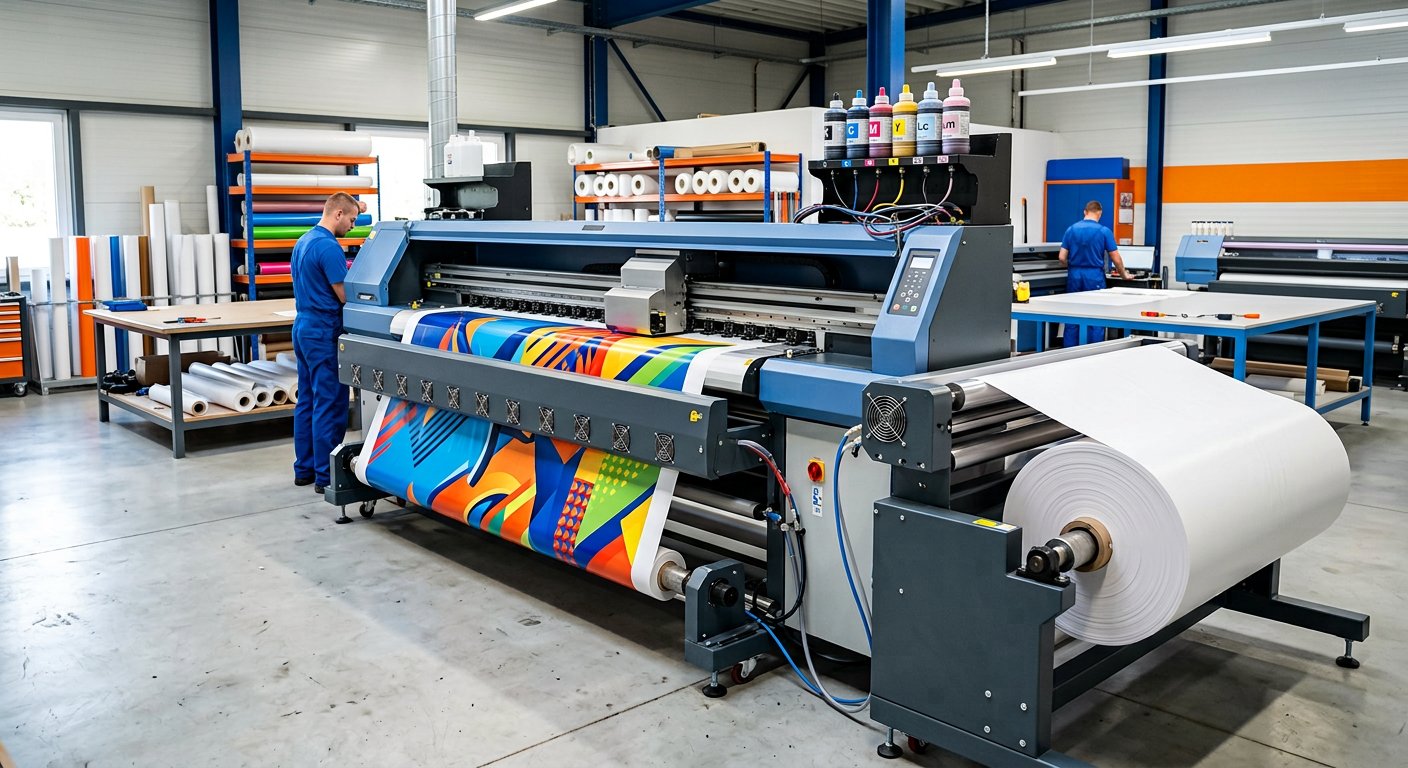
PVC flex vs vinyl — which printing media is actually better? Both are PVC-based, both print on solvent machines, and both dominate Indian signage — but they’re engineered for completely different jobs. Flex is the flexible, economical fabric for banners, frames, and hoardings; vinyl is the smooth film for pasting onto surfaces, vehicles, glass, and boards. This guide compares the two media material-by-material — construction, surface, mounting, durability, cost — so you never spec the wrong one again.
Material Construction: Fabric vs Film
| Property | PVC Flex | Vinyl |
|---|---|---|
| Structure | Polyester scrim between PVC layers (woven) | Homogeneous PVC film (non-woven) |
| Surface | Slightly textured fabric face | Glass-smooth film |
| Flexibility | Folds, rolls, ties, stretches on frames | Bends but creases; needs surface support |
| Adhesive | None (mechanically fixed) | Pressure-sensitive adhesive backing (paste-up grades) |
| Typical weights | 240–610 GSM | 80–140 GSM film + adhesive |
| Roll widths | 3.2–10 ft | 3.2–5 ft typical |
That structural difference drives everything: flex is a standalone banner material; vinyl is a surface-covering film.
Head-to-Head Comparison
| Parameter | PVC Flex | Vinyl |
|---|---|---|
| Retail rate | ₹10–30/sq ft | ₹25–60/sq ft |
| Print sharpness (close view) | Good | Excellent — photo quality |
| Outdoor life | 0.5–2+ years by grade | 1–5 years (cast > calendered) |
| Waterproof | Yes | Yes (edge sealing matters) |
| Mounting | Tied, framed, stapled, pasted | Pasted on smooth surfaces/boards |
| Large-format scaling | Unlimited (welded panels) | Limited; overlaps visible |
| Wind behaviour | Needs tension/mesh in wind | Best supported on rigid surface |
| Removability | Untie/unstaple — clean | Peel — may leave adhesive residue |
| Best for | Banners, hoardings, framed boards | Boards, vehicles, glass, walls, stickers |
Where PVC Flex Wins
- Hanging & framing: eyelets, rope, frames — flex is made to be tensioned, not stuck.
- Scale: hoardings of 200+ sq ft weld together seamlessly; vinyl panels show overlaps.
- Economy at size: 40–60% cheaper per sq ft on large jobs.
- Rough conditions: woven scrim tolerates flexing that would crease and crack vinyl.
- Reusability: banners roll up and reinstall elsewhere; vinyl dies on removal.
Where Vinyl Wins
- Surface conformity: adhesive backing wraps boards, vehicles, glass, and smooth walls.
- Close-view quality: smooth film prints razor-sharp photos and small text.
- Speciality grades: one-way vision, frosted, reflective, translucent, cast for vehicle wraps.
- Die-cut shapes: lettering, logos, stickers — impossible with flex.
- Long surface life: laminated cast vinyl runs 3–5 years on vehicles and boards.
Want to turn vinyl work into a revenue stream? Our guide on starting a vinyl & sticker printing business covers machines, margins, and products.
Cost by Job Type (2026)
| Job | Flex Cost | Vinyl Cost |
|---|---|---|
| 8×4 ft banner | ₹600–900 | Impractical (no surface to paste on) |
| 4×3 ft sunboard sign | ₹400–600 (pasted flex) | ₹700–1,200 (vinyl on board) |
| Vehicle door branding | Not viable | ₹800–2,000/side |
| Glass window graphics | Not viable | ₹25–60/sq ft |
| 20×10 ft hoarding | ₹2,400–4,400 | Impractical |
The pattern is absolute: the bigger and more exposed the job → flex; the smoother and closer the surface → vinyl. Full pricing context in our flex rate per sq ft guide.
Durability: Different Failure Modes
- Flex fails by: wind flapping (eyelet tear-out), UV fading, sag. Defence: right GSM, hemming, tension — covered in our flex durability guide.
- Vinyl fails by: edge lifting (water ingress), adhesive breakdown, scratches. Defence: sealed edges, lamination, cast grades for curves.
- In direct sun on rigid surfaces, laminated cast vinyl outlasts flex. In hanging/windy duty, flex is the only viable choice.
Print Compatibility: One Machine, Two Media
- Solvent/eco-solvent printers run both — switch media presets (heat, passes, ink load).
- Flex: standard profiles; heavier grades need more heat.
- Vinyl: lower heat (film warps), precise feed (slippery backing), and lamination for outdoor duty.
- UV printers also run both, adding rigid-board capability — see our printing technology comparison.
Decision Guide: Flex or Vinyl?
| Your Job | Choose |
|---|---|
| Banner tied between poles | Flex |
| Framed shop fascia | Flex (Star Flex) — or ACP+vinyl for premium |
| Hoarding / building wrap | Flex (frontlit/mesh) |
| Board signage (sunboard/ACP) | Vinyl pasted on board |
| Vehicle branding | Vinyl (calendered/cast) |
| Glass graphics | Vinyl (one-way/frosted) |
| Stickers & labels | Vinyl |
| Event backdrop | Flex (Star Flex for photos) |
| Photo wall / close-view interior | Vinyl |
The Hybrid Reality: Most Shops Need Both
Healthy print businesses run both lines:
- Flex = volume: banners, hoardings, political and event work keep machines busy.
- Vinyl = margin: boards, vehicles, and stickers carry 50–65% gross margins.
- One eco-solvent or solvent machine prints both — the smartest first-machine strategy for new shops.
Frequently Asked Questions (FAQs)
Q1. Is PVC flex the same as vinyl?
No. Both are PVC-based, but flex is a woven banner fabric fixed mechanically; vinyl is a smooth adhesive film pasted onto surfaces. Different construction, different jobs.
Q2. Which is cheaper?
Flex — ₹10–30/sq ft versus ₹25–60/sq ft for vinyl. The gap widens on large formats where vinyl becomes impractical anyway.
Q3. Which lasts longer outdoors?
On rigid surfaces, laminated cast vinyl (3–5 years) beats flex. In hanging/framed applications only flex is viable, and heavy grades reach 2–3 years.
Q4. Can vinyl be used like a banner with eyelets?
No — it creases and tears at fixings. Vinyl needs a supporting surface; flex is made for tying and framing.
Q5. Can flex be pasted like vinyl?
Thin flex can be pasted on walls/boards (pasting flex is common), but it has no adhesive backing — pasting uses separate glue and never matches vinyl’s clean finish.
Q6. Which gives better photo quality?
Vinyl, decisively — its smooth film keeps dots sharp at arm’s length. Flex is optimized for viewing distance.
Q7. What’s used for vehicle branding?
Always vinyl — calendered for short-term, cast for long-term wraps. Flex can’t conform to vehicle surfaces.
Q8. Can one printer print both media?
Yes. Solvent and eco-solvent printers handle flex and vinyl; you switch heat/feed presets in the RIP.
Q9. Which should a new print shop start with?
Both, on one machine — flex brings daily volume, vinyl brings high-margin work. Start with whichever your local market demands more.
Q10. How do I get the printing-vs-material decision right for customers?
Ask one question: “What surface does it mount on?” No surface (hanging/framed) → flex. Smooth surface (board, vehicle, glass) → vinyl. That’s the whole decision tree — more in our flex vs vinyl printing comparison.
Run Flex & Vinyl From One Machine
UED’s solvent & eco-solvent printers handle both media families — banners to vehicle vinyl — with genuine inks, spares, installation, and free training across India.
Final Verdict
No universal winner — only the right material for the mount. Hanging, framing, big, or budget → PVC flex. Smooth surfaces, close viewing, curves, or glass → vinyl. Stock both, spec confidently, and your shop covers the entire signage market.
