



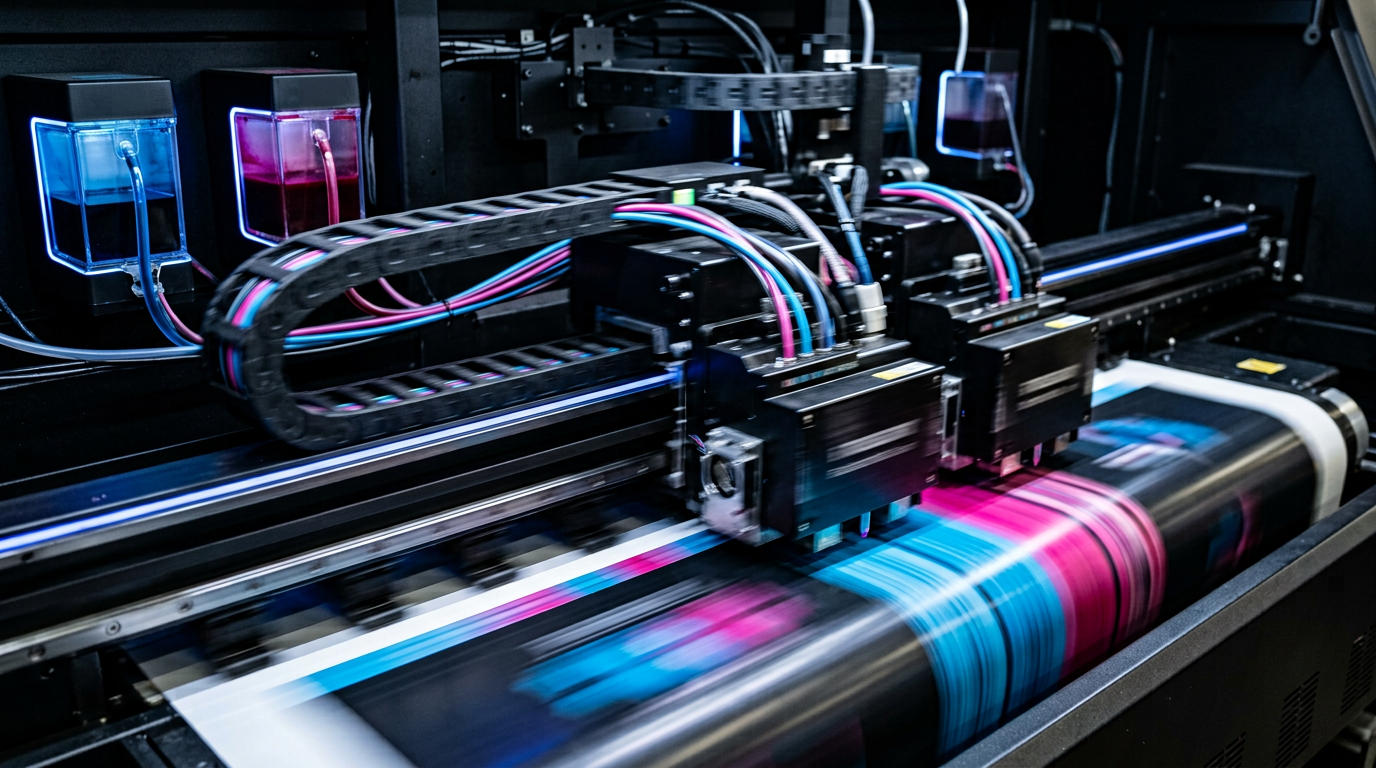
Quick Answer: A single-head eco solvent printer (1× Epson i3200) produces 12–18 sq m/hr in production mode and costs ₹1.65–2.75 lakh. A dual-head machine nearly doubles that to 25–30 sq m/hr for ₹2.75–4.5 lakh — a premium of roughly ₹1.2–1.75 lakh. Print quality is identical; you are buying speed and daily capacity. For new businesses with daily demand under ~80 sq m, the single-head is the correct, faster-payback choice. For wrap studios, busy retail hubs, or shops with confirmed same-day client obligations, the dual-head pays for itself in captured deadlines within a quarter. Below: the complete speed-price-ROI comparison to decide with numbers.
Every eco solvent machine buyer reaches the same quoting-table moment: the dealer has priced your 1.6m single-head machine, and now slides a second quotation across — the 1.8m dual-head variant, lakhs shinier. “Double speed, sir. Future-proof.” Both statements are true, and neither tells you what you actually need to know, which is: will the second head earn its ₹1.2–1.75 lakh back before it depreciates?
That answer depends on your order book’s shape — not its dreams. In this guide we put both builds through the numbers: real measured speeds, real cost differences, the mathematics of refused work, day-in-the-life scenarios, and the specific demand thresholds where each choice is correct. No brochure speeds, no sales logic — arithmetic.
The Mechanics: What the Second Head Actually Does
An eco solvent printer’s carriage traverses back and forth while the media steps forward. One i3200 head covers a 47 mm nozzle swath per pass; two staggered heads cover roughly double the print height per traverse, at otherwise identical chemistry, resolution, and droplet physics.
What the second head does not change:
- Maximum resolution or print quality at a given pass count
- Ink consumption per square metre
- Media capability or colour gamut
- Durability of the finished print
What it does change:
- Throughput per hour — the entire point
- Head capital sitting in the carriage: ₹45–80k vs ₹90–160k
- Daily maintenance minutes and cleaning chemistry consumption
- Graceful degradation: one head trouble on a single-head machine = zero revenue; on a dual-head = half speed and continued billing
Specification & Price Comparison
| Parameter | Single-Head 1.6m | Dual-Head 1.8m |
|---|---|---|
| Print heads | 1× Epson i3200 | 2× Epson i3200 (staggered) |
| Max width | 1.6 m | 1.8 m (fits full vehicle panels — bonus) |
| Machine price (2026) | ₹1.65–2.75 lakh | ₹2.75–4.5 lakh |
| Production speed | 12–18 sq m/hr | 25–30 sq m/hr |
| Quality-mode speed | 8–12 sq m/hr | 16–20 sq m/hr |
| Photo-mode speed | 5–8 sq m/hr | 10–14 sq m/hr |
| Daily capacity (8 hr) | ~100–144 sq m | ~200–240 sq m |
| Daily maintenance time | 10–15 min | 15–25 min |
| Cleaning chemistry/month | ₹1.2–2k | ₹2–3.5k |
| Head failure exposure | Full stop | ~50% speed, never stopped |
Speed Into Money: What the Hours Are Worth
Permit a worked example at India’s most common mixed-product day:
Order book: 40 sq ft shop board (laminated) + 250 sq ft sticker batch + one vehicle-half-panel (60 sq ft) + two custom wallpaper rolls (120 sq ft). Total ≈ 470 sq ft ≈ 44 sq m.
| Metric | Single-Head | Dual-Head |
|---|---|---|
| Print time (production mode) | ~3.0–3.7 hours | ~1.5–1.8 hours |
| Revenue (avg ₹32/sq ft, laminated mix) | ≈ ₹15,000 | ≈ ₹15,000 |
| Remaining day for second batch/finishing/delivery | 4 hours | 5.5–6 hours |
| Realistic daily billing ceiling | ~₹28,000 | ~₹48,000 |
The second head does not print cheaper — it prints twice before dinner. The business question is entirely: do you reliably have a second batch of paid work a day to feed it?
The Real Cost Differences Over 5 Years
| Component | Single-Head | Dual-Head |
|---|---|---|
| Machine purchase | ₹2.2L (avg) | ₹3.6L (avg) |
| Head replacements (2 sets) | ₹1.5L | ₹3.0L |
| Extra maintenance chemistry | — | ₹60–90k over period |
| Power (higher duty cycle) | — | ₹15–25k extra |
| 5-year machine-side delta | — | ≈ ₹2.5–3.2 lakh more |
| Revenue capacity delta @ 30% higher utilisation | — | +₹8–14 lakh over period |
The table displays the crux: the dual-head premium is entirely sensible if the extra capacity produces billed work; it is pure overhead otherwise. Everything below is about deciding which side of that conditional your shop sits on.
The Threshold Test: Should You Buy the Second Head?
Score your situation honestly:
| Signal | Points |
|---|---|
| Confirmed daily demand above 80–100 sq m (order book, not hopes) | +3 |
| Client obligations with same-day/next-morning deadlines (wrap studios, event suppliers, agencies) | +2 |
| Vehicle graphics / seamless-panel products are a core line | +2 (dual-head 1.8m width fits panels) |
| Current machine refuses ≥1 rush job per week | +2 |
| Your market’s peak-season 2× surges are documented reality (festivals, elections, admissions) | +1 |
| Working capital comfortably covers the premium without touching operating float | +1 |
- 6+ points: buy dual-head now. The capacity is pre-justified; you’ll wonder why you waited.
- 3–5 points: single-head with an upgrade plan. Confirm the chassis/firmware accepts a second-head retrofit in writing; know the retrofit’s price (typically ₹1.4–1.9 lakh); set the tripwire (e.g., “three straight months of refused rush work triggers the upgrade”).
- 0–2 points: single-head, unambiguously. Bank the ₹1.5 lakh difference as working capital and laminator/service budget — it will out-earn the second head at your volumes.
Two Machine-Build Warnings Before You Sign
1. Single-row “stunt dual” builds
Some budget builds bolt two XP600 or even mixed heads into a configuration and market it as “double head” — speeds that outperform single i3200 modestly, at head-life economics that underperform it badly. When comparing dual-head quotes, the exact head model (i3200 E1) is the comparison term, not the head count.
2. Upgradeable-chassis honesty
“You can add a second head later, sir” must be written on the quotation with these specifics: the machine’s mainboard/head-board must physically support dual heads, the firmware license must enable it, and the retrofit price must be capped in writing. On machines where any of these is untrue, the “upgrade path” quietly becomes a mainboard replacement story at ₹60k+ — turning the nominal ₹1.4L retrofit into real ₹2L+.
Day-in-the-Life: Same Shop, Both Machines
Shop profile: Tier-2 city, mixed sticker/board/wrap clients, ₹5.5 lakh monthly billing target.
On the single head: the printer runs nearly all day in peak weeks; rush jobs arrive and slot into evenings; the operator finishes normal days by 7 PM and festival days by 11. The laminator is never the bottleneck. Utilisation runs 40–55% of theoretical max — healthy, manageable. The ceiling arrives around ₹7–8 lakh monthly billing, where rush-day 9-hour runs begin costing clients.
On the dual head: the same order book finishes printing before lunch daily; the business’s constraint moves downstream to the laminating table and the designer. Utilisation runs 20–30% — either untapped growth capacity or idle overhead, depending on what the order book does next. If the owner uses the freed afternoon for sales and delivery expansion, in six months billing grows past the single-head ceiling and the dual build proves itself. If the order book stays flat, the second head quietly costs ₹4,000/month of depreciation without ever earning it.
Both outcomes are rational — for different shops. The machine either one bought was correct.
Refused Work: The Invisible Ledger
The strongest second-head justification hides in job histories, not spec sheets. Audit your last 90 days and price them honestly:
- Rush jobs refused or delivered late (count × average ticket × your margin)
- Clients who migrated after a missed deadline (their annual spend × your margin — the painful one)
- Premium rush surcharges (+25–50%) you could credibly charge with free capacity
Shops that run this audit typically discover ₹40k–₹1.5 lakh/year leaking through capacity friction — instantly answering the ₹1.5-lakh second-head question. Shops that audit and find ₹5k/year of friction get the same clarity in the opposite direction, and buy the laminator upgrade instead.
Room, Power & Infrastructure by Build
Each build quietly demands a different infrastructure budget — plan it into quotes:
| Requirement | Single-Head 1.6m | Dual-Head 1.8m |
|---|---|---|
| Floor space | 10×10 ft workable | 12×10 ft recommended |
| Power connection | 15A socket + 2kVA UPS | Dedicated 20A + 3kVA UPS strongly advised |
| Monthly power delta | baseline | +₹400–900 at equal output |
| AC discipline | recommended | mandatory at production duty cycles |
| Staffing at peak | 1 operator fine | Operator + helper at sustained speed (rolls finish fast) |
At full chat the dual-head drinks media rolls twice as fast — reloading every 25–35 production minutes. Staffing that cadence is either planned or it becomes your real-world speed ceiling.
The Math Users Never Run: Utilization-Adjusted Depreciation
Machines don’t depreciate per year; they depreciate per idle day. Quick arithmetic with realistic 2026 resale rates (40–50% retained for well-kept i3200 builds after 3 years):
- Single-head @ ₹2.3L, busy shop: 3-year depreciation ≈ ₹1.25L spread over ~90,000 billable sq m ≈ ₹1.4/sq m of machine cost
- Dual-head @ ₹3.8L, genuinely busy shop: depreciation ≈ ₹2.1L over ~1,80,000 sq m ≈ ₹1.2/sq m — the experienced shop’s dual runs cheaper per output
- Dual-head @ ₹3.8L, quiet shop (~50k sq m in 3 yrs): ≈ ₹4.2/sq m of avoidable overhead
The spreadsheet sentence that decides purchases everywhere: capacity utilization decides machine economics, in both directions, always.
Three Shop Profiles, Three Correct Decisions
Profile A — The Newcomer (Single Head, Correctly). First machine, Tier-3 city, no order book yet, ₹7 lakh total capital. Buys the 1.6m single i3200 + laminator, banks the ₹1.5L difference as stock and marketing. Three-month result: 45–60 sq m daily peaks against a 100+ sq m ceiling — headroom exactly sized to growth without overhead amortizing idle capacity. The premium is preserved for the tripwired upgrade trigger. Correct call by every metric.
Profile B — The Wrap Studio (Dual Head, Instantly Vindicated). Two-year-old signage shop, certified installer aboard, fleet contracts signed for delivery-bike liveries with 48-hour SLAs. Same-day obligations against a single-head’s physics would have failed within weeks — 180–220 sq m days arrive fortnightly from month one. The ₹1.6L premium returns itself inside the first quarter on rush premiums alone. Correct because the obligations were written before the quotation.
Profile C — The Premature Double (Cautionary). Six-month shop, hearsay “bigger is better,” stretches finances for the dual machine — volume stuck at 40–60 sq m/day through the next year. The unused capacity doesn’t hurt print quality one bit; it just quietly charges ₹4,000+ monthly in unused-capital depreciation while the laminator that could’ve opened premium product lines stayed unbought. The same rupee, sequenced differently, earns different fortunes.
Decision Triggers: When the Second Head Writes Its Own Order
- Three consecutive months above ~85 sq m daily average — capacity binds now, structurally
- Rush-job revenue (with +25–50% premiums) exceeds ₹40k/month while being at least partly refused today
- A signed SLA contract whose same-day/next-morning terms single-head physics cannot mathematically honor
- The wrap/fleet line formally launches — panel-width 1.8m converts from luxury into tooling
- The retrofit clause was negotiated at purchase and triggers at a fixed capped price
Conversely, hold the line if: month-to-month volumes swing above and below the threshold (seasonal ≠ structural), if any part of the dual premium must be borrowed against operating cash, or if the constraint is actually finishing labour, not print hours — in which case the correct next rupee hires hands, not heads.
The Downtime Equation: What a Dead Day Costs at Each Configuration
Head-count debates usually obsess over speed and ignore the stat that actually empties bank accounts: downtime. A machine that sits idle for repairs doesn’t just stop earning — it actively burns money on rent, salaries, and EMIs while simultaneously damaging your reputation with every delayed order.
| Scenario | Single-Head Shop | Dual-Head Shop |
|---|---|---|
| One head clogs badly (1 day lost) | 100% production stops. Full day’s billing (₹4,000–8,000) gone + possible order penalties | Machine can often run degraded on one head at ~50% speed — half billing survives |
| One head needs replacement | ₹45,000–75,000 + 2–5 days waiting for head + engineer | Same cost, but shop limps along at reduced capacity during wait |
| Statistical exposure | 1 point of total failure | 2 heads = double the failure probability, but failures rarely take both together — degradation instead of death |
| Real-world annual downtime | 8–15 lost days typical for average-maintenance shops | 5–10 lost days (partial-capacity days counted at half) |
| Annual downtime cost (at ₹6,000/day billing) | ₹48,000–90,000 | ₹30,000–60,000 |
The counterintuitive insight: dual-head machines suffer more component failures (two of everything) but experience less business damage, because failure degrades gracefully instead of stopping the shop. For a single-machine business with deadline-driven work — events, exhibitions, election material — that resilience alone can justify the second head.
Sellable Speed vs Brochure Speed: What Actually Comes Out the Other End
Brochure speeds are measured at draft mode on forgiving media with perfect files. Your billing happens at sellable quality. The honest conversion:
| Mode | Single i3200 (brochure) | Single i3200 (sellable reality) | Dual i3200 (sellable reality) |
|---|---|---|---|
| Billboard/draft (3–4 pass) | ~40–55 sq m/hr | 30–40 sq m/hr — fine for distant-viewing flex | 60–80 sq m/hr |
| Standard vinyl (6 pass) | ~25–30 sq m/hr | 15–22 sq m/hr — the everyday truth | 30–45 sq m/hr |
| Photo/close-viewing (8+ pass) | ~15 sq m/hr | 8–12 sq m/hr | 16–25 sq m/hr |
Now subtract the hidden thieves that brochures never mention: media loading (3–5 min/roll), file RIPping on slow PCs (5–15 min/job if your computer is underpowered), edge trimming, and laminated products’ extra handling. An 8-hour shift on a single-head machine yields 100–150 sq m of finished work on a good day — not the 240+ the math suggests. Plan capacity on 60–65% of theoretical throughput and you’ll never lie to a customer.
One more throttle nobody warns first-time buyers about: the RIP computer. A dual-head machine fed by a ₹15,000 assembled PC chokes on 2 GB vehicle-wrap files and spends its speed advantage waiting. Budget ₹40,000–60,000 for a proper workstation (16–32 GB RAM, SSD, decent GPU) or the second head earns nothing.
Can You Add a Second Head Later? The Upgrade-Path Truth
Dealers love saying “single now, dual later — upgrade hai.” Sometimes true, often not. The deciding factors:
- Carriage & board design: machines built on dual-head carriages (with the second head’s slots, cabling channels, and board headers already present) genuinely upgrade in a day for the head + damper + tube cost (₹60,000–90,000). Machines designed single-head from the frame up cannot — the “upgrade” becomes a carriage-and-mainboard swap costing more than the price gap you avoided.
- Firmware & RIP licensing: some board firmware is locked to one head; the RIP dongle may also be licensed per carriage config. Both are solvable — for money. Get the upgrade price in writing at purchase time.
- Frame & motor headroom: dual-head carriages are heavier. Frames and stepper/servo motors sized for one head wear faster carrying two — ask whether the rail, belt, and motor are identical to the dual model.
Practical rule: if there’s a realistic chance you’ll need dual speeds within 18 months, buy dual now — financing the ₹80,000–1,20,000 gap is cheaper than retrofitting. If dual speed is a “someday maybe,” buy a clean single-head from a maker whose design you understand, and treat any upgrade as a bonus, not a plan.
Three Buyer Profiles: Which Head Count Actually Fits You
Profile A — The Market-Street Job Shop (Most Readers): daily work is 2–8 sq m boards, stickers, and one-way vision for walk-ins, billed same-day or next-day. Monthly volume 300–600 sq m. Verdict: single i3200, confidently. Your constraint is order flow, not print speed. A dual-head sits idle 60% of the time earning nothing on its extra cost. Spend the difference on the laminator and a bigger media stock.
Profile B — The Events/Fleet Specialist: work arrives in deadline-driven bursts — a 200 sq m exhibition setup due Friday morning, a 12-car fleet branding due in a week. Gaps between bursts are normal. Verdict: dual i3200. Your entire business model is converting impossible deadlines into premium pricing; the second head is the product you’re actually selling. A single head means declining the exact jobs that pay best.
Profile C — The Side-Business / In-House Printer: a signage unit inside a gifts shop, coaching institute doing its own banners, photographer printing canvas. Volume 50–200 sq m/month, zero external deadline pressure. Verdict: single XP600 or single i3200. Utilization, not speed, decides your payback; the cheapest reliable head that does the job wins. Even consider the used market at this volume.
The Utility & Consumption Numbers Nobody Puts in Brochures
| Line Item (Monthly, Typical Indian Shop) | Single Head | Dual Head |
|---|---|---|
| Electricity (machine heaters + fans, 8h/day) | ₹3,500–5,500 | ₹4,500–7,500 |
| AC/climate for print room (added) | ₹2,500–4,500 | ₹2,500–4,500 (same room) |
| Ink at 500 sq m/month (CMYK) | ₹8,000–14,000 | ₹8,000–14,000 (same output = same ink) |
| Cleaning/maintenance consumables | ₹800–1,500 | ₹1,200–2,200 (two head circuits) |
| Scheduled part replacements (dampers, cappings, wipers — amortized) | ₹600–1,000 | ₹1,200–2,000 |
| Total non-media, non-labour overhead | ~₹15,000–26,000 | ~₹17,000–30,000 |
The lesson in that table: the running-cost gap between single and dual is only ₹2,000–4,000/month — trivial. The real dual-head premium is all in the purchase price and the (rare) double head-replacement event. Which brings the decision back to where it started: buy for your volume pattern, because that’s the only variable in this whole comparison that actually moves the profit needle.
Two Shops, One Year: The Arithmetic of Choosing Right
Nothing clarifies the single-vs-dual decision like following two realistic shops through twelve months. Both buy in the same month, both in tier-2 cities, both run by competent owners.
Shop A — New market-street job shop: chooses a dual-head 1.8m at ₹4.2 lakh because “speed future-proof hai.” Reality: daily average 35 sq m of boards and stickers, meaning the machine idles by 2 PM. The second head contributes nothing for 10 of 12 months. Extra capital locked in the machine: ₹1.4 lakh — exactly the laminator + media stock + three months’ rent buffer the shop instead financed at high interest. Month 9: cash flow strain forces discount pricing, which fills capacity but at margins that make the machine’s speed useless anyway. The machine was never the constraint; distribution was.
Shop B — Similar job shop: chooses a single-head 1.6m at ₹2.4 lakh, spends the ₹1.4 lakh difference on a laminator, opening media depth, a proper UPS, and six months of working capital. Revenue tracks Shop A almost exactly (same demand pool). Month 11: two event-decorator accounts start landing 150–250 sq m deadline bursts; Shop B deliberately quotes longer lead times, loses a few rush jobs — and books a dual-head machine from twelve months of retained profits, with cash to spare. Month 14: dual-head arrives into a proven demand pattern, and pays for itself in eight months.
The lesson isn’t “always start single-head” — Shop B’s path costs it some December rush jobs it couldn’t serve. The lesson is sequencing: buy speed when the order book proves the need, not when the brochure imagines it. If your signed pipeline already holds recurring 100+ sq m weeks, Shop B’s caution costs you money — buy dual from day one. If the pipeline is hopes and relatives’ promises, Shop A’s optimism is the expensive mistake.
The 90-Second Decision Checklist
Answer honestly and your configuration chooses itself:
- Do you have confirmed (not hoped-for) weekly volume above ~500 sq m within 6 months? Yes → lean dual.
- Is your target work deadline-brutal (events, exhibitions, elections, fleet launches) where same-week turnaround wins the order? Yes → lean dual.
- Would a 2–4 day machine stoppage mean cancelled orders and penalties, not just delayed ones? Yes → lean dual (degraded-mode resilience).
- Is this your first machine and your order book currently thin? Yes → single, firmly.
- Will the dual-head premium (₹80k–1.5L) come from cutting the laminator, UPS, or media budget? Yes → single. Always finish the ecosystem before buying speed.
- Can the seller certify (in writing) a genuine single→dual upgrade path on this exact frame? Yes → single becomes lower-risk; the option value is real.
Score it: dual-pointing answers 1–3 outvoting single-pointing 4–5 → buy dual without guilt. Anything else → buy single, bank the difference, and let your second-year order book make the next decision for you. The machine should follow the business, never lead it.
A Word on Three- and Four-Head Machines
Yes, they exist (and wide-format variants run 4+ i3200s). For the shops this guide serves, they’re nearly always the wrong buy: the same logic that separates single from dual applies squared between dual and triple — you need sustained 200+ sq m/day to feed them, their service complexity scales with head count, and at those volumes two separate dual-head machines beat one triple for redundancy (one machine down = half capacity, not zero). Three-head machines are wholesale-trade territory. When your business reaches that territory, you won’t need this guide to tell you — your order book will.
The Resale Question Nobody Asks at Purchase Time
Head count follows you into the used market. Three years from now, when you upgrade or exit, your machine’s config decides its second-hand welcome: single-head 1.6m machines are the liquid currency of the used trade — widest buyer pool (new entrants), fastest to sell, typically recovering 45–55% of original cost if maintained and logged. Dual-head machines fetch a higher absolute price but a narrower, more professional buyer pool — expect 40–50% recovery and a longer selling window. Neither is a reason to buy wrongly today, but it completes the lens: buy the head count your order book proves, maintain it like the resale value depends on it — because it does.
Frequently Asked Questions (FAQs)
Q1. Does two heads mean better print quality?
No — identical heads and identical pass counts give identical quality. Two heads offer the same quality at ~2× the hourly throughput, or higher-pass quality at single-head production speed.
Q2. Roughly how much faster is dual-head in real work?
1.8–1.9× in production modes: 25–30 vs 12–18 sq m/hr on i3200 builds. A 60-sq-m wrap day that takes 4–5 hours on one head takes about 2 on two.
Q3. What monthly volume justifies the second head?
Practitioner rule: consistent daily demand above ~80–100 sq m (≈2,000–2,600 sq m monthly) or a client obligation structure that prices rushed capacity at a premium. Below that, single-head economics dominate.
Q4. Is the 1.8m width itself worth upgrading for?
If vehicle panels/wide seamless products target your market — yes, alone justify stepping from 1.6m to 1.8m class. The width quietly eliminates seam-labour and nesting waste on standard car/bolero side panels across lakhs of jobs.
Q5. Can I add a second head to my machine later?
On genuinely dual-ready builds, yes — typically ₹1.4–1.9 lakh for head + carriage/wiring + calibration. Verify written confirmation of board support and capped retrofit price before believing the promise.
Q6. If one head fails on a dual-head machine, can I still print?
Yes — that’s its hidden insurance: the machine degrades to single-head speed and keeps billing. On single-head machines, the same failure is a full revenue stop until the part lands.
Q7. Do two heads double cleaning-solution and maintenance costs?
Roughly, yes: double nozzles to check, double wet-cap consumption, and double flush-ink on clean cycles. Budget about ₹2–3.5k monthly versus ₹1.2–2k single-head — a rounding number relative to the throughput it protects.
Q8. Single-head now + a second single-head machine later?
A genuinely smart third path: two single-head machines give you redundancy and media/complexity separation (one runs vinyl, one wallpaper) at similar total capital to one dual-head — at the cost of more space and skill overhead. This is how many established Indian shops actually scale.
Q9. Which build resells better?
Single-head 1.6m i3200 moves fastest in the used market because the buyer pool is biggest; dual-head 1.8m commands better absolute prices with slightly longer sale cycles. Both beat XP600 and DX5 machines decisively on retained value.
Q10. My dealer says dual-head saves power. True?
Per square metre — marginally, because fixed heater/lighting duty divides over double throughput. Per machine-hour — dual builds draw slightly more. It’s a trivial factor either way; choose on throughput economics, not electricity dreams.
Final Verdict
The single-vs-dual decision in 2026 resolves to one line: buy the capacity your order book confirms — and at most 25% more.
- Under ~80 sq m/day, new business: single-head i3200 — fastest payback, gentlest overhead, easiest resale.
- Above ~100 sq m/day, deadline-priced clients, wraps core: dual-head i3200 — the second head earns from week one.
- Growing but unproven: dual-ready single-head, tripwire set in writing.
- Ambitious scaling: two single-heads over one dual — the redundancy play veterans quietly prefer.
The expensive mistake in either direction is the same one: buying tomorrow’s volume on today’s money. Buy today’s capacity, keep the upgrade lever oiled, and let the queue sign the next purchase order.
Comparing single vs dual-head builds live? Our eco solvent printer range lists both configurations with transparent pricing, installation, and training. Send your daily volume estimate — we’ll model the honest break-even for your case before you choose.
