

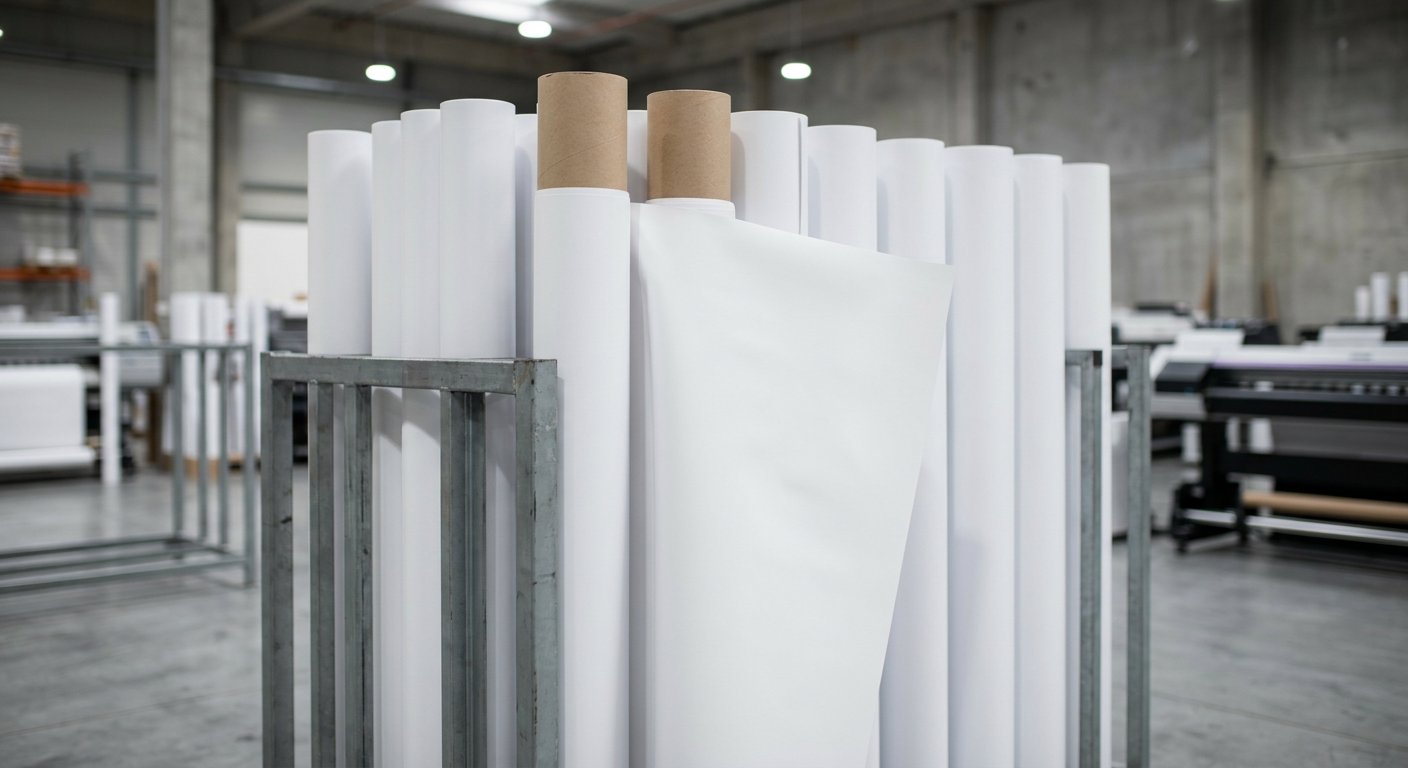
Flex printing media comes in several types — standard flex, Star Flex, frontlit, backlit, mesh, and blockout — each engineered for a specific job. Pick the wrong media and your banner fades in a month or glows unevenly in a light box; pick right and the same print serves you for years. This guide breaks down every major type of flex printing media available in India in 2026, with GSM options, prices, outdoor life, and exactly which application each one is made for.
What Is Flex Media Made Of?
All flex media shares the same basic construction: a polyester scrim (a grid of woven threads) laminated between two layers of PVC. The scrim provides tensile strength; the PVC coating provides a smooth, ink-receptive, waterproof surface. What differs between media types is:
- GSM (grams per square metre) — thickness and weight, from 240 to 610+
- Surface coating — matte vs glossy (Star Flex), ink absorption layer
- Optical design — light-blocking (frontlit), light-diffusing (backlit), or light-blocking core (blockout)
- Structure — solid or perforated (mesh)
1. Standard (Normal) Flex — The Workhorse
The default material of Indian banner printing. Standard flex has a matte finish, comes in 240–440 GSM, and is the cheapest option on the market.
- GSM options: 240, 280, 340, 440
- Retail rate: ₹10–25/sq ft depending on GSM
- Outdoor life: 6–12 months
- Best for: political banners, event banners, short-term promotions, budget hoardings
- Avoid for: premium branding, anything meant to last 2+ years
2. Star Flex — The Premium Glossy Choice
Star Flex (also called gloss flex or high-gloss banner) carries a smoother, coated surface that makes colours pop and whites look brilliant. It’s the go-to upgrade for shop boards and branding work. Not sure it’s worth it? Read our Star Flex vs Normal Flex comparison. Not sure it’s worth it? Read our Star Flex vs Normal Flex comparison.
- GSM options: 280, 340, 440
- Retail rate: ₹18–30/sq ft
- Outdoor life: 1–2 years
- Best for: shop boards, exhibition stalls, premium hoardings, showroom branding
- Why it’s better: the coating holds ink droplets sharply, giving deeper blacks and more vibrant colours than normal flex
3. Frontlit Flex — Made to Be Seen from the Front
Frontlit media is designed for signage lit from the outside (floodlights) or unlit signage. It has a white or grey backside that reflects light forward, keeping colours bright. Heavier grades (440–610 GSM) are built for large hoardings that must survive wind loads.
- GSM options: 440, 510, 610
- Retail rate: ₹25–40/sq ft
- Outdoor life: 2–3 years
- Best for: large outdoor hoardings, highway billboards, building wraps
4. Backlit Flex — For Glowing Sign Boards
Backlit flex is translucent — it diffuses light evenly from bulbs or LEDs placed behind it, creating the glowing sign boards you see on shops at night. It’s heavier (510–610 GSM) and prints with higher ink saturation so colours stay vivid when illuminated. Unsure which lighting setup you need? Read Backlit Flex vs Frontlit Flex: Difference & Uses.
- GSM options: 510, 610
- Retail rate: ₹35–60/sq ft
- Outdoor life: 2–3 years
- Best for: glow sign boards, light boxes, petrol pumps, malls, pharmacies, 24×7 shops
- Printer note: backlit prints usually need a “double-hit” (higher ink load) setting in the RIP so they don’t look washed out when lit
5. Mesh Flex — The Wind-Proof Option
Mesh flex has thousands of tiny perforations that let wind pass through, reducing wind load by up to 70%. This makes it the only safe choice for large elevated hoardings, building wraps, and fence banners in stormy areas.
- GSM options: 270, 320, 370
- Retail rate: ₹25–45/sq ft
- Outdoor life: 1–2 years
- Best for: building wraps, high-rise hoardings, fencing, windy coastal areas
- Trade-off: slightly softer image quality because of the holes — not for close viewing
6. Blockout Flex — Double-Sided Printing
Blockout flex has a black or opaque layer inside that stops light passing through — so you can print different designs on both sides without show-through. It’s the heaviest and most expensive banner material.
- GSM options: 610, 680
- Retail rate: ₹40–70/sq ft
- Outdoor life: 2–3 years
- Best for: double-sided hanging banners, mall interiors, airport & metro signage, street pole flags
Flex Media Comparison Chart (2026)
| Media Type | GSM | Rate (₹/sq ft) | Outdoor Life | Ideal Use |
|---|---|---|---|---|
| Standard flex | 240–440 | ₹10–25 | 6–12 months | Budget banners, political work |
| Star flex | 280–440 | ₹18–30 | 1–2 years | Shop boards, premium branding |
| Frontlit | 440–610 | ₹25–40 | 2–3 years | Hoarding, highway signage |
| Backlit | 510–610 | ₹35–60 | 2–3 years | Glow sign boards, light boxes |
| Mesh | 270–370 | ₹25–45 | 1–2 years | Building wraps, windy locations |
| Blockout | 610–680 | ₹40–70 | 2–3 years | Double-sided displays |
Choosing for a specific job? See our detailed picks in Best Flex for Shop Boards and Outdoor Advertising.
Which Flex Media Should You Choose? (By Application)
| Application | Recommended Media | Why |
|---|---|---|
| Shop board (2+ years) | Star Flex 280–340 GSM | Vibrant colour, smooth finish, long life |
| Wedding/event banner (1 week) | Standard flex 240–280 GSM | Cheapest; short duration doesn’t justify premium |
| Political hoarding (1–2 months) | Standard flex 280 GSM | Cost-effective at massive volumes |
| Glow sign board | Backlit 510 GSM | Even light diffusion when illuminated |
| Highway hoarding | Frontlit 440–510 GSM | Wind strength + 2–3 year outdoor life |
| Building wrap | Mesh 270–370 GSM | Wind passes through; no flapping or tearing |
| Hanging banner (both sides visible) | Blockout 610 GSM | No show-through between sides |
| Exhibition stall backdrop | Star Flex 280 GSM | Sharp, photo-quality appearance up close |
Popular Flex Brands in India
Media quality varies more than most buyers realise. Well-known brands in the Indian market include Star Flex, Flexit, Uniflex, Winsome, Galaxy, Era, and Korean imports like Seungil and Hiflex. Branded media costs ₹1–3/sq ft more than unbranded rolls but delivers better ink adhesion, fewer wrinkles, consistent thickness, and longer colour life. If a quote seems unusually cheap, ask which media brand is being used — unbranded thin flex is the most common trick in the trade.
GSM Guide: Matching Thickness to Duration
| GSM | Feel & Strength | Recommended Duration |
|---|---|---|
| 240 GSM | Thin, flexible, economical | Days to 1 month |
| 280 GSM | Standard shop-banner grade | 1–6 months |
| 340 GSM | Sturdy, holds tension well | 6–18 months |
| 440 GSM | Heavy hoarding grade | 1–2 years |
| 510–610 GSM | Premium frontlit/backlit grade | 2–3 years |
Tips for Printers: Choosing Media for Your Machine
- Match media width to your machine: 6 ft and 8 ft solvent printers take 5 ft and 8 ft rolls; never load wider rolls than your printable width.
- Adjust heater settings per media: thicker backlit and blockout need higher mid/post heat (45–55°C) to dry fully.
- Backlit needs more ink: increase ink limit in your RIP by 20–30% for backlit jobs.
- Buy media in bulk rolls (typically 50–100 m) for 10–20% better pricing than cut lengths.
- Store rolls upright in dry conditions — moisture-waved flex wrinkles mid-print and causes head strikes.
Frequently Asked Questions (FAQs)
Q1. Which flex media is best for shop boards?
Star Flex 280–340 GSM for framed shop boards, or backlit 510 GSM if you want a glowing sign board with lights behind it.
Q2. What is the difference between frontlit and backlit flex?
Frontlit is opaque and designed to be lit from the front (or not lit at all); backlit is translucent and made to glow with lights behind it. Backlit is heavier and roughly ₹10–20/sq ft costlier.
Q3. Is Star Flex worth the extra cost?
Yes for anything displayed longer than 6 months or viewed up close. Its coated surface gives visibly brighter colours and 1–2 years of outdoor life versus 6–12 months for standard flex.
Q4. What GSM flex should I use for hoardings?
Minimum 340 GSM for hoardings up to 40 sq ft; use 440–510 GSM frontlit for large or long-duration hoardings, and mesh above 100 sq ft or in windy areas.
Q5. Can I print double-sided on normal flex?
Not cleanly — light shows through and both images bleed into each other. Use blockout flex for true double-sided printing.
Q6. Which media works in heavy wind?
Mesh flex. Its perforations cut wind load by roughly 70%, making it the standard for building wraps and elevated hoardings.
Q7. Does media brand really matter?
Yes. Branded media (Star Flex, Flexit, Uniflex, etc.) gives consistent coating, better ink adhesion, and 30–50% longer outdoor life than unbranded rolls costing only ₹1–3/sq ft less.
Q8. What media is used for glow sign boards?
Backlit flex 510 GSM printed with a higher ink load, stretched over an LED or tubelight box — the standard construction for glowing shop signs in India.
Running a Flex Printing Business?
The right machine plus the right media equals profit. Unified Engineering Dynamics supplies solvent & eco-solvent flex printers, genuine inks, and spare parts across India — with installation and free operator training included.
Final Word
Choosing flex printing media is a simple matching game: duration + application + budget. Standard flex for short and cheap, Star Flex for vibrant and lasting, backlit for glow boards, frontlit for hoardings, mesh for wind, and blockout for double-sided work. Match the media to the job, and every rupee you spend prints visible value.
