

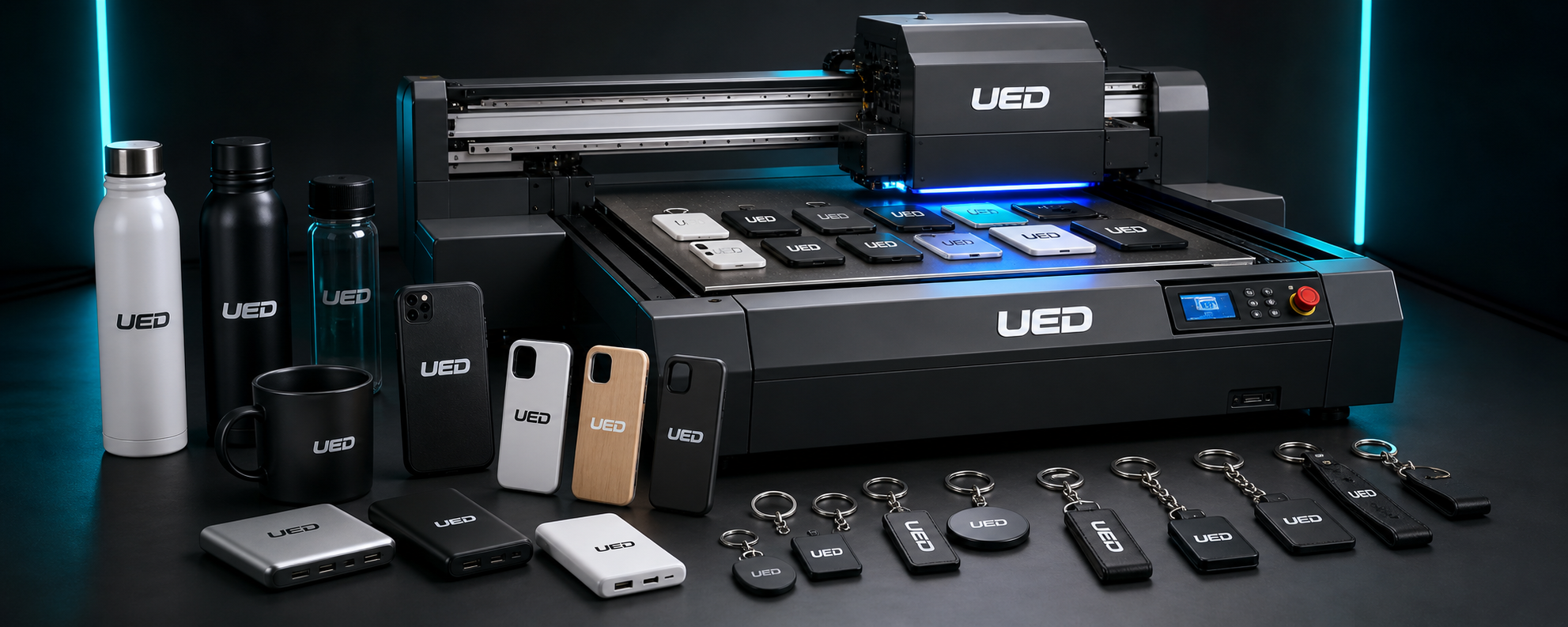
Promotional products — pens aside — are increasingly a UV-printing goldmine: phone stands, keychains, bottles and tumblers, power banks, USB sticks, acrylic awards, leather-look notebooks, golf balls, phone cases, signage plaques and a hundred more small rigid items that take a crisp, durable UV print. Corporate gifting and event merchandise buy these in quantity, pay for personalisation, and reorder every season. This guide explains how to print small objects at scale with a UV flatbed, how to hold and register them, and how to price a per-piece business that compounds.
Why UV is the right technology for objects
Most promotional items are rigid, irregular and made of plastics, metals, wood or leather-look materials — exactly what a UV flatbed handles with instant cure and no plates. Unlike pad printing or screen printing, UV needs no per-colour setup, prints full-colour photography and white ink on dark or transparent items, and runs a single piece as cheaply as a thousand. That combination — full colour, no minimums, mixed materials in one run — is why UV has captured the personalised and short-run promotional market that older processes priced out of reach.
Jigs, fixtures and the art of holding small things
The core skill in object printing is holding each item repeatably so the print lands in the same place every time. Simple laser-cut or 3D-printed jigs that seat a phone case, keychain or bottle cap in a known position turn a fiddly job into a production run. For bottles and tumblers, a rotary attachment spins the object under the head for wrap-around printing. For flat-but-thick items, set the head height from the tallest point and use a media-height sensor. Investing in a small library of jigs per product type is the single biggest throughput multiplier in object printing, and it is what separates a hobby from a business.
Materials and adhesion across the promo range
Promotional items span ABS, acrylic, metal, coated aluminium, wood, leather-look PU and glass. Plastics like ABS and polypropylene vary in surface energy; polypropylene and some soft-touch coatings often need a primer or flame/plasma treatment, while ABS and acrylic usually bond with a wipe. Metals follow the metal rules: degrease, and promote for durable items. The professional habit is to keep a test log per item type and supplier, because the same “phone case” from two factories can print completely differently. A promoter pen or wipe-on primer in the standard kit covers the stubborn cases.
White ink and personalisation at scale
Dark and transparent promo items are common, so a white channel is essential — a white under-base under full colour, or white-only logos on coloured stock. Variable data is where UV shines for corporate work: print each power bank with a different employee name, each award with a unique recipient, each batch with a serial or QR. Driving variable data from a spreadsheet makes a thousand unique pieces no harder than a thousand identical ones, and it is a capability buyers of awards and onboarding kits actively seek.
The corporate gifting calendar and building recurring revenue
Promotional demand is seasonal and calendar-driven: financial-year-end gifting, festival gifting (Diwali and corporate festivals), conference and event merchandise, new-joiner onboarding kits, and anniversary or product-launch giveaways. The shops that win this business build a catalogue of printable items with per-piece pricing at quantity breaks, and they proactively contact past corporate buyers ahead of each season. One satisfied HR or marketing contact becomes a recurring annual order. Because personalisation and small batches are UV’s sweet spot, you can profitably serve the orders that big screen printers decline.
Pricing per-piece work that actually makes money
Per-piece pricing must account for machine time, handling and jig setup, not just ink. A run of 500 keychains is dominated by loading and unloading labour; batch them on trays with jigs to cut handling, and price by quantity break so larger runs earn through efficiency. Charge setup/design once, and add premiums for white ink on dark items, variable data and premium substrates. Track the true cost per piece including labour, because the classic error is winning a big promo order at a price that consumes more labour than it returns.
Machine choice for objects
Object printing wants a flatbed with good Z-height (bottles and thick items), a reliable media-height sensor, a white channel and, ideally, a rotary attachment for drinkware. Small-format and A3/A2 flatbeds are excellent entry machines for gifts and promo; larger flatbeds gang many items per run. If drinkware is a focus, confirm rotary capability early. Our DTF UV and object printer range covers the small-object niche, while a UV flatbed printer scales the gang-run business.
Common mistakes in promo printing
- Skipping jigs and hand-placing items, then shipping mis-registered runs.
- Assuming all plastics bond; polypropylene and soft-touch coatings need testing or primer.
- Under-pricing labour on high-handling small runs.
- Forgetting head-height on thick items and striking the carriage.
- Quoting variable data without checking the data file, then re-running batches.
Frequently asked questions
Can UV print on bottles and tumblers?
Yes, with a rotary attachment for wrap-around or a jig for flat-panel printing. Use primer on difficult coatings and test for dishwasher or abrasion expectations honestly.
Is pad printing dead?
No — very long single-colour runs still favour pad printing. UV wins on full colour, personalisation, short runs and mixed items. Many shops offer both or partner out.
How durable is UV on a phone case?
On ABS and good-quality cases, with proper prep, it resists daily handling well; soft-touch and oily coatings are the exceptions and should be tested.
A deeper look: awards, trophies and the personalisation premium
Awards are the ideal UV product: acrylic, wood and metal blanks, full-colour logos, unique recipient names and quantities from one to hundreds, all with a deadline that customers pay to meet. Build standard award designs with editable name/date fields, keep common blanks in stock, and offer same-week turnaround. The margin is strong because the item is emotionally important and visibly premium. Corporate onboarding kits — a printed notebook, badge and desk item per new joiner — are the recurring cousin of awards. Together they form a dependable, high-margin stream that uses the machine’s small-batch strength.
A deeper look: turning one-off gifts into a catalogue business
The consumer side of object printing — photo keychains, fridge magnets, phone stands, festive gifts — thrives on a tidy menu with clear prices and fast turnaround. Display samples at the counter, run seasonal promos, and take orders online with an upload flow. The economics work through batching: collect orders through the day and gang them into one or two machine runs. Over time the catalogue, the jigs and the ordering flow become an asset that earns daily with little selling effort, and it introduces countless customers to your trade capabilities. It is the friendliest on-ramp to UV printing and a steady base layer of revenue.
Colour management across coloured and transparent plastics
Promotional items come in every base colour, so absolute colour accuracy against a paper proof is difficult. The professional approach is to print a physical sample on the actual item, approve it with the buyer, and treat that as the standard rather than arguing with a monitor. White under-base dramatically improves colour fidelity on dark and transparent stock, and a consistent white opacity keeps batch-to-batch matches close. Keep approved samples per client so reorders match the original. Managing the buyer’s expectation that the plastic item will never perfectly match a paper proof — and showing them a real sample instead — prevents most disputes and builds trust.
A batch workflow that keeps small runs profitable
Object printing dies on handling, not printing. Design the flow: collect orders, group by item type, load trays of the same item into jigs, run the machine through the whole batch, then finish and pack. Standardise packaging per product so packing is mechanical. Use variable-data files to drive names and serials automatically rather than hand-editing. The goal is for one operator to load, run and pack a large batch with minimal touch time, because the machine cost per piece is already low and the labour is the variable that decides profit. A tidy batch flow is worth more than a faster machine.
Drinkware, dishwasher expectations and honest claims
Bottles, tumblers and mugs are high-demand promo items, but customers often assume UV print is dishwasher-proof. It can resist hand washing very well with proper primer and cure, and some UV systems with a dedicated hard varnish approach dishwasher tolerance, but you must test and state the limit honestly. Offer a printed care card (“hand wash recommended”) with every drinkware order, and where dishwasher durability is non-negotiable, refer to sublimation or fired ceramic decoration. Honest claims keep the account; over-promising a dishwasher-safe print that fades loses it.
Leather-look notebooks, desk sets and onboarding kits
Corporate onboarding and gifting increasingly favour curated kits: a leather-look notebook, a pen, a keychain, a desk sign and a card, all branded and packed together. UV prints crisply on PU and leather-look covers, acrylic desk signs and metal keychains, so one shop can produce the whole kit. Offer it as a package — design, print, assemble and pack — and price per kit. Kits are higher value, stickier and more memorable than a single logo item, and they recur annually for every new joiner and festival. This is the natural upsell from a first pen or keychain order.
Building the sample kit that sells corporate orders
A portable sample kit is the highest-leverage sales tool in promo printing: a small case with a printed phone stand, keychain, power bank, award, drinkware sample, notebook and a printed price sheet with quantity breaks. Take it to HR, marketing and event managers, leave a printed menu, and follow up before each gifting season. Because promo buyers are repeat buyers, one meeting can seed years of orders. Photograph the kit’s contents for the website and social channels, and update it each season with current bestsellers. The kit converts the abstract “we print on anything” into a concrete, priced menu that buyers can act on.
ROI and choosing the right object printer
Object printing pays back fast on modest machines because per-piece margins are high and demand is broad. A small or A3/A2 flatbed with white ink and a rotary attachment can sustain a profitable gift and promo line; larger flatbeds gang more items per run and add big items like awards and signage plaques. Prioritise white ink reliability, a dependable media-height sensor and rotary capability if drinkware is a focus, and plan for a growing jig library. Our UV flatbed printer and object printer range covers this niche, and we help configure jigs, inks and workflow so the machine earns from its first batch.
Troubleshooting the most common object defects
- Mis-registration across a run — almost always a jig or placement issue; standardise seating and add a datum stop.
- Ink lifting off plastic — surface-energy issue; test the plastic, add primer or pretreatment, and re-tape-test.
- Faint colour on dark items — insufficient white under-base opacity; increase white layers or print white twice.
- Head strike on thick items — set head height from the tallest point and enable the height sensor.
- Variable data errors — validate the data file and print one proof piece before running the batch.
Promotional and object printing also has a compounding quality the big-format trades lack: every corporate client who reorders annually becomes a predictable line of revenue, and every consumer gift order builds the catalogue and jigs that make the next one cheaper to run. Master the jigs, the materials log and the seasonal calendar, and this becomes one of the most dependable income streams in a UV shop.
Conclusion
Promotional and object printing is where UV’s no-minimum, full-colour, mixed-material strengths translate directly into margin. Build jigs, keep a materials test log, master white ink and variable data, and sell to the corporate calendar as well as the consumer counter. See our digital UV printer range or talk to us about jigs, rotary attachments and the right flatbed for object work.
