

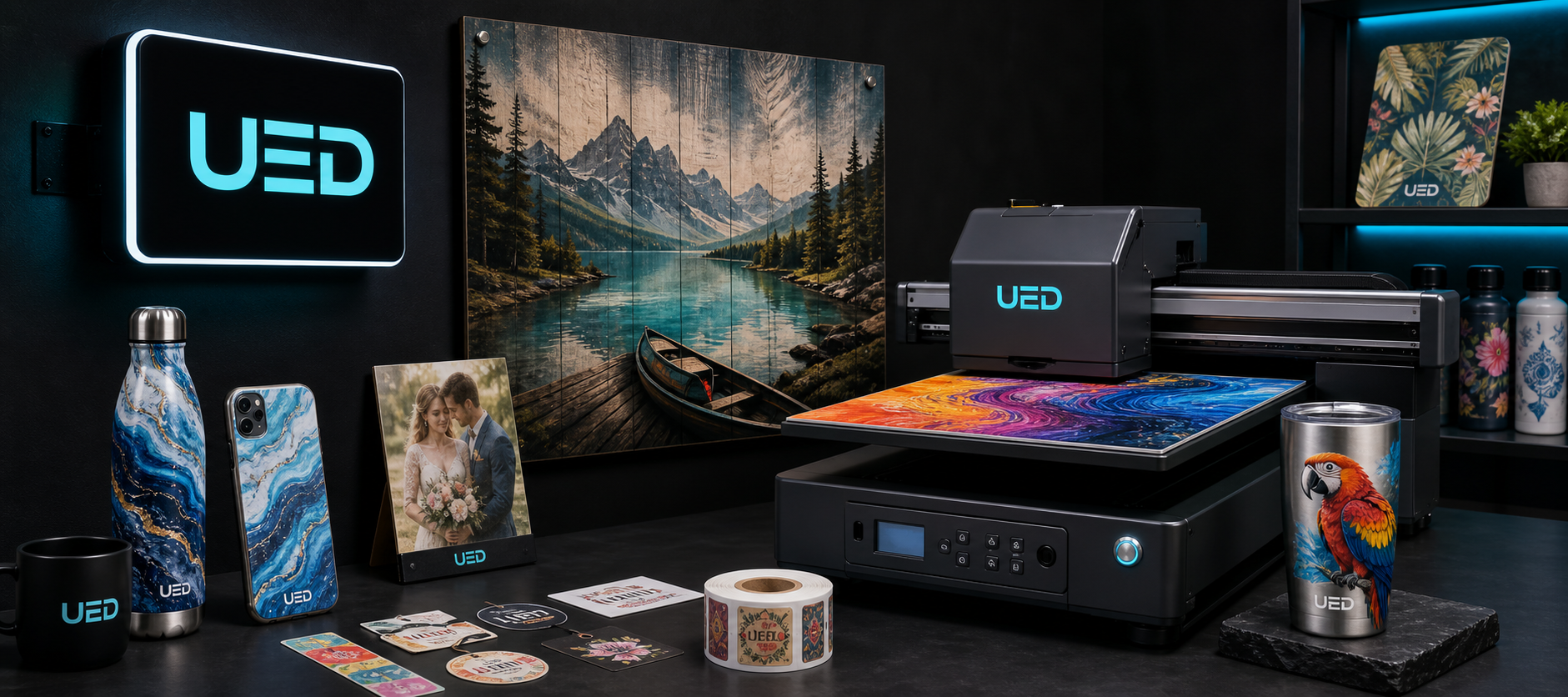
UV printing is one of the few technologies that lets a small Indian business sell to homeowners, retailers, corporates and factories from the same machine, which is why it keeps producing profitable niches. This guide lists the most profitable UV printing business ideas and opportunities in India for 2026, with the customer, the margin logic and the machine each needs, so you can pick an idea that matches your market and your strengths.
Why UV printing keeps minting niches
UV printing’s economics favour niche businesses: no plates or minimums, full colour on almost any surface, white ink for premium finishes and instant cure for fast turnaround. That means a small shop can profitably serve orders a big offset or screen printer cannot — one-off murals, personalised gifts, short-run packaging, industrial labels. The opportunity is not in competing on volume but in owning niches where personalisation, speed and material range create pricing power.
Idea 1 — premium signage and retail branding studio
Produce acrylic and ACP shop boards, lightbox panels, window graphics and menu boards for retail. Customer: shop owners, QSR chains, malls. Margin: strong, because rigid signage is value-priced. Machine: UV flatbed plus a roll-to-roll or hybrid for flexible. The retail branding niche recurs as campaigns refresh, building retainers.
Idea 2 — personalised gifting and photo products
Phone cases, keychains, photo blocks, awards, name plates and festival favours, personalised on demand. Customer: consumers and corporates. Margin: very strong, because value is emotional. Machine: compact flatbed or DTF UV with white ink. The gifting calendar (weddings, festivals, corporate year-end) gives predictable peaks; batching with jigs keeps per-piece cost tiny.
Idea 3 — interior décor and printed surfaces
Glass splashbacks, wood and MDF wall art, tile murals, wardrobe and door skins for homes, cafés and offices. Customer: homeowners, interior designers, hospitality. Margin: premium, bespoke pricing. Machine: flatbed with white+varnish and adhesion discipline. This niche sells on sight, so a sample wall and designer relationships drive sales.
Idea 4 — industrial identification and compliance
Machine labels, asset tags, control-panel facias, pipe markers and safety signage for factories and facilities. Customer: maintenance and purchase managers. Margin: good and recurring, compliance-driven and recession-resistant. Machine: flatbed with durable ink and varnish. A few maintenance contracts create steady, high-retention revenue.
Idea 5 — short-run packaging and labels
Premium boxes, display units, clear/metallic labels, prototypes and limited editions for brands. Customer: D2C brands, boutique foods, cosmetics. Margin: strong, because UV removes plate costs and minimums. Machine: flatbed for rigid/prototypes, roll-to-roll for labels. This niche sits at the start of a brand’s cycle and can grow into ongoing production.
Idea 6 — advertising production house
Banners, hoardings, vehicle graphics, lightboxes, POS and event graphics for agencies and retailers. Customer: advertising agencies, chains, event companies. Margin: volume on flexible, premium on rigid and backlit. Machine: roll-to-roll plus flatbed (or hybrid). The advertising niche is deadline-driven, so speed and installation capability are the differentiators.
Idea 7 — corporate gifting and onboarding kits
Curated branded kits — notebook, badge, desk sign, bottle — packed per new joiner or festival. Customer: HR and marketing teams. Margin: strong per kit, recurring annually. Machine: flatbed with white ink across materials. Kits are higher-ticket and stickier than single items, and one corporate contact anchors a season of orders.
Idea 8 — events, weddings and exhibitions
Wedding décor, stage backdrops, signage, favours and exhibition stands. Customer: event planners, families, exhibitors. Margin: premium and deadline-driven. Machine: flatbed plus roll-to-roll for backdrops. The events niche is seasonal but intense; standard packages and fast turnaround capture it.
Choosing the idea that fits you
Match the idea to three things: your local demand (survey enquiries), your strengths (design-led décor versus volume advertising versus industrial discipline), and your capital (gifting starts cheap; advertising needs more). The best idea is the intersection of real local demand and your strengths, funded within your capital. Start with one idea, master it, then add adjacent niches that share the machine.
Common mistakes when picking a UV business idea
- Choosing the idea you like rather than the one your market buys.
- Launching several niches at once and mastering none.
- Under-pricing premium niches by material cost instead of value.
- Ignoring the preparation discipline that premium substrates demand.
- Not building a sample wall and catalogue, so nobody knows your range.
Frequently asked questions
Which UV idea is most profitable for a beginner?
Usually personalised gifting or premium signage: low entry cost, strong margins and clear local demand, with a manageable learning curve.
Can one machine serve several ideas?
Yes — a flatbed serves gifting, décor, signage and industrial; adding a roll-to-roll opens advertising and labels. Start with one idea per machine, then stack.
How much capital do I need to start?
A compact gifting setup can start low; a signage or advertising setup needs more for the machine, stock and working capital. Model the first-year total, not just the machine.
A deeper look: stacking niches on one machine
The compounding strategy is to stack compatible niches on the same machine across the week: gifting batches on quiet days, signage boards on delivery days, industrial small batches between. Because the families peak at different times, stacking smooths utilisation and raises revenue per asset. Track contribution per niche monthly and give more capacity to the earners; over time the machine becomes a multi-business platform rather than a single-product tool.
A deeper look: validating an idea before buying the machine
Validate cheaply before investing: run a soft launch by outsourcing a few real orders for the chosen niche, price them, deliver them and measure margin and repeat interest; talk to ten prospective customers and note what they buy and at what price; and check local competition. If the soft launch shows real, payable demand, buy the machine to capture that margin in-house. Validating first turns the purchase from a bet into a scale-up of proven demand.
Idea 9 — DTF UV transfers and object-printing service
A newer niche is UV DTF transfers: printing full-colour, varnished decals that transfer onto irregular objects — bottles, helmets, appliances — without a flatbed press at the point of use. Selling transfers lets you serve customers who cannot justify a machine, and it scales because one print run feeds many end users. Machine: a DTF UV printer. The niche suits a production-minded shop supplying retailers and customisers, and it pairs naturally with a gifting line.
Idea 10 — the combined print-and-finish studio
Some of the most profitable shops combine UV printing with finishing and fabrication: cutting, edge-polishing acrylic, framing, mounting and installation. By owning the whole chain from artwork to installed product, they capture margin at every step and present a single accountable supplier. The added equipment is modest (cutter, polisher, hand tools) but the pricing power is large, because customers pay for a finished outcome. This is the natural evolution of a signage or décor niche into a full studio.
The online channel for UV niches
Several UV niches sell beautifully online: personalised gifts, photo products, name plates and wedding favours can be ordered with an upload flow and shipped nationwide. An online catalogue with templates widens the market far beyond the local radius and smooths seasonal demand. Pair it with the counter and corporate channels, and batch online orders into efficient machine runs. The online channel turns a local machine into a national gifting business.
Pricing and packaging the chosen idea
Whatever the idea, price it on value and package it for easy buying. Gifting gets quantity breaks and gift-wrap add-ons; signage gets design-plus-install packages; industrial gets per-piece menus with setup amortised; corporate kits get per-kit pricing. Clear packages reduce quoting time, raise average order value and make the offer comparable on outcome rather than on square footage. A well-packaged niche is half sold before the first conversation.
From idea to the first hundred customers
Launch narrow and loud in one channel: build a sample wall and photograph it, run a soft launch to existing contacts, and ask each satisfied customer for a referral and a photo. For B2B niches, take the sample kit to ten prospects; for consumer niches, run a seasonal promo online and at the counter. The first hundred customers come from focus and follow-up, not from a broad scatter; master them and the niche’s repeatability takes over.
Seasonality and the niche calendar
Each niche has a calendar, and stacking them smooths the year: gifting peaks at festivals and weddings, signage at openings and retail seasons, corporate kits at year-end and onboarding cycles, events through wedding and conference seasons, industrial steadily. Plan stock and marketing against each calendar so the machine never sits idle in one niche’s off-season while another peaks. A business that reads its niches’ calendars earns through the year rather than in bursts.
The moat: preparation and reliability
Because UV niches are open to anyone with a machine, the durable moat is execution: a per-substrate preparation log, adhesion test records, on-time delivery and careful packing. Reliability converts a first order into a repeat account and a referral, compounding into a reputation that a newcomer with the same machine cannot buy. In niche UV businesses, the moat is not the printer; it is the discipline around it.
When to add the second machine
Add the second machine when a niche’s proven demand overflows the first: regularly declining rigid work signals a flatbed; declining banner and vinyl signals a roll-to-roll. Until then, outsource selectively to keep the customer while you learn the margin. Buying the second machine to serve proven overflow — not to create demand — is the discipline that keeps expansion profitable and the platform growing on evidence.
That is the playbook: pick the niche your market already pays for, prove it with a soft launch, master one niche at a time, and let the machine compound for you. Run with discipline, a UV printer becomes one of the most profitable small printing businesses you can start in India this year.
The compounding advantage of starting now
UV printing in India is still early enough that most towns have few shops offering the premium niches, so an entrant in 2026 can still claim décor, gifting and industrial niches before they saturate. Every month of operation builds the sample wall, the client list, the preparation log and the reputation that a later entrant must buy or imitate. Starting now, with a validated niche and a disciplined launch, is itself a competitive advantage that compounds quietly while the market matures.
Begin with the niche you can win locally, deliver it reliably, and let each satisfied customer fund and refer the next. The ideas here are not a menu to order everything from but a map of where UV printing earns in India in 2026; your job is to pick the square of it you can own, and own it well.
Focus beats breadth in this market: the shops that win are not the ones with the longest price list but the ones that own a niche so well that the town thinks of them first for it.
That focus, applied month after month, is how a single UV machine becomes a local institution for a whole category of printing — and how its owner builds a business that is hard to displace.
Choose it, prove it, master it, then expand — that simple loop, repeated with discipline, is the entire secret of profitable UV printing in India.
And when the niche is yours, the adjacent ones follow, because customers who trust you for one UV product are glad to hand you the next.
Start small, think in niches, and let proof lead capital.
Conclusion
UV printing’s no-minimum, full-colour, any-surface economics keep creating profitable Indian niches: premium signage, gifting, décor, industrial identification, short-run packaging, advertising, corporate kits and events. Pick the intersection of local demand, your strengths and your capital; validate with a soft launch; master one niche; then stack adjacent ones on the same machine. Explore the digital UV printer range or talk to us about matching a machine to your chosen idea.
