



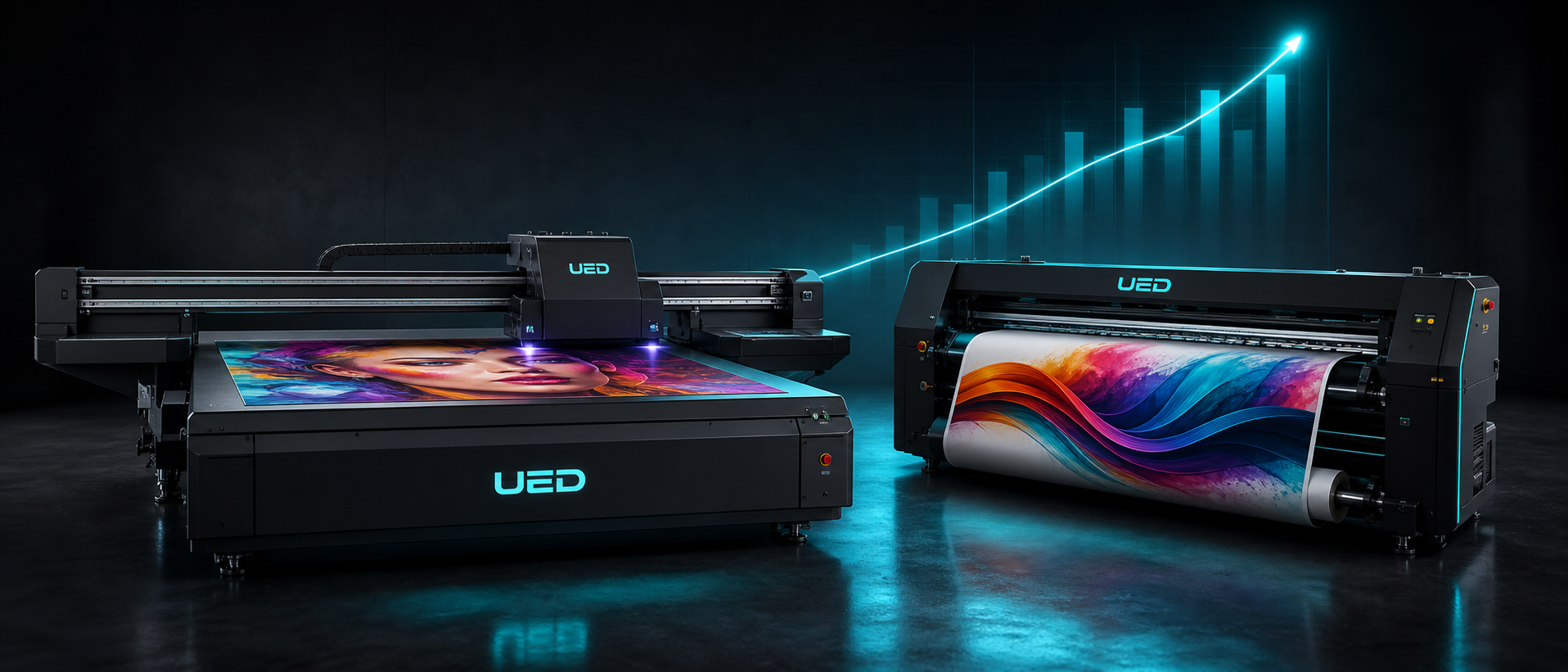
On paper, a UV flatbed and a UV roll-to-roll look like rivals; in a profitable shop they are complementary engines with different economics. This guide compares them across the four dimensions that actually decide a purchase — applications, investment, speed and profitability — with the practical numbers and thinking a buyer needs to choose well, or to plan the pairing that most successful shops eventually run.
Applications: two non-overlapping worlds
The roll-to-roll owns flexible media: frontlit and backlit banners, hoardings, vehicle graphics, window films, stickers, labels, backlit films, canvas and wallpaper. The flatbed owns rigid and 3D: acrylic, glass, wood, MDF, metal, ACP, tile, foam board, and objects from phone cases to awards. There is little overlap — a flatbed will not run banner rolls at volume and a roll-to-roll will not print a glass panel — so the application question is really “which world does my customer live in?”
Investment: machine, floor and finishing
Entry roll-to-roll UV machines typically cost less than equivalently capable flatbeds, and their finishing kit (trimmers, laminators, grommet tools) is modest. A flatbed costs more and demands board racking, a prep bench and packing materials. Total installed cost — machine, finishing, storage, installation — should be compared, not just the machine sticker. Expect the flatbed route to start with a meaningfully higher total outlay, recovered through higher per-piece pricing.
Speed: square metres versus finished pieces
A roll-to-roll prints continuously on wide media and typically posts higher square metres per hour, suiting volume work. A flatbed prints slower per square metre, but gangs many small pieces per pass and each pass yields finished, sellable items. The meaningful speed metric is revenue per hour, not square metres per hour: a flatbed’s slower square metres can out-earn a roll-to-roll’s faster ones when the pieces carry premium prices. Compare the two on your five most common jobs, timed end to end.
Profitability: margin per piece versus margin per metre
Roll-to-roll profitability is a volume game: thin margin per square metre multiplied by many metres, with profit hinging on utilisation, waste control and fast finishing. Flatbed profitability is a value game: fat margin per piece multiplied by fewer pieces, with profit hinging on preparation quality, premium finishes and consultative selling. Both can be very profitable; they simply concentrate risk differently — the roll route in price competition, the flatbed route in utilisation.
Labour and handling costs
The roll route’s labour sits downstream: trimming, laminating, grommeting, installing — often at height or on site. The flatbed route’s labour sits upstream and at the bench: cleaning, priming, jigging, packing. Neither is trivial; the difference is when and where the work happens. Cost labour honestly in both models, including installation travel for roll work and careful packing for flatbed work, because unbudgeted labour is the most common margin leak.
Waste, consumables and hidden costs
Roll work wastes media at the edges and in mis-trims, and consumes laminates, grommets and installation hardware. Flatbed work wastes sheets to strikes and adhesion failures, and consumes primers, varnish, jigs and protective packing. White ink is a consumable cost on both but heavier on flatbed premium work. Track waste as a percentage of revenue per route and attack the bigger leak; a few points of waste separate a good year from a great one on either machine.
Pricing: per-square-foot versus value pricing
Roll work is usually priced per square foot in a transparent, competitive market, so price discipline and cost control drive profit. Flatbed work is usually value-priced — per piece, per project — because the customer buys an outcome, not an area; this is where design help, material choice and finish create pricing power. Businesses that move customers from per-foot to per-piece pricing lift their whole margin profile, which is an argument for adding flatbed capability once volume clients are secured.
Utilisation and payback
Because their economics differ, the two machines want different utilisation profiles. A roll-to-roll needs high daily utilisation at modest margin to pay; a flatbed needs moderate utilisation at high margin. Model payback for each at 50% and 75% utilisation and see which survives in your market. The machine that stays profitable at low utilisation is the safer anchor; the other is the growth bet.
Which earns more: a worked comparison
Illustratively: a roll-to-roll at 60 sq m/day at a modest net margin per sq m yields steady daily profit; a flatbed at 15 sq m/day of rigid work at several times that margin per sq m can yield comparable or higher daily profit from a quarter of the area. The numbers vary by market, but the structure holds — volume versus value — and shows why a shop with both captures both streams and smooths its income.
The pairing most successful shops run
Because the two machines serve different demand streams from the same customers, mature shops run both: the roll-to-roll feeds cash flow and keeps clients’ flexible work in-house; the flatbed converts those clients to higher-margin rigid and personalised work. The pairing also cross-sells — a banner client becomes an acrylic-sign client. If capital allows only one now, choose by your dominant stream and plan the pairing as the explicit next step.
Common mistakes in comparing the two
- Comparing brochure speed instead of revenue per hour on real jobs.
- Ignoring finishing and installation labour in the roll model.
- Ignoring preparation and packing labour in the flatbed model.
- Buying for the market you admire rather than the one you can win.
- Treating them as rivals instead of complementary engines.
Frequently asked questions
Which has better margins?
The flatbed, per piece, typically by a wide margin. The roll-to-roll compensates with volume. Total profit depends on utilisation and market, not the machine alone.
Which is safer in a slow market?
The flatbed’s higher per-piece margin tolerates lower volume; the roll-to-roll needs volume to pay. In a slow market, value tends to hold better than volume.
Can one operator run both?
Yes, with training, but each has distinct skills; at full load most shops dedicate an operator per machine.
A deeper look: building a simple profitability model
For each machine, list your five most common jobs with realistic selling price, media/ink/consumable cost, labour minutes and price per hour. Compute contribution per job and per machine-hour, then multiply by achievable weekly hours at conservative utilisation. The machine with the higher contribution per hour in your market wins the first slot; the other becomes the second. This one-page model, rebuilt quarterly, keeps your investment decisions grounded in your actual numbers rather than vendor demos.
A deeper look: choosing by margin versus choosing by volume
A margin-led strategy (flatbed first) suits owners who enjoy design, materials and consultative selling and who can tolerate lumpy cash flow; it builds a defensible, differentiated business. A volume-led strategy (roll-to-roll first) suits operators who excel at throughput, logistics and fast service and who want steady daily revenue; it builds scale and cash flow. Neither is superior — they reward different owner strengths. Choose the strategy that matches how you actually like to run a business, because you will live with it daily.
Depreciation, resale and future-proofing
Machines are also assets, so consider their afterlife. Roll-to-roll UV machines hold value reasonably when maintained, because banner demand is persistent; flatbeds hold value when they have reliable white and varnish and a proven adhesion record. Keep service logs, head-hour records and sample output with the machine, because a documented history lifts resale. Future-proofing also matters: choose platforms whose ink sets and media support are still evolving, so the machine you buy today can still sell tomorrow’s products.
Energy, environment and running conditions
The two platforms have different environmental needs. Roll-to-rolls want stable temperature and low dust to keep media tracking true; flatbeds want the same plus careful control of static and debris that can ruin rigid prints. Both need reliable power and, for UV, stable voltage to protect lamps and electronics. Budget for the environment — extraction where needed, temperature control, clean floors — because a machine in a poor environment underperforms and ages faster, quietly eroding the economics you modelled.
The role of each machine in a downturn
It is worth asking how each engine behaves when the market slows. The roll-to-roll’s volume is defensive in one sense — banners and promos continue even in downturns — but its thin margins compress further under price pressure. The flatbed’s premium work is more discretionary and can dip, but its high per-piece margin means fewer jobs still cover costs. A shop with both can lean on volume for cash flow and value for margin, which is another quiet argument for the pairing as the business matures.
Insurance, liability and job risk
The two routes carry different job risks. Roll work often ends in installation at height or on site, bringing safety and liability considerations; a failed hoarding is visible and costly. Flatbed work carries the risk of damaging expensive rigid sheets and the reputational cost of an adhesion failure on a client’s premises. Insure appropriately, write clear specifications and warranties, and price the risk into each route. Managing these distinct liabilities well is part of the profitability comparison that brochures never show.
Seasonality and cash-flow shape across the two
The two engines also differ in cash-flow rhythm. Roll-to-roll work spikes with elections, festivals and retail seasons, giving intense but lumpy revenue; flatbed décor and corporate work is steadier but slower. A shop that understands its own seasonality can use the two machines to smooth income — leaning on volume in peak seasons and on value in the quiet ones. When you compare profitability, look across a full year rather than a single month, because a machine that looks weak in its off-season may be essential to the annual result.
In practice, the contribution-per-hour worksheet is most powerful when revisited quarterly: as media prices, ink costs and your selling prices shift, the ranking of the two machines on your real jobs can change, and a shop that re-runs the model keeps routing work to the engine that currently earns best. That habit of continuous, evidence-based routing is what separates a profitable multi-machine shop from one that simply owns two printers.
So the comparison resolves not into a winner but into a strategy. Applications decide which machine a job belongs to; investment and space decide what you can field; speed and profitability decide how each earns. Most advertising and signage businesses will find that the flatbed supplies margin and the roll-to-roll supplies volume, and that owning both — routed by contribution per hour — produces a smoother, stronger income than either alone. Start with the one your market rewards today, and build toward the pairing deliberately.
Whichever you choose first, hold the same standards: reliable white ink, disciplined maintenance, honest durability claims and careful media handling. A well-chosen machine run well will always out-earn a perfect machine run casually, so invest in process and training alongside hardware, and let the numbers — not the showroom — keep guiding you.
A final practical tip: before signing for either machine, print your five most common jobs on the exact model you intend to buy, costed with your media and ink, and time them end to end including finishing. That single demonstration, done honestly, tells you more about applications, investment, speed and profitability than any brochure, and it is the best possible foundation for the decision.
Use that evidence, not the demo, as your contract with the future: the machine that performs on your jobs, with your media, at your prices, is the machine that will pay.
Bring those real numbers to your supplier and demand the same honesty in return; a vendor confident in their machine will welcome a side-by-side test on your work.
Conclusion
Flatbed and roll-to-roll differ across applications, investment, speed and profitability not as rivals but as complementary engines: value versus volume. Compare them on revenue per hour and contribution per hour using your real jobs, pick the one your market rewards, and plan the pairing that captures both streams. See the digital UV printer range or contact us to build your comparison on real numbers.
