

For advertising businesses — banners, hoardings, vehicle graphics, lightboxes, retail promos — the equipment debate of the decade is UV roll-to-roll versus eco-solvent. Eco-solvent built the modern advertising trade; UV is challenging it on quality, media range, durability and safety. Which is better for an advertising business is not a religion; it depends on your order mix, your clients and your costs. This guide compares them honestly and gives a buying view.
Why eco-solvent dominates advertising today
Eco-solvent earned its dominance for good reasons: low machine and ink cost, excellent outdoor durability on flex and vinyl, fast dry times good enough for lamination workflows, and a mature, inexpensive supply chain for media and heads. For pure banner and hoarding volume, eco-solvent remains extremely cost-competitive, which is why most advertising shops run it. Any honest comparison must start by respecting that economics, not dismissing it.
What a UV roll-to-roll changes
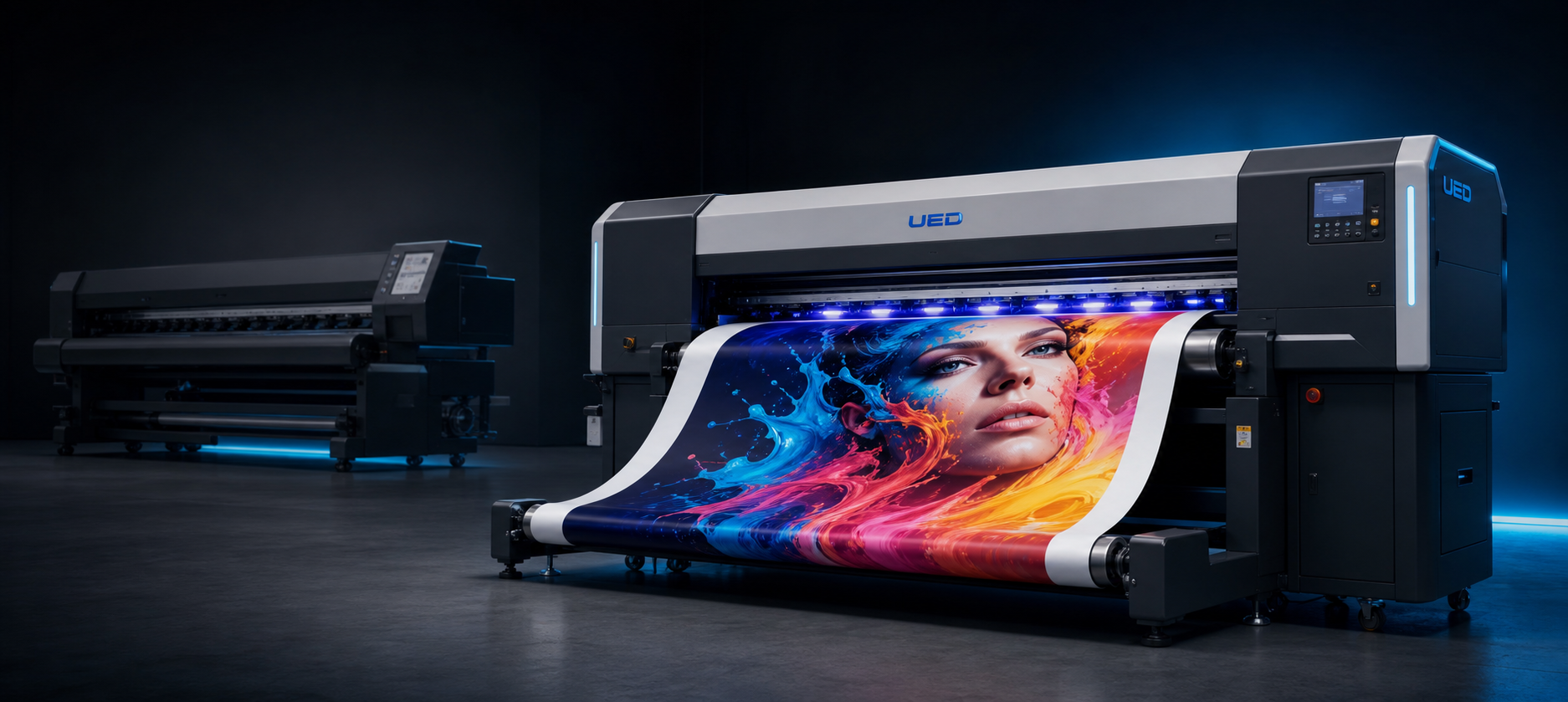
A UV roll-to-roll printer cures ink instantly with UV light rather than evaporating solvent. The practical gains for advertising: no lamination needed for many jobs (instant handling and scratch resistance), the ability to print white ink for stickers, backlit day-night graphics and window films, a wider flexible media range including some textiles and speciality films, and near-zero odour and VOCs, which matters for indoor production and operator safety. These are real differentiators where the advertising market is moving upmarket.
Print quality head to head
Both produce sharp, vivid outdoor graphics. Eco-solvent inks bite into the media surface, giving a slightly matte, durable image that flexes well — ideal for banners and wraps. UV inks sit on the surface with a glossier, more saturated pop and finer detail at high resolutions, ideal for backlit, retail and close-view graphics. For long-view hoardings the difference is negligible; for close-view retail and backlit work, UV generally looks more premium. Quality alone rarely decides it; the application decides it.
Speed and turnaround
Eco-solvent machines are fast and, with lamination added, still quick; UV is fast and removes the lamination step for many jobs, so total turnaround can be shorter. In a same-day advertising market, UV’s instant cure is a genuine operational advantage: print, trim, ship without waiting or laminating. Where lamination is still required (long-term vehicle wraps, abrasive sites), eco-solvent’s workflow is unchanged and UV adds a laminate step, narrowing the gap.
Ink cost, media cost and running cost
Eco-solvent ink is cheaper per ml than UV ink, and eco media is cheap and abundant, so on pure banner volume eco-solvent usually wins on cost per square metre. UV ink costs more but removes laminate cost on many jobs and unlocks higher-priced products (white-ink stickers, backlit, speciality media). The right comparison is cost per sellable product, not cost per ml: on commodity banners eco wins; on premium advertising products UV’s higher price outweighs its higher ink cost.
Durability and the lamination question
Eco-solvent prints are famously durable outdoors but are usually laminated for abrasion and long life, adding cost and a step. UV prints are instantly scratch-resistant and UV-stable; for many advertising applications they run unlaminated outdoors for the campaign’s life. For multi-year exposure or high-abrasion (vehicle wraps, floor graphics), lamination is still best practice on either. So the durability edge is situational: UV saves lamination on short-to-medium campaigns; eco plus laminate remains the belt-and-braces long-term answer.
Odour, VOCs and operator safety
Eco-solvent emits odour and VOCs during printing and drying, requiring ventilation and care in enclosed shops; some sites and clients (malls, food retail, schools) restrict solvent work. UV curing releases negligible odour and VOCs, making it safer for operators and acceptable in more environments. For an advertising business serving indoor-sensitive clients or located in a shared building, UV’s clean operation is a real commercial and compliance advantage.
White ink and the products only UV opens
The clearest functional gap: eco-solvent generally has no usable white ink, while UV roll-to-roll prints white. That unlocks clear-vinyl stickers with white, day-night backlit graphics, double-sided window films and high-opacity prints on coloured and metallic media — a set of premium advertising products eco-solvent simply cannot offer. If your advertising clients want these, UV is not optional; it is the only route.
Media range for advertising
Both handle the advertising staples: flex, vinyl, backlit, canvas. UV extends further into speciality and heat-sensitive media (some textiles, foils, films) because it cures without heat, and into white-ink products. Eco-solvent stays within solvent-compatible media but covers the advertising staples comprehensively and cheaply. For a standard advertising mix they overlap heavily; for an upmarket or speciality mix, UV’s range is the differentiator.
Which is better for an advertising business: the honest split
If your book is commodity banner and hoarding volume in a price-competitive market, eco-solvent is still the better economics and the safer buy. If your book includes retail branding, backlit, stickers, window graphics and clients who pay for premium and same-day, UV roll-to-roll wins on product range, turnaround and clean operation. Most growing advertising businesses find they need both: eco for volume, UV for premium — which is why many run the two side by side.
Running both: the two-machine advertising shop
The two-machine model is common and rational: route commodity banners and hoardings to eco-solvent for lowest cost, and route backlit, stickers, window films and premium retail to UV for margin and speed. This keeps the price war on the eco machine while the UV machine lifts the average margin. The key is disciplined job routing so each machine does the work it is cheapest or most profitable at, rather than defaulting everything to one.
Environmental and client perception
Brands increasingly ask about sustainability and safety in their supply chain. UV’s low-VOC, low-odour process and reduced laminate waste are easier to position as responsible than solvent printing. For advertising businesses pitching corporate and retail accounts, this can be a genuine differentiator in tenders and brand-safety questionnaires, adding a soft but real commercial edge to UV.
Buying decision framework
- Commodity banner volume, tight margins: eco-solvent first.
- Premium retail, backlit, stickers, same-day: UV roll-to-roll first.
- Indoor-sensitive clients or shared premises: favour UV.
- Established eco shop adding margin: add UV, keep eco for volume.
- New shop unsure of mix: start with the side your enquiries favour.
Common mistakes in the UV vs eco debate
- Buying UV for commodity banner work and losing on cost per metre.
- Buying eco-solvent and then being unable to quote white-ink premium products.
- Ignoring ventilation and VOC compliance costs for eco in enclosed shops.
- Assuming UV never needs lamination and over-promising durability.
- Not routing jobs by economics once both machines are owned.
Frequently asked questions
Is UV print as durable as eco-solvent outdoors?
For typical campaign life, yes; for multi-year or high-abrasion, lamination is best practice on either. Eco’s bite-in gives a slight edge in flex durability.
Can UV replace my eco-solvent machine?
For premium and mid work, often yes; for high-volume commodity banner, eco usually remains cheaper. Many shops keep both.
Which is cheaper to run per banner?
Eco-solvent, on a plain banner. UV wins on products where white ink, no-lamination or speciality media justify a higher price.
A deeper look: migrating from eco-solvent to UV without losing volume
Shops moving upmarket should not switch off eco-solvent; they should add UV and re-route. Keep eco for the price-sensitive volume that defends cash flow, and shift backlit, stickers, window and premium retail to UV where margin and turnaround improve. Train the team on UV white-ink and media handling, rebuild pricing for the premium line, and market the new capabilities to existing clients first. Over a year or two the UV share grows as clients upgrade, while eco continues to hold the base — a migration, not a replacement.
A deeper look: the advertising order mix that decides it
Audit three months of orders into two buckets: commodity (plain banners, hoardings) and premium (backlit, stickers, window, vehicle, retail fit-out). If premium is under 20%, eco-solvent is the right single machine. If premium is 20–50%, a UV roll-to-roll added to eco transforms margin. If premium is over 50%, UV should be the primary machine with eco as the volume overflow. This single ratio, measured honestly, resolves most UV-versus-eco arguments for advertising businesses.
Printhead and maintenance economics compared
Maintenance cost is a real divider. Eco-solvent heads are generally cheaper to replace and the ecosystem is mature, keeping service costs predictable for volume shops. UV heads can be costlier and UV adds white-ink maintenance (circulation, agitation) that demands discipline. However, UV’s instant cure reduces downtime from drying and lamination bottlenecks. Factor head price, expected head life and white-ink labour into the running cost of each, because over several years maintenance is a significant and often underestimated part of total cost.
Future-proofing: where the advertising market is heading
The advertising market is drifting toward premium, short-run, personalised and indoor-sensitive work — retail experiences, backlit displays, window campaigns, brand activations — exactly the territory UV serves best, while commodity banner growth flattens. Buying only eco-solvent bets on the commodity segment persisting; adding UV positions a business for the upmarket drift. This is not an argument to abandon eco, but to ensure the portfolio includes the capability the market is moving toward, so the business grows with demand rather than against it.
Client case: splitting the book for margin
Consider a mid-size advertising shop that audited its book and found 60% commodity banner and 40% premium. It kept eco-solvent for the 60% and added a UV roll-to-roll for the 40%. Within a year, the UV line — backlit, stickers, window and same-day retail — lifted average job margin substantially while eco defended volume and cash flow. The shop did not replace anything; it routed by economics. That single discipline, applied consistently, is the practical answer to UV versus eco for most advertising businesses.
Training the team and pricing the premium UV line
Adding UV to an eco-solvent shop is as much a people project as a machine project. Train operators on white-ink discipline, media handling and the no-lamination workflow, and train sales on the new premium products so they actually sell them — a UV machine that sales staff cannot explain is a margin opportunity missed. Rebuild pricing for the UV line on value, not cost-plus: backlit, stickers and same-day retail command premiums, so price them as premium products with clear lead times. With trained people and confident pricing, the UV line delivers the margin the machine promises.
In the end, the UV-versus-eco question has no single answer because advertising is not a single market. Commodity banner volume still belongs to eco-solvent on cost; premium, white-ink, same-day and indoor-sensitive advertising belongs to UV on capability and margin. The businesses that win are those that measure their own order mix, buy accordingly, and — once they own both — route every job to the machine that earns it best. That discipline, more than any brand or model, is what makes an advertising print business profitable.
And remember that whichever side you start on, the fundamentals of good printing still decide profit: calibrated colour, reliable heads, honest lead times and careful finishing. The machine opens the market; the discipline keeps it. Measure your mix, buy for the demand you have, and let each proven premium job pull you a little further upmarket.
Finally, involve your best clients in the decision. Ask your top advertising accounts what they wish you could produce — backlit, white-ink stickers, same-day retail, or cheaper banners. Their answers are your order mix in their own words, and buying the machine that serves your best clients’ unmet needs is the most reliable route to profitable growth in the advertising trade.
Conclusion
Eco-solvent remains the cost champion of commodity advertising volume; UV roll-to-roll is the premium champion of quality, white-ink products, same-day turnaround and clean operation. The better machine is the one your order mix pays for — and for most growing advertising businesses, the winning answer is both, routed by economics. Explore the digital UV printer range or contact us to model your mix before buying.
