


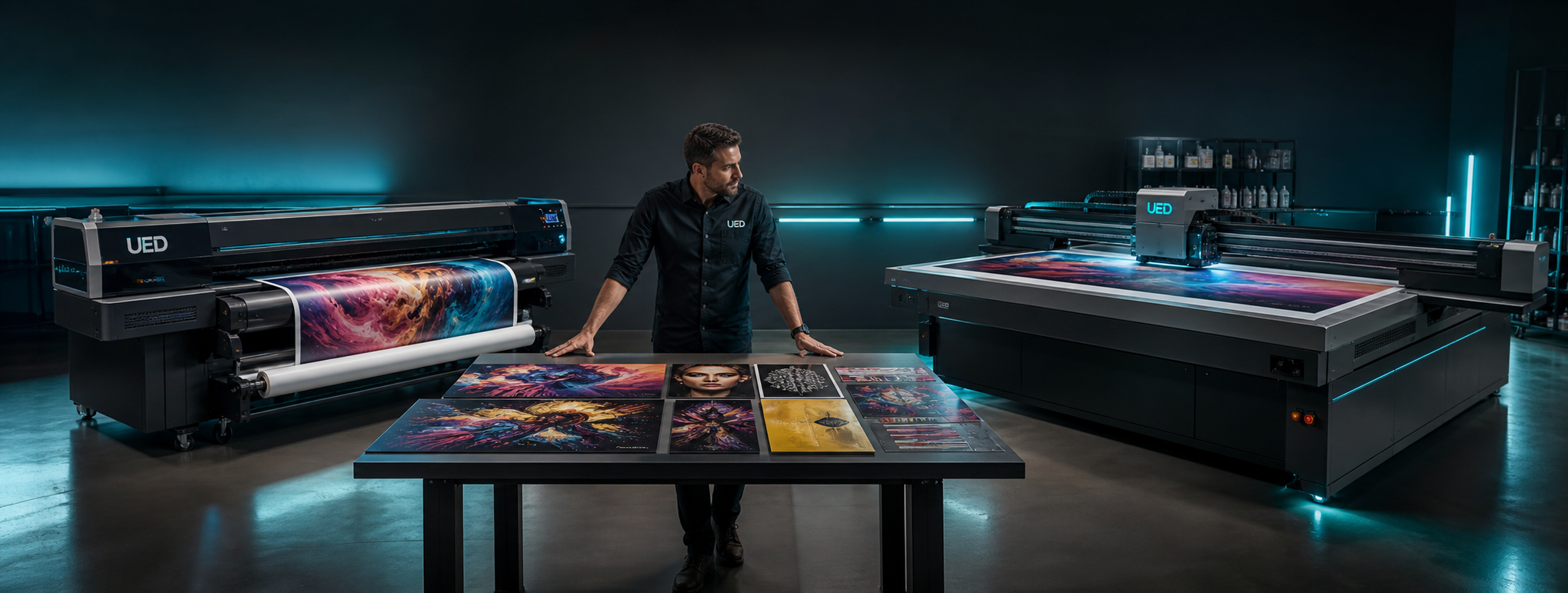
Every printing business that adopts UV eventually faces the same first question: roll-to-roll or flatbed — which machine do I buy first? The answer sets your product line, your customers and your cash flow for years, so it deserves a structured decision rather than a showroom impulse. This guide walks through how to read your market, the case for each first machine, capital and payback, skills and space, and the mistakes that make a first purchase a regret.
Your first machine chooses your business
It is tempting to think of the first printer as just equipment, but it is really a strategy. A first UV roll-to-roll printer commits you to flexible-media volume: banners, vinyl, stickers, backlit media — high frequency, fast turnaround, thin margins, strong cash flow. A first UV flatbed printer commits you to rigid value: signage boards, décor, gifts, industrial panels — lower frequency, higher margins, consultative selling. Neither is better; they are different businesses, and the first machine is the fork in the road.
Reading your local market before choosing
Start outside the building, not inside it. Survey your radius: how many advertising agencies, event companies, retail chains and signage shops buy flexible media daily? How many interior designers, gift shops, corporates and homeowners buy rigid décor and personalisation? Talk to ten prospective customers in each camp and note what they buy, from whom, at what price and what they cannot get locally. The camp with the stronger unmet demand — and the purchasing power to pay — is the market your first machine should serve.
The case for buying a roll-to-roll first
Buy the roll-to-roll first when your market is advertising-heavy: busy commercial streets, event and wedding markets, vehicle-fleet branding and retail promotions that consume banner and vinyl by the metre. The roll-to-roll earns through daily volume, builds cash flow quickly, and its jobs are simple to quote and fast to turn. It is also the easier business to staff, since finishing and installation skills are common. If you need revenue from week one in a price-competitive market, the roll-to-roll is the pragmatic first buy.
The case for buying a flatbed first
Buy the flatbed first when your market values finished, personalised, rigid pieces: interior décor, retail fit-outs, corporate branding, gifts and awards, industrial identification. These jobs carry margins several times material cost and face less price war than banner work. The flatbed also differentiates you — fewer local shops can print glass, wood and acrylic well — so you compete on capability rather than price. If your strength is design and consultative selling, the flatbed matches it.
Capital, payback and cash flow
Entry roll-to-roll machines are often cheaper and their media cheaper, so the roll route starts with lower capital and lower prices but faster turnover. The flatbed route starts with higher capital and costlier media but much higher per-piece prices. Model payback for both with realistic utilisation: volume recovers the roll-to-roll; value recovers the flatbed. Importantly, compare cash-flow shape: the roll-to-roll gives many small, frequent payments; the flatbed gives fewer, larger payments. Choose the shape your working capital can live with.
Skills and labour: two different teams
Roll-to-roll work rewards speed and tidy finishing: loading media, trimming, grommeting, laminating, installing. Flatbed work rewards preparation discipline: cleaning, priming, head-height, careful handling and packing of rigid pieces and objects. Audit your team’s natural strengths and the hiring market in your area; a first machine that fits existing skills ramps faster. If you must train either way, choose the skill set with the deeper local hiring pool, because staff turnover is a real cost in print.
Space and the hidden footprint
First machines also choose your floor plan. A roll-to-roll needs length for media plus a finishing bench and storage for rolls; a flatbed needs a large flat footprint plus racking for boards and a prep/packing area. Measure the true footprint including materials and finished goods, not just the machine outline. A shop that underestimates this discovers that the second machine — or even the first at full load — does not fit, forcing an expensive move.
Competition: go where the gap is
Map local competitors by machine. If three shops already run roll-to-rolls fighting over banner price, entering with a fourth roll-to-roll means a price war; a flatbed could open an uncontested décor niche. Conversely, if several flatbeds serve décor but nobody prints banner locally, the roll-to-roll captures the volume. The best first machine is often the one your competitors do not have, provided the demand for it is real. Differentiation beats head-on competition for a first mover.
The 80/20 rule of your order book
If you already trade (even without UV), apply the 80/20 rule: which 20% of your products make 80% of your profit, and are they flexible or rigid? If your profit is in signage boards and décor, the flatbed protects and grows it. If your profit is in banner volume, the roll-to-roll does. Letting your existing profit concentration lead the first purchase de-risks it, because you are buying a machine for demand you have already validated.
Financing and risk for a first machine
Most first machines are financed, so stress-test the repayment. Run each candidate at half your optimistic volume and confirm it still covers its instalment and leaves margin. The roll-to-roll’s risk is margin compression; the flatbed’s risk is utilisation. The machine whose pessimistic case still services its debt is the safer first commitment. Never let the optimistic case be the only one you model.
Mistakes people make with a first purchase
- Buying the machine they find impressive rather than the one their market buys.
- Choosing on headline speed or bed size instead of revenue per hour on real jobs.
- Under-budgeting finishing space, consumables and working capital.
- Ignoring white-ink reliability, then losing the premium products.
- Buying both capabilities too early via a hybrid or second machine before demand proves it.
Frequently asked questions
Can I start with one and add the other?
Yes — that is the recommended path. Buy the machine for your dominant market, then add the other when you are regularly declining that work.
Is a hybrid a safe first machine?
It can be, for a balanced general sign shop with limited space. Just accept its compromises and cost premium, and plan a dedicated second machine as volume grows.
Which recovers investment faster?
In a busy advertising market, the roll-to-roll via volume; in a décor/industrial market, the flatbed via margin. The market decides, not the machine.
A deeper look: a 12-month plan for each route
Roll-first route: months 1–3 establish banner, vinyl and sticker volume with same-day service; months 4–6 add vehicle graphics and lightbox media; months 7–12 target agency accounts and add installation capability, banking cash for a flatbed. Flat-first route: months 1–3 establish acrylic signage and gifts with a strong sample wall; months 4–6 add glass, wood and corporate branding; months 7–12 pursue interior designers and industrial accounts, banking cash for a roll-to-roll. Both plans use the first machine to prove and fund the second.
A deeper look: knowing when to add the second machine
The trigger is repeated declined work. Track every enquiry you cannot serve; when a category — rigid or flexible — reaches a steady weekly value you are outsourcing or refusing, the second machine is funded by proven demand, not hope. Until then, outsource selectively to keep the customer while you learn the real margin. This discipline keeps expansion demand-led and prevents the classic error of buying a second machine to create demand rather than to serve it.
The hybrid as a first machine: when it makes sense
A hybrid can be a sensible first machine for a general sign shop with a balanced but moderate mix and limited space, because it covers both media forms from day one and avoids declining work. But treat it as a deliberate compromise: it costs more than a single-purpose machine, asks an operator to master two workflows, and rarely matches a dedicated machine’s peak in either mode. Choose a hybrid first only when versatility is genuinely more valuable than peak performance in your market, and plan a dedicated second machine for whichever side grows.
Working capital and media stock for a first machine
First-machine buyers often budget the machine and forget working capital. A roll-to-roll needs a standing stock of popular flex and vinyl widths so same-day promises hold; a flatbed needs common rigid sheets (acrylic, foam board, MDF) and packing materials in stock. Both tie up cash. Under-stocking costs you the fast jobs that build reputation; over-stocking ties cash in slow movers. Start with a tight, fast-turning stock of your five best sellers per route and expand as sales data tells you, keeping working capital as part of the first-machine budget.
Marketing the first machine from day one
A first machine needs a launch plan, not just installation. Build a sample wall of the products it makes, photograph them well, and announce the new capability to your existing customers before chasing new ones — existing clients are the fastest first orders. For a roll-to-roll, lead with same-day banners and stickers; for a flatbed, lead with acrylic signage and personalised gifts. A focused launch on the machine’s strongest products creates early cash flow and the testimonials that fund the next step.
Two archetypes: city shop versus town shop
A city shop in a dense commercial market usually faces strong banner competition but also dense demand for premium retail and corporate branding; there, a flatbed-first differentiation often beats joining the banner price war. A town shop with fewer competitors and a broad, general demand may do better starting with a roll-to-roll to become the local volume hub, then adding rigid capability. The same decision framework yields different first machines in different markets — which is exactly the point of reading your market before buying.
Financing, suppliers and the first 90 days
Treat the supplier as a partner, not just a vendor: negotiate training, installation, a service response commitment and consumable pricing, and prefer suppliers with local engineers because downtime is the real cost. If financing, match the repayment to the machine’s cash-flow shape — shorter for a fast-paying roll-to-roll, longer for a flatbed building margin. Then run a disciplined first 90 days: launch to existing clients, build the sample wall, track every enquiry by flexible versus rigid, and review weekly. The data you collect in the first quarter becomes the business case for the second machine.
The decision, ultimately, is not about printers but about customers. The roll-to-roll is the right first machine for a business built on advertising volume and fast cash flow; the flatbed is the right first machine for a business built on finished, personalised, high-value pieces. Neither choice is a mistake when it follows real demand, a pessimistic payback test and an honest read of your space, skills and working capital. Buy the machine your market already pays for, run it well for a year, and let proven demand — not ambition — choose the second.
Keep a simple rule as you go: every declined enquiry is data, every outsourced job is research, and every satisfied first-machine client is a prospect for the second. The first UV printer is a bet on your reading of the market; the discipline of measuring what it proves is what turns that bet into a growing business.
Many owners find it useful to revisit this decision annually. Markets shift, a roll-to-roll client base can mature into rigid signage demand, and a flatbed décor studio can attract agency volume. The first machine is a starting point, not a life sentence, and the businesses that grow fastest are those that re-read their market each year and let the data — not habit — decide what comes next.
Conclusion
There is no universally correct first machine — only the correct first machine for your market. Read local demand, follow your profit concentration, model the pessimistic case, fit the space and the skills, and buy the platform your customers already pay for. The second machine comes when proven demand demands it. Explore the digital UV printer range or talk to us before you commit capital.
