



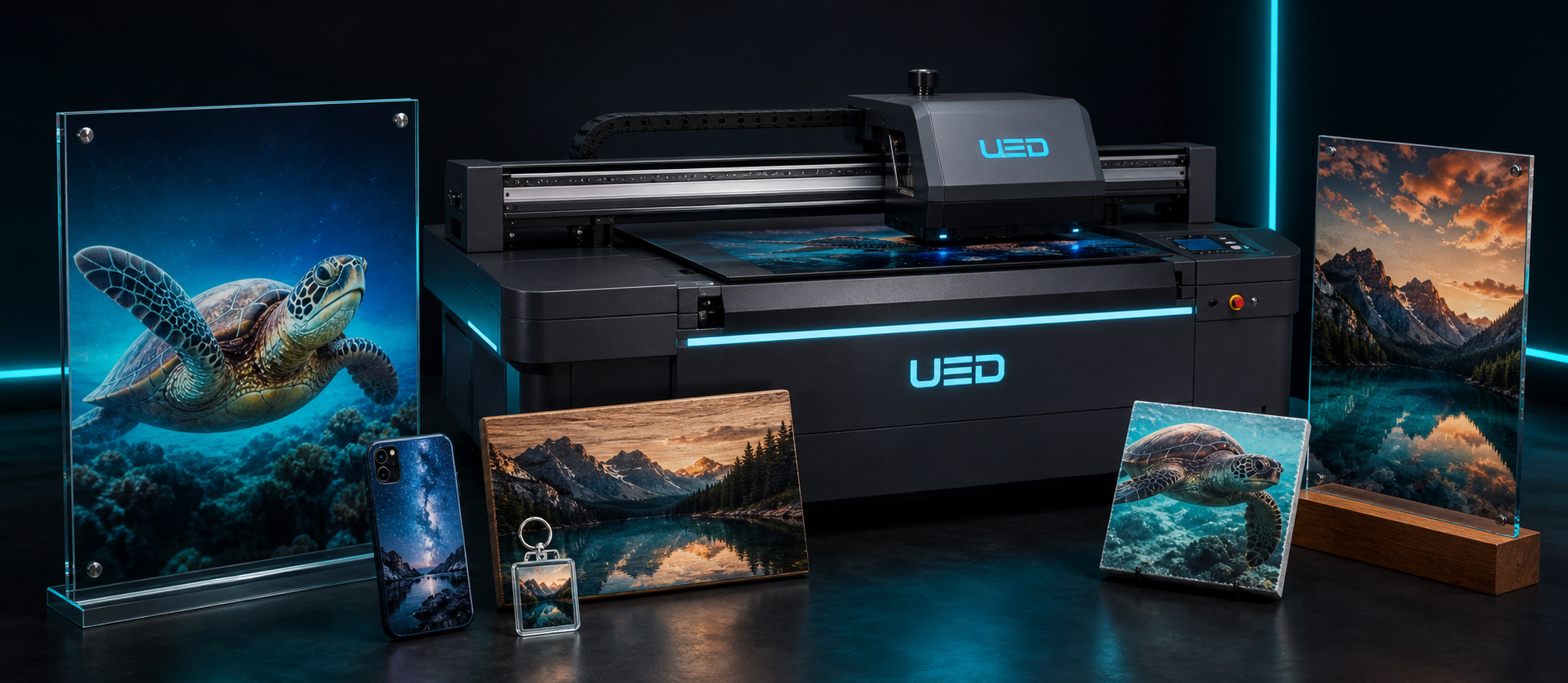
One of the most-asked questions in digital printing is simple to state and enormous to answer: what can you actually print on a UV printer? The honest reply is “almost anything flat, and a great many things that aren’t,” because UV ink cures on the surface of virtually any substrate. This guide lists 25+ profitable applications across signage, décor, personalisation, industrial and packaging, with the substrate and the margin logic for each, so you can see the machine as a product platform rather than a single-purpose tool.
Why UV prints on so much
UV ink does not need to soak into a substrate or evaporate a carrier; it cures instantly under UV light into a durable film on the surface. That means it adheres — with the right preparation — to acrylic, glass, wood, MDF, metal, tile, leather-look PU, plastics, stone-look boards and more. Add white ink for dark and transparent materials and varnish for finish and protection, and the printable product universe becomes very large. The constraint is rarely the printer; it is knowing the preparation and the market for each substrate.
Signage and display applications
- Acrylic signs and backlit lightbox panels.
- Aluminium composite panel (ACP) outdoor boards.
- PVC foam board exhibition and site signage.
- Metal and stainless industrial and wayfinding signs.
- Glass architectural and retail signage.
- Corrugated plastic and corrugated display boards.
- Double-sided hanging boards and menu boards.
Décor and interior applications
- Printed glass splashbacks and feature panels.
- Wood and MDF wall art, signs and furniture panels.
- Ceramic tile murals, coasters and house-number tiles.
- Acrylic photo blocks and wall décor.
- Laminate and acrylic wardrobe and door skins.
- Custom ceiling and partition graphics.
Personalisation and gifting applications
- Phone cases and phone stands.
- Keychains, fridge magnets and badges.
- Personalised photo frames and blocks.
- Wooden and acrylic awards and trophies.
- Engraved-look name plates and desk signs.
- Bottles, tumblers and mugs (with rotary).
- Leather-look notebooks and wallets.
- Wedding and festival favours.
Industrial and functional applications
- Machine labels, asset tags and serial plates.
- Control-panel facias and safety signage.
- Pipe markers and compliance labels.
- Instrument dials and scale printing.
- Prototype and short-run panel printing.
Packaging, labels and short-run applications
- Short-run premium boxes and rigid packaging.
- Product labels on clear and metallic stock (roll-to-roll).
- Point-of-sale and retail display units.
- Prototypes and brand mockups.
- Limited-edition and personalised packaging.
The margin logic across applications
The applications sort into three economic families. Volume family — banners, foam board, labels — earns through square metres at thin margins. Value family — acrylic, glass, wood, tile décor — earns through finished pieces at fat margins. Recurring family — industrial labels, corporate gifting, packaging — earns through repeat orders and relationships. A resilient UV business holds at least two families, using volume for cash flow and value or recurring for margin. Knowing which family each product belongs to helps you price and market it correctly.
Choosing your first applications
Do not launch all 25+ at once. Pick three to five products you can produce beautifully and that match your local demand — for a signage shop, acrylic signs, foam board and ACP; for a gift shop, phone cases, awards and photo blocks. Build templates, jigs and a sample wall for those, master their preparation and pricing, then expand family by family. A focused launch creates early cash flow and the confidence to widen the catalogue.
Preparation is the real product knowledge
Each substrate has a preparation rule: glass and tile want primer and careful handling; metal wants degrease, abrasion and promoter; plastics vary and some need pretreatment; wood wants sealing of porous grain. The shop that keeps a per-substrate preparation log and adhesion test record turns “we can print on anything” into “we can print on anything reliably,” and reliability is what converts curiosity into repeat, premium orders.
Common mistakes when expanding the product range
- Launching too many products at once and mastering none.
- Selling a substrate without its preparation discipline, then eating failures.
- Pricing by material cost instead of finished value.
- Ignoring white ink and varnish, then missing the premium finishes.
- Not photographing and displaying new products, so nobody knows you offer them.
Frequently asked questions
Can a UV printer print on fabric?
Some UV machines print certain textiles and coated fabrics, but fabric is generally the domain of sublimation/DTF; UV’s strength is rigid and synthetic surfaces.
Is there anything a UV printer cannot print on?
Very porous, untreated, or food-contact surfaces without the right ink/coating, and highly flexible items that need stretchable ink. The rule is to test each substrate and be honest about its use-case.
Which applications are most profitable?
Typically personalised gifts, awards, glass and acrylic décor, and industrial identification — the value and recurring families — because customers pay for personalisation and durability, not area.
A deeper look: building a product catalogue that sells
Treat the 25+ applications as a catalogue to curate, not a list to dump. Group them into the three families, assign each a price point and lead time, photograph each beautifully, and present them as collections (Signage, Décor, Gifts, Industrial, Packaging) so customers can browse by need. A curated catalogue with clear pricing turns walk-ins and website visitors into orders without a sales conversation, and it makes your capability visible in a way a machine in a back room never does.
A deeper look: cross-selling across families
The families cross-sell naturally: a banner client is a prospect for acrylic signage; a corporate gifting client for awards and onboarding kits; an industrial client for compliance labels and panels. Track each client’s first product and proactively introduce the adjacent family with a sample. Over time a single customer can hold several product lines, raising lifetime value and smoothing demand, because when one family is quiet another is peaking. The multi-family catalogue is not just revenue; it is resilience.
Spotlight: acrylic and the premium signage family
Acrylic is the flagship of the value family: glossy, premium and versatile, it takes a beautiful UV print and, with back-face printing, becomes scratch-proof signage and glowing backlit panels. The products — reception logos, shop boards, lightbox faces, photo blocks — carry strong margins because customers compare them to fabricated signage, not to a banner. Master acrylic preparation, back-face workflow and edge finishing and you own a premium line that anchors the whole catalogue.
Spotlight: glass and tile décor
Glass and tile turn a UV flatbed into an interior-finish supplier. Printed glass splashbacks, feature panels and tile murals sell on sight and command bespoke pricing; the preparation discipline (primer, careful handling) is the entry ticket. These products attract interior designers and homeowners, a clientele that values design and finish over price, and a single kitchen or feature-wall job can equal many square metres of banner revenue.
Spotlight: personalisation and the gift economy
Personalised gifts are the friendliest UV products: phone cases, keychains, awards, photo blocks, name plates and festival favours, each carrying a name, date or photo that makes it a keepsake. The margins are strong because value is emotional, and variable data means each unique piece costs the same as the last. Batched with jigs and templates, gifting becomes a steady, high-margin stream that introduces countless customers to your wider capability.
Spotlight: industrial identification
Industrial identification is the quiet recurring family: machine labels, asset tags, control-panel facias, pipe markers and safety signage, renewed constantly by factories and facilities. It is compliance-driven and recession-resistant, and buyers value durability and fast small-batch turnaround over design flair. UV flatbed printing with durable ink and varnish is ideal, and a single maintenance contract can recur for years.
Spotlight: packaging, labels and short-run
Short-run packaging and labels are UV’s growth edge: premium boxes, display units, clear and metallic labels, prototypes and limited editions that offset and flexo cannot serve economically. Brands need these for launches, tests and seasonal variants, and they pay for speed and no-minimums. This family builds relationships at the start of a brand’s product cycle, which often grow into ongoing production work.
Seasonality across the application families
The families peak at different times: gifting surges at festivals and weddings, signage and retail campaigns at openings and seasons, industrial work runs steadily, and packaging follows product launches. A multi-family catalogue therefore smooths income across the year, which is a strategic benefit beyond revenue: when one family is quiet, another peaks. Plan stock and marketing around each family’s calendar and the machine stays earning through the year.
Pricing each family correctly
Price the volume family competitively per square foot, but never below the cost that includes waste and finishing; price the value family per piece on the finished outcome, because customers compare a glass splashback to a kitchen upgrade, not to a print; and price the recurring family on contracts and quantity breaks that reward loyalty. Keeping three pricing models — per-foot, per-piece and per-contract — matched to the three families prevents the classic error of pricing a premium piece like a banner or a banner like a premium piece.
The sample wall as your best salesperson
UV products sell on sight, so a physical sample wall is the highest-return marketing you can build: one strong piece from each family, clearly priced, beautifully lit. A customer who touches a printed wood panel, sees a backlit acrylic glow and picks up a personalised keychain understands your range in a minute and self-selects into orders. Rotate the wall seasonally and photograph it for the website; the wall converts walk-ins and gives salespeople a tangible story.
Workflow: from enquiry to delivered product
Across families the winning workflow is consistent: qualify the application and substrate, confirm preparation and durability expectations in writing, proof on the actual material, produce with the family’s jig or template, finish and pack carefully, and deliver with a care card. Documenting this per family keeps quality high as you add products, and the written expectation step is what prevents the few disputes that sour otherwise profitable work.
Scaling the catalogue without losing quality
As the catalogue grows, standardise: a template per gift product, a jig per object type, a preparation card per substrate, and a price sheet per family. This turns each new product from a bespoke experiment into a repeatable line, so the hundredth order costs less than the tenth. Add one family at a time, prove it, then widen; the catalogue compounds into an asset that earns daily with little selling effort.
The platform mindset: one machine, many businesses
The deepest way to think about a UV printer is not as a printer but as a platform on which several small businesses run: a signage business, a décor business, a gifting business, an industrial service and a packaging service, all sharing one machine, one team and one roof. Each family has its own customers, calendar and margin, and together they diversify risk and smooth cash flow in a way a single-product shop never can. The owners who thrive are those who manage the platform deliberately — adding families as they prove out, pricing each correctly, and cross-selling relentlessly.
Start narrow, master preparation and pricing, photograph everything, and let each satisfied family of customers introduce you to the next. The 25+ applications are not a checklist to complete but a ladder to climb, one proven product family at a time.
That ladder, climbed steadily, is how a single UV printer becomes the foundation of a diversified, resilient printing business rather than a one-product gamble.
Revisit the catalogue each season, retire what does not sell, and double down on the families that do; a living catalogue, tuned to real demand, is the compounding asset that keeps a UV business growing year after year.
In short, the machine is the platform; your curation, preparation and pricing are the business.
Conclusion
A UV printer is a product platform: 25+ profitable applications across signage, décor, gifts, industrial and packaging, each with its own substrate, preparation and margin logic. Start with a few you can master, price by value, keep a preparation log, and expand family by family while cross-selling across them. Explore the digital UV printer range or talk to us about building your application catalogue.
