



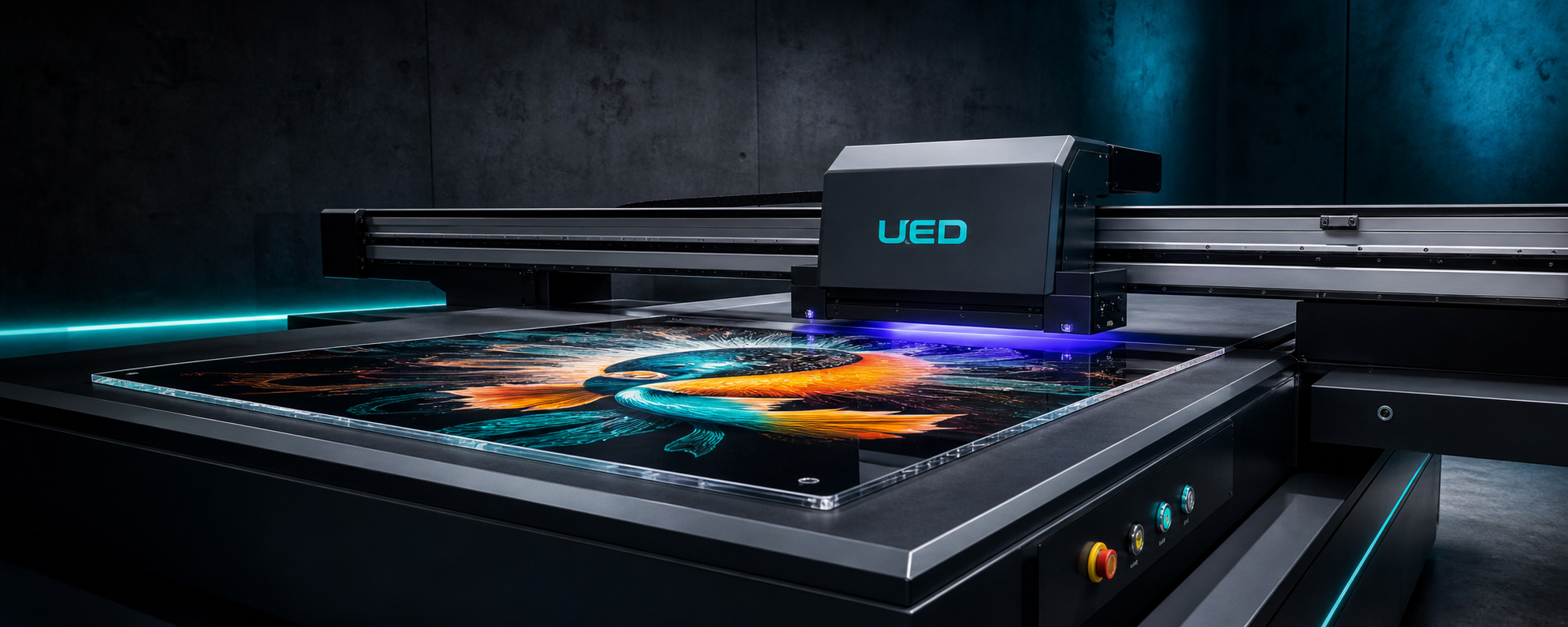
UV flatbed printer prices in India in 2026 range from desktop and A3/A2 object printers to large-format 2×3 m and bigger production beds, and the right buy depends less on the sticker price than on bed size, heads and the white/varnish/rotary options that create your sellable products. This guide explains the price drivers, gives indicative 2026 brackets by bed size and configuration, and provides a buying framework so you invest in the bed your market will pay for. Prices are indicative INR market ranges, ex-works, and vary by configuration and supplier; confirm a written quote.
What drives the price of a UV flatbed
The base price follows bed size: an A3/A2 object printer is a fraction of a 1.2×2.4 m bed, which in turn is a fraction of a 2×3 m or 3.2×2 m production bed. Heads multiply it: single i3200 versus dual i3200 versus Konica/Ricoh industrial heads. Options add further: white ink, varnish, a rotary attachment for bottles, extended Z-height for thick objects, and pin/vacuum registration for double-sided work. Build quality — frame rigidity, vacuum strength, height sensing — separates budget from production builds. These levers explain almost any quote.
Indicative 2026 price brackets by bed size
- Desktop/A3–A2 object printers: roughly ₹2–6 lakh. Gifts, phone cases, small personalisation.
- 60×90 cm beds: roughly ₹6–14 lakh. Small signage, gifts, awards, light décor.
- 1.2×2.4 m (4×8 ft) beds: roughly ₹14–30 lakh. The signage-shop sweet spot; handles standard boards.
- 2×3 m and larger production beds: roughly ₹30 lakh–1 crore+. Full sheets, ACP, industrial panels, high volume.
Within each band, white/varnish/rotary and head brand move the number meaningfully. Use the bands to sanity-check quotes.
Printhead options and their economics
As with roll-to-roll, heads set purchase and running economics. i3200-based flatbeds give excellent quality at moderate head cost and dominate the signage and décor market. Konica and Ricoh industrial heads suit high-volume and industrial flatbed work where uptime and head life matter more than initial saving. For most gift, signage and décor businesses, i3200 value is correct; for panel and industrial volume, industrial heads pay. Always get head price and expected life in the quote.
The options that create margin: white, varnish, rotary
White ink unlocks dark and transparent substrates — acrylic, glass, coloured metal — the premium décor and signage work. Varnish adds gloss, matte, texture and protection that lift perceived value. A rotary attachment opens drinkware and cylindrical printing. Each option adds cost, but each opens a product family that carries premium margins, so they are usually the best money spent on a flatbed. A CMYK-only flatbed on a white-foam-board diet earns far less than a white+varnish flatbed selling finished décor.
Running cost and cost per finished piece
Model running cost per finished piece, not per square metre: ink and varnish per piece, substrate cost, waste from strikes and adhesion failures, and labour for prep and packing. Flatbed economics live in the gap between substrate cost and finished-piece price, which is large for décor and gifts. Track waste and prep labour, because they are the main leaks; a disciplined prep bench protects the margin the machine promises.
Hidden and first-year costs
- Installation, levelling, training and a service contract.
- RIP, profiling and colour management.
- Substrate stock (acrylic, MDF, foam board, glass) and racking.
- Primers, varnish, jigs, packing materials.
- Spare heads and white-ink consumables.
- Power conditioning and a clean, temperature-stable space.
New versus used flatbeds
Used flatbeds can be attractive, but check frame rigidity, vacuum, height sensors and head history; a warped bed or worn vacuum ruins print quality regardless of heads. Insist on a printed test on your substrates, head-hour logs and a commissioning warranty. For a first flatbed, new with support is usually the safer buy; used suits a second capacity bed from a trusted supplier.
Price versus the value a flatbed creates
The flatbed is bought for margin, so judge price against the value it unlocks. A ₹20 lakh white+varnish flatbed selling acrylic signage, glass décor and gifts at several times material cost can recover faster than a cheaper machine limited to foam board. Compare candidates on contribution per hour from your real product mix, not on bed size alone; the machine that earns more per hour is cheaper whatever its sticker.
Financing and payback
Match financing to the flatbed’s cash-flow shape — fewer, larger payments than a roll-to-roll — and stress-test at half utilisation. Because flatbed margins are high, moderate utilisation still services debt, but the risk is demand, not margin; ensure your market for rigid work is real before committing. Keep a year-one buffer for heads, primers and consumables.
Choosing the right bed size for your money
Buy the bed your largest common job needs, not the largest you can afford. Signage shops standardise on 4×8 ft sheets, so a 1.2×2.4 m bed avoids cutting and re-handling; gift shops do fine on 60×90 cm; panel and industrial work may need 2×3 m. A bed one size too small forces cutting and doubles handling; one size too big wastes floor and capital. Measure your actual job sizes and choose the bed that fits them with a little headroom.
How to get a comparable quote
- Fix the spec: bed size, heads, channels, rotary, Z-height, registration.
- Ask head brand, head price, expected life in writing.
- Ask inclusions: RIP, profiling, installation, training, warranty, service response.
- Request printed samples on your substrates with adhesion test data.
- Compare first-year total cost and contribution per hour, not sticker.
Common flatbed pricing mistakes
- Buying the biggest bed affordable instead of the size your jobs need.
- Skipping white/varnish to save, then missing the premium market.
- Ignoring vacuum, registration and height-sensing quality that decide rigid print quality.
- Buying used without inspecting bed flatness and vacuum.
- Under-budgeting primers, jigs and packing that the rigid workflow needs.
Frequently asked questions
What is a realistic starting budget for a UV flatbed in India?
A capable 60×90 cm machine with white starts roughly ₹8–14 lakh; a 4×8 ft signage bed with white+varnish sits roughly ₹18–30 lakh ex-works, before installation and stock.
Is a small A3 flatbed worth it for gifts?
Yes for a focused gifting business; it has low entry cost and strong per-piece margins. It caps out when you add signage boards, so plan the upgrade path.
Do industrial heads justify their price on a flatbed?
At high daily volume and industrial work, yes — uptime and head life pay. For décor and signage volumes, i3200 value is usually the better economics.
A deeper look: flatbed TCO worksheet
As with roll-to-roll, build a three-year TCO per candidate: purchase + installation + training; annual ink, varnish, substrates, waste, maintenance, spares, one head replacement; financing cost. Divide by realistic finished pieces per year to get cost per piece, and compare with your selling prices per product. The flatbed with the best contribution per piece at your volume wins. Re-run quarterly as ink and substrate prices move, and use the worksheet to negotiate inclusions rather than just discounts.
A deeper look: matching configuration to product strategy
Decide the product strategy first, then the configuration. A gift studio needs white, small jigs and perhaps rotary, not a huge bed. A signage shop needs a 4×8 bed, white+varnish and pin registration. An interior décor studio needs white+varnish, good Z-height and strong vacuum for glass and wood. An industrial printer needs bed size, industrial heads and adhesion support. When the configuration follows the product strategy, every option you pay for opens revenue, and the price becomes an investment rather than a cost.
Maintenance cost by flatbed class
Flatbed maintenance scales with bed size and options. Desktop and 60×90 beds need routine head care and occasional heads at low cost. A 4×8 signage bed adds vacuum and registration upkeep plus white/varnish consumables. Large production beds add industrial head costs, lamp service and bed re-levelling. Budget maintenance as a percentage of revenue per class and hold spares for your season. Because flatbed work is often deadline-driven signage and décor, a day down in season costs more than the spare parts you did not keep, so the spare policy is a revenue protection, not an expense.
Regional price variation and where to buy
Flatbed prices also vary by channel and region. A local distributor with an engineer and showroom may quote higher but delivers installation, levelling, training and fast service that a distant importer does not. Freight and installation travel for a large bed are significant, so compare on a delivered, levelled and commissioned basis. For a bed that must hold registration across a 4×8 sheet, the quality of installation matters as much as the machine, so favour suppliers who commission properly in your region.
When to upgrade your flatbed
Upgrade when a constraint caps revenue: bed size forcing you to cut and re-handle boards, lack of white/varnish closing premium work, or heads at capacity. Each upgrade should buy the specific constraint’s removal. Because a well-kept flatbed retains value, plan upgrades as adding capability while the old bed continues as capacity or a dedicated line — for example, keeping the first bed for gifts while a new 4×8 takes signage. This staged approach keeps capital productive and avoids stranding a good machine.
Budgeting the rigid-work ecosystem
A flatbed needs its own ecosystem: board racking, a prep and priming bench, packing station, jigs, and clean power. Budgeting only the bed leaves these unfunded, and rigid work quality depends heavily on prep and handling. Including the ecosystem in the plan ensures the machine delivers its promised margin, because a flatbed’s profit is made as much at the prep bench and packing table as at the print head.
A worked example: costing a 4×8 ft signage flatbed
Take a 1.2×2.4 m dual-i3200 bed with white and varnish quoted at ₹24 lakh ex-works. Add installation, levelling and training ₹1 lakh, RIP/profiling ₹1–2 lakh if separate, first substrate stock and racking ₹2–3 lakh, and primers, jigs and packing buffer ₹1–2 lakh. First-year outlay roughly ₹29–32 lakh. Because finished rigid pieces carry margins several times material cost, a modest number of jobs per day yields strong annual contribution; the bed typically recovers through value rather than volume. Again, run your own product mix through the model — the structure, not the example numbers, is the tool.
The right bed is the one your jobs already pay for
The temptation is to buy the largest bed or the most heads as insurance; the discipline is to buy the configuration your current and proven demand pays for, with the options that open your chosen product families. A correctly sized white+varnish bed earns more than an oversized CMYK bed, because options create sellable products while excess size only creates excess capital. Let the product strategy, the job sizes and the TCO worksheet choose, and the price becomes an investment with a payback rather than a hope.
Bring the worksheet and your substrate samples to every demo, and demand printed, adhesion-tested output before you commit; the supplier confident in their bed will welcome it, and the evidence it gives you is worth more than any discount they might offer.
Finally, treat the 2026 brackets as planning anchors, not promises: configurations and prices move, so re-check current quotes against them, keep your TCO model current, and time the purchase to proven demand. A well-timed, well-specified flatbed is one of the best investments a signage or décor business can make.
Do that, and the bed you buy becomes the foundation of the margin engine your signage or décor business was missing.
And once the bed is in, hold the same discipline you used to buy it: track contribution per piece, keep the prep bench disciplined, and let proven demand — not the brochure — decide the next option or the next machine.
Conclusion
UV flatbed prices in India in 2026 span roughly ₹2 lakh for desktop object printers to over ₹1 crore for large production beds, with the signage-and-décor sweet spot in the ₹14–30 lakh band for a 4×8 ft white+varnish machine. Choose bed size from your real job sizes, heads from your volume, and options from your product strategy; then compare on contribution per hour and cost per piece. Explore our UV flatbed printer range or request a configured quote.
